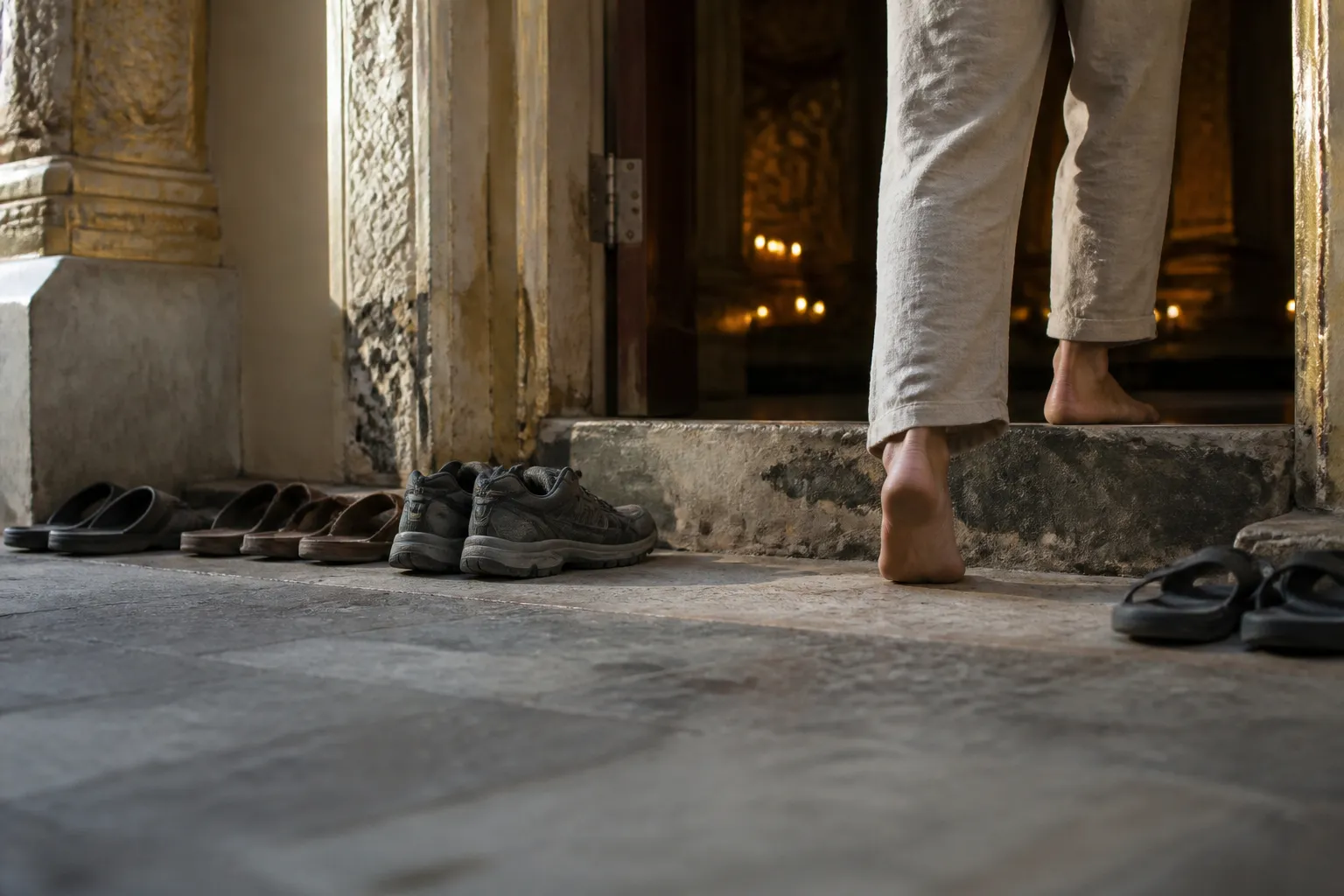
The first time I got turned away from a temple, I was annoyed in a way I’m not proud of. It was 34°C, I was wearing knee-length hiking shorts that I genuinely believed were respectable, and a woman at the gate pointed at my legs and shook her head. I remember thinking: the monks are wearing robes with one shoulder bare, and my knees are the problem? It took me years and a lot of gates to understand that I had the question backwards. So — why can’t you wear shorts in a temple? Not “what are the rules,” but why do these particular rules exist, in wildly different religions, on opposite sides of the planet, and why do they converge on almost exactly the same answer?
The Short Answer
Shorts are banned in temples for three overlapping reasons, and the first one is the one almost nobody says out loud:
- Register, not skin. Shorts are leisure clothing. Wearing them into a sacred space says you dropped in between the beach and lunch. The rule polices what your outfit signals about your intent, not how much leg is showing.
- A body hierarchy. In Buddhist and Hindu cultures, the body is ranked — head highest and most sacred, feet lowest. Legs sit at the wrong end of that scale, so exposing them in a sacred space is a spatial insult, not a sexual one.
- They are working religious buildings. Meteora, the Vatican, Wat Pho — every one is a functioning place of worship where people are praying while you photograph. The dress code is the price of admission to someone’s church, not a museum policy.
It Was Never Really About Skin
Start with the observation that ruins the “modesty” explanation. Walk around Bangkok on any weekday and you will see Thai people in shorts everywhere — on the BTS, at markets, in offices with casual policies. Go to a beach in Greece an hour from Meteora and modesty is plainly not a national value. The same people who enforce the temple rule wear shorts in ordinary life without a second thought.
Which means the rule cannot be about the leg. It’s about what the garment means. Clothing is a register the way language is a register — you don’t swear at a funeral, and you don’t wear board shorts to one. Shorts belong to the vocabulary of leisure: holidays, beaches, sport, being off-duty. Bringing that vocabulary into a space that people organize their whole lives around reads as a small announcement that this stop is recreational for you.
And that reframes the rule entirely. It isn’t the temple protecting itself from your body. It’s a request that you visibly mark the visit as different from the rest of your day. The trousers are the marking. That’s why a local will happily wear shorts all morning and then change before going to make merit at the temple in the afternoon — same person, same legs, different register.
The Body Hierarchy That Makes Legs the Problem
Here is the piece that makes the Buddhist version click, and once you have it, a dozen other bits of etiquette suddenly stop being arbitrary. Thai and broader Southeast Asian belief treats the body as vertically ranked in sacredness: the head is the highest and most spiritually significant point, and the feet are the lowest and least clean.
That single idea explains an enormous amount of behavior you’ll observe and probably misread:
- You don’t touch a Thai person’s head, even affectionately, even a child’s.
- You don’t step over someone sitting or lying on the floor.
- You sit in front of a Buddha image with your legs tucked behind you, because pointing your feet at the image is the offense — that posture has a name, and Thais will quietly fold themselves into it the moment they sit down.
- Shoes come off before you enter — the boundary between profane ground and sacred floor is literal.
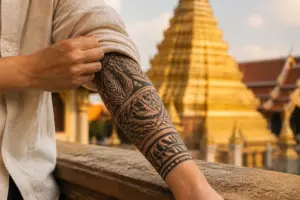
- Sacred tattoos are traditionally placed above the waist, never on the legs or feet.
Now put shorts into that framework. Displaying the lower half of your body — the low end of the sacredness scale — in the highest-status space in the community is a category error. It is closer to putting your feet on a table than to indecency. That is genuinely a different offense than the one Western visitors assume they’re committing, and understanding it is the difference between following a rule resentfully and following it easily.
Riap Roi: The Standard You’re Actually Being Judged Against
Thai has a word that does a lot of quiet work here: riap roi — neat, tidy, orderly, put-together, proper. It’s applied to handwriting, to a room, to a plan, and very much to how a person is dressed. Being riap roi is a social virtue, and turning up somewhere important not riap roi is a mild but real failure of manners.
This is the standard the temple gate is applying, and it explains the cases that otherwise seem inconsistent — why long trousers made of thin, crumpled beach fabric sometimes get a longer look than tidy ones, why a well-fitted linen shirt sails through where a technical hiking layer draws a squint. The target isn’t coverage as a number of centimeters. It’s looking like you made an effort. Aim at that and you will clear almost every gate in Asia without thinking about the specific rule at all.
Why Christian Monasteries Landed on the Same Rule From a Different Direction
Here’s the genuinely interesting bit. Greek Orthodox monasteries have no head-and-feet hierarchy and no concept of ritual leg pollution — and they arrived at a nearly identical dress code anyway.
At Meteora, the rule is long trousers for men, a skirt below the knee for women, covered shoulders for everyone. It comes out of monastic tradition and a scriptural strand — 1 Corinthians 11 on covering and comportment in prayer — filtered through centuries of practice in communities whose entire purpose is to be set apart from ordinary life. That’s the operative word: set apart. A monastery is deliberately not the world. Dressing as you would in the world collapses a distinction the whole institution is built on.
Different theology, different mechanism, same conclusion — because both are solving the same problem. The specific rule about skirts at Meteora, and the fact that the monasteries hand out wrap skirts at the entrance, is covered in our Meteora dress code guide, site by site. The Vatican runs the same logic with less mysticism and more security guards — and, as travelers discover, enforces it twice on the same visit.
Hindu Temples Add a Purity Layer
Hindu practice brings in something the others don’t: ritual purity as a live, physical concern, which produces rules that catch visitors completely off guard. Many South Indian temples ban leather items entirely — belts, wallets, handbags, watch straps — because leather comes from cattle. Some restrict the inner sanctum to Hindus regardless of dress. Others require men to remove their shirts before entering the sanctum, which is a startling inversion for anyone who has spent the trip learning to cover up. It’s the clearest proof that “cover more” isn’t the underlying principle; conforming to the specific space is.
Sikh practice makes the same point from another angle. At the Golden Temple, the non-negotiable is a covered head for everyone, men included — scarves are handed out free at the entrance — and leg coverage is a secondary concern. Every tradition has a thing it cares most about, and it is not always the thing you were braced for.
Why Enforcement Got Stricter as Tourism Grew
One last factor, and it’s the least spiritual: scale. A monastery receiving forty pilgrims a week does not need a written dress code. A site receiving four thousand people a day, most of them from cultures with no shared intuitions about any of this, absolutely does.
What used to be an unspoken understanding among people raised inside the tradition became a laminated sign, a staff member at a gate, and a rack of loaner sarongs. That is why the rules feel bureaucratic — they were formalized recently even though they are old, and formalization always makes a norm feel more arbitrary than it is. The sarong rental desk isn’t the tradition. It’s the tradition’s customer-service department.
What This Means for What You Pack
If the reasoning above is right, then the practical conclusion is simpler than a country-by-country rulebook. You are trying to signal effort and mark the visit as non-casual. Almost everywhere, that reduces to:
- Legs covered past the knee, shoulders covered, in fabric that looks intentional. Loose lightweight trousers beat “technically knee-length” shorts every time.
- A large scarf in your bag, always. It’s shoulders, it’s a head covering, it’s an improvised wrap, it’s sun protection. One item, four rules.
- Shoes you can get off in two seconds. You will remove them dozens of times a day, and laces get old fast.
- Assume the strictest site sets your outfit for the day. Temple-hopping means dressing for the toughest gate on the itinerary, not the average one.
From there, the site-specific detail is where the friction actually lives. We’ve written the granular versions: Thailand and the temple-by-temple Bangkok breakdown, Angkor Wat in 40°C heat, Asia as a whole, sacred sites worldwide, and whether you need to cover tattoos.
Frequently Asked Questions
Why can’t you wear shorts in a temple?
Because shorts are leisure clothing, and wearing them into a sacred space signals that the visit is casual. The rule is about register rather than skin — locals wear shorts daily and change before going to the temple. In Buddhist and Hindu cultures there’s a second layer: the body is ranked from the sacred head down to the unclean feet, so exposing the legs in a holy space is a spatial insult rather than an indecent one.
Why do temple dress codes always say knees and shoulders?
Knees and shoulders are the two thresholds that reliably separate leisure clothing from everything else across most cultures — shorts and sleeveless tops are the global uniform of being off-duty. They’re also easy to check at a gate, which matters enormously at sites processing thousands of visitors a day. The pairing is a practical proxy, not a theological number.
Is the temple dress code stricter for women than men?
It varies by tradition, and not always in the direction you’d expect. Buddhist temples apply roughly the same knees-and-shoulders standard to everyone, though men are more often waved through in practice. Greek Orthodox monasteries like Meteora are genuinely stricter on women, requiring a below-knee skirt rather than trousers. Some Hindu temples ask men to remove their shirts before entering the sanctum, and the Golden Temple requires a covered head from everyone.
Can I just rent or borrow a cover-up at the entrance?
Usually yes. Most heavily-visited sites keep sarongs, wrap skirts, or shawls at the gate, free or for a small deposit — Meteora’s monasteries hand out wrap skirts, and Thai temples like Wat Pho rent sarongs. It works, but expect a queue in peak season, shared fabric in serious heat, and the occasional smaller site that has none. Carrying your own scarf is faster and more comfortable.
Do the rules apply if I’m not religious?
Yes, and that’s the point. The dress code isn’t asking you to believe anything — it’s asking you to acknowledge that the building means something to the people using it. These are working places of worship where someone is praying a few metres from where you’re taking photos. Compliance is a courtesy to the congregation, not a statement of faith.
Are knee-length shorts acceptable at temples?
Rarely, and it’s the most common way travelers get caught out. Even where the written rule says “knees covered,” staff read the whole garment — shorts signal casual regardless of hem length, and they ride up when you sit or climb stairs. Strict sites like Bangkok’s Grand Palace turn away knee-length shorts routinely. Lightweight long trousers cost you almost nothing in comfort and remove the argument entirely.
The rules stopped irritating me the day I understood I wasn’t being told my body was shameful. I was being asked to dress like the place mattered. That’s a much easier request to say yes to — and it turns out a pair of thin linen trousers answers it almost everywhere on earth.
About This Article

Written by Elena Vasquez. Elena Vasquez is a full-time traveler and the founder of Witty Passport. Over fifteen years and more than 50 countries across six continents — including a stretch spent leading groups professionally through Southeast Asia and the remote highlands of South America — she's written the kind of destination guides she always wished existed: practical, specific, and built on real experience rather than recycled itineraries. More about this site.
Scope and limits. Elena is a full-time traveler, not a licensed travel agent or immigration adviser. Entry requirements, visa rules, and advisories change without notice — always confirm against the official government source for your destination and passport before booking.
Verify this against a primary source
Specifics change, and your situation may differ from the one described here. These are the authorities worth checking directly:
- U.S. Department of State — entry requirements and travel advisories
- CDC Travelers' Health — vaccination and health notices by destination
- TSA — current carry-on and screening rules