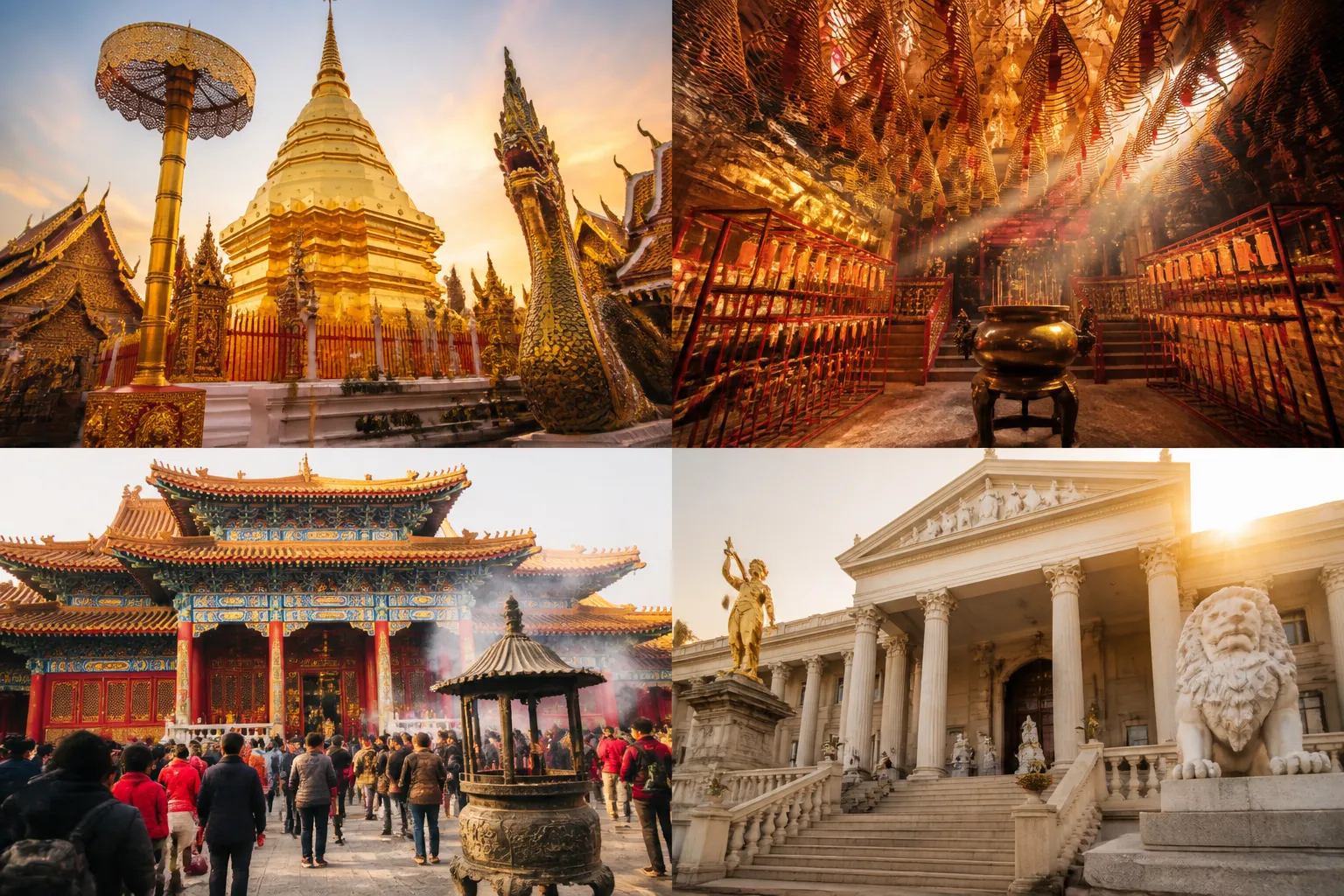
Most trip-planning sites will tell you Thailand has one temple dress code, easy, done — pack accordingly and move on. That’s exactly the assumption that got my friend Marcus turned away at the gate of Doi Suthep in Chiang Mai, his cargo shorts sitting a couple of inches above the knee and a guard shaking his head no. He’d done his homework on “temple dress codes in Thailand,” he just hadn’t caught the part where the Chiang Mai temple dress code for men and women runs noticeably stricter than what flies in Bangkok. What followed was a slow, sulky walk back down the mountain while he killed time at a souvenir stall — and a lot of muttering on my part about how much bad information gets passed around regarding temple etiquette in this part of the world.
Thailand gets all the attention in these conversations, but travelers land in Hong Kong, Beijing, and the Philippines just as confused, and the rules shift dramatically depending on whether you’re stepping into a Buddhist temple, a Taoist shrine, or a monument someone built privately with no religious oversight at all. After enough temple visits across the continent to lose count, I can tell you flatly that generic advice doesn’t hold up site to site. So here’s the actual breakdown — what you can and can’t wear at four temples that generate the most specific, and most frequently botched, dress code questions.
| Temple | Shoulders Covered | Knees Covered | Dress Code Enforced |
|---|---|---|---|
| Chiang Mai (Doi Suthep, Wat Chedi Luang, Wat Phra Singh) | Required | Required | Yes |
| Man Mo Temple, Hong Kong | Not required | Not required | No |
| Lama Temple, Beijing | Required | Required | Yes |
| Temple of Leah, Cebu | Not required | Not required | No |
Chiang Mai Temple Dress Code for Men and Women: The Real Requirements
Chiang Mai is where this question comes up most, so let’s start there. Whether you’re headed to Doi Suthep — the gold-topped temple perched above the city — or the historic cluster in the Old City like Wat Chedi Luang and Wat Phra Singh, here’s the part you need locked in before you go.
Shoulders and knees, both covered, no exceptions. There’s no “I’m just visiting” clause, and no, a tank top doesn’t sneak by. For men in particular: shorts that end above the knee get you denied at the entrance. I’ve watched this play out more than once. Sleeveless shirts and singlets are off-limits too, even when it’s 35 degrees Celsius and every instinct says otherwise.
The easiest fix is packing a pair of lightweight zip-off hiking pants before you land. They convert at the knee, so you’re covered at temples and comfortable everywhere else. Show up without a plan (plenty do) and you’re not stuck — vendors at the base of Doi Suthep rent sarongs for roughly 60-80 Baht, and the Old City is stocked wall to wall with cheap cotton elephant pants in every pattern imaginable.
Here’s the detail nobody puts in the guidebooks: Doi Suthep sits at around 1,000 meters, so it runs distinctly cooler than downtown Chiang Mai. Pack a light layer no matter the forecast — you’ll want it on the songthaew ride up from the Nimman Road area, and the air-conditioned temple interior hits cold after you’ve just climbed 300-plus steps to get there.
What Men Should Actually Wear to Chiang Mai’s Temples
For guys specifically, the real options come down to long pants or a sarong. Pants that hit mid-calf are fine too. If you’re buying gear ahead of the trip, convertible zip-off pants are the smart call — breathable while you’re wandering the city, full coverage the second you need it.
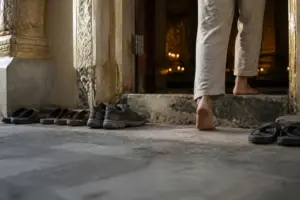
On footwear: most temples are shaded or air-conditioned, and shoes come off at the door regardless, so don’t overthink what’s on your feet.
Man Mo Temple’s Dress Code in Hong Kong: Stricter Than It Looks, or Not Strict at All?
This is where most travel guides steer you wrong, either with stale info or unnecessary paranoia. Man Mo Temple — the moody Taoist shrine on Hollywood Road in Hong Kong’s Central district — has no official dress code whatsoever.
Between the spiraling incense coils overhead and smoke thick enough to catch the light, the place looks like it should come with rules. It doesn’t. No signage, no enforcement — a guard isn’t going to blink at a sundress or short sleeves.
That said — and this matters — Man Mo isn’t a tourist set piece, it’s a working Taoist temple with people coming in daily to pray. So the fact that you can wear whatever doesn’t mean you should. Skip the bikini top and the mesh tank at home. Aim for “smart casual,” not “beach day.”
A few other practical points: those enormous hanging incense coils are real votive offerings from worshippers, not props, so hands off. Photos are fine, but don’t step in front of someone mid-prayer. And if you want the real version of this temple, go around 8 or 9 in the morning when locals are actually there worshipping — that’s the atmosphere, not the midday tourist churn.
Shorts at Beijing’s Lama Temple: Where the Line Actually Gets Enforced
The Lama Temple, or Yonghe Gong, ranks among the most significant Tibetan Buddhist sites outside Tibet, and it pulls serious crowds in Beijing. Here’s the part that matters: the dress code at the entrance is genuinely enforced.
Official policy covers shoulders and knees, and staff take it seriously when the site is busy — someone is actually watching. No shorts, full stop, for anyone. On the worst summer heat days enforcement can loosen slightly, but don’t count on it. Carry a light cardigan or a long scarf just in case; you can always knot it around your waist if you overheat.
One difference from what you’d expect in Thailand: shoes stay on inside Lama Temple. No removing them at the door.
Worth doing while you’re there: grab three incense sticks at the entrance — included in the CNY 25 ticket, roughly $3.50 — and follow the offering ritual alongside locals, moving counterclockwise through the four main halls and lighting incense at each one. It’s the same route pilgrims have walked for generations. The centerpiece is an 18-meter sandalwood Buddha, the largest single-piece sandalwood carving anywhere. Cameras have to stay off inside the main halls, but the courtyards and outer grounds are fair game.
Worth knowing: the temple sits inside a genuinely lovely hutong district. Pair the visit with a wander over to the nearby Guozijian, the old Imperial Academy, and give yourself a couple of hours to get lost in the narrow lanes of shops and teahouses.
Cebu’s Temple of Leah: The One Where the Dress Code Barely Applies
Quick correction before anything else: the Temple of Leah in Cebu, Philippines, isn’t a religious site at all. It’s a private monument, built in 2012 by a widower as a tribute to his late wife, Leah Villa Albino-Gonzales. The Parthenon-style architecture has made it one of Cebu’s biggest draws for visitors.
Since there’s no religious function here, you’ll find the dress code far looser than at a Buddhist or Taoist temple. Shorts are fine. Sleeveless tops, no problem. You’re touring a monument with a view, not stepping into an active place of worship.
Still, private attractions can change their rules on a whim, so it’s worth confirming before you head up. Entry runs around PHP 200, about $3.60 USD. The temple is tucked in the Busay hills above Cebu City — get there by taxi or habal-habal — and the sunset view over the city spread out below is worth timing your visit around. Pair it with a stroll and dinner at one of the restaurants up on the hill.
The One Sarong That Kept Me From Becoming the Next Marcus
There’s a specific moment of dread that hits when you’re outside a Southeast Asian temple and realize your pants aren’t going to cut it — what you need at that point is something small enough to pack, fast enough to wrap, and convincing enough that you don’t look like you’ve draped a beach towel over yourself at a sacred site. A decent sarong is the whole difference between quietly fitting in and becoming the story someone tells at dinner for years.
Where it earns its keep
- Barely registers as extra weight in a daypack — mine’s disappeared into a side pocket more times than I can count, forgotten right up until the moment I need it.
- Ties fast enough that you’re not the person holding up the entrance line while everyone waits behind you — I’ve got it down to under 30 seconds now.
- The lightweight fabric holds up surprisingly well in a 95-degree courtyard, which counts for a lot more than you’d guess after two hours standing in direct sun.
Where it falls short
- A loud Hawaiian print doesn’t exactly whisper “respectful visitor” — expect a sideways glance or two from monks; it reads more like a last-minute airport purchase than intentional dress.
- Tie it loose and it slips, which means you’re either cinching it too tight or fussing with it mid-prayer hall — there’s not much of a comfortable middle ground.
I did second-guess myself the first time I wrapped one at Angkor Wat—felt like I was playing dress-up—but within five minutes I realized nobody cares if you look like a tourist as long as you’re covering your legs. Get the Eicolorte Hawaiian Beach Sarong and keep it in your bag for every temple visit.
Frequently Asked Questions
Can men wear shorts above the knee to Chiang Mai temples?
No. Shorts that end above the knee get you denied at the entrance to Chiang Mai temples like Doi Suthep, Wat Chedi Luang, and Wat Phra Singh. Men should wear long pants or a sarong instead, with pants hitting mid-calf or longer as acceptable options.
Does Man Mo Temple in Hong Kong have a dress code?
Man Mo Temple on Hollywood Road has no official dress code and no enforcement. However, it’s a working Taoist temple where locals pray daily, so respectful casual dress—not beach attire—is appropriate, even though technically you can wear whatever you want.
What’s the dress code at Beijing’s Lama Temple?
The Lama Temple enforces a genuine dress code requiring shoulders and knees to be covered. No shorts are permitted, full stop. Staff actively watch enforcement, especially when the site is busy, though it may loosen slightly on extreme summer heat days.
Can I wear sleeveless tops to Cebu’s Temple of Leah?
Yes. The Temple of Leah in Cebu is a private monument built in 2012, not a religious site, so the dress code is far looser than at Buddhist or Taoist temples. Shorts and sleeveless tops are fine, though private attractions can change rules anytime.
About This Article

Written by Elena Vasquez. Elena Vasquez is a full-time traveler and the founder of Witty Passport. Over fifteen years and more than 50 countries across six continents — including a stretch spent leading groups professionally through Southeast Asia and the remote highlands of South America — she's written the kind of destination guides she always wished existed: practical, specific, and built on real experience rather than recycled itineraries. More about this site.
Scope and limits. Elena is a full-time traveler, not a licensed travel agent or immigration adviser. Entry requirements, visa rules, and advisories change without notice — always confirm against the official government source for your destination and passport before booking.
Verify this against a primary source
Specifics change, and your situation may differ from the one described here. These are the authorities worth checking directly:
- U.S. Department of State — entry requirements and travel advisories
- CDC Travelers' Health — vaccination and health notices by destination
- TSA — current carry-on and screening rules