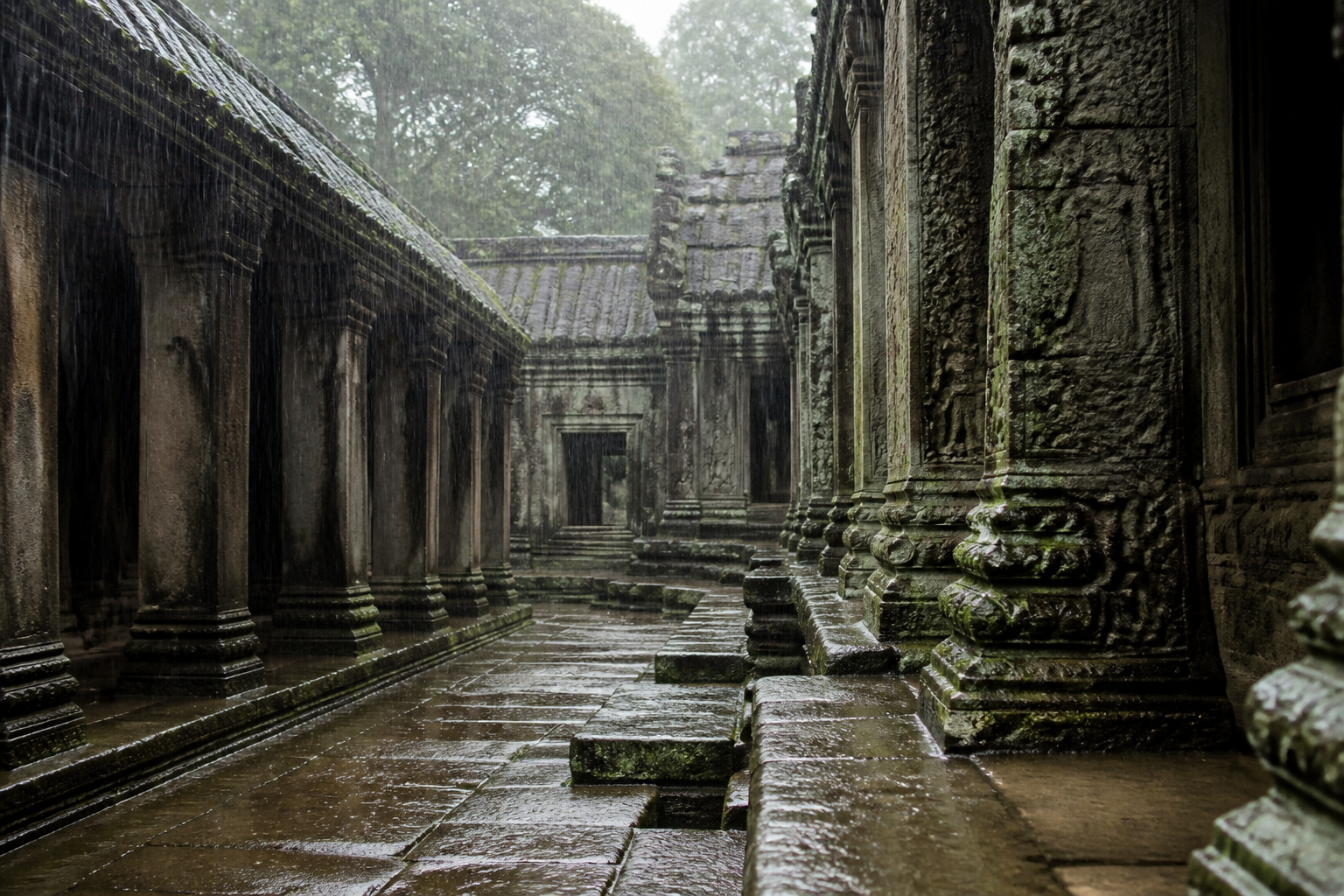
October is when Angkor Wat stops performing for Instagram and starts showing you what it’s actually like. The tour buses thin out. The ticket lines disappear. And the rain doesn’t stop for three weeks straight.
Most guides will tell you to bring waterproof bags and a good attitude. That’s not wrong. But it’s not the whole picture. October monsoon season at Angkor Wat isn’t just wet—it’s a fundamentally different trip. Your camera gear behaves differently. Your body responds differently. The temples themselves look and feel different. If you’re thinking of going, you need to know what’s waiting before you arrive.
The Rain Isn’t Occasional—It’s Relentless
Monsoon doesn’t mean scattered showers. It means the sky opens up for hours at a time, often in the afternoon, sometimes in the morning, sometimes at both. You might get thirty minutes of heavy downpour followed by ninety minutes of drizzle. The humidity stays crushing even when it’s not actively raining.
The ground saturates quickly. Stone pathways between temple complexes become slick within minutes. Jungle runoff channels water through walkways faster than you’d expect. Within a week of heavy rain, puddles the size of small ponds form in the lower courtyards of Ta Prohm and Bayon.
Expect to be wet almost continuously—not soaked necessarily, but damp. Your clothes dry slower. Mold starts thinking about your camera bag. Sweat mixes with rain so you can’t tell where one ends and the other begins.
What Actually Happens to Your Gear
Electronics: Humidity is the enemy, not just water. Your phone screen fogs from the inside out. Your camera lens fogs when you move from air-conditioned spaces to 90-percent humidity outdoors. Memory cards and batteries drain faster in wet heat.
Store electronics in truly sealed bags—not just a regular waterproof case, but something with desiccant packets that you refresh daily. Ziplock bags work. Purpose-built dry bags work better. Open your bags in air conditioning for at least an hour before using any camera or phone, or the condensation will damage the lens coating.
Clothing: Cotton becomes a liability. It absorbs water and dries slowly, creating conditions where mold and mildew thrive within days. Synthetic quick-dry materials are non-negotiable. Merino wool base layers handle sweat and humidity better than cotton, though they’re pricier. Your socks will be wet. Bring more socks than you think you’ll need—at least twice as many.
Footwear: Hiking boots hold water. Sandals with good grip (not flip-flops) are closer to practical, though you’ll want something with ankle support for the uneven stone. Drainage-friendly trail runners with aggressive treads work best. Your feet will be wet and pruned by noon. That’s just October.
Everything else: Backpack straps rot. Leather watch bands grow mold. Paper guidebooks dissolve. Your toiletry bag becomes a swamp. Pack everything in smaller sealed bags within your main pack. Separate wet gear from dry gear.
Your Body in October Heat and Humidity
October at Angkor Wat sits around 80–90°F (27–32°C) but feels hotter because of the humidity. The air is so thick it’s almost liquid. Sweating becomes ineffective—your body can’t cool itself through evaporation because the air is already saturated with moisture.
Heat exhaustion isn’t dramatic in the moment. It creeps. You feel fine, then suddenly dizzy. You were hydrated an hour ago, but somehow you’re not anymore. Electrolyte loss matters more than pure water intake because you’re sweating constantly.
Bring more water than seems reasonable—at least 3–4 liters for a full day of temple touring, especially if you’re walking between complexes. Electrolyte tablets or powders help more than plain water. Start hydrating before you feel thirsty.
Insect activity peaks in October. Mosquitoes are aggressive. Leeches appear in muddy areas and wet vegetation. Dengue and other mosquito-borne illnesses are a legitimate concern. A good DEET-based insect repellent isn’t optional—it’s essential. Reapply after rain or heavy sweating. Lightweight long sleeves and pants, despite the heat, reduce exposure. Speak with a travel health professional about vaccinations and preventive measures well before you depart.
The Temples Look and Feel Completely Different
Rain darkens the stone, making carved details more visible in some places and harder to see in others. Moss and algae growth accelerates in October, covering surfaces that are bare in dry season. The jungle around Ta Prohm is actively aggressive in monsoon—vines thicker, everything greener, the boundary between temple and wilderness almost nonexistent.
Water cascades off roof edges and through courtyards in ways you don’t see in dry season. Some passages that are walkable in March become minor streams in October. The sound of water is constant—dripping, running, echoing off stone.
Fewer people also changes the feel fundamentally. You might spend twenty minutes alone at a temple complex. The contemplative quality increases. The tourist-trap feeling disappears. You’re not fighting for angles in selfies.
How to Actually Prepare (Beyond “Bring a Rain Jacket”)
| What to Pack | Why It Matters | Alternative |
|---|---|---|
| Sealed dry bags with desiccant | Humidity damages electronics more than rain | Ziplock bags + silica packets |
| Quick-dry synthetic clothing | Cotton retains moisture and grows mold | Merino wool base layers (pricier) |
| 3–4 liters water capacity | Plain dehydration hits fast in heat | Electrolyte packets or tablets |
| Trail runners or drainage sandals | Waterlogged boots cause blisters and fungal issues | Anything with aggressive tread |
| DEET-based insect repellent | Dengue risk is real in monsoon | Cover more skin instead of relying on repellent alone |
| Quick-dry towel | Standard towels take 24+ hours to dry | Microfiber, or just air-dry and accept dampness |
Book accommodation with reliable air conditioning and a functioning dehumidifier if possible. Fan-only rooms make it much harder to dry out at night. Air conditioning is where you recover from the heat and humidity.
Plan shorter temple visits than you would in dry season. Half-days are more realistic and safer than full eight-hour marathons. Your body processes heat differently in monsoon.
Consider visiting early morning or late afternoon, avoiding the peak heat hours of 11 a.m. to 3 p.m. Afternoon rain often clears crowds anyway.
The Upside
The obvious benefit is fewer tourists. Ticket lines are minimal. You can move through temples without navigating crowds. The experience feels less transactional.
Prices drop noticeably in October. Hotels, guides, and local services offer discounts during low season. Your money goes further.
The landscape is genuinely more beautiful to many eyes—everything vivid, water running everywhere, light filtered through clouds. Photographers often prefer the softer, cloud-diffused light over harsh dry-season sun.
The Simple Bottom Line
October at Angkor Wat is worth going for, but only if you understand what you’re signing up for. It’s not a harder version of dry-season tourism. It’s a different trip entirely—wetter, hotter in how it feels, more demanding on gear and body, but also quieter and more genuine. Pack specifically for monsoon conditions, not generic travel. Expect to be damp. Manage heat and hydration seriously. And accept that this version of Angkor Wat is seeing the place on its own terms, not yours.
About This Article

Written by Elena Vasquez. Elena Vasquez is a full-time traveler and the founder of Witty Passport. Over fifteen years and more than 50 countries across six continents — including a stretch spent leading groups professionally through Southeast Asia and the remote highlands of South America — she's written the kind of destination guides she always wished existed: practical, specific, and built on real experience rather than recycled itineraries. More about this site.
Scope and limits. Elena is a full-time traveler, not a licensed travel agent or immigration adviser. Entry requirements, visa rules, and advisories change without notice — always confirm against the official government source for your destination and passport before booking.
Verify this against a primary source
Specifics change, and your situation may differ from the one described here. These are the authorities worth checking directly:
- U.S. Department of State — entry requirements and travel advisories
- CDC Travelers' Health — vaccination and health notices by destination
- TSA — current carry-on and screening rules