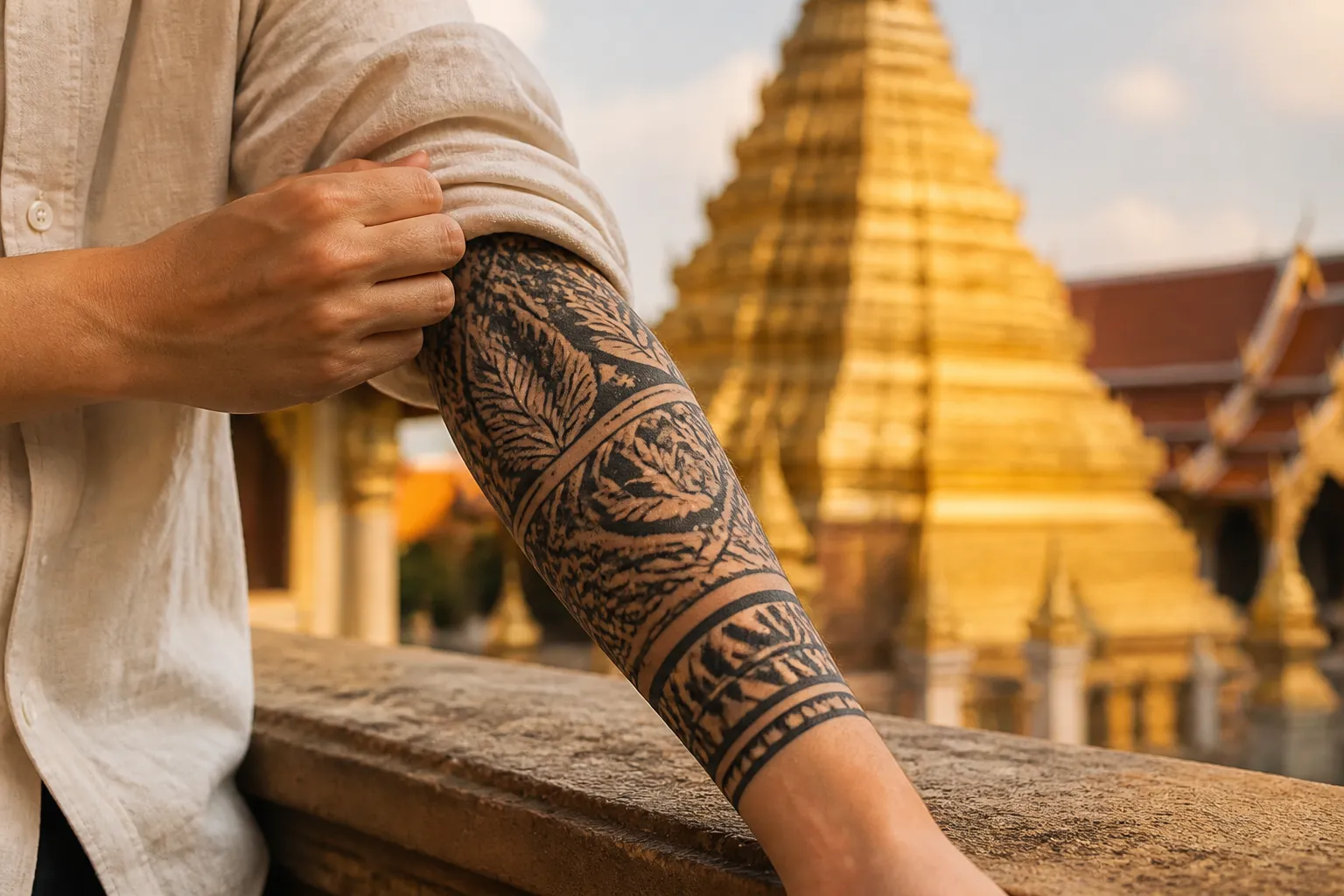
I have watched three separate people hover outside the gate at Wat Pho, tugging a sleeve down over a forearm, doing the mental math on whether they were about to offend an entire religion. I have done it myself. So let me get the useful part out of the way first: Buddhist temples do not have tattoo bans. There is no monk at the door checking your arms. The thing people are actually worried about — the reason “do I need to cover up tattoos for a Buddhist temple” gets searched at 2am the night before a flight — is a much narrower problem than the general anxiety suggests, and it has almost nothing to do with the temple itself.
The Short Answer, Country by Country
Tattoos of any normal kind — script, flowers, portraits, geometric sleeves, your dog — are a non-issue at working Buddhist temples across Asia. What draws real consequences is a tattoo of the Buddha himself, and only in specific countries.
| Country | General tattoos | Buddha / religious tattoos |
|---|---|---|
| Thailand | Fine. Nobody checks. | Legal, but genuinely unwelcome. Airport signage discourages it. Cover it. |
| Sri Lanka | Fine. | Highest risk anywhere. Travelers have been detained and deported. Cover it completely. |
| Myanmar | Fine. | High risk. The country has jailed foreigners over misused Buddha imagery. |
| Cambodia | Fine. | Low risk, but Angkor staff may ask you to cover it. |
| Japan | Fine at temples and shrines. | Non-issue. (Onsen are a separate problem — see below.) |
| Laos / Vietnam | Fine. | Low risk. Discretion appreciated at active temples. |
The Tattoo That Actually Gets People Deported
In April 2014, a British nurse named Naomi Coleman flew into Colombo from India. Immigration officers spotted a tattoo on her arm — the Buddha seated on a lotus flower. She was arrested on suspicion of “hurting others’ religious feelings,” held for several days, taken before a magistrate, and put on a flight back to London. Coleman is a practising Buddhist. She said she got the tattoo out of devotion, not disrespect. It made no difference to the outcome.
That case is the single most important thing to understand about tattoos and Buddhism, and it is worth being precise about what it does and doesn’t mean. There is no Sri Lankan law that specifically bans a Buddha tattoo. What exists is a broad statute about insulting religion, a majority-Buddhist country that is extremely sensitive about its faith, and immigration officers with discretion. Coleman’s case was not unique — it was just the one that made international news. If you have a Buddha inked anywhere visible and you are flying into Sri Lanka, wear long sleeves through immigration. This is not overcaution. It is the one place where the downside is your entire trip.
Thailand: Nobody Stops You at the Gate, But Those Airport Signs Exist for a Reason
Thailand is where most travelers are heading, so let’s be clear about the gap between “legal” and “welcome.” You will not be denied entry to Thailand over a Buddha tattoo. You will not be turned away from Wat Arun. But if you have flown into Suvarnabhumi or Phuket you may have walked past a billboard reading “BUDDHA IS NOT FOR DECORATION” — a campaign run by the Knowing Buddha Organization, aimed squarely at arriving tourists.
It isn’t fringe sentiment, either. Thailand’s culture ministry has publicly called visible tattoos of Buddha, Ganesh, and Jesus on foreign tourists culturally inappropriate, and back in 2011 it pushed tattoo parlours to stop inking religious images on foreigners altogether. The government’s stated objection was that these tattoos were rarely a genuine expression of the wearer’s faith — that Buddha was being worn as an aesthetic.
So: no legal risk, real social friction. In practice this means a Thai person is unlikely to say anything to your face, because saying something confrontational to a stranger cuts against every instinct in Thai social life. You will simply be quietly thought less of. Cover it at temples, and you have solved the whole problem with a shirt.
Placement Matters More Than You’d Expect
This is the part almost nobody explains to travelers, and it changes how the offense is read. In Thai belief, the body runs on a spiritual hierarchy: the head is the highest and most sacred point, the feet are the lowest and least clean. It is the same logic behind not touching a Thai person’s head, not stepping over someone lying down, and tucking your feet behind you rather than pointing them at a Buddha image when you sit.
Apply that hierarchy to a tattoo and you get a sliding scale of offense. A Buddha on your upper back or shoulder is the least objectionable placement. A Buddha on your calf, ankle, or foot is genuinely upsetting to devout Thais in a way that has nothing to do with the artwork and everything to do with where you put it. If you are planning ink and you want it to sit well in Thailand, the rule of thumb the tradition itself uses is simple: sacred imagery goes above the waist.
Your Temple Outfit Already Covers Most of This
Here is the quietly practical resolution to the whole worry. Buddhist temple dress codes already require covered shoulders and covered knees. If you are dressed correctly for the temple in the first place, your upper arms, shoulders, chest, back, and thighs are all under fabric before you ever reach the entrance. The tattoos still exposed are on your forearms, lower legs, ankles, feet, neck, and hands.
Which gives you a genuinely short checklist. Ask yourself one question — is there a Buddha, a deity, or a religious symbol on a part of me that will still be visible in temple clothes? If no, you are done thinking about it. If yes, a lightweight long-sleeve layer or a scarf handles it, and you should be carrying one anyway for the shoulder rule. Our Thailand temple dress code guide covers what that outfit actually looks like in 35°C heat, and the Bangkok temple-by-temple breakdown tells you which sites enforce hardest.
If You Already Have the Tattoo and the Flight Is Booked
Nobody needs a lecture about a decision they made eight years ago. Practical options, in order of how much they actually help:
- A long-sleeve linen shirt. The single best purchase. It solves the tattoo question, the shoulder rule, and sunburn in one item, and linen or lightweight cotton won’t cook you the way a hoodie will.
- Tattoo cover-up cream. Genuinely effective on small pieces and worth it for a Sri Lankan immigration line. High-pigment concealer, set with powder. Sweats off in tropical heat within a couple of hours, so it is a border-crossing tool, not an all-day one.
- Kinesiology tape or a fabric plaster. Fine for a small ankle piece. On a full sleeve it looks stranger than the tattoo.
- Reconsider the itinerary. Only relevant for one country. If you have a large, unmissable Buddha tattoo and Sri Lanka is on a flexible route, that is a real decision to weigh rather than a thing to gamble on.
A Note on Sak Yant, If You’re Thinking About Getting One
Sak yant — the sacred geometric tattoos applied with a long steel rod, at temples like Wat Bang Phra and by lay masters called ajarns — is the one case where a tattoo makes you more welcome rather than less. Foreigners get them. It is not appropriation to receive one properly.
The etiquette is specific, though. At a temple the monk chooses your design based on what he judges you need; you don’t order off a menu the way you would at a studio. The placement rules follow the same body hierarchy as everything else — sak yant sits above the waist, Buddha and master yants go on the upper back, arms, or side torso, and the feet are absolutely off-limits. Monastic discipline also shapes how women are tattooed: a woman is usually worked on by a lay ajarn rather than a monk, or the monk keeps a cloth or the rod itself between his hand and her skin. And a sak yant traditionally comes with precepts you are expected to keep afterward. Ask what yours are before the needle, not after.
The Japan Exception Worth Knowing
If your tattoo anxiety came from something you read about Japan, note that it is a completely different issue and does not apply to temples. Japanese temples and shrines — Sensō-ji, Fushimi Inari, Kiyomizu-dera — have no tattoo policy at all. The Japanese tattoo problem is about onsen, sentō, gyms, and some pools, and it stems from the historical association between irezumi and organized crime, not from religion. Many onsen now admit tattooed guests or provide cover stickers, and private-bath bookings sidestep the question entirely. Same for a Korean jjimjilbang — a bathing-culture question, not a sacred-space one.
Frequently Asked Questions
Do I need to cover my tattoos at a Buddhist temple?
Not for ordinary tattoos. Buddhist temples have dress codes about coverage of shoulders and knees, not about ink, and no temple in Thailand, Cambodia, Laos, Vietnam, or Japan will refuse you over a tattoo. The exception is a tattoo of the Buddha or another religious figure, which you should cover — always in Sri Lanka and Myanmar, and as a courtesy in Thailand.
Can you be deported for a Buddha tattoo?
Yes, in Sri Lanka. British nurse Naomi Coleman was detained at Colombo airport in 2014 over a Buddha-on-lotus tattoo and deported, and hers is not the only case. Sri Lanka has no law naming Buddha tattoos specifically, but it does have laws against insulting religion and immigration officers who apply them. Myanmar has jailed foreigners over misuse of Buddha imagery. Thailand has not deported anyone for a tattoo.
Is a Buddha tattoo illegal in Thailand?
No. It is legal and you will not be stopped at the border or at a temple. It is, however, actively discouraged — Thailand’s culture ministry has called religious tattoos on tourists culturally inappropriate, and campaign billboards near major airports read “Buddha is not for decoration.” Keep it covered at temples and in formal settings.
Does it matter where on my body the tattoo is?
Significantly. Thai and broader Southeast Asian belief treats the head as the most sacred part of the body and the feet as the lowest. A Buddha on the upper back or shoulder is the least offensive placement; one on the calf, ankle, or foot causes real upset. Sacred imagery belongs above the waist.
Are tattoos allowed at Angkor Wat?
Yes. Angkor’s dress code enforces covered shoulders and knees and says nothing about tattoos. Because that coverage hides most large pieces anyway, the question rarely comes up — though staff may ask you to cover a visible religious tattoo before you enter an active shrine.
Do tattoos stop you entering temples in Japan?
No. Japanese temples and shrines have no tattoo restrictions. Japan’s tattoo rules apply to onsen, public baths, gyms, and some pools, and come from an association with organized crime rather than religion. Many onsen now permit tattoos or supply cover stickers.
The whole worry, in one line: cover the Buddha, not yourself. Dress correctly for the temple and everything else takes care of itself. If you want the full picture on getting the outfit right across Asia, start with our Asian temple dress code guide, or the reasoning behind the rules if you’d rather understand them than memorize them.
About This Article

Written by Elena Vasquez. Elena Vasquez is a full-time traveler and the founder of Witty Passport. Over fifteen years and more than 50 countries across six continents — including a stretch spent leading groups professionally through Southeast Asia and the remote highlands of South America — she's written the kind of destination guides she always wished existed: practical, specific, and built on real experience rather than recycled itineraries. More about this site.
Scope and limits. Elena is a full-time traveler, not a licensed travel agent or immigration adviser. Entry requirements, visa rules, and advisories change without notice — always confirm against the official government source for your destination and passport before booking.
Verify this against a primary source
Specifics change, and your situation may differ from the one described here. These are the authorities worth checking directly:
- U.S. Department of State — entry requirements and travel advisories
- CDC Travelers' Health — vaccination and health notices by destination
- TSA — current carry-on and screening rules