No map is going to warn you about the part that actually trips people up: the second you step past the locker room threshold at a Korean jjimjilbang, clothing simply isn’t a concept anymore. I learned this at 11:47pm inside Dragon Hill Spa in Seoul, standing there with a folded set of orange shorts and a matching tee in my hands, entirely unclear on the next move. A grandmother beside me had already peeled off every layer without a flicker of hesitation. A teenager on my other side was mid-undress and mid-phone-call simultaneously, treating the whole thing as background noise. To her it was nothing. To me it was everything. I’d shown up with a swimsuit tucked in my bag, a skincare routine I was proud of, and the misplaced confidence of someone who’d “read up on it beforehand.” Turns out I hadn’t read nearly enough. The swimsuit doesn’t come out of the bag. Neither does the skincare. Nothing comes out of the bag. You enter the bathing section exactly as you arrived on this planet — no exceptions, no negotiating. Every first-timer hits this exact fork in the road, where either you commit or you bail. I inhaled, told myself this was precisely the kind of moment I travel for, and copied the grandmother step for step. Hands down one of my better calls in Seoul. So if you’ve landed here searching for an actual korean jjimjilbang what to wear guide, consider this it — I’m covering the whole thing, down to the details I wish someone had shoved under my hotel door the evening before.
Why Korean Bathhouse Etiquette for Foreigners Is a Whole Different Cultural Education
On paper, the jjimjilbang (찜질방) sounds straightforward enough — bathhouse, sauna, sleeping hall — right up until you’re wandering a seven-story complex at midnight wondering whether cracking open a baked egg inside the charcoal room counts as a minor scandal. It does. Eat the egg somewhere else. Consider that your one free tip.
These places have anchored Korean social life for generations, morphing from simple shared bathhouses into sprawling wellness compounds that double as gym, restaurant, movie theater, and cheap overnight lodging. Dragon Hill Spa, tucked near Yongsan Station, is the version built with tourists in mind — seven levels, a rotation of themed sauna rooms, a rooftop pool, a kitchen dishing out galbi and bibimbap well past 2am, a PC gaming room, a small screening room, and a shared co-ed hall where a few hundred bodies bunk down on heated floors in identical pajamas. Getting in costs around ₩15,000 (about $11 USD) for a day visit, with the overnight rate only slightly higher. That’s less than one cocktail in Gangnam for a warm, spotless place to sleep near the center of the city. File that away if you’re stretching a budget.
Before you go, it helps to know how the whole place is laid out:
- The nude bathing zone: Split by gender, no swimwear allowed, and run on a strict cleanliness code. A full shower is mandatory before you touch any communal tub — identical to the rule at Japanese onsen, and there’s zero wiggle room on this. Washing thoroughly beforehand is simply the baseline courtesy here.
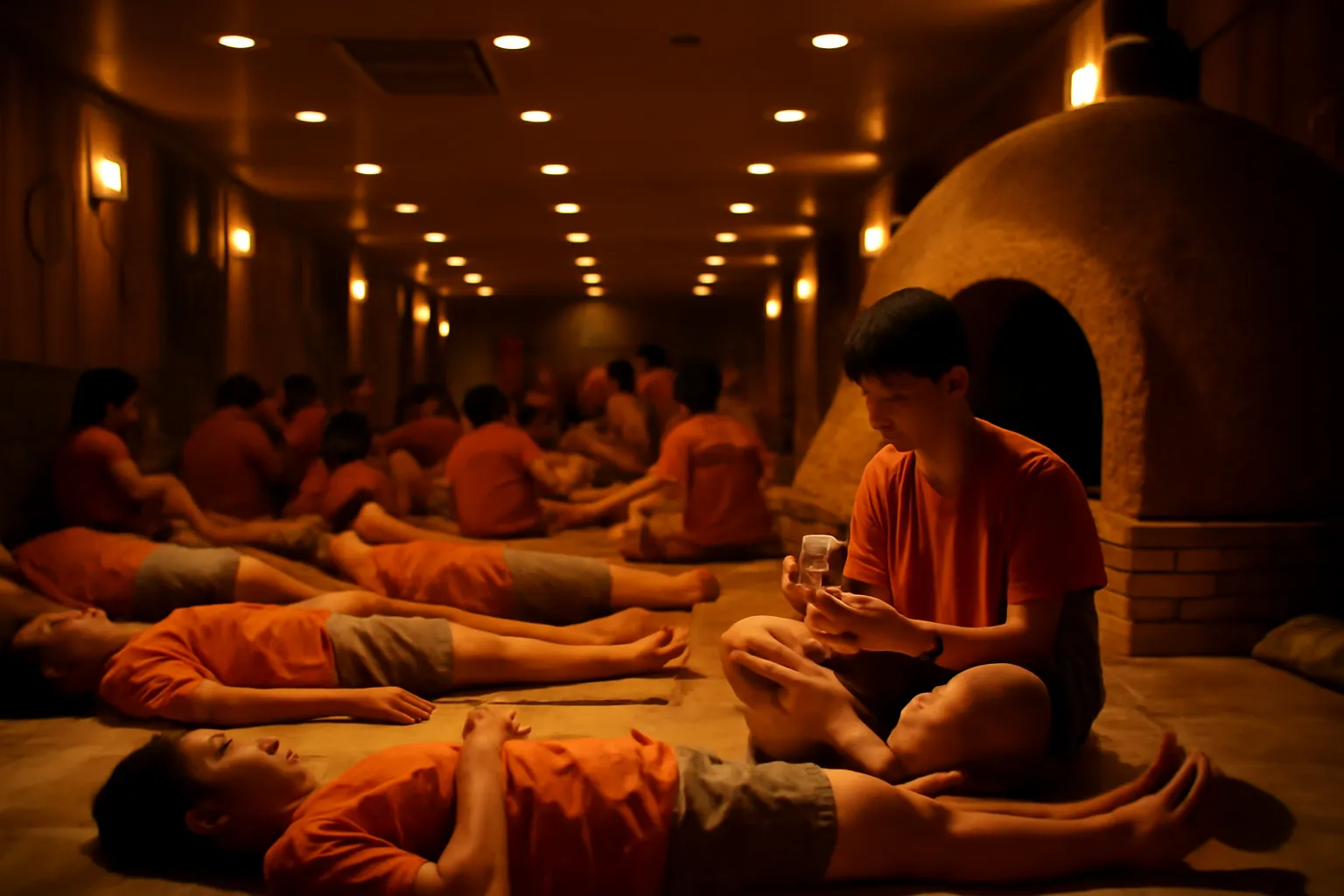
- The main jjimjilbang level: Mixed-gender, fully dressed in the uniform they hand you, and unexpectedly social. Rent a locker, get a key, get the outfit. That cotton shorts-and-shirt combo is what you’ll be living in for the rest of your visit.
- The sauna rooms: Usually anywhere from 7 to 10 themed chambers, spanning a frigid ice room (around 15°C/59°F) to a scorching charcoal room that climbs near 90°C/194°F. Jade room, salt room, pyramid room — each runs on its own heat logic and its own vibe. Rotate through them gradually and keep drinking water the whole time.
- The 양머리 (yang-mori) towel trick: This is where you twist your small towel into a shape resembling sheep ears and perch it on your head. It looks ridiculous. Literally everyone does it. It’s part social ritual, part practical sweat-blocker for your eyes. Practice the fold before you land in Seoul — YouTube has tutorials, and yes, I mean that seriously.
- The baked eggs (맥반석 계란): Hard-boiled eggs roasted in mineral stone, running just a few hundred won apiece, typically eaten cross-legged in the common lounge. Pair one with a chilled sikhye (식혜) — a sweet fermented rice drink poured from a can. Together they’re basically the unofficial jjimjilbang snack, and somehow it hits perfectly at 1am.
There’s a genuine learning curve around korean bathhouse etiquette for foreigners, but it’s a gentle one. Locals at these places have seen plenty of wide-eyed visitors freezing near the lockers before. Watch what everyone else does, smile, go with it, and you’ll settle in within twenty minutes flat.
The Sleepwear That Finally Stopped Me From Drenching Every Jjimjilbang Visit
A jjimjilbang, at its core, means hours spent draped in a flimsy cotton outfit while surrounded by heated chambers, stone beds, and a crowd of strangers, all while trying to look like you’re not actively dissolving into a puddle. Whatever thin shorts-and-shirt combo they hand you starts to feel purely symbolic once the heat kicks in.
What actually helps
- Bamboo viscose with real moisture-wicking pull, unlike the rental gear that just sticks to you — this means you can sit in the jade room without turning into a human dishrag.
- Light enough that it doesn’t stack extra heat onto rooms that are already blistering, yet substantial enough that you’re not feeling bare while lounging in a room full of strangers.
- The cooling effect is real — I noticed a clear difference between this fabric and the standard-issue cotton set, particularly during the long stretches spent in the cooler relaxation rooms.
Where it falls short
- They’re pricier than you’d expect for what’s essentially dressed-up loungewear, and you’re still required to swap into the facility’s own shorts-and-shirt combo once you hit the actual bathing zones — so realistically, the upgrade only matters in the common areas.
- Sizing runs loose, and inconsistently so — I ordered the exact same size on a second trip and ended up swimming in the fabric, which is a frustrating gamble when you’re ordering internationally.
I almost ditched them after my first overnight stay, convinced they were overkill for a place where you spend half the time undressed anyway. But then I realized I was actually sleeping better, sweating less, and not waking up feeling like I’d been marinating in my own moisture — and that changed everything. Joyaria Womens Cooling Viscose Made from Bamboo Pajamas Lightweight Moisture Wicking PJs
Frequently Asked Questions
What do you wear in the bathing section of a jjimjilbang?
You wear nothing in the bathing section—no swimsuit, no exceptions. You enter exactly as you arrived on this planet. The nude bathing zone is split by gender, and a full shower is mandatory before you touch any communal tub. This is a strict cleanliness code with zero wiggle room.
How much does Dragon Hill Spa in Seoul cost?
A day visit to Dragon Hill Spa costs around ₩15,000 (about $11 USD), with the overnight rate only slightly higher. That’s less than one cocktail in Gangnam for a warm, spotless place to sleep near the center of the city.
What is the yang-mori towel trick at Korean jjimjilbangs?
The yang-mori towel trick involves twisting your small towel into a shape resembling sheep ears and perching it on your head. It looks ridiculous, but literally everyone does it. It’s part social ritual and part practical sweat-blocker for your eyes.
What temperature range do jjimjilbang sauna rooms reach?
Jjimjilbang sauna rooms usually feature 7 to 10 themed chambers, ranging from a frigid ice room at around 15°C/59°F to a scorching charcoal room that climbs near 90°C/194°F. You should rotate through them gradually and keep drinking water the whole time.
About This Article

Written by Elena Vasquez. Elena Vasquez is a full-time traveler and the founder of Witty Passport. Over fifteen years and more than 50 countries across six continents — including a stretch spent leading groups professionally through Southeast Asia and the remote highlands of South America — she's written the kind of destination guides she always wished existed: practical, specific, and built on real experience rather than recycled itineraries. More about this site.
Scope and limits. Elena is a full-time traveler, not a licensed travel agent or immigration adviser. Entry requirements, visa rules, and advisories change without notice — always confirm against the official government source for your destination and passport before booking.
Verify this against a primary source
Specifics change, and your situation may differ from the one described here. These are the authorities worth checking directly:
- U.S. Department of State — entry requirements and travel advisories
- CDC Travelers' Health — vaccination and health notices by destination
- TSA — current carry-on and screening rules