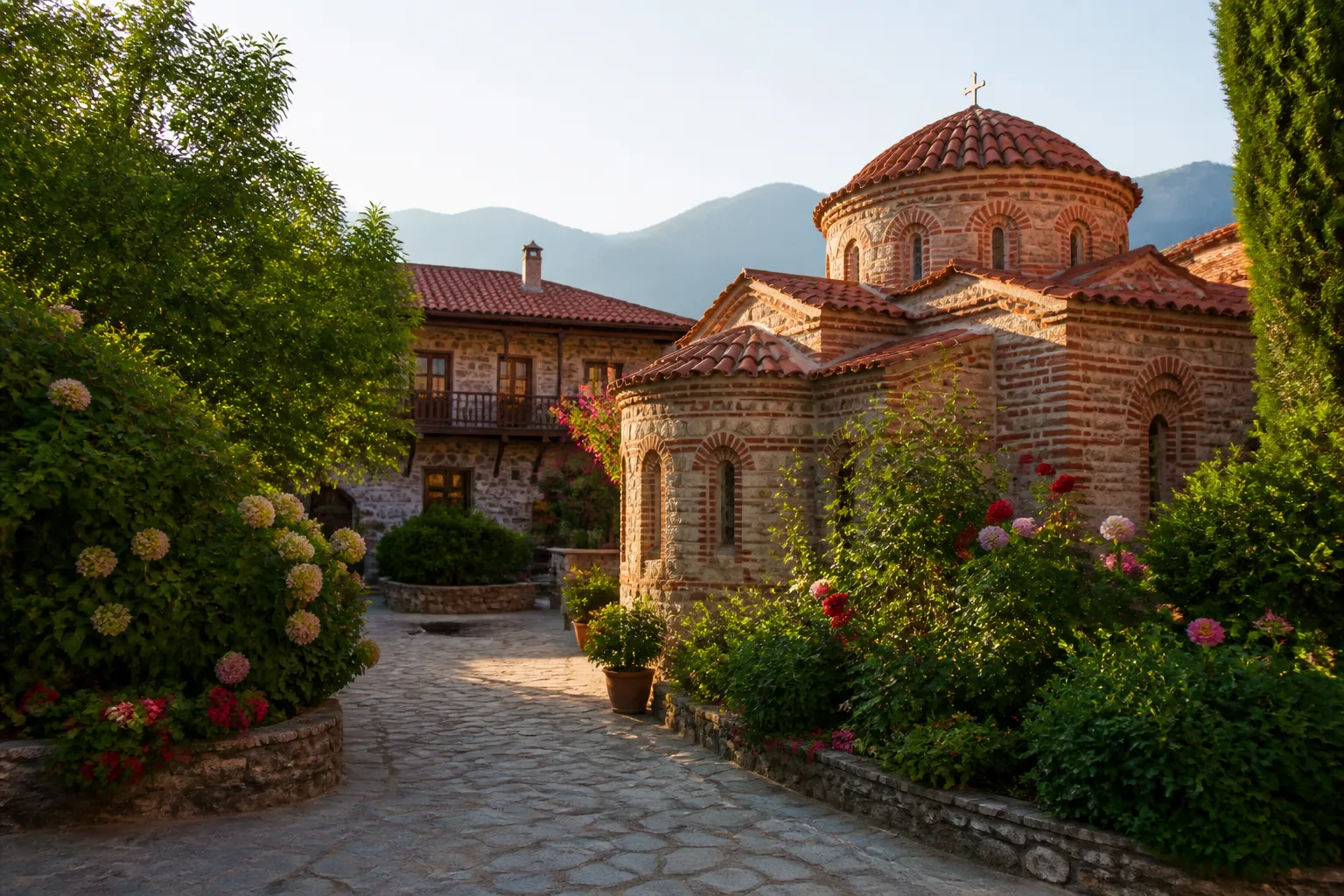
The dress code to Ayios Paisios — the Holy Monastery of St. John the Theologian in Souroti — is stricter than almost any other Orthodox site you’ll visit in Greece. Women must wear a long skirt below the knee (trousers are not accepted here, full stop), shoulders must be covered, and a headscarf is expected near the tomb of Saint Paisios. Men need full-length trousers and a sleeved shirt. I learned exactly how seriously this is enforced during a visit with a group of pilgrims from Thessaloniki — the nuns at the gate are polite but firm, and there are no loaner skirts waiting for you at the entrance the way there might be at Meteora.
Dress Code to Ayios Paisios: What the Rules Actually Are
A quick note on naming: when people search “Ayios Paisios monastery” or “Agios Paisios Souroti,” they’re referring to the same place — the convent in the village of Souroti, about 30–40 minutes northeast of Thessaloniki, where Elder Paisios of Mount Athos is buried. Since his canonization as a saint in 2015, this site has become one of the most visited Orthodox pilgrimage destinations in all of Greece. It is a working convent of nuns, which means the expectations around dress and behavior reflect that — not the more tourist-accustomed atmosphere you might find at Meteora.
Here’s exactly what’s required:
- Women — skirts only. Long skirts that fall below the knee are mandatory. Trousers, leggings, and culottes are not permitted for women at this site, even if covered by a long top. This is enforced at the entrance.
- Women — covered shoulders. No sleeveless tops, tank tops, or off-shoulder styles. A cardigan or light shawl over a sleeveless shirt is generally acceptable.
- Women — headscarf near the tomb. A headscarf or scarf wrapped over the hair is expected in the area near Saint Paisios’s tomb and relics, particularly during or near service times. Outside of services it isn’t always enforced for every visitor, but bringing one is strongly recommended — it’s a sign of respect pilgrims take seriously here.
- Men — long trousers. No shorts, no exceptions. Long trousers and a sleeved shirt are required.
- Men — no sleeveless shirts. A regular T-shirt is fine; a vest or tank top is not.
- Photography restrictions. Photography near the tomb and relic area is restricted. Follow posted signs and the lead of pilgrims around you — this is not a place where people are casually snapping photos.
- Visiting hours. Like most Greek monasteries, Souroti follows a schedule with a midday closure. Morning hours are typically around 8:00–12:00 and afternoon hours around 16:00–19:00 (these can shift seasonally, so confirm before you go). Arriving close to opening is wise on weekends.
- Crowds. The site gets extremely busy around Saint Paisios’s feast day on July 12, and on weekends year-round. Plan for queues, especially to venerate the tomb.
- Getting there. There is no direct public transport to Souroti from Thessaloniki. Most visitors arrive by private car or as part of an organized pilgrimage tour from the city. The drive takes roughly 30–40 minutes depending on traffic.
The overall tone at this site is genuinely devotional. The majority of visitors are Orthodox Christians who have come specifically to pray and venerate. Treating it as a sightseeing stop will feel out of place — and your attire signals that immediately at the gate.
What to Actually Wear (and Pack Before You Go)
Because the skirt rule is non-negotiable and there’s no lending system at the gate, the single most important thing you can do is plan your outfit in advance. Here’s my practical packing list for visiting the monastery of Saint Paisios:
- A loose, full-length or midi skirt that clears the knee comfortably when you’re walking or climbing steps. Flowy fabrics work well in the summer heat. I’ve seen visitors wearing something like the Aodemo Women’s Flowy Maxi Skirt — lightweight, packs flat, and the elastic waist makes it easy to throw on over clothes you’re already wearing.
- A loose, sleeved top or a cardigan you can layer over a sleeveless shirt.
- A lightweight scarf or headscarf you can wrap over your hair near the tomb — a standard rectangular scarf works fine.
- Comfortable flat shoes. The ground is uneven in places and you may be standing in a queue for some time.
- Water, especially in summer — there’s limited shade while you wait.
Men should simply wear long trousers and a regular T-shirt or button-down. Nothing complicated — just no shorts, no sleeveless, and keep it respectful in terms of graphics or slogans on clothing.
Common Mistakes and a Few Extra Tips
Assuming the rules are the same as Meteora. They’re not. The monasteries at Meteora have grown accustomed to international tourists and often offer wraps or skirts to borrow at the entrance. Souroti is a pilgrimage site that primarily serves Orthodox faithful — the expectation is that you already know the dress code and come prepared. Don’t bank on flexibility at the door.
Visiting on a feast day without planning for crowds. July 12, the feast of Saint Paisios, draws enormous numbers of pilgrims. If you go on that day, expect very long waits and very tight quarters near the tomb. A quieter weekday visit outside of summer will give you a more contemplative experience.
Forgetting the headscarf. Even if it’s not verbally requested every time, wearing one near the tomb is the respectful norm. Pack it. It takes up no space.
If you’re planning a broader trip visiting sacred sites in Greece, our guide to the Meteora Monasteries dress code covers each individual monastery’s requirements in detail. And if you’re traveling more widely, what to wear at sacred sites worldwide is worth bookmarking before you go.
Getting the dress code to Ayios Paisios right takes about five minutes of planning — a long skirt, a scarf, covered shoulders. Do it in advance and your entire visit will be smoother, more respectful, and more meaningful. It’s a genuinely moving place to visit, and arriving prepared lets you focus entirely on that.
Affiliate Disclosure: This post contains affiliate links. As an Amazon Associate, I earn from qualifying purchases. If you buy something through my links, I may earn a small commission at no extra cost to you. I only recommend gear I’ve actually used on the road.