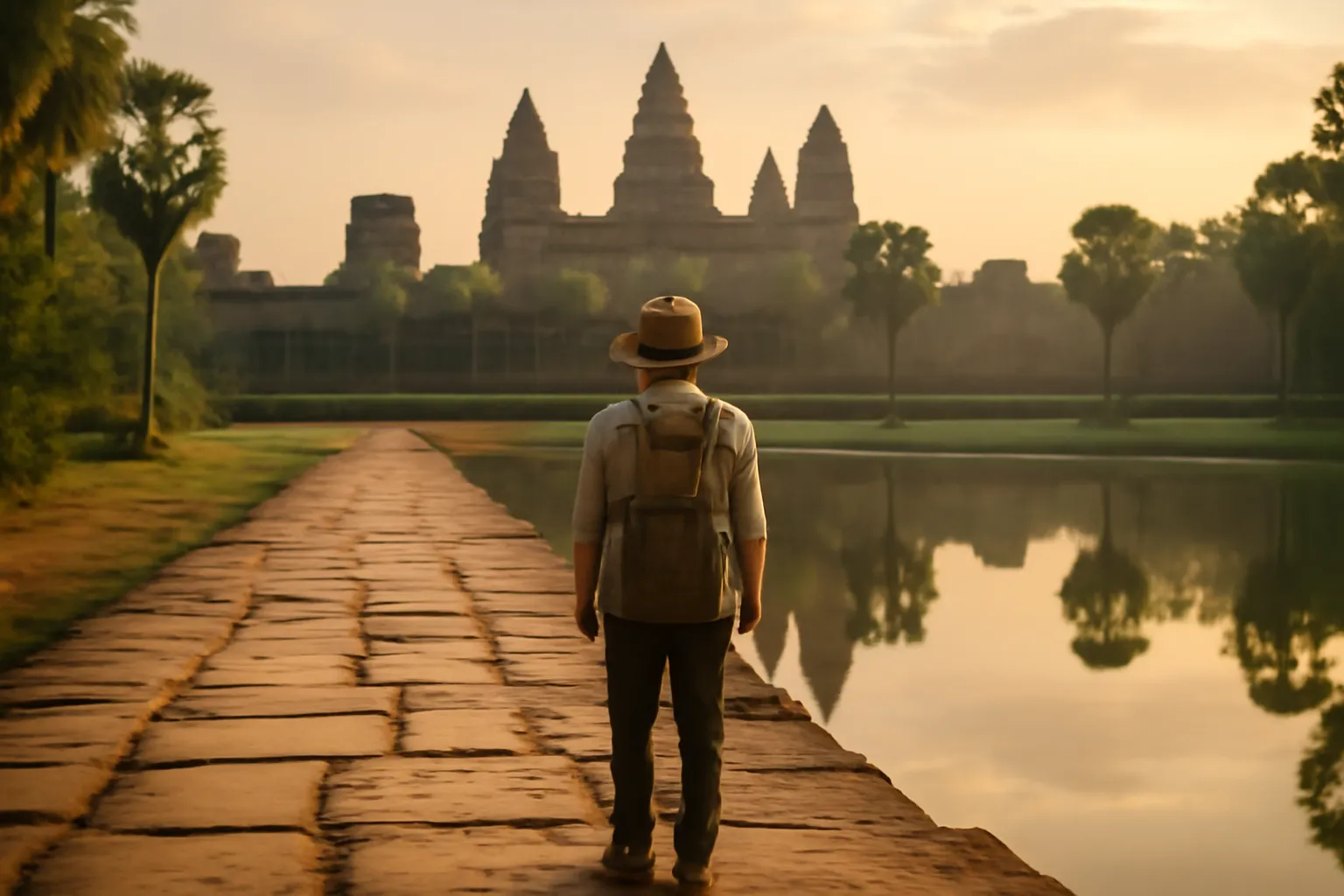
By 12:47pm I was folded sideways in the back seat of a tuk-tuk, skull resting against the metal railing, unable to focus on anything but the heat shimmer swallowing the jungle around me. Sokha, my driver, took one look and delivered his verdict without asking a single question: “You need hotel now.” He’d clearly run this rescue before. I’d been out since before dawn — the towers of Angkor Wat turning gold as the sun came up, the fig roots strangling their way through Ta Prohm, the brutal stone stairs of Bayon under my boots — and by early afternoon my body had quietly quit on me. Here’s the part nobody mentions when you search angkor wat dress code heat what to wear: the dress code and the climate aren’t two separate hurdles. They merge into one brutal, compounding problem. When it’s 40°C with 80% humidity, “cover your shoulders and knees” stops being a wardrobe note and starts being a survival variable. I’d layered a linen shirt over a tank top, and by 7am it was already soaked through, plastered to me like an unwanted second skin. Sokha drove me straight back to the hotel, where I lay flat under a ceiling fan for three hours, questioning every decision that had brought me to that exact moment. Honestly? Best travel lesson I’ve ever paid for.
| Temple Site | Distance from Others | Shade Availability |
|---|---|---|
| Angkor Wat | Not walking distance | Nearly nonexistent |
| Angkor Thom | Not walking distance | Nearly nonexistent |
| Ta Prohm | Not walking distance | Nearly nonexistent |
| Bayon | Not walking distance | Nearly nonexistent |
| Banteay Srei | Not walking distance | Nearly nonexistent |
| Pre Rup | Not walking distance | Nearly nonexistent |
Why Angkor Wat’s Dress Code in Cambodia’s Heat Is a Uniquely Punishing Combination
Start with the map, because most visitors show up expecting a single temple and instead find themselves facing an entire region. The Angkor Archaeological Park sprawls across more than 400 square kilometers of northwestern Cambodia, and the headline sites — Angkor Wat, Angkor Thom, Ta Prohm, Bayon, Banteay Srei, Pre Rup, plus roughly a dozen smaller ruins scattered between them — are nowhere near walking distance from each other. A tuk-tuk isn’t a nice-to-have; it’s basically required. And those bumpy rides down cracked jungle roads end up being the only stretches of the day where you feel anything like a breeze.
April sits in the gap between Cambodia’s hot season and the monsoon, and it happens to be the hottest month on the calendar. Siem Reap regularly climbs to 40°C during the day, sometimes higher. Humidity holds steady between 75 and 85 percent. This isn’t the dry desert heat where sweat evaporates and actually cools you down. This is the version where sweat just pools on your skin, doing absolutely nothing useful. Your body works overtime for zero payoff. Heat exhaustion, and in the worse cases heat stroke, are real medical risks here — Angkor sees more tourist medical evacuations than almost any other temple site in Southeast Asia.
Layer the dress code on top of that. Angkor’s temples enforce their rules explicitly, and Angkor Wat itself is the strictest of all. Shoulders covered. Knees covered. Try to reach the upper sanctuary — the innermost level everyone’s aiming for — without following the rules, and guards will turn you back with zero negotiation. This isn’t red tape for its own sake. Angkor Wat is a living, active Hindu-Buddhist site, not a museum piece. Khmer people have treated this ground as sacred since the 12th century, back when King Suryavarman II built it as a tribute to Vishnu and the cosmos itself. Covering your arms is a small ask given what the place actually is.
Then there’s the stone. The laterite and sandstone that make up these temples soak up heat all morning and release it back at you like a slow-cooking oven. Walk through Angkor Wat’s galleries by 10am and you’re basically being roasted from every direction at once. Shade is nearly nonexistent between sites. The jungle looks lush and close, sure, but the causeways and paths themselves sit wide open under the sun. The reflecting pools photograph beautifully. They do nothing for your body temperature. This is the reality that every glossy sunrise shot — cool, golden, perfectly lit — conveniently leaves out. Once you actually understand this, you’re finally in a position to think seriously about surviving angkor wat heat with your dignity and your core temperature both intact.
For a broader look at how sacred sites around the world handle dress requirements, our guide to temple dress codes at sacred sites worldwide covers everything from Angkor to the Vatican.
The Arm Sleeves That Kept Me From Melting at Angkor Wat
Covering shoulders and knees sounds like a minor ask until you’re actually standing in 40°C heat wrapped in long sleeves that turn your arms into slow-roasting meat. I found out the hard way that ordinary fabric just doesn’t work here — you need something engineered to push heat away rather than trap it against your skin.
What worked
- The cooling fabric isn’t just marketing — you notice the difference immediately. Duck into shade between temples and you can actually feel it pulling moisture off your skin instead of trapping it like a damp towel.
- UPF 50+ coverage means you’re not reapplying sunscreen every hour and a half, which is a relief when you’re mid-climb on ancient stone steps with nowhere to stop and dig out a bottle.
- They grip just enough to stay in place even as you sweat through everything else, without ever feeling like you’ve strapped a tourniquet to your arm for an eight-hour day.
What didn’t
- The price feels steep for what amounts to a couple of arm sleeves, and you’ll question the purchase right up until about twenty minutes into your first temple morning, when you’ll stop questioning it entirely.
- Color options are slim — black, navy, or white, take your pick. If you care about matching your outfit, that ship has sailed. Not passing out beats looking coordinated.
I almost ditched them halfway through my first morning—convinced I was overheating because of them, not in spite of them—but the moment I took them off to test, I understood. SportsTrail Women’s Cooling Arm Sleeves with UPF 50+ Sun Protection turned an ordeal into something almost bearable.
Frequently Asked Questions
What is Angkor Wat’s dress code for visiting temples?
Angkor Wat requires shoulders and knees to be covered. Guards will turn you back without negotiation if you try to reach the upper sanctuary without following these rules. The dress code is enforced because Angkor Wat is a living, active Hindu-Buddhist site that Khmer people have treated as sacred since the 12th century, when King Suryavarman II built it as a tribute to Vishnu and the cosmos.
How hot does it get at Angkor Wat in April?
April is the hottest month on Cambodia’s calendar. Siem Reap regularly climbs to 40°C during the day, sometimes higher, with humidity holding steady between 75 and 85 percent. This humid heat means sweat pools on your skin rather than evaporating, and Angkor sees more tourist medical evacuations than almost any other temple site in Southeast Asia.
Is a tuk-tuk necessary to visit Angkor Archaeological Park?
Yes, a tuk-tuk is basically required. The Angkor Archaeological Park sprawls across more than 400 square kilometers of northwestern Cambodia, and headline sites like Angkor Wat, Angkor Thom, Ta Prohm, Bayon, Banteay Srei, and Pre Rup are nowhere near walking distance from each other. Tuk-tuk rides are the only stretches where you feel anything like a breeze.
Why is shade so limited at Angkor Wat temples?
The laterite and sandstone that make up these temples soak up heat all morning and release it back at you like a slow-cooking oven. The causeways and paths sit wide open under the sun with nearly nonexistent shade between sites, and the reflecting pools photograph beautifully but do nothing for your body temperature.
About This Article

Written by Elena Vasquez. Elena Vasquez is a full-time traveler and the founder of Witty Passport. Over fifteen years and more than 50 countries across six continents — including a stretch spent leading groups professionally through Southeast Asia and the remote highlands of South America — she's written the kind of destination guides she always wished existed: practical, specific, and built on real experience rather than recycled itineraries. More about this site.
Scope and limits. Elena is a full-time traveler, not a licensed travel agent or immigration adviser. Entry requirements, visa rules, and advisories change without notice — always confirm against the official government source for your destination and passport before booking.
Verify this against a primary source
Specifics change, and your situation may differ from the one described here. These are the authorities worth checking directly:
- U.S. Department of State — entry requirements and travel advisories
- CDC Travelers' Health — vaccination and health notices by destination
- TSA — current carry-on and screening rules