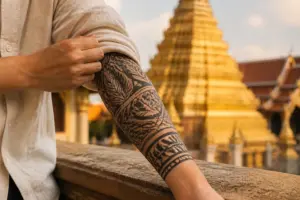
The thing that catches people out in Bali is not the sarong. Everyone has heard about the sarong. It is the second piece — the sash tied around your waist on top of it — that sends a steady trickle of visitors back to the rental stall at the gate, holding a perfectly adequate sarong and wondering what else there could possibly be. The Bali temple dress code is two garments, not one, and that is the single most useful thing to know before you go.
Bali’s temples are not ruins and they are not museums. They are in daily use. Offerings get placed in the morning, ceremonies run on a calendar most visitors never see, and the dress rules exist because a working temple has a dress code the way a working mosque or cathedral does. Get the two pieces right and nobody at the gate will give you a second look. This guide covers the universal rules, the temples where things get stricter, and the restrictions that have nothing to do with clothing at all — the ones that surprise people most.
The Universal Rules: Two Garments and Three Don’ts
Every major temple on the island expects the same baseline. Get this right and the rest is detail.
- A sarong (kamen) covering you below the knee. This applies to men and women equally. Shorts underneath are fine — nobody is checking what the sarong is covering.
- A sash (selendang) tied at the waist, over the sarong. This is the piece people forget. It is usually explained as marking the division between the upper and lower body — the pure and the less pure — and it is not optional at most sites.
- Shoulders and upper arms covered. Tank tops, crop tops, and anything strappy will not pass.
- No swimwear, and nothing sheer or very tight. Technically covering a limb is not the same as covering it. This is where beach-to-temple days go wrong.
- Hats off inside temple grounds. Sunglasses on your head count as a hat often enough that it is easier to just take them off.
Sarongs and sashes are available to rent or borrow at the entrance of essentially every ticketed temple. Expect to pay a small amount — figures in the range of 10,000 to 30,000 rupiah get quoted, though this varies by site and I would not plan a day around an exact number. At some temples the rental is folded into the ticket price and handed to you without comment.
My honest advice: buy your own on day one. A sarong costs very little in any market, it dries in an hour, it doubles as a beach towel and a bus blanket, and you will stop treating temple visits as a logistical problem. The rental ones are clean and perfectly fine. They are also damp, unflattering, and the same four patterns across the whole island.
Bali Temple Dress Code by Temple
| Temple | Sarong + sash | What’s different here | Enforcement |
|---|---|---|---|
| Besakih (Mother Temple) | Required | The island’s most important temple and a major ceremonial site; inner courtyards may be closed to non-Hindus entirely | Strictest — treat it as the benchmark |
| Tirta Empul | Required, and it gets wet | A working purification spring; visitors bathe only in marked sections, and you need a second dry sarong for afterward | Strict, with its own bathing etiquette |
| Uluwatu | Required | Clifftop site, usually paired with the evening kecak performance; the monkeys will take sunglasses and loose sarong ends | Standard |
| Tanah Lot | Required | The rock temple itself is not open to visitors; the dress code applies to the grounds | Standard |
| Ulun Danu Beratan | Required | Mostly visited as a lakeside photo site; shrine areas still apply the full code | Standard, lighter on the grounds |
One caveat worth stating plainly, because a lot of travel writing about Bali states it the other way: I could not find an official islandwide regulation published by the province setting a single dress code with specific penalties for visitors. You will read confident claims about fines and even deportation for temple dress violations. Treat those as unverified. What is real is that individual temples set and enforce their own rules through the local desa adat (customary village), which is exactly why Besakih feels stricter than a lakeside shrine. The signage at the gate is the authority, not a blog post — including this one.
Tirta Empul: The One That Needs a Plan
Tirta Empul is the temple where the dress code becomes a packing problem rather than a clothing problem, because you get in the water.
The purification pools are a functioning religious site — Balinese Hindus come here to perform melukat, a cleansing ritual, and it is not a tourist attraction with a spiritual theme. Visitors who wade do so in sections that are marked for them, and the sarong goes in fully wet. Some of the spouts are reserved for specific ritual purposes and for funeral rites, and you should not simply work along the row.
- Bring a second sarong, dry, for after. There is a changing area, and you will want it.
- Wear something under the sarong you are happy to be seen wet in.
- Watch what the Balinese families ahead of you do, and follow it. This is far more reliable than any written instruction, mine included.
- If you are not going to take it seriously, watch from the side. That is a completely acceptable choice and nobody will mind.
The Restrictions That Are Not About Clothing
This is the part that catches people genuinely off guard, and it is worth knowing before you are standing at a gate.
Menstruation. Women who are menstruating are asked not to enter temple grounds. How this is framed varies — at some temples it is a request on a sign, at others it is presented as a rule, and it most consistently applies to the jeroan, the inner sanctum. Nobody checks and nobody asks. It operates entirely on the honor system, which is precisely why visitors who have not read about it in advance walk past the sign without registering what it says.
Recent bereavement and illness. The same inner-courtyard restriction commonly extends to people who have had a death in the immediate family recently, and to those who are unwell. The underlying logic is ritual purity rather than hygiene.
Active ceremonies. When a ceremony is running, non-Hindus are generally not admitted to the areas where it is taking place. You may be able to watch from an outer courtyard. You may be turned away from the whole complex, and if you have traveled an hour to get there, that is simply the day you have had. Temples are not scheduled around visitors, and ceremony calendars are not published for tourists in any form you can reliably plan around.
The obvious ones. Do not climb on shrines or walk in front of someone who is praying. Do not stand above a priest. Do not point your feet at a shrine when sitting. If you have photographed your way through temples elsewhere in Asia, the instinct that a thing which looks like a plinth is a place to stand for a better angle is the instinct to suppress.
What I’d Actually Pack
- Two sarongs. One in the bag permanently, one for Tirta Empul days.
- One sash. Buy it with the sarong; they are sold together and the vendor will tie it on you the first time.
- A light long-sleeved shirt that packs small. It solves the shoulder rule in 30°C heat better than a shawl, which slides off constantly.
- Slip-on shoes. You will take them off repeatedly.
Bali’s rules are, honestly, among the gentlest I have run into at major religious sites. Nobody is hostile about it and the fix is always available at the gate. The reason to get it right in advance is not to avoid a penalty — it is that arriving correctly dressed changes the kind of visit you have. You spend the first ten minutes looking at the gate carvings instead of queuing at a rental stall.
For how Bali compares to the rest of the region, my guide to Asian temple dress codes puts the rules side by side — the sash is genuinely a Balinese particular, and assuming Thailand’s rules travel here is how most people end up at the rental stall. The worldwide sacred sites guide covers the wider picture, and Angkor Wat in 40°C heat is the closest thing to a comparable problem.
Frequently Asked Questions
Do I need a sash as well as a sarong at Bali temples?
Yes, at most temples. The sash (selendang) is tied at the waist over the sarong and is a distinct requirement, not decoration. It is the piece visitors most often arrive without, because the sarong gets all the attention in guidebooks. Rental stalls at the gate supply both together.
Can men wear shorts to a Bali temple?
Not on their own. A sarong over the shorts solves it, and the dress code applies to men and women equally — men are not exempt from either the sarong or the sash. Shoulders need covering too, so a t-shirt works and a vest does not.
Can you visit Bali temples during your period?
Menstruating women are asked not to enter temple grounds, and the restriction applies most consistently to the inner sanctum (jeroan). It is framed as a request at some temples and as a rule at others, and it is never checked — it runs on the honor system. The outer grounds and the surrounding site are usually still visitable where the signage allows.
Can you be fined for breaking the Bali temple dress code?
I found no official islandwide regulation setting specific penalties for visitors on dress, despite a lot of confident writing to the contrary. In practice temples enforce their own rules at the gate, and the enforcement is refusal of entry until you put on a rented sarong and sash — not a fine. Climbing on shrines and similar conduct is a different matter and has drawn real consequences for visitors.
About This Article

Written by Elena Vasquez. Elena Vasquez is a full-time traveler and the founder of Witty Passport. Over fifteen years and more than 50 countries across six continents — including a stretch spent leading groups professionally through Southeast Asia and the remote highlands of South America — she's written the kind of destination guides she always wished existed: practical, specific, and built on real experience rather than recycled itineraries. More about this site.
Scope and limits. Elena is a full-time traveler, not a licensed travel agent or immigration adviser. Entry requirements, visa rules, and advisories change without notice — always confirm against the official government source for your destination and passport before booking.
Verify this against a primary source
Specifics change, and your situation may differ from the one described here. These are the authorities worth checking directly:
- U.S. Department of State — entry requirements and travel advisories
- CDC Travelers' Health — vaccination and health notices by destination
- TSA — current carry-on and screening rules