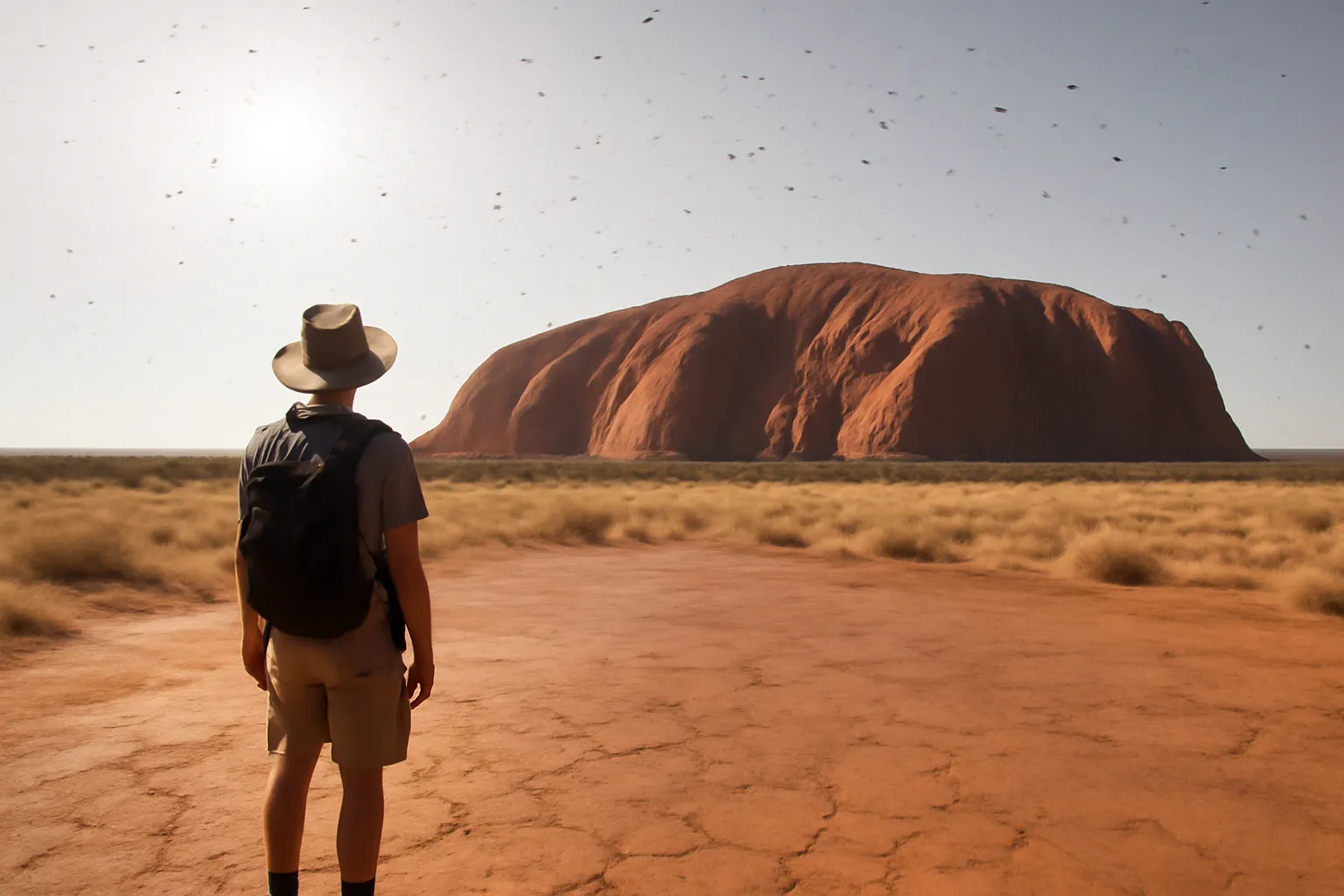
Winter mornings at Uluru are forgiving enough that you could turn up half-prepared and still leave happy; summer mornings are not, and that’s precisely why summer is the better version of this trip if you actually want the experience that leaves people speechless. At 5:17am on the Talinguru Nyakunytjaku viewing platform, I had no coffee, the wrong clothes, and roughly forty other bleary strangers who’d all set the same absurd alarm. Then the rock started its performance. Three hundred and forty-eight metres of stone moved from charcoal to bruised purple to burnt sienna to a red so saturated it looked like the ground itself had caught fire. I just stood there, jaw open, forgetting I owned a phone, forgetting everything else — for about twenty-two minutes I was, genuinely, a better person. Then the sun cleared the horizon properly, and almost instantly the heat ratcheted up, the flies arrived like some kind of biblical sentence, and I realized, a beat too late, that my baseball cap was going to do nothing at all for my ears, my neck, or the backs of my hands across the 10.6 kilometres of open desert still ahead of me. Nobody photographs that part for Instagram — standing at one of the most sacred landscapes on the planet, half-transcendent and half-panicking about sun exposure. But that’s the moment that quietly decides how the rest of your visit goes. Here’s what actually matters: what to wear, how to handle the sun, the cultural etiquette that isn’t optional, and why a decent hat and the correct hat are two very different purchases out here.
Why Sun, Culture, and Desert Heat Create a Uniquely Challenging Combination at Uluru
Uluru marks the spiritual and geographic center of the Red Centre, and almost nothing about it rewards a casual approach. Start with the sun, because it isn’t messing around. Through the summer stretch — roughly October to March — the UV index at Uluru regularly climbs past 14, and context matters here: the World Health Organisation labels anything above UV 11 “extreme.” At UV 14, bare skin can start burning in under ten minutes. The desert air gives you almost no natural filtering — no smog to soften it, no cloud cover for weeks on end, no real shade beyond the car park. The base walk, known as Lungkata, is 10.6 kilometres of fully exposed red sand and rock, and if you set out at the culturally correct dawn hour, you’ll be walking straight into a rising sun by 7am. Nine tourists needed hospital treatment for heat-related illness in the region last year, and that figure is almost certainly low, given how many people quietly retreat to their rental cars rather than report how they’re feeling.
The temperature swing, meanwhile, borders on unbelievable. My phone thermometer read 6°C at 5:30am on the sunrise platform. By 10:15am it read 38°C — a 32-degree jump in under five hours. Northern Territory summer heat is genuinely hazardous for anyone without real experience in dry, extreme climates, and the warning signs — dizziness, sweat that suddenly stops, a fog settling over your thinking — can arrive faster than you’d expect when you’re busy staring at one of the most beautiful landscapes on the planet.
The difficulty here isn’t just physical, though. This is Anangu country — home to the Pitjantjatjara and Yankunytjatjara peoples — and being a guest carries real obligations. The climb up the rock has been permanently off-limits out of respect for Anangu law since October 2019. Specific areas around Uluru hold ceremonial significance and are marked clearly with signage asking visitors not to photograph them. These signs aren’t gentle suggestions — if an Anangu ranger asks you to delete an image, you delete it, no negotiation. Learning the cultural layout of the park, which spots are open to visitors and which call for a respectful distance, genuinely changes how you experience the place. That’s why booking an Anangu-led cultural walk through the Uluru-Kata Tjuta Cultural Centre may be the single smartest thing you do here — not just out of politeness, but because it turns a scenic walk into something with actual meaning behind it.
From September through March, there’s also the fly situation, and words genuinely fail me here. They’re relentless, everywhere, and drawn specifically to moisture — your eyes, your nose, your mouth. Locals have a name for the constant hand-wave in front of your face: the “Australian salute.” Most visitors are doing it themselves within forty-five minutes of stepping off the plane.
The Hat That Kept Me From Turning Into a Sunburned Wreck at Uluru
There’s no bluffing your way through Red Centre sun in summer. Even at 5:17am you’re already running on borrowed time, and once Uluru finishes its light show, you’re left standing out in the open with nowhere to hide for the next three hours.
What actually holds up
- The brim is properly wide — not stylish-wide, but built-for-Australian-sun-wide — shielding your ears and the back of your neck in a way no baseball cap manages.
- It stays put through the gusty walks around the rock (I watched three separate caps go tumbling into the dust that same morning; this one didn’t budge).
- Unlike a floppy sun hat, it holds enough shape to pack flat in a day pack and pop back into form without the crumpled-out-of-a-suitcase look.
Where it comes up short
- It leans practical over pretty — if your goal is a picture-perfect travel photo, this is a form-follows-function trade-off, and it’s noticeable.
- The inner sweatband holds onto moisture in humid conditions, so if you’ve flown in from somewhere tropical and are still damp, plan on it feeling clammy for the first twenty minutes of wear.
I almost ditched it halfway through the base walk because I felt like I looked ridiculous, but by mid-morning when everyone else’s shoulders were turning angry pink, I was genuinely grateful for my dorky brim coverage. EINSKEY Wide Brim Sun Hat with UPF 50+ protection
Frequently Asked Questions
What’s the UV index like at Uluru during summer months?
Through the summer stretch from roughly October to March, the UV index at Uluru regularly climbs past 14, which the World Health Organisation labels as extreme. At UV 14, bare skin can start burning in under ten minutes because the desert air provides almost no natural filtering from sun exposure.
Is the Uluru rock climb still open to visitors?
No. The climb up the rock has been permanently off-limits out of respect for Anangu law since October 2019. Visitors can walk the Lungkata base walk, which is 10.6 kilometers of fully exposed red sand and rock, but the rock itself is no longer accessible for climbing.
What should I know about photographing at Uluru?
Specific areas around Uluru hold ceremonial significance and are marked clearly with signage asking visitors not to photograph them. If an Anangu ranger asks you to delete an image, you delete it with no negotiation. Respecting these restrictions is a genuine obligation as a guest in Anangu country.
How much does temperature change during a Uluru summer visit?
The temperature swing is dramatic. One visitor recorded 6°C at 5:30am on the sunrise platform and 38°C by 10:15am — a 32-degree jump in under five hours. This extreme swing makes proper sun protection and hydration critical for anyone spending hours walking in the open desert.
About This Article

Written by Elena Vasquez. Elena Vasquez is a full-time traveler and the founder of Witty Passport. Over fifteen years and more than 50 countries across six continents — including a stretch spent leading groups professionally through Southeast Asia and the remote highlands of South America — she's written the kind of destination guides she always wished existed: practical, specific, and built on real experience rather than recycled itineraries. More about this site.
Scope and limits. Elena is a full-time traveler, not a licensed travel agent or immigration adviser. Entry requirements, visa rules, and advisories change without notice — always confirm against the official government source for your destination and passport before booking.
Verify this against a primary source
Specifics change, and your situation may differ from the one described here. These are the authorities worth checking directly:
- U.S. Department of State — entry requirements and travel advisories
- CDC Travelers' Health — vaccination and health notices by destination
- TSA — current carry-on and screening rules