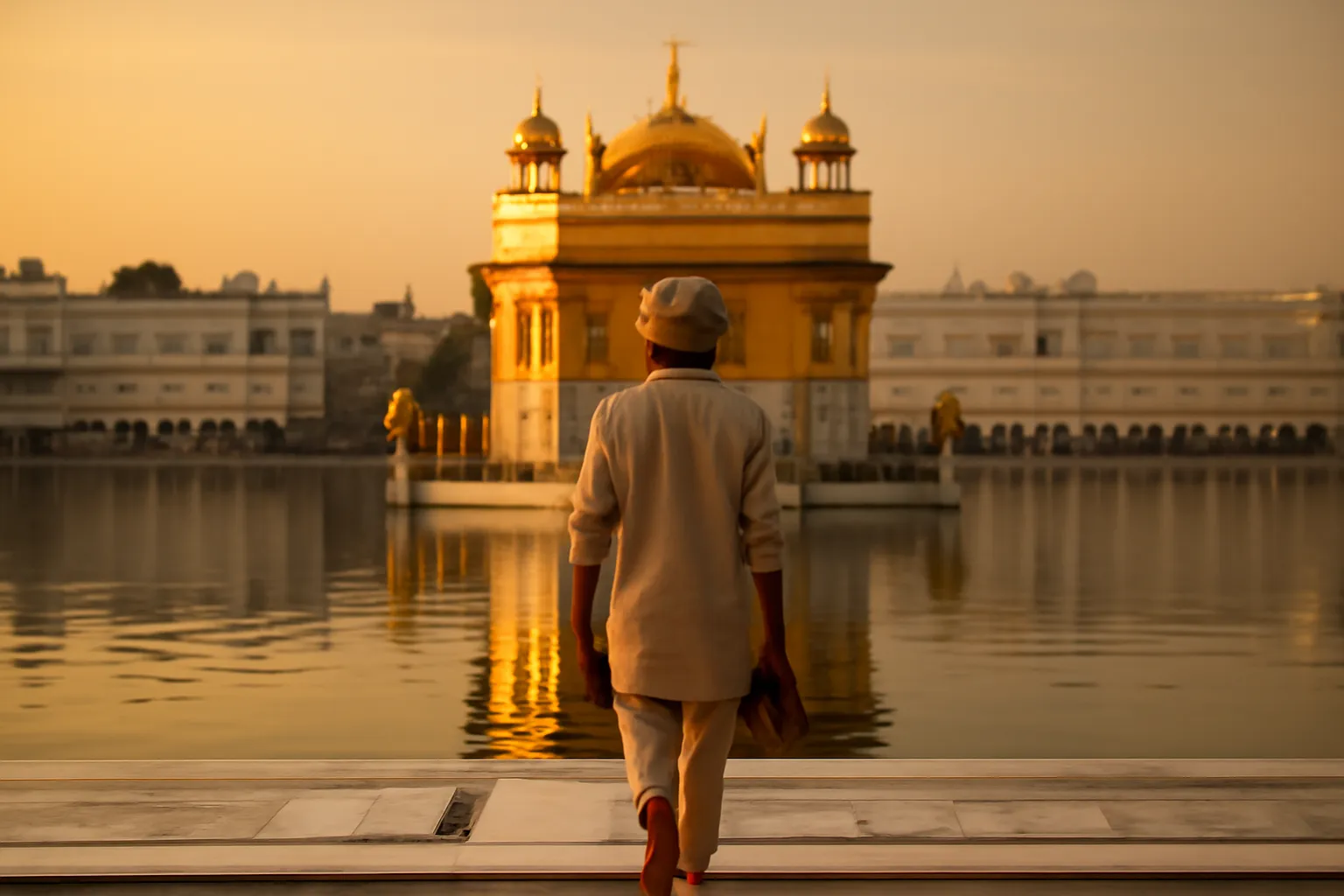
Scroll through Golden Temple advice online and you’ll bump into two contradictory claims fast: one camp insists you can skip packing a head covering entirely, since volunteers hand them out free at the gate — why carry the extra weight? The other camp insists that leaning on the gate stash means you’ll feel the gap the instant someone has to fix your oversight for you. The second camp has it right, and I know because I lived it at 4:47 in the morning, barefoot on marble gone cold overnight, standing at the entrance to Sikhism’s holiest site while still half-asleep and thoroughly under-prepared. Sri Harmandir Sahib — the Golden Temple — was doing the thing it does at that hour, appearing to manufacture its own light, the gilded sanctum throwing its reflection across the motionless surface of the Amrit Sarovar in a way that looks invented rather than built. My camera was ready. My shoes were locked away. I’d already sloshed through the shallow foot-washing channel. What I’d skipped, somewhere in the fog of predawn logistics, was anything to cover my head. An older volunteer noticed right away — a magnificent white beard, the unhurried calm of someone who’d been rising before 5am for something sacred for decades. He smiled, not unkindly, pulled a bright orange bandana from a basket by the entrance, and settled it onto my head with the ease of a man who’d done exactly this ten thousand times before. He probably had. It was, at once, one of the kinder gestures a stranger has ever offered me and one of the more embarrassing moments of my travels, because I’d known better. I’d read all about the golden temple amritsar dress code head covering rule before I ever left home. I’d simply failed to act on it, lost in the scramble of a predawn rickshaw ride through streets that were just waking up. Don’t be me. Or, fine — be me, just better prepared than I was.
| Item | Rule | Details |
|---|---|---|
| Head covering | Non-negotiable | Required for everyone; free bandanas available at entrance |
| Shoulders and knees | Must be covered | Tank tops and shorts not permitted; scarves available to borrow |
| Shoes | Must be removed | Stored free at counters before gate; bare feet on marble parikrama |
| Tobacco, alcohol, leather | Prohibited | Includes leather belts; leather shoes already removed |
| Cameras | Not allowed inside | Inner sanctum only; Guru Granth Sahib recited nonstop |
Why the Golden Temple Dress Code Is Unlike Any Other Religious Site You’ll Visit
Dress codes at sacred sites aren’t unique to Amritsar — you’ve likely already covered your shoulders walking into a European cathedral, tied a sarong around your waist before a Balinese temple, or slipped your shoes off outside a mosque somewhere. The Golden Temple asks for all of that and stacks a few more layers on top, and understanding the reasoning behind each rule before you show up beats learning it after some kind stranger has already bailed you out with a shared bandana.
Sri Harmandir Sahib rises from the middle of a large rectangular pool in Amritsar, Punjab, in India’s northwest. Work on the temple started in the late 1500s under the fifth Sikh Guru, Guru Arjan Dev Ji, who deliberately gave the structure four separate entrances — one per side — as a statement that the place belonged to people arriving from every direction, every caste, every faith. That founding idea of inclusion still runs the place today. There’s no admission charge and never has been. The doors stay open around the clock, every day of the year. The langar kitchen feeds something like 100,000 people daily, free of charge, no questions asked, ever. At a time when countless historic temples across the country shut lower castes out entirely, the Golden Temple was conceived as a direct answer to that exclusion. Knowing that history reframes the dress code completely. It isn’t a restriction being imposed on you. It’s a leveling mechanism — equality and respect built into a space that asks everyone who walks in, Sikh or Hindu, Muslim or Christian, atheist or curious tourist, to arrive looking the same.
Here’s precisely what visiting a Sikh temple dress code actually demands once you’re at the Golden Temple:
- Head covering: Non-negotiable for absolutely everyone — men, women, kids, any faith, no carve-outs and no “I forgot.” Free bandanas wait at the entrance if you show up bare-headed, but flip back to my opening story for exactly how that feels.
- Shoulders and knees covered: Tank tops and shorts don’t make it past the entrance. Scarves and wraps can be borrowed there too — though, again, bringing your own beats relying on the basket.
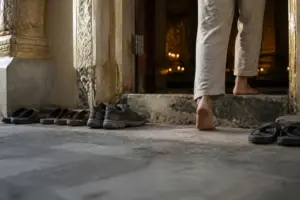
- Shoes removed: Shoes come off before you even reach the gate, at the free storage counters set up for exactly this. From there you’ll pass through a shallow foot-washing channel — the sarovar entrance stretch — before your bare feet hit the marble parikrama circling the sacred pool.
- No tobacco, alcohol, or leather: Tobacco, alcohol, and leather are all off-limits, leather belts and leather shoes included — though since your shoes are already off by that point, the footwear part takes care of itself.
- No photography inside the Harmandir Sahib: Cameras stay away inside the inner sanctum, where the Guru Granth Sahib is recited nonstop, day and night — it isn’t there for your photo roll. Read the room, listen to the scripture, and leave the camera in your bag.
Here’s the environmental catch most guidebooks skip entirely: Amritsar’s weather doesn’t do gentle. Summer temperatures routinely climb to 44–46°C (111–115°F), and the marble parikrama ringing the pool bounces that heat back up at you even as the sun bears down from above. Try the full loop around the Amrit Sarovar barefoot on a June afternoon and your soles will genuinely struggle — volunteers do hose sections of marble down periodically, which takes the edge off, but you’ll still find yourself moving quicker than planned. Come December or January and that same marble turns near-freezing before sunrise, with the foot-washing pool delivering a properly bracing cold. A cotton bandana in summer turns into a damp, clingy mess inside twenty minutes. And if it’s a communal one pulled from the entrance basket — clean, functional, reused by thousands before you — you’re sweating straight into shared history.
The Bandana That Got Me Through the Golden Temple Langar Without Overheating
Dawn at the Golden Temple is gorgeous, no argument there, but come midday — particularly if you’re seated in the langar hall alongside hundreds of other pilgrims — those marble floors turn into a heat trap and the air thickens enough to feel solid. I found this out the hard way, parked in a shaded but airless courtyard, nothing on my head, already dehydrated before the free meal had even reached me.
Where it delivers
- The cooling effect genuinely lasts for hours once it’s wet — not the usual 20-minute window. I dunked mine in cold water straight from the sarovar and it stayed noticeably cool through a full two-hour stretch in the langar hall.
- It’s thin enough to wear knotted under a scarf or dupatta, so you can stay within the dress code rules while still keeping UV off your neck and scalp.
- Unlike a standard bandana, this fabric won’t soak up sweat and turn into a clingy, soggy mess — it stays breathable and keeps evaporating instead.
Where it falls short
- It’s still just a bandana — if you’re counting on real sun protection, pair it with a hat or your dupatta, because the UPF rating only helps the skin it’s actually covering.
- The cooling wears off eventually as the water dries out, so on a full day at the temple, plan on having water nearby to re-wet it.
I almost ditched mine in my bag that morning—convinced it was unnecessary tourist gear—but after three hours in the langar hall, I was grateful I’d thrown it in. If you’re visiting the Golden Temple between April and September, grab a GOT Sports UPF 50+ Cooling Bandana before you go.
Frequently Asked Questions
What exactly must be covered at the Golden Temple?
Head covering is non-negotiable for absolutely everyone. Shoulders and knees must also be covered — tank tops and shorts aren’t permitted. Shoes must be removed before the gate at free storage counters, and you’ll pass through a shallow foot-washing channel before reaching the marble parikrama circling the sacred pool.
Can I rely on borrowing a head covering at the Golden Temple entrance?
Free bandanas wait at the entrance if you arrive bare-headed, but bringing your own is better. Relying on the entrance basket means a volunteer will need to fix your oversight for you — which, while kind, is far less comfortable than arriving prepared with your own head covering.
What items are prohibited inside the Golden Temple?
Tobacco, alcohol, and leather are all off-limits, including leather belts and leather shoes. Cameras also stay away inside the inner sanctum, where the Guru Granth Sahib is recited nonstop, day and night — leave your camera in your bag while you’re inside.
How hot does the marble floor get at the Golden Temple?
Summer temperatures in Amritsar routinely climb to 44–46°C (111–115°F), and the marble parikrama ringing the pool bounces that heat back up at you even as the sun bears down from above. In December or January, that same marble turns near-freezing before sunrise.
About This Article

Written by Elena Vasquez. Elena Vasquez is a full-time traveler and the founder of Witty Passport. Over fifteen years and more than 50 countries across six continents — including a stretch spent leading groups professionally through Southeast Asia and the remote highlands of South America — she's written the kind of destination guides she always wished existed: practical, specific, and built on real experience rather than recycled itineraries. More about this site.
Scope and limits. Elena is a full-time traveler, not a licensed travel agent or immigration adviser. Entry requirements, visa rules, and advisories change without notice — always confirm against the official government source for your destination and passport before booking.
Verify this against a primary source
Specifics change, and your situation may differ from the one described here. These are the authorities worth checking directly:
- U.S. Department of State — entry requirements and travel advisories
- CDC Travelers' Health — vaccination and health notices by destination
- TSA — current carry-on and screening rules