
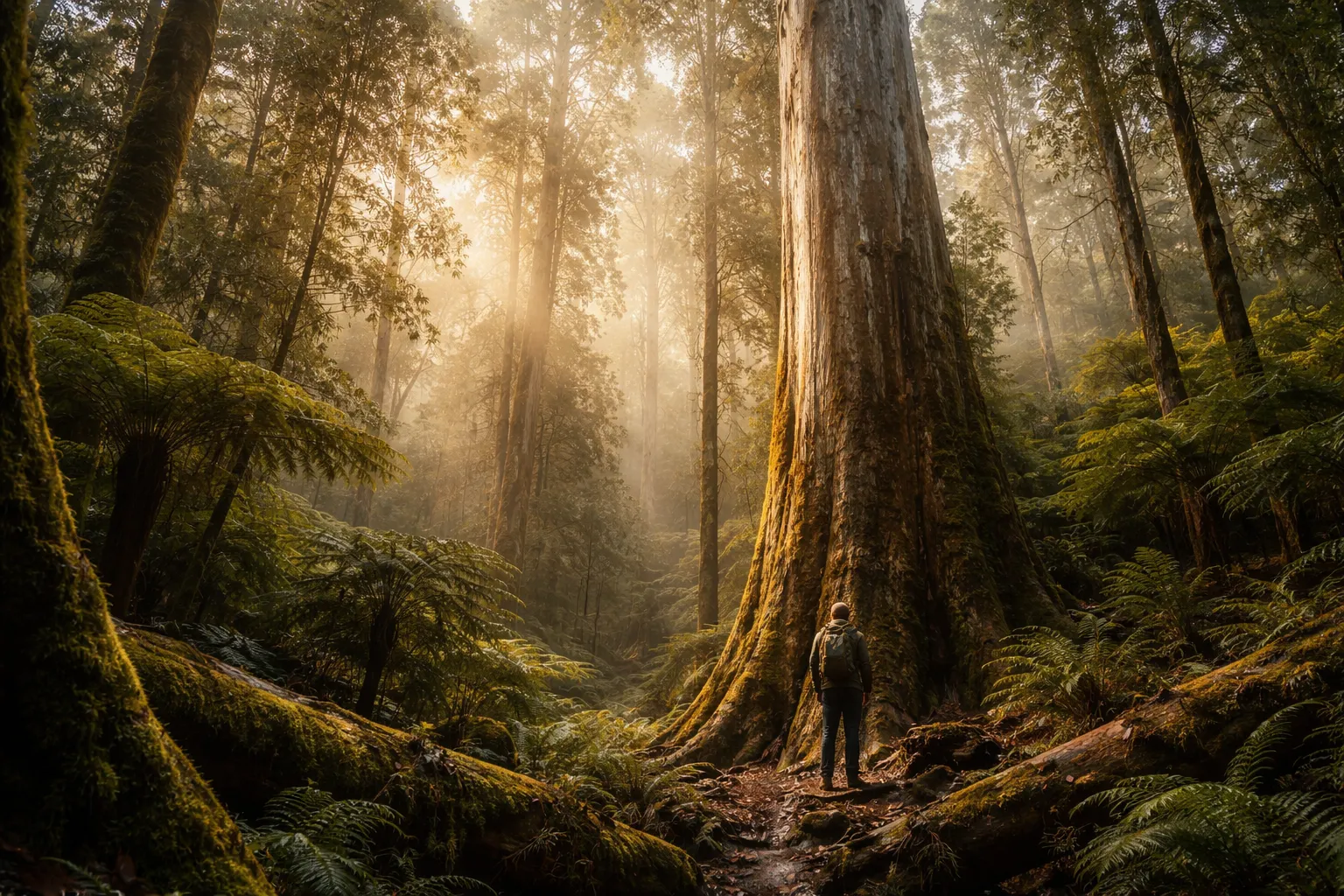
The first time the scale truly hit me, I was craning my neck so far back that my hat fell off. I was standing at the base of a mountain ash in the Yarra Ranges, roughly an hour east of Melbourne, and the tree I was looking at was so tall that its canopy dissolved into a green haze somewhere above 80 metres. It looked less like a tree and more like a biological skyscraper — something that had no business being made of wood and bark. The strangest part? This wasn’t even one of the record-holders. The oldest eucalyptus trees in Australia make this specimen look like a sapling. The tallest known individual, a mountain ash named Centurion growing in Tasmania’s Arve Valley, stands at 100.5 metres — taller than the Statue of Liberty with its pedestal, taller than Big Ben, taller than any flowering plant that has ever been precisely measured anywhere on Earth. And most travellers fly straight past it on the way to Hobart.
This post contains affiliate links. As an Amazon Associate, I earn from qualifying purchases at no extra cost to you.
What Is the Tallest Flowering Plant on Earth, and How Old Do Eucalyptus Trees Get?
The tallest flowering plant species on Earth is Eucalyptus regnans, commonly called mountain ash — and the tallest confirmed living specimen is Centurion, measured at exactly 100.5 metres (330 feet) in Tasmania’s Arve Valley. That measurement was taken using LiDAR (light detection and ranging) aerial survey technology in 2008 and confirmed by ground-based laser measurement. Centurion is not an estimate or a legend. It is a precisely documented tree, with GPS coordinates, a name, and its own ongoing monitoring program.
For historical context that will genuinely make your head spin: in 1872, a felled mountain ash in Victoria called the Ferguson Tree was recorded at 132.6 metres (435 feet) by government surveyor William Ferguson. If accurate, that measurement would place it above the current world record holder, a coast redwood named Hyperion at 115.9 metres (380 feet), making the Ferguson Tree the tallest tree ever documented by any species. The measurement is disputed — no independent verification exists, and the tree was already cut down by the time anyone thought to double-check — but the historical record is real, and the implication is staggering.
So how old do eucalyptus trees actually get? The honest answer depends on species. Eucalyptus regnans, the mountain ash, typically lives 400 to 500 years under ideal conditions, though most specimens that might have reached that age were logged during the 19th and 20th centuries. Across the broader genus, most eucalyptus species live 200 to 400 years. Snow gums (E. pauciflora) growing at high altitude in the Australian Alps are estimated at 400-plus years for some individuals, their trunks twisted into extraordinary sculptural forms by decades of alpine wind and ice. There are more than 900 eucalyptus species, and approximately 893 of them are found nowhere outside Australia — this is, in botanical terms, one of the most dominant and successful tree genera on the planet.
Scientists determine the age of eucalyptus trees through a combination of methods: dendrochronology (counting growth rings in cross-sections of felled specimens), radiocarbon dating of heartwood, and statistical modelling based on known growth rates for a given species and altitude. Living specimens cannot be cored without risk of disease, so age estimates for standing old-growth trees often carry meaningful uncertainty ranges. A mountain ash that looks ancient may be a 200-year-old post-fire regeneration. A gnarly, knee-high snow gum on an exposed ridge might be older than the American Revolution.
The Science of Why Eucalyptus Trees Are Built to Burn
Here is the fact about eucalyptus that changes how you see every forest walk in Australia: these trees did not simply survive fire. They evolved to cause it, depend on it, and weaponise it against every other plant trying to share their territory. This is not hyperbole. Eucalyptus leaves are saturated with volatile oils — the same compounds that give the genus its characteristic sharp scent — and those oils are highly flammable. When a eucalyptus forest burns, it often burns hotter and faster than almost any other temperate forest on Earth, and that intensity is, in evolutionary terms, precisely the point.
The eucalyptus fire adaptation strategy has been approximately 60 million years in the making, shaped during the drying of the Australian continent as it drifted north after Gondwana’s break-up. As Australia grew hotter and drier, eucalyptus didn’t just tolerate fire cycles �� it built a survival toolkit around them. Three mechanisms are worth understanding before you walk into any Australian bush:
- Epicormic regeneration: Dormant buds sit protected beneath the bark of trunks and branches. Within weeks of a fire that strips every leaf and kills nearly every competitor, a eucalyptus begins pushing out new growth directly from its bark — vivid green shoots against charred black wood. It looks like a miracle. It is engineering.
- Lignotubers: Many eucalyptus species store starch and dormant buds in a woody swelling at or below ground level. Even if the entire above-ground tree is killed, the lignotuber can regenerate a new stem from scratch.
- Serotinous capsules: Woody seed capsules remain sealed on branches for months or years, releasing seeds in large quantities in response to the heat and light signals following a fire — when competitors are gone, nutrients are released from ash, and canopy gaps let in sunlight.
The ecological consequence is a forest that essentially resets on a cycle, clearing the competition and giving eucalyptus seedlings a scorched but fertile starting line that other species cannot match. The conservation consequence is grimmer: old-growth mountain ash — the ancient specimens that represent the true age ceiling of the species — cannot regenerate after severe fire the way younger trees can. A 400-year-old mountain ash killed by an intense crown fire is gone for four centuries. Victoria’s 2009 Black Saturday fires destroyed an estimated 25 percent of the remaining old-growth mountain ash in the Central Highlands. Tasmania’s Centurion survived a 2019 fire by a margin of roughly 100 metres.
Eucalyptus regnans is currently listed as a species of conservation concern in parts of its range, and the old-growth stands that remain are, in geological terms, irreplaceable within any human lifetime.
Where to See Giant Eucalyptus Trees: The Best Destinations in Victoria and Tasmania
The good news for travellers is that some of the most extraordinary ancient eucalyptus trees in Australia are genuinely accessible, and a dedicated long weekend from Melbourne can get you into multiple old-growth environments without a single night in a tent if that’s not your style.
Yarra Ranges National Park, Victoria
This is your most practical first stop. Yarra Ranges sits approximately 75 kilometres east of Melbourne’s CBD, and the Rainforest Gallery boardwalk near Marysville places you inside a dense stand of old-growth mountain ash within a 400-metre flat walk. The trees here are not the tallest survivors, but they are tall enough to be disorienting — 70 to 80 metre trunks rising from a cool-temperate rainforest understory of tree ferns. Go on a weekday in autumn (March to May) for atmospheric mist and dramatically reduced crowds. The Rainforest Gallery is wheelchair accessible. Cathedral Range State Park nearby offers more challenging hikes with excellent mountain ash canopy overhead.
Great Otway National Park and the Otway Fly Treetop Walk, Victoria
The Otway Fly, located approximately 180 kilometres southwest of Melbourne near the town of Beech Forest, is a 600-metre elevated steel walkway that peaks at 25 metres above the forest floor — high enough to move through the lower canopy of the surrounding mountain ash and Otway messmate forest. Entry costs AUD $29 for adults (2024 pricing; verify before visiting). It’s one of the best places in Victoria to understand the vertical scale of these forests without needing strong legs or hiking boots. Great Otway National Park itself contains accessible old-growth pockets along the Otway Ranges Great Walk, a multi-day route for those who want full immersion.
Styx Valley and Arve Valley, Tasmania
This is where to see giant eucalyptus trees at their most extreme. The Styx Valley, sometimes called the “Valley of the Giants,” contains mountain ash individuals exceeding 80 metres, with a short walking loop near the Big Tree Reserve that places you next to named specimens. The Arve Valley, roughly 60 kilometres southwest of Hobart via the Huon Valley, is home to Centurion itself — though access requires some advance research, as the tree sits off a forestry road and visiting conditions vary seasonally. The Tahune AirWalk, located in the same region, offers a suspended walkway experience above a swingbridge over the Huon River with mountain ash and swamp gum canopy visible from the platform. Fly into Hobart, hire a car, and allow at least two days to properly explore the Huon Valley corridor. Spring (September to November) and autumn are both excellent; summer (December to February) is peak tourism season and roads can be busy.
Bonus Stop: Rainbow Eucalyptus in Maui, Hawaii
If your Australia trip connects through Hawaii, or if you simply want to check off the most visually striking member of the genus: Eucalyptus deglupta, the rainbow eucalyptus, is the only eucalyptus species native outside Australia (it originates from the Philippines and Indonesia), and a remarkable planted grove lines the Road to Hana on Maui’s north coast, near the Ke’anae Peninsula. The bark peels in patches to reveal vivid greens, blues, purples, and orange beneath — it looks digitally edited in photographs and genuinely surreal in person. It is not ancient here, but it is extraordinary.
The One Thing Worth Packing for an Australian Forest Walk
I’ll be honest with you: you don’t need much specialist gear to walk in an Australian forest. Good boots, layered clothing, and a rain shell will handle 90 percent of conditions in the Otways or the Yarra Ranges. But there is one small item I started bringing on forest walks several years ago that has genuinely enhanced the experience, and it costs less than a park entry fee.
Eucalyptus essential oil. Not as a wellness trend or a vague aromatherapy gesture — but as a direct sensory connection to the chemistry that makes these forests what they are. The volatile oils you smell when you walk into a eucalyptus forest are primarily 1,8-cineole, also called eucalyptol, and inhaling a diluted amount of a quality oil before and after a forest walk creates a kind of olfactory bookmark for the experience. The scent recall is remarkably strong, months later.
The oil I use and recommend is Plant Therapy Organic Eucalyptus Globulus Essential Oil — 100% pure, USDA Certified Organic, undiluted and therapeutic grade, available in a 10 mL bottle. Eucalyptus globulus is one of the most chemically true-to-forest species in the genus, and Plant Therapy’s third-party GC/MS testing (gas chromatography/mass spectrometry) means you’re getting verifiable purity, not a diluted fragrance oil. I add two drops to a small personal inhaler or mix with a carrier oil for a travel-sized balm.
The honest limitation: essential oil is not a substitute for being in the forest, and if you’re prone to respiratory sensitivity, eucalyptus oil can be an irritant in high concentrations. Always dilute, always patch test, and don’t use undiluted oil directly on skin. For most people, a single 10 mL bottle will last an entire trip and continue working as a travel memory trigger for years afterward.
Planning Your Visit to Australia’s Ancient Eucalyptus Forests — What Most Guides Won’t Tell You
The biggest mistake travellers make with Australian forest destinations is treating them as half-day tick-boxes between coastal drives. The Yarra Ranges and the Otways are beautiful but genuinely large — Great Otway National Park alone covers 103,000 hectares — and the best old-growth stands require some intentional navigation beyond the most-photographed carparks.
A few things most itineraries skip entirely:
- Mobile coverage is patchy to non-existent in the Otway Ranges and most of Tasmania’s south-west forests. Download offline maps (Maps.me or Gaia GPS work well) before you leave town, and carry a physical backup of any trail routes you’re using.
- Mountain ash old-growth is not the same as plantation or regrowth. Victoria’s Central Highlands contains vast areas of 70-to-100-year-old regrowth eucalyptus — impressive in its own right but not the same ecological or visual experience as true old-growth with its multi-species understorey and 400-year canopy. Do your homework on which specific trail sections access genuine old-growth before you drive three hours.
- Fire closures are real and unpredictable. Both Yarra Ranges and Great Otway National Park implement Total Fire Ban closures during high fire danger days (typically November through April), and sections of forest can remain closed for months post-fire. Check Parks Victoria’s website the day before any planned visit: parks.vic.gov.au. Tasmania’s national park closures are managed by Tasmania Parks and Wildlife Service.
- Combine the Otways with the Great Ocean Road, but go east-to-west (Melbourne toward Warrnambool) rather than the default tourist direction — you’ll face the dramatic cliff views from the best angle and hit popular stops before tour buses.
For broader planning around Victoria and Tasmania, the Australia content on this site is worth reading before you book: see our posts on exploring Victoria’s most underrated landscapes, a first-timer’s guide to Tasmania, the best road trips from Melbourne, and Australia packing and preparation tips for the full picture.
In terms of physical demands: the Rainforest Gallery in Yarra Ranges and the Otway Fly are genuinely accessible for most fitness levels, including families with young children. The Styx Valley walks in Tasmania involve easy to moderate terrain on maintained tracks. Reaching Centurion itself requires more research and may involve unsealed forest roads — check current access conditions with the Huon Valley tourism office before making it a central part of your itinerary.
Why Standing Next to an Ancient Tree Actually Changes Something
The oldest eucalyptus trees in Australia were alive before European contact with the continent. A 400-year-old mountain ash in the Styx Valley germinated around 1625 — when Galileo was still publishing, when the Thirty Years’ War had not yet begun, when nobody in Europe had any idea that this forest, or this tree, or this particular geometry of bark and oil and evolutionary fire-logic existed on the far side of a planet they were only beginning to understand. That tree has survived fire, storm, logging operations that took everything around it, and two centuries of a changed climate. It is still growing.
There is a specific kind of perspective recalibration that happens when you stand at the base of something that enormous and that old. It doesn’t require any particular spiritual inclination. It just requires standing there long enough to actually absorb the scale — which takes longer than most people allow before they reach for their phone.
If you want to carry a small piece of that chemistry home with you — or anchor the sensory memory of a forest walk that you’ll want to revisit for years — the Plant Therapy Organic Eucalyptus Globulus Essential Oil is the most honest way I know to do it without pretending a small bottle is a substitute for the real thing. It isn’t. But it is a remarkable prompt. Go find the oldest eucalyptus trees in Australia. The trees are waiting, and they are extraordinarily patient.