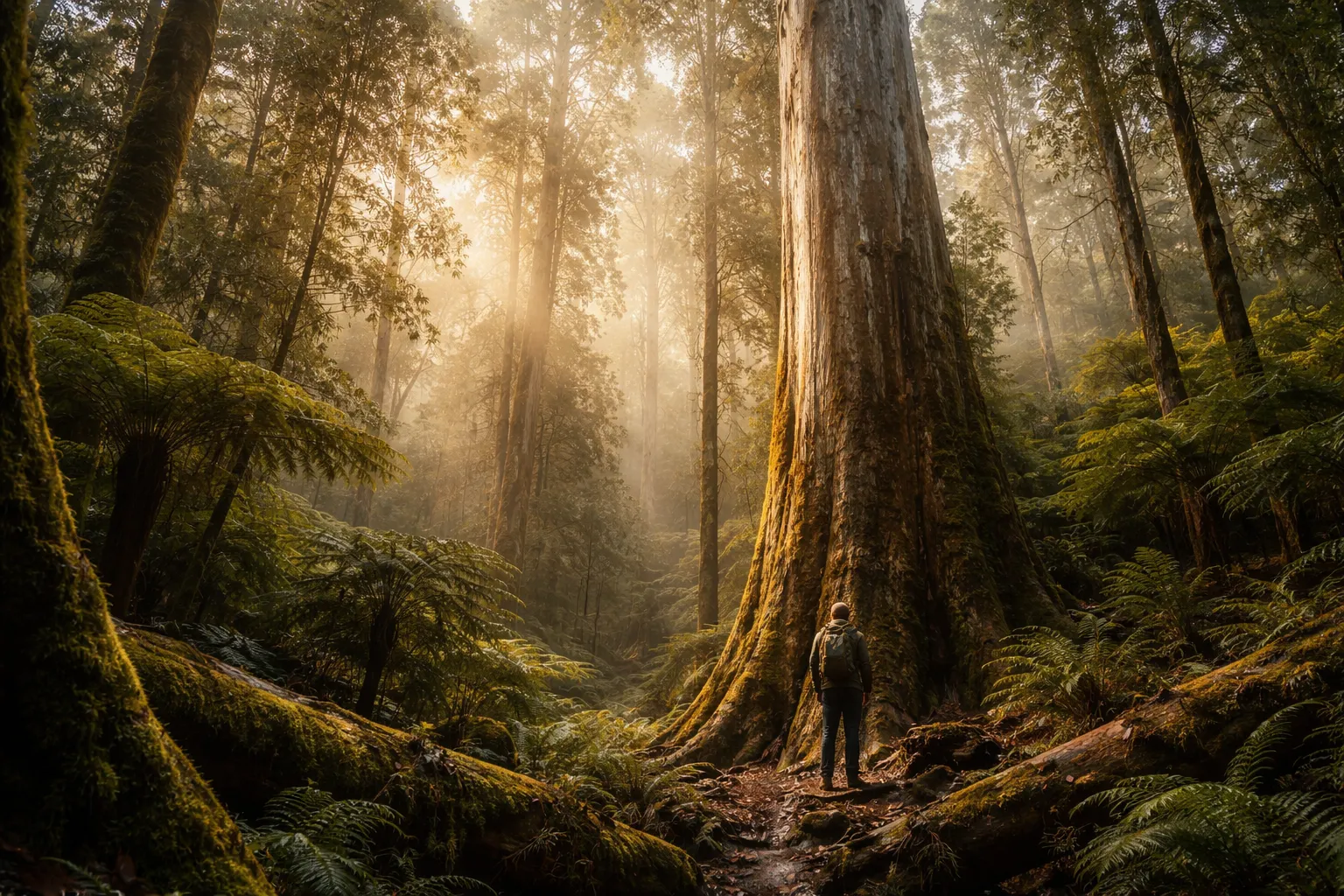
My hat’s already on the ground behind me because I tilted my head back too far, and even now I can’t locate where this mountain ash actually ends. I’m standing at the base of one in the Yarra Ranges, about an hour east of Melbourne, and the canopy simply dissolves into a green blur somewhere north of 80 metres up. It doesn’t read as a tree so much as a piece of vertical infrastructure — wood and bark pretending to be architecture. And here’s the part that rearranges your sense of scale entirely: this specimen isn’t even close to the record. Australia’s oldest eucalyptus trees make this one look juvenile by comparison. The current title-holder, a mountain ash in Tasmania’s Arve Valley named Centurion, tops out at 100.5 metres — taller than the Statue of Liberty plus its pedestal, taller than Big Ben, taller than any flowering plant ever measured with precision anywhere on the planet. Most people driving toward Hobart never even glance in its direction.
What Is the Tallest Flowering Plant on Earth, and How Old Do Eucalyptus Trees Get?
The title of tallest flowering plant on Earth belongs to Eucalyptus regnans, known plainly as mountain ash, and the record-holding living tree is Centurion — logged at precisely 100.5 metres (330 feet) in Tasmania’s Arve Valley. That figure came from LiDAR aerial survey work in 2008, later cross-checked with ground-based laser measurement. Nothing about Centurion is folklore or approximation. It has GPS coordinates, a name, a documented history, and an active monitoring program tracking it year to year.
Now for a piece of history that reorders everything: back in 1872, government surveyor William Ferguson recorded a felled Victorian mountain ash — later called the Ferguson Tree — at a staggering 132.6 metres (435 feet). Take that number at face value and it would eclipse today’s tallest tree of any species anywhere, the coast redwood Hyperion, which stands at 115.9 metres (380 feet). That would make the Ferguson Tree the tallest tree ever documented, full stop, of any kind, anywhere. The catch is that nobody verified it independently, and the tree was already timber by the time anyone considered checking the math. Disputed or not, the paper trail exists, and the implication is enough to make you sit down.
As for lifespan — it depends entirely on which eucalyptus you’re asking about. Mountain ash, given the right conditions, can push 400 to 500 years, though the specimens that might have gotten there were largely felled during the logging booms of the 1800s and 1900s. Across the genus more broadly, 200 to 400 years is closer to typical. Snow gums (E. pauciflora), scattered high through the Australian Alps, are believed to reach 400-plus years in some cases, their trunks warped into strange sculptural shapes by decades of wind and ice at altitude. There are over 900 eucalyptus species in total, and roughly 893 exist nowhere else on Earth but Australia — botanically, this is about as dominant as a tree genus gets.
Researchers piece together eucalyptus age through a few overlapping methods: counting rings in cross-sections of already-felled trunks (dendrochronology), radiocarbon dating the heartwood, and running statistical models based on typical growth rates for a species at a given elevation. Standing trees can’t safely be cored — it opens them up to disease — so age estimates for living old-growth specimens usually come with real uncertainty attached. A mountain ash that looks impossibly old might just be 200 years of vigorous post-fire regrowth. Meanwhile a stunted, twisted snow gum clinging to an exposed ridge could easily predate the American Revolution.
Why Eucalyptus Trees Are Essentially Built to Burn
Here’s the detail that changes how you look at every Australian forest trail afterward: eucalyptus trees didn’t merely learn to survive fire. They evolved to trigger it, rely on it, and turn it into a weapon against any plant competing for their ground. That’s not exaggeration for effect. Eucalyptus leaves are packed with volatile oils — the same compounds behind that unmistakable sharp scent — and those oils burn easily and hot. A eucalyptus forest on fire tends to burn faster and more intensely than almost any other temperate forest system on the planet, and evolutionarily speaking, that intensity is exactly the point of the whole design.
This fire strategy took roughly 60 million years to develop, forged as the Australian continent dried out while drifting north following the break-up of Gondwana. As the land got hotter and drier, eucalyptus didn’t just cope with recurring fire — it built its entire survival plan on top of it. There are three specific mechanisms worth knowing before you set foot in any Australian bushland:
- Epicormic regeneration: Buds sit dormant, tucked safely beneath the bark along trunks and branches. Within weeks of a fire severe enough to strip every leaf and kill off nearly all the competition, the eucalyptus starts sprouting fresh green growth directly out of scorched bark. It reads as a small miracle. It’s really just engineering.
- Lignotubers: A number of eucalyptus species keep a reserve of starch and dormant buds inside a woody swelling right at or beneath ground level. Even when the entire visible tree is killed off, that lignotuber can throw up a brand-new stem from nothing.
- Serotinous capsules: Hard seed capsules stay clamped shut on the branches for months or even years, then burst open in response to the heat and light that follow a fire — right when the competition has been cleared, nutrients are pouring out of the ash, and canopy gaps are letting sunlight flood in.
Ecologically, this amounts to a forest that hits reset on a recurring schedule, wiping out rivals and handing eucalyptus seedlings a burnt but nutrient-rich head start nothing else can match. The conservation angle is far bleaker: genuine old-growth mountain ash — the specimens actually old enough to represent the species’ true ceiling — can’t bounce back from a severe fire the way younger trees can. Kill a 400-year-old mountain ash with an intense crown fire, and it’s gone for the next four centuries, full stop. Victoria’s Black Saturday fires in 2009 wiped out an estimated 25 percent of the remaining old-growth mountain ash across the Central Highlands. Tasmania’s Centurion, for what it’s worth, made it through a 2019 fire with roughly 100 metres of buffer to spare.
Eucalyptus regnans currently carries conservation-concern status across parts of its range, and whatever old-growth remains is, in practical terms, unrecoverable within any human lifetime.
Where to Actually Find These Giant Eucalyptus Trees: Victoria and Tasmania
The reassuring bit is that plenty of Australia’s most jaw-dropping ancient eucalyptus trees are entirely reachable, and a focused long weekend out of Melbourne can drop you into several old-growth landscapes without a single tent night involved, assuming that’s not your idea of a good time.
Yarra Ranges National Park, Victoria
Start here — it’s the most sensible first move. Yarra Ranges sits roughly 75 kilometres east of Melbourne’s city centre, and the Rainforest Gallery boardwalk near Marysville drops you into a thick stand of old-growth mountain ash after only a 400-metre flat stroll. These aren’t the record-setting trees, but they’re tall enough to genuinely mess with your sense of proportion — trunks running 70 to 80 metres, rising out of a cool-temperate rainforest floor thick with tree ferns. Aim for a weekday in autumn (March through May) for atmospheric mist and noticeably thinner crowds. The Rainforest Gallery itself is wheelchair accessible. Cathedral Range State Park, close by, offers tougher trails with plenty of mountain ash canopy overhead for those wanting more of a workout.
Great Otway National Park and the Otway Fly Treetop Walk, Victoria
The Otway Fly sits about 180 kilometres southwest of Melbourne near Beech Forest, offering a 600-metre elevated steel walkway that climbs to 25 metres above the forest floor — enough height to put you inside the lower canopy of the surrounding mountain ash and Otway messmate forest. Entry runs AUD $29 for adults (2024 pricing — double-check before you go). It’s genuinely one of the easiest ways in Victoria to grasp the vertical scale of these forests without needing hiking boots or particularly strong legs. Great Otway National Park itself has accessible old-growth sections along the Otway Ranges Great Walk, a multi-day route for anyone wanting to go all in.
Styx Valley and Arve Valley, Tasmania
This is where the scale becomes almost absurd. The Styx Valley — nicknamed the “Valley of the Giants” — holds mountain ash specimens exceeding 80 metres, and a short loop trail near the Big Tree Reserve puts you right beside named individuals. The Arve Valley, about 60 kilometres southwest of Hobart via the Huon Valley, is where Centurion itself lives — though getting there takes a bit of homework first, since the tree sits off a forestry road and access shifts with the seasons. The Tahune AirWalk, in the same region, gives you a suspended walkway plus a swingbridge crossing over the Huon River, with mountain ash and swamp gum canopy visible right from the platform. Fly into Hobart, rent a car, and set aside a minimum of two days to properly cover the Huon Valley corridor. Spring (September to November) and autumn both work well; summer (December to February) is peak season, and the roads show it.
Extra Stop: Rainbow Eucalyptus on Maui, Hawaii
If your route to Australia routes you through Hawaii, or you just want to tick off the most photogenic member of this entire genus: Eucalyptus deglupta, the rainbow eucalyptus, is the sole eucalyptus species that’s actually native outside Australia (it hails from the Philippines and Indonesia), and a striking planted grove runs along the Road to Hana on Maui’s north coast, near the Ke’anae Peninsula. The bark sheds in irregular patches to reveal streaks of vivid green, blue, purple, and orange underneath — it looks Photoshopped in pictures and honestly a little unreal in person. There’s nothing ancient about this grove, but it’s remarkable all the same.
The Eucalyptus Oil That Rescued My Sinuses in the Yarra Ranges
Craning your neck for hours in a damp forest thick with eucalyptus pollen and mist is basically a formula for congestion that trails you all the way back to your hotel bed. I found this out the hard way after my first full day in the Yarra Ranges, when my sinuses essentially staged a mutiny.
What actually helps
- A handful of drops stirred into hot water clears your sinuses within minutes — this isn’t wishful thinking, it’s a genuine payoff after a day spent breathing forest air.
- Because you’re standing next to the real trees all day, the scent feels authentic rather than manufactured, which somehow makes the whole thing feel more credible than a bottle bought off a shelf back home.
- A tiny bottle barely dents your luggage allowance and outlasts several trips, which makes it a genuinely economical thing to pack if you travel often.
What doesn’t hold up
- The scent is potent enough that one careless drop in a hotel room turns the whole space into what feels like a eucalyptus plant explosion — expect the smell to linger for hours.
- If you’re skeptical about essential oils to begin with, the placebo-versus-genuine-effect question will keep nagging at you, and you’ll likely spend the trip second-guessing whether it’s doing anything at all.
I almost left it behind in Melbourne on the second day, convinced I was overcomplicating a simple head cold — but by night two of the forest hikes, I was genuinely grateful I’d brought it. Plant Therapy Organic Eucalyptus Globulus Essential Oil became my nightly ritual.
Frequently Asked Questions
How tall is Centurion, the world’s tallest flowering plant?
Centurion, a mountain ash in Tasmania’s Arve Valley, tops out at 100.5 meters (330 feet), making it the tallest flowering plant ever measured with precision on Earth. The height was logged via LiDAR aerial survey work in 2008 and later cross-checked with ground-based laser measurement.
Where can I see old-growth mountain ash near Melbourne?
Yarra Ranges National Park sits roughly 75 kilometers east of Melbourne’s city center. The Rainforest Gallery boardwalk near Marysville offers a 400-metre flat stroll through old-growth mountain ash with trunks running 70 to 80 meters tall. The boardwalk is wheelchair accessible.
What is the Otway Fly and how much does it cost?
The Otway Fly is a 600-metre elevated steel walkway located about 180 kilometers southwest of Melbourne near Beech Forest that climbs to 25 meters above the forest floor, putting you inside the lower canopy of mountain ash and Otway messmate forest. Entry runs AUD $29 for adults (2024 pricing).
How long can mountain ash trees live?
Mountain ash, given the right conditions, can push 400 to 500 years, though most specimens that might have reached that age were felled during the logging booms of the 1800s and 1900s. Age estimates for living old-growth specimens usually come with real uncertainty attached.
About This Article

Written by Elena Vasquez. Elena Vasquez is a full-time traveler and the founder of Witty Passport. Over fifteen years and more than 50 countries across six continents — including a stretch spent leading groups professionally through Southeast Asia and the remote highlands of South America — she's written the kind of destination guides she always wished existed: practical, specific, and built on real experience rather than recycled itineraries. More about this site.
Scope and limits. Elena is a full-time traveler, not a licensed travel agent or immigration adviser. Entry requirements, visa rules, and advisories change without notice — always confirm against the official government source for your destination and passport before booking.
Verify this against a primary source
Specifics change, and your situation may differ from the one described here. These are the authorities worth checking directly:
- U.S. Department of State — entry requirements and travel advisories
- CDC Travelers' Health — vaccination and health notices by destination
- TSA — current carry-on and screening rules