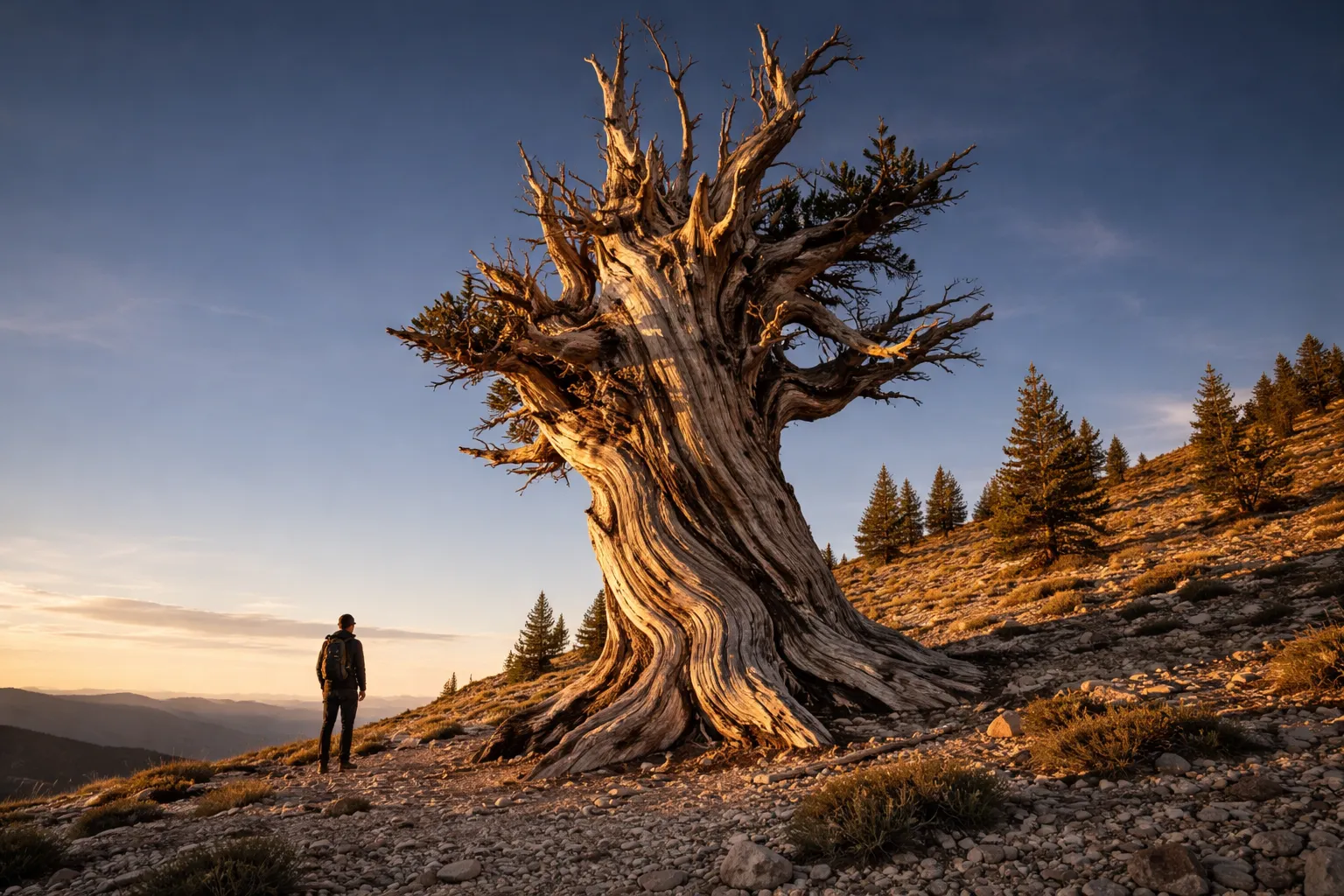
Thin air, a sun with zero interference from clouds, my chest working overtime somewhere near 10,200 feet — and directly in front of me, a tree that had already logged a thousand years on this earth before anyone in Egypt stacked the first pyramid stone. Not petrified. Not a replica somebody planted for the tourists. An actual living organism, still cycling resin, still holding on in these White Mountain gusts since somewhere around 2832 BCE. The bark corkscrews in these strange, deliberate-looking curls, wrung into shape by thousands of years of altitude and wind until it looks almost designed rather than grown. A single ribbon of live tissue, no wider than my palm, is all that’s keeping the whole ancient structure running. I put my hand out, then pulled it back before I made contact — it felt like an intrusion somehow. This is the bristlecone pine, the oldest tree on the planet — and if seeing one has never crossed your mind as something worth planning a trip around, that’s about to change.
How Old Is the Oldest Tree on Earth? Here’s the Definitive Answer
The title of oldest known living non-clonal tree belongs to Methuselah, a Great Basin bristlecone pine (Pinus longaeva) rooted in the White Mountains of Inyo County, California, clocking in at roughly 4,856 years as of 2024. Do the math and it sprouted near 2832 BCE — ahead of Stonehenge’s completion, ahead of the earliest Egyptian pyramid, ahead of the wheel becoming standard equipment across Mesopotamia. Put plainly: it beats the Great Pyramid of Giza by about 800 years.
People ask me “what’s the oldest tree in the world,” and usually they’re mixing up a couple of separate categories, so here’s the breakdown. Methuselah is the record-holder among confirmed living non-clonal individuals — a single trunk, a single tree. A clonal organism operates by different rules entirely: Pando, the quaking aspen colony in Utah, is estimated at 80,000 years old as a genetic entity, but that’s a shared root network supporting countless stems, not one continuous trunk. Methuselah is singular. One root system, one uninterrupted thread of cellular life running back nearly five thousand years.
And here’s the twist most people miss: Methuselah has already been dethroned, quietly. Back in 2012, researchers cored another Great Basin bristlecone pine in that same White Mountains stretch and got a reading of 5,069 years — meaning it took root close to 3050 BCE, around the same era as the earliest Sumerian writing. The Forest Service won’t say which tree it is or where. Nobody official will. Both the identity and the coordinates stay under wraps.
Dendrochronology — reading tree rings — is how any of these ages get confirmed. Every ring marks a year of growth. In bristlecones, those rings compress down to widths you practically need a microscope to separate. Researchers use an increment borer, a slender hollow drill, to pull a pencil-width core from the trunk that leaves the tree unharmed. Then they count, cross-check against known ring chronologies, and land on an age precise to the exact year. Not a ballpark. Not a rough window. One year, confirmed.
Some context for scale: Methuselah had already hit 500 years old while Europe’s Bronze Age was still getting started. By the time it turned 2,000, Julius Caesar hadn’t been born yet. It has sat through the rise and fall of every empire, every writing system, every religion that existed the day its first needle broke through the dirt.
The Biology That Lets Bristlecone Pines Cheat Death for Millennia
Plants that live this long usually aren’t thriving in any conventional sense — they’re just extremely good at not dying. Bristlecone pines have taken brutal, resource-poor, high-altitude conditions and flipped them into a survival advantage. Their biology is a lesson in doing the absolute minimum, and doing it perfectly.
The pace of growth is almost absurd. A Great Basin bristlecone thickens its trunk by roughly one inch of diameter every hundred years. One inch, one century. So a trunk measuring 12 inches across has spent 1,200 years getting there. That crawling growth rate produces wood that’s incredibly dense and heavily loaded with resin — nearly impossible for the fungi, bacteria, and insects that usually break down dead wood within a few decades to touch. Bristlecone logs that died 7,000 years ago have been found sitting exposed on the ground, still intact enough to count rings on. The wood essentially refuses to decompose on any human timescale.
These trees hold on above 10,000 feet in the White Mountains, where the growing season runs a mere 45 days a year. The ground beneath them is dolomite — alkaline, rocky, and stingy with nutrients. Almost nothing else can be bothered to grow there. That’s exactly the point. Fewer neighbors means fewer diseases, fewer insects, fewer of the biological pressures that wear trees down at lower elevations. The environment’s hostility functions as a kind of armor.
Maybe the strangest part: bristlecones can keep functioning on just a thin strip of living bark, sometimes only a few inches across, linking roots to canopy. As parts of the tree die off with age, the living tissue narrows down to whatever single channel still works. The dead wood sticks around as a kind of scaffolding. The tree spends no energy propping up sections that have already stopped functioning — it’s brutal efficiency, and it’s elegant.
Here’s a fact worth sitting with: bristlecone ring records stretch back so far and are calibrated so precisely that scientists rely on them to correct radiocarbon dating itself. Every time a physicist dates an artifact using carbon-14, that number’s accuracy leans on a correction curve built largely from bristlecone pine rings. These trees aren’t just ancient — they’re the measuring stick we use to figure out the age of everything else.
Then there’s the Prometheus story. Back in 1964, a grad student working in Wheeler Peak, Nevada — a nearby bristlecone stand — got his coring tool stuck in a trunk and simply cut the tree down to retrieve it. He had no idea what he was dealing with. Once the rings were tallied, the tree turned out to be 4,862 years old. It’s still counted as one of the costliest blunders in the history of dendrochronology, and the field hasn’t fully let it go, even decades later.
Getting to the Ancient Bristlecone Pine Forest
The Ancient Bristlecone Pine Forest lies inside Inyo National Forest, up in the White Mountains of eastern California, on the far side of Owens Valley from the Sierra Nevada. Nobody stumbles onto this place by accident. It takes some deliberate effort to reach — and the mountain more than pays that effort back.
Getting There
Coming off Highway 395, head east at Big Pine, California. Take Highway 168 east for about 13 miles until you hit White Mountain Road, then head north and climb roughly 10 more miles to reach the Schulman Grove Visitor Center. The pavement holds the whole way, but expect a steep, winding climb — large RVs and trailers should skip this one. Budget about 45 minutes of driving uphill from Big Pine. The visitor center itself sits around 10,100 feet, with the trails climbing higher still.
Access generally runs from late May to mid-November, depending on how the snowpack behaves that year. Check road conditions with Inyo National Forest before making the drive — this road shuts down fast once weather turns, with little warning.
Trail Options at Schulman Grove
Schulman Grove takes its name from Edmund Schulman, the University of Arizona researcher who pinned down Methuselah’s age in 1957, just two years before he passed away. It’s the main visitor hub and the spot you want to head for. Two trails start from the visitor center:
- Discovery Trail: A 1-mile loop with barely any elevation change, giving you a first look at the forest and a handful of ancient trees with signage explaining what you’re seeing. Fine even if altitude tends to hit you hard.
- Methuselah Trail: 4.5 miles round trip, around 800 feet of climbing, winding through the Methuselah Grove where the true elders are clustered — Methuselah included, though you’ll pass it without any clue which trunk it actually is.
That last part is worth dwelling on: the Forest Service intentionally leaves Methuselah unmarked and unnamed on-site. Signage in the grove will tell you that you’re somewhere near the tree, but there’s no coordinate, no photo marker, no numbered stake pointing you to the right one. It’s a vandalism-prevention measure, and given what happened to Prometheus, a fair one. You’ll walk the entire loop, examine every twisted ancient shape, and just wonder. That not-knowing turns out to be part of the appeal — it sits with you in a good way.
Give Yourself Time to Adjust to the Altitude
The mistake I see most often: people drive straight from sea level up to 10,000 feet and hit the Methuselah Trail without pausing. Altitude sickness is a real risk up here — headaches, nausea, dizziness — and it will wreck your day faster than any storm could. Spend at least a night in Bishop (4,150 feet) before you go up. Drink more water than feels necessary. Take it slow. These trees have been standing here for five millennia — they can spare another twenty minutes while you catch your breath.
A Field Guide Small Enough to Actually Carry at 10,000 Feet
When you’re short on breath and staring at something that could be five thousand years old, the last thing you need is a 40-pound coffee-table book or a guide written for people who admire trees from an armchair. What you want is identification help, context, and a bit of history — without adding weight to shoulders that are already complaining.
What holds up
- Genuinely pocket- or daypack-sized — it rode along the entire hike without me second-guessing bringing it, unlike most tree guides that seem built for a gift shop counter, not a trail.
- The bristlecone photos and write-ups go deep enough that you’re not just squinting at a twisted trunk with no context — you actually grasp why the bark spirals and why so much dead wood is exposed.
- The historical framing genuinely hits different when you’re face-to-face with something older than written civilization — it turns the walk into something memorable instead of just another trail.
Where it falls short
- The binding loosens up fast if you’re opening and closing it repeatedly on the trail, and the paper isn’t waterproof — one surprise downpour and you’ll be nursing a soggy book for the rest of the hike.
- A few of the trail details read as outdated; I ended up checking my phone anyway for current access info, which cuts into the whole point of keeping things light.
Halfway through the hike, I almost left it behind at a rest stop because I figured my phone could handle everything—and I would have regretted it the moment I was standing in front of an ancient tree with no signal and no way to verify what I was seeing. A Day in the Ancient Bristlecone Pine Forest
Frequently Asked Questions
How old is Methuselah, the oldest tree on Earth?
Methuselah, a Great Basin bristlecone pine in the White Mountains of Inyo County, California, clocks in at roughly 4,856 years as of 2024. It sprouted near 2832 BCE, beating the Great Pyramid of Giza by about 800 years.
How do scientists determine the exact age of bristlecone pines?
Researchers use dendrochronology—reading tree rings—to confirm age. An increment borer, a slender hollow drill, pulls a pencil-width core from the trunk without harming the tree. Scientists then count rings and cross-check against known chronologies, landing on an age precise to the exact year.
When can you visit the Ancient Bristlecone Pine Forest?
Access generally runs from late May to mid-November, depending on how the snowpack behaves that year. The road shuts down fast once weather turns, with little warning, so check road conditions with Inyo National Forest before making the drive.
Which trail should I take to see Methuselah at Schulman Grove?
The Methuselah Trail is a 4.5 miles round trip with around 800 feet of climbing, winding through the Methuselah Grove where the true elders are clustered. The Forest Service intentionally leaves Methuselah unmarked on-site as a vandalism-prevention measure.
About This Article

Written by Elena Vasquez. Elena Vasquez is a full-time traveler and the founder of Witty Passport. Over fifteen years and more than 50 countries across six continents — including a stretch spent leading groups professionally through Southeast Asia and the remote highlands of South America — she's written the kind of destination guides she always wished existed: practical, specific, and built on real experience rather than recycled itineraries. More about this site.
Scope and limits. Elena is a full-time traveler, not a licensed travel agent or immigration adviser. Entry requirements, visa rules, and advisories change without notice — always confirm against the official government source for your destination and passport before booking.
Verify this against a primary source
Specifics change, and your situation may differ from the one described here. These are the authorities worth checking directly:
- U.S. Department of State — entry requirements and travel advisories
- CDC Travelers' Health — vaccination and health notices by destination
- TSA — current carry-on and screening rules