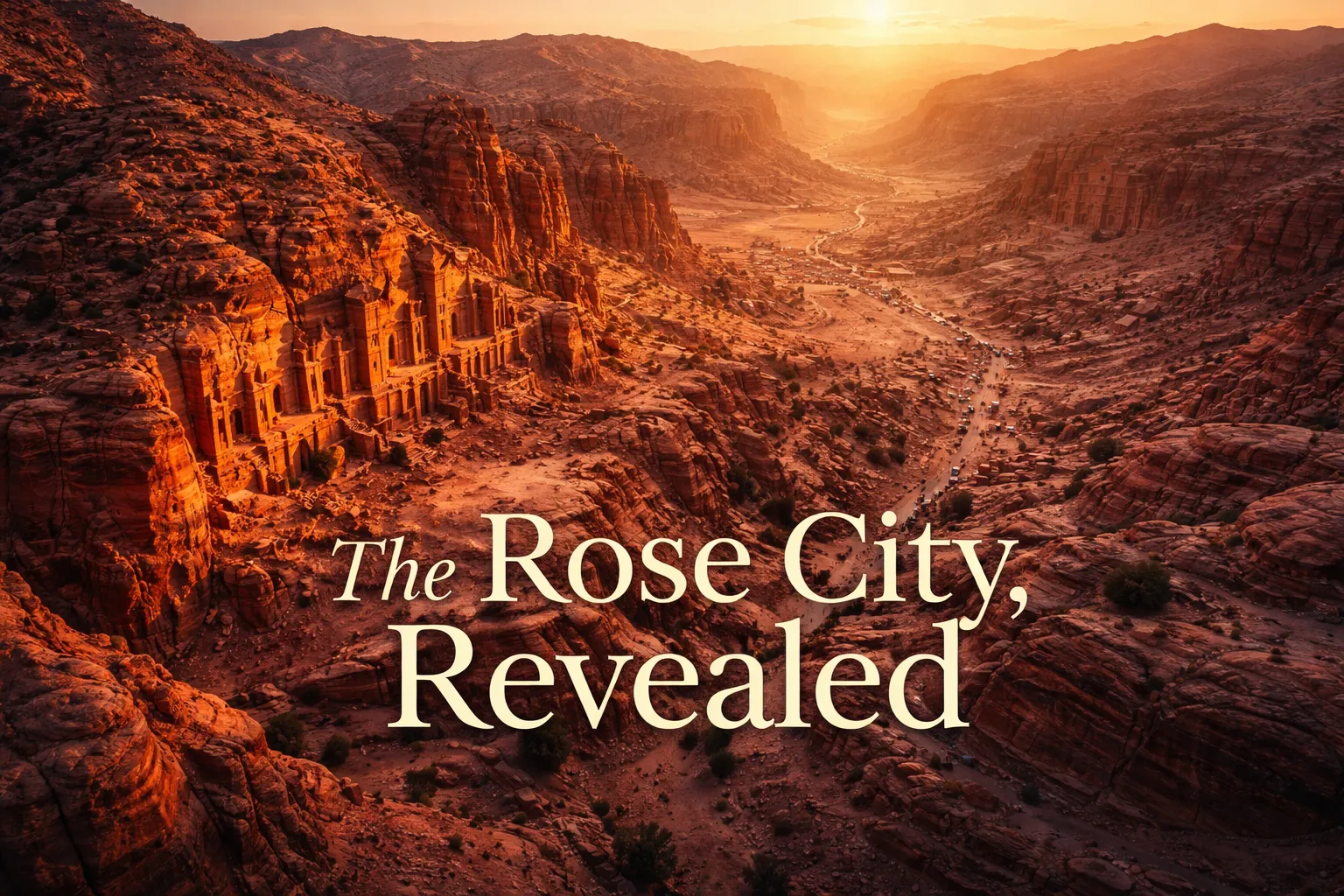
One well-traveled Jordan forum will tell you the only shot worth having at Petra is the ground-level Treasury reveal at the end of the Siq — everything else, including aerial photography, is dismissed as gimmick or afterthought. Another corner of the internet insists drones are pointless here anyway since flying is banned inside the park. The second claim is the one that’s actually misleading, because it conflates “restricted” with “impossible,” and the difference matters enormously once you understand what altitude does to this place. When my aircraft finally cleared the canyon rim and Petra opened up beneath it in bands of rose, amber, and burnt sienna, I understood something that two millennia of visitors arriving on foot never quite grasped: this isn’t a single carved facade tucked into a cliff. It’s an entire city chiseled out of a mountain range. Petra Jordan drone photography doesn’t merely offer a new angle — it rewrites what you think this site actually is. From 200 meters up, the Siq reduces to a hairline fracture in the rock, and the Treasury’s famous carved pediment shrinks to something the size of a postage stamp at its far end. But the carved facades keep going for kilometers in every direction, and only then does the Rose City nickname finally make sense.
Petra Jordan Drone Photography: Flight Brief
| GPS Coordinates (Treasury) | 30.3285° N, 35.4444° E |
| GPS Coordinates (Monastery) | 30.3406° N, 35.4320° E |
| Recommended Altitude Range | 150–300m AGL for landscape context; 80–120m for facade detail |
| Best Time of Day | 6:00–8:30 AM (golden hour, low tourist density) and 4:30–6:00 PM (sunset warmth on rose sandstone) |
| Best Season | March–April and October–November (mild temps, dramatic skies, lower visitor numbers) |
| Drone Regulations | Drones are officially restricted inside the Petra Archaeological Park. A permit from the Jordan Civil Aviation Regulatory Commission (CARC) is required. Commercial operators occasionally receive approval; unauthorized flights risk equipment confiscation and fines. |
| Skill Level Required | Advanced — narrow canyon approaches, unpredictable thermal currents, no-fly proximity to UNESCO site |
| Nearest Airport | King Hussein International Airport (AQJ), Aqaba — approx. 120 km south |
What the View From Above Shows You That the Siq Never Will
Walk to the end of the Siq and look up at the Treasury, and you’re seeing precisely what the Nabataeans engineered you to see — one overwhelming facade built to fill your entire field of vision. As theater, it’s flawless. But the petra aerial view treasury shot tells an entirely different architectural story. Hovering at roughly 250 meters, you can follow the full 1.2-kilometer path of the Siq canyon as it twists before spilling into the Petra basin. The Treasury itself shrinks back into its proper context — one carved facade among dozens lining the canyon walls — and for the first time, the underlying geometric logic of the whole city becomes readable.
Ad Deir, known to most travelers as the Monastery, tends to be the shot that catches aerial photographers off guard. At 47 meters wide and 48 meters tall, it’s physically bigger than the Treasury, yet the 800-step climb required to reach it means the majority of Petra’s visitors never lay eyes on it. Seen from above, the Monastery occupies a high plateau with the Valley of Moses — Wadi Musa — unfolding behind it to the west, a framing that simply doesn’t exist at ground level. Late in the day, western light lands directly on the carved urn finial crowning the facade while the plateau around it sinks into shadow, producing one of the most striking aerial compositions anywhere in the Middle East.
The Royal Tombs — five ornately carved facades strung along the eastern cliff — only click into place architecturally once you’re airborne. On foot, you take each tomb in individually. From 150 meters, the row reveals itself as a single, planned memorial complex, with the Urn Tomb’s courtyard terrace visible as a deliberate civic space carved directly into the rock. The Colonnaded Street, Petra’s principal Roman-era thoroughfare, appears from up here as the clear organizing spine linking the city’s ceremonial center — something a twenty-minute walk along it never quite reveals from the ground.
Then there’s the color itself. The rose-tinted sandstone that gave Petra its nickname behaves in ways only altitude can expose. On the ground, you’re limited to the warm tones of whichever facade happens to be in front of you. At 200 meters, you watch the entire basin’s color temperature shift as the sun travels — deep burgundy while morning shadow still lingers, blazing coral through midday, and a soft mauve at dusk that photographers keep describing as otherworldly. Catch the petra from above rose city shot at the right minute and it stops being just a photograph — you’re documenting a geological event as it happens.
Is Flying a Drone at Petra Actually Legal? The Rules and the Reality
Here’s the part I won’t soften, because far too many travel sites skip past it: drone flying over petra without a permit is illegal, and enforcement isn’t theoretical. The Petra Archaeological Park falls under UNESCO World Heritage status and the jurisdiction of the Petra Development and Tourism Region Authority (PDTRA), and Jordan’s Civil Aviation Regulatory Commission (CARC) has designated it restricted airspace. Rangers patrol the site continuously, and confiscating equipment is the routine consequence for unauthorized launches. I’ve talked to operators who watched their drones get taken this exact way. It’s not worth gambling on.
There is a legitimate permit process, though it’s not something an independent traveler can casually arrange. Commercial film and photo productions can apply through CARC and the Jordan Tourism Board, and the timeline usually runs four to six weeks at minimum, with requirements to show professional credentials, insurance coverage, and a defined shooting plan. For anyone serious about pursuing this, the Jordan Film Commission (film.jo) is the right first call — they’ve arranged sanctioned aerial shoots over Petra for both documentary and commercial productions before. Costs vary widely depending on the scope of the project.
Here’s the honest situation for independent photographers: the striking aerial images of Petra you’ve come across online came either from permitted commercial crews or from photographers flying off the ridgelines just outside the park’s boundary — a legal gray zone that demands careful GPS confirmation of exactly where that boundary sits. The elevated plateau above the Monastery, along with the ridges overlooking Wadi Rum farther south, offer legitimate high vantage points without ever crossing into restricted airspace. Speaking of which — if Wadi Rum is part of your Jordan route, the wadi rum petra drone guide combination deserves real planning, since Wadi Rum’s permit process is noticeably more accessible and its sandstone terrain is just as spectacular from the air.
Compositions Worth Chasing: Altitude and Timing for Each Shot
Straight Down the Siq Toward the Treasury
The signature Petra aerial composition puts the drone directly over the Siq at roughly 220–280 meters, aimed straight down the canyon’s axis toward the Treasury facade. Nailing this shot depends on early light — the window between 7:00 and 8:00 AM in spring and autumn — when the sun sits low enough to throw directional shadow into the Siq while still lighting the upper carved details of the Treasury. The slot canyon’s narrowness gives you a natural leading line that ground photography can only hint at; from directly overhead, it becomes the shot’s dominant element.
Ad Deir Bathed in Sunset Light
Set up at 100–150 meters, positioned slightly northeast of the Monastery facade, during the last 45 minutes before dark. From this altitude, the carved urn finial atop the facade catches the day’s final direct sunlight while the plateau behind it glows in reflected warmth. Frame the winding trail from the valley floor into the lower portion of the shot — it supplies the scale and context that makes the structure’s isolation feel genuinely remote. This is the composition that best conveys how overlooked the Monastery’s grandeur really is.
The Royal Tombs Read as One Complex
From 180–200 meters at a slightly oblique northeast angle, all five Royal Tomb facades fit into a single frame alongside the canyon geography surrounding them. Mid-morning is the ideal window, when direct light hits the east-facing cliff. This is the shot that best demonstrates the urban planning sophistication of the Nabataeans — monuments that appear isolated at ground level reveal themselves as a coherent architectural district once you’re above them.
The Colonnaded Street as the City’s Spine
Positioned at 250–300 meters and looking north along the valley’s main axis, the Colonnaded Street resolves into the organizing infrastructure of an entire city. Shoot around midday, when the stone column stubs throw short shadows and the surviving white marble catches the sharpest contrast against the rose-colored canyon walls. This altitude exposes the full scale of the lower city — markets, temples, civic spaces — that most visitors pass through on foot without ever recognizing as one unified urban plan.
The Gear That Kept My Drone Off Petra’s Canyon Walls
Petra’s canyon generates its own microclimate — sudden gusts capable of slamming an aircraft into sandstone before you’ve even registered what’s happening. I found this out the hard way on my second flight there, and it’s the reason I won’t launch over the Rose City again without protective armor on my drone.
What works
- Barely registers as added weight, so your battery holds up while you’re chasing the light across the canyon during golden hour.
- The carbon fiber genuinely absorbs impact — I saw it deflect a rock strike mid-gust and the drone just kept flying.
- Stays clear of the camera gimbal and propeller guards, so protection doesn’t come at the cost of image quality.
What doesn’t
- Fitting it on-site with sand everywhere is fiddly — practice the installation at home before you ever need it in the field.
- It nudges your drone’s center of gravity just enough that you’ll likely need to recalibrate the IMU before your first flight with it attached.
I almost didn’t bother with it after that second flight scare—figured I’d just be more careful—but three near-misses in the next two days proved me wrong. Carbon Fiber Armored Bumper for DJI NEO 2
Frequently Asked Questions
Do I need a permit to fly a drone at Petra Jordan?
Yes. Petra is designated restricted airspace by Jordan’s Civil Aviation Regulatory Commission (CARC). Drone flying without a permit is illegal, and rangers patrol continuously to enforce this—confiscating equipment is routine consequence for unauthorized launches. A legitimate permit process exists through CARC and the Jordan Tourism Board, requiring professional credentials, insurance, and a defined shooting plan, with timelines typically running four to six weeks.
What altitude should I fly drones at Petra for the best shots?
Recommended altitude ranges are 150–300m AGL for landscape context showing the entire carved city, and 80–120m for detail of individual facades. Specific compositions vary: the Siq shot works best at 220–280 meters, the Monastery at 100–150 meters, and the Royal Tombs at 180–200 meters. Altitude choice depends on whether you’re capturing scale or architectural detail.
When is the best time to photograph Petra by drone?
The best seasons are March–April and October–November for mild temperatures, dramatic skies, and lower visitor numbers. Within those seasons, fly during 6:00–8:30 AM for golden hour with low tourist density, or 4:30–6:00 PM for sunset warmth on the rose sandstone. Specific shots require their own timing windows: the Siq shot needs 7:00–8:00 AM, and the Monastery shot works best in the last 45 minutes before dark.
Is it legal to fly drones outside Petra park boundaries instead?
The ridgelines overlooking Petra just outside the park’s boundary represent a legal gray zone that requires careful GPS confirmation of exactly where the park boundary sits. The elevated plateau above the Monastery and ridges overlooking Wadi Rum farther south offer legitimate high vantage points without crossing into restricted airspace, though verification is essential.
About This Article

Written by Elena Vasquez. Elena Vasquez is a full-time traveler and the founder of Witty Passport. Over fifteen years and more than 50 countries across six continents — including a stretch spent leading groups professionally through Southeast Asia and the remote highlands of South America — she's written the kind of destination guides she always wished existed: practical, specific, and built on real experience rather than recycled itineraries. More about this site.
Scope and limits. Elena is a full-time traveler, not a licensed travel agent or immigration adviser. Entry requirements, visa rules, and advisories change without notice — always confirm against the official government source for your destination and passport before booking.
Verify this against a primary source
Specifics change, and your situation may differ from the one described here. These are the authorities worth checking directly:
- U.S. Department of State — entry requirements and travel advisories
- CDC Travelers' Health — vaccination and health notices by destination
- TSA — current carry-on and screening rules