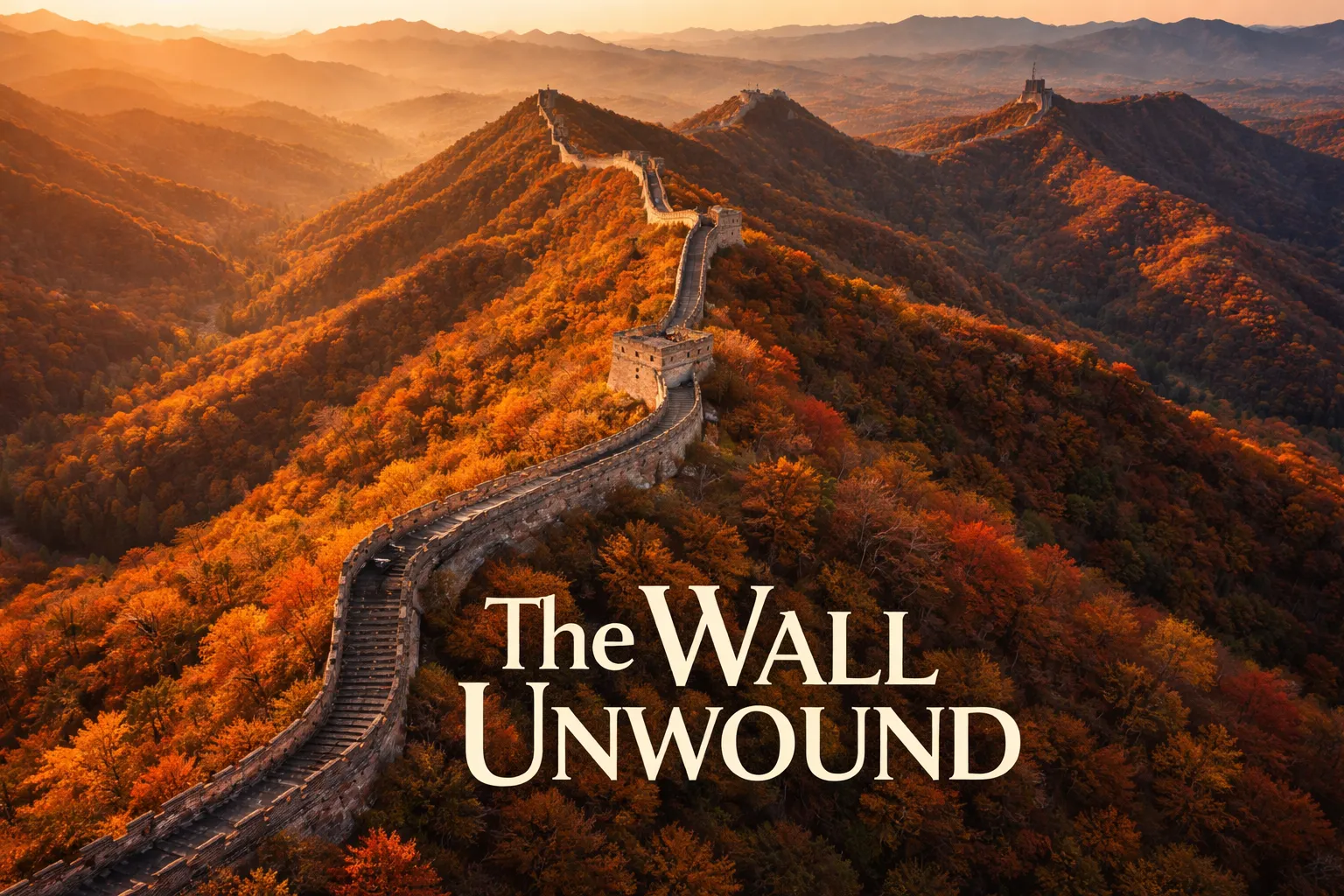
Both thumbs steady on the sticks, I watch the drone climb past the last pine branches above Jinshanling, and suddenly the Great Wall fills the entire frame before I’ve even leveled the gimbal — and I forget to breathe for a second. No photograph I’d studied beforehand, no documentary segment, not even hours spent walking the stones myself, came close to preparing me for what great wall of china drone footage reveals from 150 meters up. The wall isn’t simply crossing the mountains here. It becomes the mountains — following every ridge, dropping into every valley, disappearing toward the horizon in both directions like a stone spine grafted onto the earth by some obsessive giant. Standing on it, you experience one section. Airborne, you finally grasp what 21,196 kilometers is actually trying to tell you.
Great Wall of China Drone Flight Brief
| Best GPS Coordinates (Jinshanling) | 40.6753° N, 117.2437° E |
| Best GPS Coordinates (Jiankou) | 40.4408° N, 116.4537° E |
| Best GPS Coordinates (Simatai) | 40.6546° N, 117.2747° E |
| Recommended Altitude Range | 80–300m depending on composition (see section below) |
| Best Time of Day | Golden hour (6:00–8:00am) and dusk (5:00–7:00pm, season-dependent) |
| Best Season | Mid-October to early November (autumn foliage peak) |
| Drone Regulations Summary | CAAC registration mandatory; Badaling and Mutianyu are strict no-fly zones; Jinshanling and Jiankou require advance permission; always verify current restrictions before flying |
| Skill Level Required | Advanced — mountain thermals, ridge winds, and permit complexity make this unsuitable for beginners |
| Nearest Major Airport | Beijing Capital International (PEK) — 90–120km depending on section |
Why Aerial Shots of the Great Wall Show You Something Ground-Level Never Will
Walking the wall, scale hits your legs first — the punishing climb, the stone underfoot that’s never quite even, watchtowers materializing every few hundred meters. Get airborne, though, and an entirely separate truth appears. Suddenly you can see how the wall actually negotiates with the terrain. Ming Dynasty builders clearly used the mountains’ own ridgelines as their foundation, laying stone along the sharpest, most defensible crests they could find. From 200 meters, those centuries-old tactical calls read like an open map.
Second discovery: the color collision. Grey limestone and granite slice through vegetation that transforms completely with the calendar. October turns the surrounding slopes into a blaze of orange and red, and the wall cutting through it looks almost too vivid to be unedited footage. Come winter, that same wall rises out of snow-blanketed hillsides as stark black-and-white geometry. On foot, you’re swallowed inside that color. From a drone, you get the whole canvas at once.
Third realization — and no ground photo ever quite delivers this one — is just how narrow the wall looks against the wilderness swallowing it. From altitude, it shrinks to a single pencil line drawn across hundreds of kilometers of unbroken mountain forest. The sheer stubbornness behind building it, the obsession it represents, hits differently once you can see how tiny it actually is against the land it was meant to control.
The Sections Worth Flying: Where Great Wall Aerial Shots Actually Deliver
Jinshanling — Where Most Aerial Photographers Start
Roughly 125 kilometers northeast of Beijing, Jinshanling earns its reputation as the go-to section for great wall aerial photography, and for good reason. The wall runs along a dramatic east-west ridge here, dropping steeply on either side, which builds a natural leading line stretching toward the horizon from nearly any elevated angle. It’s been partially restored — enough that the watchtowers still look sharp and photogenic — yet the crowds are a small fraction of what you’d find at Badaling, so your footage stays clean of tourist clutter. Elevation shifts throughout the section give aerial footage real drama as the wall rises and falls with the land beneath it. Flying here means coordinating with local authorities first, and yes, it’s a process, but the results are worth every form you fill out.
Jiankou — Untamed Wall Swallowed by Forest
Jiankou is the section aerial photographers talk about when they’re being honest about what they actually want. About 90 kilometers north of Beijing, this unrestored stretch is slowly losing ground to dense forest — watchtowers lean at angles that shouldn’t hold, whole segments have crumbled into loose rubble, and moss covers most of the exposed stone. From above, Jiankou reads less like a preserved monument and more like a ruin someone just stumbled across. The “Arrow Nock,” where the wall bends sharply at a steep ridge junction, has become one of the most recognized aerial compositions to come out of China. Ground access here is technically prohibited, which complicates any shoot, but photographers who’ve legitimately captured drone flying over great wall china footage at this location tend to agree it’s the most atmospheric section in any season.
Simatai — Water Reflections and Late-Day Light
Simatai has something the other two don’t: water. The Miyun Reservoir stretches directly beneath several sections of wall here, and get the altitude and angle right and you can frame the wall’s reflection rippling in still water while the stone itself climbs the cliffs overhead. That doubles the visual payoff of any shot and produces a symmetry that borders on unreal. Simatai’s night lighting is its own draw too — the stretch near Gubei Water Town glows after dark, and while nighttime flights bring extra regulatory hoops, that ambient light opens up serious long-exposure aerial possibilities for anyone equipped for it. It’s also one of the few sections where organized tourism infrastructure has historically made photography permissions easier to negotiate.
Getting the Shot: Altitude and Framing by Composition
There’s no single “right” altitude for shooting the Great Wall — it depends entirely on what you’re trying to say with the frame. Below are the four compositions behind nearly every standout piece of great wall drone footage, along with the altitudes I’ve found actually work in the field:
- The Infinity Line (250–300m): Take the drone up to 250–300 meters and tilt the camera roughly 45 degrees toward the horizon. At this height, the wall collapses into one unbroken line slicing through the mountains in either direction. A telephoto zoom compresses the ridgelines stacked behind it. Jinshanling is the place to try this — the wall runs uninterrupted for kilometers in view.
- The Watchtower Shadow Frame (80–120m): For crisp watchtower detail with dramatic shadow lines, drop to 80–120 meters within the first two hours of sunrise. At that altitude, the low sun stretches the tower’s jagged silhouette long and angular across the rampart below. Position slightly east of the tower so the shadow reaches toward your camera. This is the shot that defines golden-hour Great Wall footage.
- The Fog Break-Through Shot (30–60m): After a rainy night, valley fog often pours through the mountain gaps and half-buries the wall. The sweet spot for capturing the wall emerging from that fog is 30–60 meters — high enough that the valleys vanish into white, low enough that the wall’s surface texture stays sharp. Get there before dawn and hover over a ridge section where the fog is actively moving through the gaps. Jiankou’s thick forest produces the most dramatic version of this.
- The Autumn Canopy Overhead Shot (150–200m): Come mid-October, hover the drone at 150–200 meters directly above the wall with the camera pointed straight down. The wall reads as a grey stone thread cutting through a patchwork of red, orange, and gold. This top-down angle works best at Jiankou, where the forest is densest and the color saturation hits hardest.
Drone Laws at the Great Wall: The Rules That Actually Matter
No sugarcoating this: flying a drone at the Great Wall involves real legal complexity, active enforcement in certain spots, and prep work most visitors never expect to need. Here’s the unvarnished version of great wall drone regulations China as they stand right now.
CAAC Registration Isn’t Optional. Any drone weighing over 250 grams has to be registered with China’s Civil Aviation Administration through the UTMISS system. Foreign visitors register via the official CAAC app or website before they ever fly. Officials at the more popular Wall sections do check for this. Handle it before you leave home — the process needs a Chinese phone number for verification, so sort out a local SIM or a contact in-country ahead of time.
Badaling and Mutianyu Are Simply Off-Limits. Both sections sit inside Beijing’s controlled airspace and fall under protected cultural heritage no-fly rules. Permit or no permit, flying here is illegal. Don’t try it. Consequences run from equipment seizure to steep fines to potential detention. I’ve personally watched photographers walk away without their gear at these two locations. It isn’t worth the gamble.
Jinshanling, Jiankou, and Simatai Need Advance Clearance. These sit outside Beijing’s tightest restricted zone but still demand coordination with local scenic area management and, sometimes, aviation authorities as well. The approval process is unpredictable and can drag on for weeks. Working with a local fixer or a licensed Chinese production company noticeably improves your odds of flying legally. A handful of Beijing-based drone operators specialize specifically in permitted Great Wall shoots — even booking one session with a pro is a legitimate shortcut to the best sections done right.
The Honest Truth: Unpermitted Great Wall drone footage circulates online, and yes, some photographers have flown remote sections without getting caught. That’s not advice I’m handing out. Enforcement keeps tightening, and the risk — legal, reputational, and to future photographer access at these sites — is genuine. The permitted path takes longer, but it’s the one worth taking.
The Drone Built to Handle the Wall’s Wind — and China’s Airspace Rules
Getting the shot above the Great Wall means nothing if your hardware can’t survive mountain gusts or clear a checkpoint without a hassle. I needed a drone stable enough to hold its line in unpredictable wind and compact enough to move through multiple border crossings without drawing extra attention.
Where it delivers
- The gimbal held steady through gusts at Jinshanling strong enough to have turned a lighter drone into scrap — the footage never once stuttered.
- Battery life lines up with what’s advertised (close to 46 minutes), so I could cover several wall sections in a single morning without burning through three spare batteries — or my permitted flying window.
- Its smaller footprint drew far less scrutiny from local security than the bulkier professional rigs I’ve traveled with before — checkpoints went faster than I braced for.
Where it falls short
- You’re still on the hook for navigating China’s drone registration system — this camera doesn’t get you out of that paperwork, it just doesn’t add to it.
- Above 150 meters over rough terrain, the remote occasionally drops signal in dead zones between ridgelines, meaning you’ll need to pull back and reposition.
I had one moment where the wind pushed the drone sideways faster than I expected, and I genuinely thought I’d lose it over a ravine—but the stabilization snapped it back into frame. If you’re serious about capturing the Great Wall the way it deserves to be seen, the DJI Mavic 3 Pro with RC is the only camera I’d trust at those altitudes.
Frequently Asked Questions
Is drone flying allowed at Badaling and Mutianyu on the Great Wall?
No. Both sections sit inside Beijing’s controlled airspace and fall under protected cultural heritage no-fly rules. Flying here is illegal regardless of permits, with consequences including equipment seizure, steep fines, and potential detention.
Which Great Wall sections allow drone flights with permission?
Jinshanling, Jiankou, and Simatai permit drone flying with advance clearance from local scenic area management and sometimes aviation authorities. The approval process is unpredictable and can take weeks, but working with a local fixer or licensed Chinese production company improves your odds.
What altitude should I fly for capturing watchtower detail?
Fly at 80–120 meters within the first two hours of sunrise for crisp watchtower detail with dramatic shadow lines. Position slightly east of the tower so the shadow reaches toward your camera for the most defined golden-hour footage.
Do I need to register my drone before flying in China?
Yes. Any drone weighing over 250 grams must be registered with China’s Civil Aviation Administration through the UTMISS system. Foreign visitors register via the official CAAC app or website before flying, using a Chinese phone number for verification.
About This Article

Written by Elena Vasquez. Elena Vasquez is a full-time traveler and the founder of Witty Passport. Over fifteen years and more than 50 countries across six continents — including a stretch spent leading groups professionally through Southeast Asia and the remote highlands of South America — she's written the kind of destination guides she always wished existed: practical, specific, and built on real experience rather than recycled itineraries. More about this site.
Scope and limits. Elena is a full-time traveler, not a licensed travel agent or immigration adviser. Entry requirements, visa rules, and advisories change without notice — always confirm against the official government source for your destination and passport before booking.
Verify this against a primary source
Specifics change, and your situation may differ from the one described here. These are the authorities worth checking directly:
- U.S. Department of State — entry requirements and travel advisories
- CDC Travelers' Health — vaccination and health notices by destination
- TSA — current carry-on and screening rules