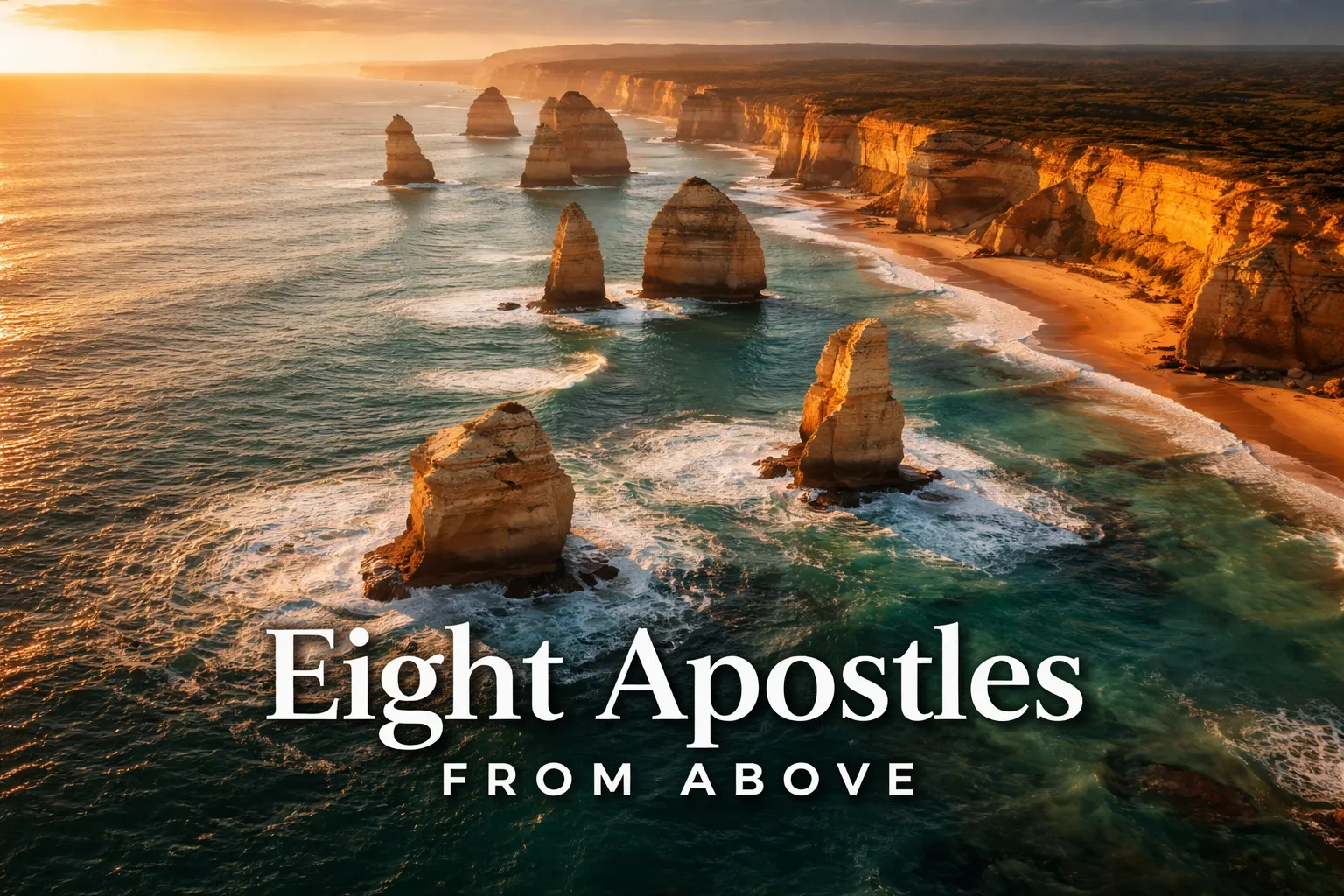
Twelve Apostles Drone Photography Australia: What You See When You Finally Rise Above the Cliffs
Everyone assumes the Twelve Apostles are a “look and move on” stop — snap the postcard shot from the boardwalk, tick the box, drive on toward Loch Ard Gorge. I believed that too, for years, until I sent a drone up over the cliff edge and watched that assumption fall apart in about four seconds. Standing at the clifftop viewpoint with everyone else, I was impressed, sure, but I was still just looking at a postcard. Once the gimbal cleared the rock face and the Southern Ocean opened up underneath, the entire geological narrative locked into place. Twelve apostles drone photography Australia is one of those rare aerial experiences where gaining altitude doesn’t just make the shot prettier — it changes what you’re actually seeing. From 80 metres up, these limestone stacks stop being scenery and start reading like a timeline: ancient coastline caving in slowly, ocean chewing its way inland at its own pace, eight survivors standing in water that’s coming for them next. Anyone planning a drone session along the Great Ocean Road should clear off their memory cards well in advance. You’ll fill them faster than you expect.
Drone Flight Brief: Twelve Apostles at a Glance
| GPS Coordinates | 38.6647° S, 143.1051° E (main viewing area, Port Campbell National Park) |
| Recommended Altitude Range | 60–120 metres for stacks-and-ocean compositions; up to 300 metres (legal ceiling under CASA standard rules) for full coastline context shots |
| Best Time of Day to Fly | Civil twilight through first 90 minutes after sunrise — light is golden, winds are at their calmest window |
| Best Season | March–May (autumn) for stable light, lower crowds, and manageable Southern Ocean winds; December–February brings harsh midday glare and peak tourist foot traffic |
| Drone Regulations Summary | CASA standard remotely piloted aircraft (RPA) rules apply. Recreational drones under 250g require registration; drones 250g–25kg require registration and operator accreditation. No specific restricted airspace over the Apostles (check CASA’s Can I Fly There? app before every flight). Port Campbell National Park does not impose a blanket drone ban, but Parks Victoria guidelines ask pilots to avoid disturbing wildlife and other visitors. Flying is permitted under standard CASA rules — this makes the Twelve Apostles one of the more accessible natural wonders for legal drone photography in Australia. |
| Skill Level Required | Intermediate — Southern Ocean wind gusts demand confident manual control; not recommended for first-time pilots |
| Nearest Town | Port Campbell, 12 km east |
Things the Aerial View Gives Away That the Clifftop Never Will
From the boardwalk, all you get is eight stacks standing apart from each other. From up in the air, you get the whole backstory. The limestone cliffs behind them are pocked with caves and sea arches down at the waterline — future apostles in the middle of being carved loose from the mainland. What reads as a solid wall of rock from ground level turns out, from above, to be badly undercut at the edges, with turquoise water shoving into hollow pockets that will one day give way and produce the next round of isolated pillars. Watching that through a drone feed is one of the most physically geological things I’ve ever experienced.
The ninth stack — the one that came down on 3 July 2005, when a 50-metre pillar gave way and dropped into the sea — hasn’t vanished from view entirely. From above, it’s a scatter of pale limestone rubble sitting in shallow water right where it used to stand. You’d walk past the viewing platform and never clock it, but at 80 metres it’s obvious. That debris field also makes for a genuinely strong compositional anchor — an entire story about impermanence contained in one frame.
Then there’s the wave behavior around each stack’s base, which is its own kind of aerial payoff. Every stack disrupts the incoming swell in its own way, throwing off concentric rings of white water that spread out like a slow-motion blast. Stretch the exposure and those rings would smear into silk; shoot a drone frame at 1/1000s instead and they lock into something almost mathematically clean. The palette alone — deep navy open water, electric turquoise shallows, burnt-orange limestone — looks borderline oversaturated even straight out of the RAW file, until you check the histogram and realize that’s simply what the coast looks like.
The Best Shots to Capture: Compositions for Twelve Apostles Aerial Photography
The Golden Sunrise Stack Cluster (60–80m, Looking West)
Get your drone up 60–80 metres above the waterline, roughly 200 metres offshore, and point it west toward the densest cluster of stacks in that first 20-minute window after sunrise. The low light coming from the east rakes across the limestone and shifts it from pale grey to deep amber-gold, while the shaded seaward faces stay in blue shadow. That contrast between lit and unlit rock only holds for about 15 minutes before the sun climbs high enough to flatten it all out, so move fast. Push your shutter to at least 1/800s to freeze the wave movement, and shoot a bracketed sequence — the gap between the bright limestone and the shadowed interior of the ocean will push any sensor to its limit.
The Full Coastline Overview (200–300m, Looking East-Northeast)
Climb to 200–300 metres — still legal within CASA’s 300-metre ceiling — and you get the wide context frame: the Great Ocean Road reduced to a thin ribbon above the cliffline, the stacks scattered irregularly below, and the coast stretching on toward Loch Ard Gorge. At this height the scale of the erosion actually clicks in a single image — the road supplies the human reference point, the stacks supply the geological one. Shoot vertically at this altitude to capture the whole drop from clifftop to ocean floor, which stays visible through the turquoise shallows.
The Wave Interference Close-Up (30–50m, Directly Overhead)
Drop down to 30–50 metres straight above a single stack and shoot directly down. The wave pattern spreading out from its base forms a natural bullseye, the stack sitting as the target while rings of white water expand into deep blue around it. This is more abstract than literal — the stack itself almost becomes secondary to the fluid geometry surrounding it. Keep your shutter at 1/1000s or quicker to hold the wave texture sharp. DJI’s vertical shooting modes handle this composition well for social crops, but always capture the full 4K frame anyway so you’ve got room to crop later.
Can You Fly a Drone at the Twelve Apostles? Regulations and Practical Reality
Short answer: yes. Register properly, follow CASA’s standard rules, and drone flying here is both legal and entirely doable. That actually puts the Twelve Apostles ahead of a lot of other natural landmarks — in Australia and abroad — where restrictions make great ocean road drone photography a much bigger hassle. Here’s what needs sorting before you launch.
Under CASA’s recreational drone rules (updated in 2022), any drone weighing 250 grams or more needs registration through the CASA website, and the pilot needs a recreational flyer accreditation, which is a free test done online. Recreational flyers without extra approval are capped at 120 metres AGL (above ground level) — the 300-metre ceiling is reserved for certified commercial operators flying under RePL. Standard recreational rules still apply on top of that: keep clear of people, avoid populated areas, maintain visual line of sight, and stay 5.5 kilometres away from controlled aerodromes. As of this writing, there’s no proclaimed restricted airspace over Port Campbell National Park — but check the CASA “Can I Fly There?” app the day of your flight regardless, since temporary flight restrictions can appear with little warning.
Parks Victoria doesn’t take an all-or-nothing stance on drones in national parks. Unlike some other Australian states, Victoria has no blanket ban on recreational drones in its parks. What Parks Victoria does ask is that pilots stay clear of wildlife — nesting seabirds nest on and around the stacks — avoid flying intrusively over other visitors, and follow whatever signage is posted. I’ve flown here plenty of times without a problem, but I always launch from the car park rather than the boardwalk, keep each session short, and land well before the tour buses roll in. Early morning matters twice over here: for calmer wind and for fewer people underneath your flight path.
Wind is the real-world hurdle that no regulation prepares you for. Southern Ocean gusts at the Apostles can jump from dead calm to 40+ km/h within minutes, especially once the sea breeze kicks in mid-morning. Your safe window runs from civil twilight to around 9:00am local time. I’ve had a session end abruptly at 9:30am when gusts pushed my drone right up against its lateral correction limits. Pull the Bureau of Meteorology’s coastal forecast for Port Campbell the night before and again the morning of, and treat anything forecast above 20 km/h sustained as your cue to stay grounded.
Beyond the Apostles: Great Ocean Road Aerial Drone Photography Opportunities
The Apostles soak up all the attention, but the coastline around them holds some of the strongest australia coastal drone spots I’ve come across anywhere on earth. Loch Ard Gorge, only 2 kilometres southwest, changes completely from the air: what feels like a tight, enclosed inlet from ground level turns out from 80 metres to be an almost perfectly symmetrical slice cut into the limestone plateau, its walls throwing flawless reflections onto the teal water below. The 1878 story of shipwreck survivor Tom Pearce hauling Eva Carmichael to safety hits differently once you can see, from above, exactly how tiny that beach is and how vertical those walls really are.
London Arch — known as London Bridge until its landward arch caved in back in 1990, leaving two tourists stranded on the seaward chunk — is another remarkable subject from the air, 8 kilometres west of the Apostles. The surviving arch frames the water beneath it, and shot straight down it forms a clean rectangular window of blue. The Grotto, a blowhole formation 5 kilometres west of Port Campbell, is best photographed at low tide from 40–60 metres, where the spiral stone ramp and dark cave mouth create a natural line pulling the eye down to the waterline. Give this stretch of coast a full day and treat the Apostles as the headline act, with these three as the supporting cast.
The Drone That Made Me Stop Worrying About Wind at the Cliff Edge
Flying over the Twelve Apostles puts you in conditions that don’t forgive much — ocean thermals, sudden gusts rolling off the Southern Ocean, and no margin for error above those 100-meter drops. What you need is a drone that isn’t going to drift toward the rocks the second you look down at your phone.
What works
- A 42-minute flight time is plenty to cover the whole site, loop back for a second angle, and still land with charge left — which matters when you’re 50 meters up and a 15-knot wind is nudging you toward the cliffs.
- The RC 2’s built-in screen means you can actually frame your shot instead of fighting phone glare in bright coastal sun, and it keeps a solid signal even from awkward positions on the cliff platform.
- Gimbal stabilization holds up well enough in wind that the footage doesn’t look shaky or accidental — your shots come across as deliberate, not like the ocean breeze is pushing the drone around.
What doesn’t
- The Fly More Combo adds noticeable bulk to your pack, and if you’re walking between several viewpoints around Port Campbell, you’ll notice every extra battery and the charging hub in your bag.
- Thermal updrafts coming off the cliff face can still catch the drone off guard with sudden altitude jumps, no matter how good the stabilization is — it’s an upgrade, not a cure-all, just a far better tool than what I was flying before.
I had one genuinely terrifying moment when a thermal gust sent the drone sideways while I was reviewing footage on the screen remote, but the obstacle avoidance caught it before anything went wrong. DJI Air 3S Fly More Combo (RC 2 Screen Remote Controller)
Frequently Asked Questions
Can I legally fly a drone at the Twelve Apostles?
Yes. Under CASA’s recreational drone rules, drones weighing 250 grams or more need registration and the pilot needs free recreational flyer accreditation. There’s no proclaimed restricted airspace over Port Campbell National Park, but check the CASA “Can I Fly There?” app before flying. Parks Victoria asks that you avoid disturbing wildlife and other visitors.
What altitude should I fly at Twelve Apostles for best shots?
Fly between 60–80 meters for stack-and-ocean compositions. For full coastline context, climb to 200–300 meters, which is still legal under CASA’s 300-metre ceiling. For wave interference close-ups, drop to 30–50 meters directly overhead of a single stack.
When is the best time to fly a drone at Twelve Apostles?
March–May offers stable light, lower crowds, and manageable Southern Ocean winds. Fly from civil twilight through the first 90 minutes after sunrise for golden light and calmest winds. Your safe window typically runs until around 9:00am local time before gusts exceed 40 km/h.
What drone features matter most at Twelve Apostles?
You need 42 minutes of stable flight time to cover the whole site with batteries to spare. An RC 2 screen remote eliminates phone glare in bright coastal sun and maintains signal from awkward cliff positions. Gimbal stabilization must hold steady in wind without drifting toward the 100-meter drops.
About This Article

Written by Elena Vasquez. Elena Vasquez is a full-time traveler and the founder of Witty Passport. Over fifteen years and more than 50 countries across six continents — including a stretch spent leading groups professionally through Southeast Asia and the remote highlands of South America — she's written the kind of destination guides she always wished existed: practical, specific, and built on real experience rather than recycled itineraries. More about this site.
Scope and limits. Elena is a full-time traveler, not a licensed travel agent or immigration adviser. Entry requirements, visa rules, and advisories change without notice — always confirm against the official government source for your destination and passport before booking.
Verify this against a primary source
Specifics change, and your situation may differ from the one described here. These are the authorities worth checking directly:
- U.S. Department of State — entry requirements and travel advisories
- CDC Travelers' Health — vaccination and health notices by destination
- TSA — current carry-on and screening rules