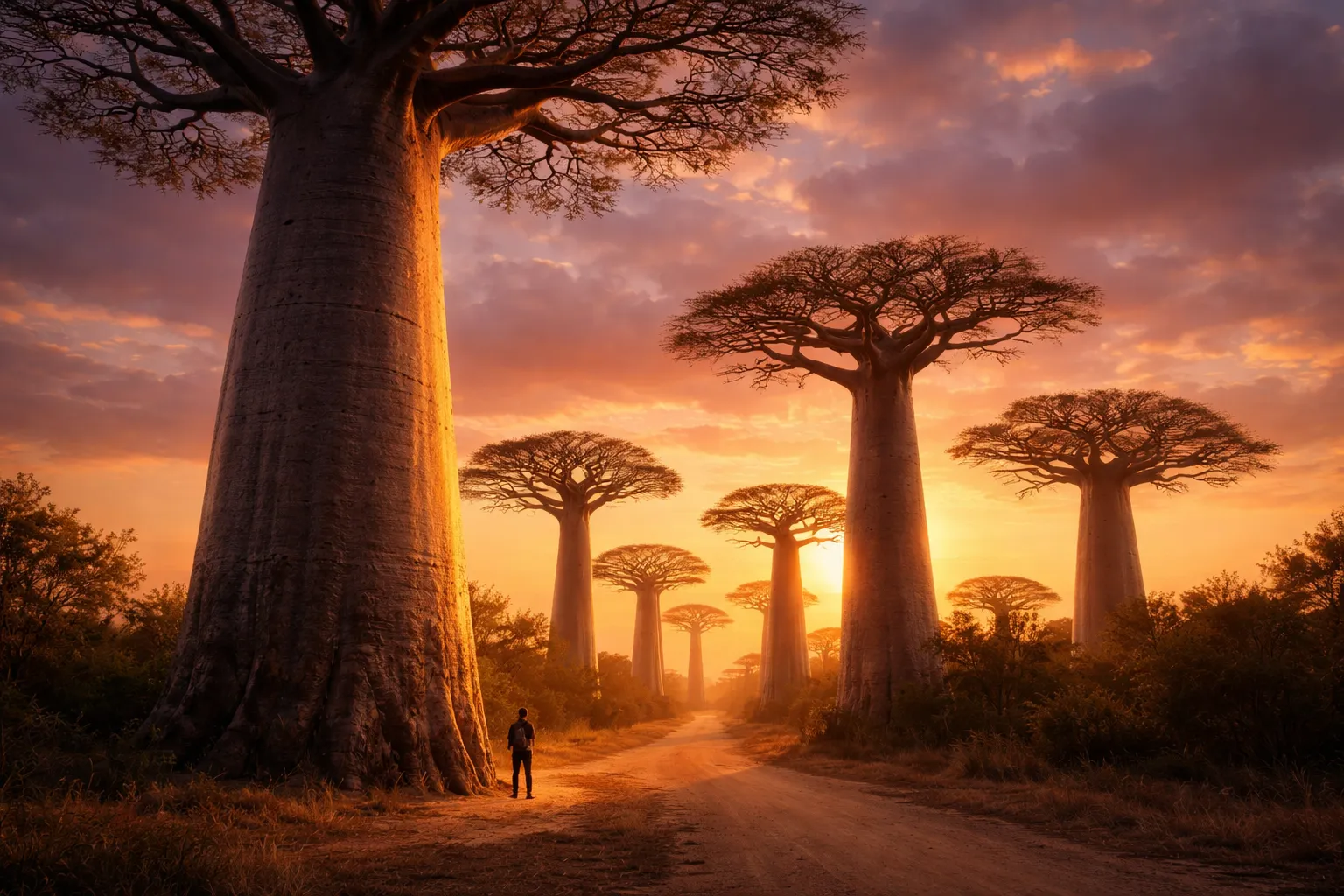
Skip the shade at the Avenue of the Baobabs and you’ll be rationing water within the hour — there is genuinely nowhere to hide from the sun once you’re among those trunks, and that’s the first thing worth knowing before the wonder of the place takes over. Because it does take over. The trunk isn’t really a trunk at all — it reads more like a fortress column, something a deity might have built by flipping an ordinary tree upside down and jamming it roots-first into the red Malagasy dirt. I remember standing outside Morondava watching a 30-meter giant catch fire in the late sun, and the thought that landed wasn’t lyrical at all. It was arithmetic: this particular tree had already logged four centuries of existence before a single European ship ever rounded the Cape of Good Hope. So if you’re wondering how old are baobab trees actually get, the blunt answer is that they make our usual definition of “old” look almost laughably premature. These aren’t merely long-lived trees — they’re standing monuments that predate entire civilizations’ proudest achievements, and a disturbing number of the oldest have started dying within our lifetimes, which is worth understanding before you plan a trip around seeing them.
How Old Are Baobab Trees? Here’s the Honest, Science-Backed Answer
The African baobab (Adansonia digitata) typically lives somewhere between 1,000 and 2,500 years, and the oldest confirmed individuals have cleared the 2,000-year mark. That puts it in the running for the oldest flowering plant species on the continent, and it sits comfortably among the longest-lived trees anywhere on the planet by nearly any measure you’d care to use.
And here’s the twist that makes this more than just an impressive number. The extreme african baobab tree lifespan exists because these aren’t true woody trees in the conventional botanical sense at all — they’re technically the largest succulents on Earth. Their trunks hold tens of thousands of liters of water, and instead of one solid central trunk, their interior is a fused knot of multiple stems, a structure with no real equivalent elsewhere in the plant world. That oddity means the growth rings you’d rely on to age an oak or a sequoia don’t form in any dependable way inside a baobab. Getting a real number means radiocarbon-dating organic matter pulled from deep inside the trunk cavity — and when researchers actually do that, the ages that come back are hard to fully process.
A few concrete data points help ground just how extreme baobab tree age estimation gets:
- The Glencoe Baobab in Limpopo, South Africa, was dated at roughly 1,835 years old before it partially caved in during 2009. At its widest, the trunk measured close to 47 meters around.
- The Sunland Baobab, also in Limpopo, was put at approximately 1,700 years old, with a trunk circumference of 33.4 meters — spacious enough that a working bar and wine cellar were once built into its hollow core. It gave way between 2016 and 2017.
- The Prison Tree outside Derby in Western Australia (Adansonia gregorii, the Australian boab) measures 14.7 meters around and is thought to be more than 1,500 years old.
- The Avenue of the Baobabs trees in Madagascar (Adansonia grandidieri, Grandidier’s baobab) are estimated at around 800 years old and reach heights of up to 30 meters.
For scale: the oldest verified living coast redwood comes in around 2,200 years old. The oldest baobab ever documented — a Zimbabwean specimen radiocarbon-dated shortly before it collapsed — registered at roughly 2,450 years. Do the math and that tree sprouted around 430 BCE, meaning it was already a grown adult while Aristotle was still walking around teaching.
Eight baobab species exist worldwide: six found only in Madagascar, one spread across mainland Africa, and one confined to northwestern Australia. Growth patterns and maximum age vary slightly between them, but they all share that same basic, almost ridiculous, sense of scale.
Dating an Ancient Baobab — and Why the Oldest Specimens Keep Collapsing
Figuring out a baobab’s true age is a legitimately thorny scientific problem. Unlike most trees from temperate climates, baobabs don’t lay down neat, consistent annual rings — their growth responds to irregular seasonal rainfall rather than a steady yearly cambium push. Complicating things further, multiple stems fuse together over the centuries, producing layered wood tissue that can’t be read in order the way you’d count rings across a pine cross-section.
The workaround scientists landed on is accelerator mass spectrometry (AMS) radiocarbon dating, the same technique archaeologists use on ancient artifacts. Researchers pull wood samples from deep inside hollow trunk cavities, where the oldest surviving material sits, then measure the carbon-14 to carbon-12 ratio. For trees in this age bracket, the method holds accuracy to within a few decades — impressive, considering the “subjects” were alive during the Byzantine Empire.
Beyond raw age, what makes baobabs biologically bizarre is their capacity to hoard water. A single mature African baobab trunk can store up to 120,000 liters — a built-in survival strategy for arid landscapes that also turns these trees into essential dry-season lifelines for elephants, which gouge into the trunks with their tusks to reach the moisture inside. The bark simply grows back. The tree keeps going. It’s been repeating this cycle for thousands of years.
Now here’s the part that should worry anyone hoping to see these trees in person. A 2018 study in Nature Plants found that 9 of the 13 oldest known African baobabs had either died outright or partially collapsed over the previous 12 years. That’s not statistical noise — that’s a rapid, ongoing collapse of the oldest living organisms on the planet happening basically in front of us. The Glencoe Baobab, the Sunland Baobab, the Holboom Tree: all lost or badly damaged. The researchers considered it too improbable to be simple coincidence and pointed toward climate change — namely, extended droughts and rising temperatures across southern Africa — as the most probable culprit, while stopping short of calling it proven. When scientists studying organisms older than most civilizations start sounding alarmed, that’s worth listening to.
That’s also how why are baobab trees dying went from a niche research question to a topic showing up in mainstream conservation conversations. Adansonia digitata isn’t officially classified as endangered, but losing its most ancient individuals this fast represents a loss — ecological and historical — that no species-level status can really capture.
Where to Actually Go See Baobab Trees
Avenue of the Baobabs, Morondava, Madagascar
This is the destination everyone means when they picture baobabs. The baobab tree Madagascar Avenue — officially Allée des Baobabs — is roughly 260 meters of unpaved road lined by about 25 Grandidier’s baobabs (A. grandidieri), each somewhere near 800 years old and rising 25 to 30 meters into the air. These are the survivors of a forest cleared for farmland generations back; they were left standing because baobabs are simply too enormous, and too woven into the local ecosystem, to remove casually.
On the practical side of avenue of the baobabs visiting: the site sits about 19 kilometers north of Morondava, a modest coastal city along Madagascar’s western edge. The access road is deeply rutted red laterite, and a 4WD is strongly advised, particularly outside the dry months. The dry season, May through October, is the clear window to visit — roads stay drivable, skies stay clear, and the golden-hour light is genuinely something else. Both sunrise and sunset deliver, though most photographers gravitate toward sunset for the warm, backlit glow it throws across the rust-toned road; sunrise rewards you instead with thinner crowds and cooler air.
As of now there’s no admission fee, though local guides will offer their services — tip well, since the nearby communities lean heavily on tourism revenue. Morondava’s domestic airport connects to Antananarivo in about 90 minutes, a far more sensible option than the 10-to-14-hour overland haul from the capital.
Limpopo Province, South Africa
Even with the Sunland Baobab gone, the Lekgalameetse area and the wider Limpopo bushveld hold one of the densest clusters of ancient A. digitata anywhere on the continent. Mapungubwe National Park, a UNESCO World Heritage Site near where South Africa meets Zimbabwe and Botswana, pairs Iron Age ruins with baobabs that were already fully grown when the Mapungubwe Kingdom thrived here between 900 and 1,300 CE. The historical and visual weight of the place stacks up fast.
Derby, Western Australia
The Boab Prison Tree — a hollow A. gregorii measuring 14.7 meters around and believed to be over 1,500 years old — stands 7 kilometers south of Derby in the Kimberley. Reportedly, it was used to hold Aboriginal prisoners overnight during the 1890s. It’s a heavy, historically loaded site, and it deserves to be treated that way rather than as a photo stop. The Kimberley beyond it offers some of the country’s most striking boab country, especially along the Gibb River Road.
Victoria Falls Region, Zimbabwe and Zambia
The floodplains flanking Victoria Falls on both the Zimbabwean and Zambian sides of the Zambezi hold considerable numbers of ancient baobabs. If you’re pairing a Falls visit with wildlife photography — and you should be — these trees make for striking foreground subjects during dawn and dusk landscape shots.
When My Energy Gave Out Mid-Walk Through the Baobab Grove
Madagascar’s heat doesn’t let up, and the Avenue of the Baobabs gives you nothing to hide behind — just you, a row of thirty-meter giants, and hours of unfiltered sun. I’d budgeted the whole afternoon for photographing and wandering among the trees, but somewhere around the two-hour mark I was completely drained, dehydrated, and hitting a wall hard.
What worked
- Dissolves cleanly into water with no grit or chalkiness — a real plus when you’re pouring it into a sketchy bottle refill somewhere in rural Madagascar
- Kicks in quickly enough that you’re not forced to cut your photo session short and hobble back to the vehicle after just two hours
- Packs light enough for a daypack without becoming dead weight, and at 1.5 pounds it stretches across several outings
What didn’t
- The flavor is sharply sour — I ended up adding honey just to get it down, which somewhat undercuts the whole pack-light appeal
- It needs a few minutes to fully dissolve in warm water, and desperation will absolutely tempt you to gulp it down before it’s ready
I nearly skipped bringing it on my second day at the baobabs because I’d doubted whether a powder could actually cut through that specific kind of sun-drunk fatigue—but thirty minutes after mixing it into lukewarm water, I realized I could think clearly again. If you’re planning long, exposed walks in Madagascar or anywhere similarly unforgiving, grab Terrasoul Superfoods Organic Baobab Fruit Powder, 1.5 Pounds.
Frequently Asked Questions
How old do African baobab trees typically get?
African baobabs typically live between 1,000 and 2,500 years, with the oldest confirmed individuals clearing the 2,000-year mark. The oldest baobab ever documented was a Zimbabwean specimen radiocarbon-dated at roughly 2,450 years old, meaning it sprouted around 430 BCE.
Why are baobab trees dying so rapidly?
A 2018 study found that 9 of the 13 oldest known African baobabs died or partially collapsed over the previous 12 years. Researchers pointed toward climate change—extended droughts and rising temperatures across southern Africa—as the most probable culprit.
Is there an admission fee at Avenue of the Baobabs Madagascar?
As of now there’s no admission fee at the Avenue of the Baobabs in Morondava. Local guides offer their services at the site, and visitors are advised to tip well since nearby communities lean heavily on tourism revenue.
What’s the best time to visit baobab trees in Madagascar?
The dry season from May through October is the clear window to visit the Avenue of the Baobabs. Roads stay drivable and skies stay clear during these months, with golden-hour light particularly striking at sunset for warm, backlit photography.
About This Article

Written by Elena Vasquez. Elena Vasquez is a full-time traveler and the founder of Witty Passport. Over fifteen years and more than 50 countries across six continents — including a stretch spent leading groups professionally through Southeast Asia and the remote highlands of South America — she's written the kind of destination guides she always wished existed: practical, specific, and built on real experience rather than recycled itineraries. More about this site.
Scope and limits. Elena is a full-time traveler, not a licensed travel agent or immigration adviser. Entry requirements, visa rules, and advisories change without notice — always confirm against the official government source for your destination and passport before booking.
Verify this against a primary source
Specifics change, and your situation may differ from the one described here. These are the authorities worth checking directly:
- U.S. Department of State — entry requirements and travel advisories
- CDC Travelers' Health — vaccination and health notices by destination
- TSA — current carry-on and screening rules