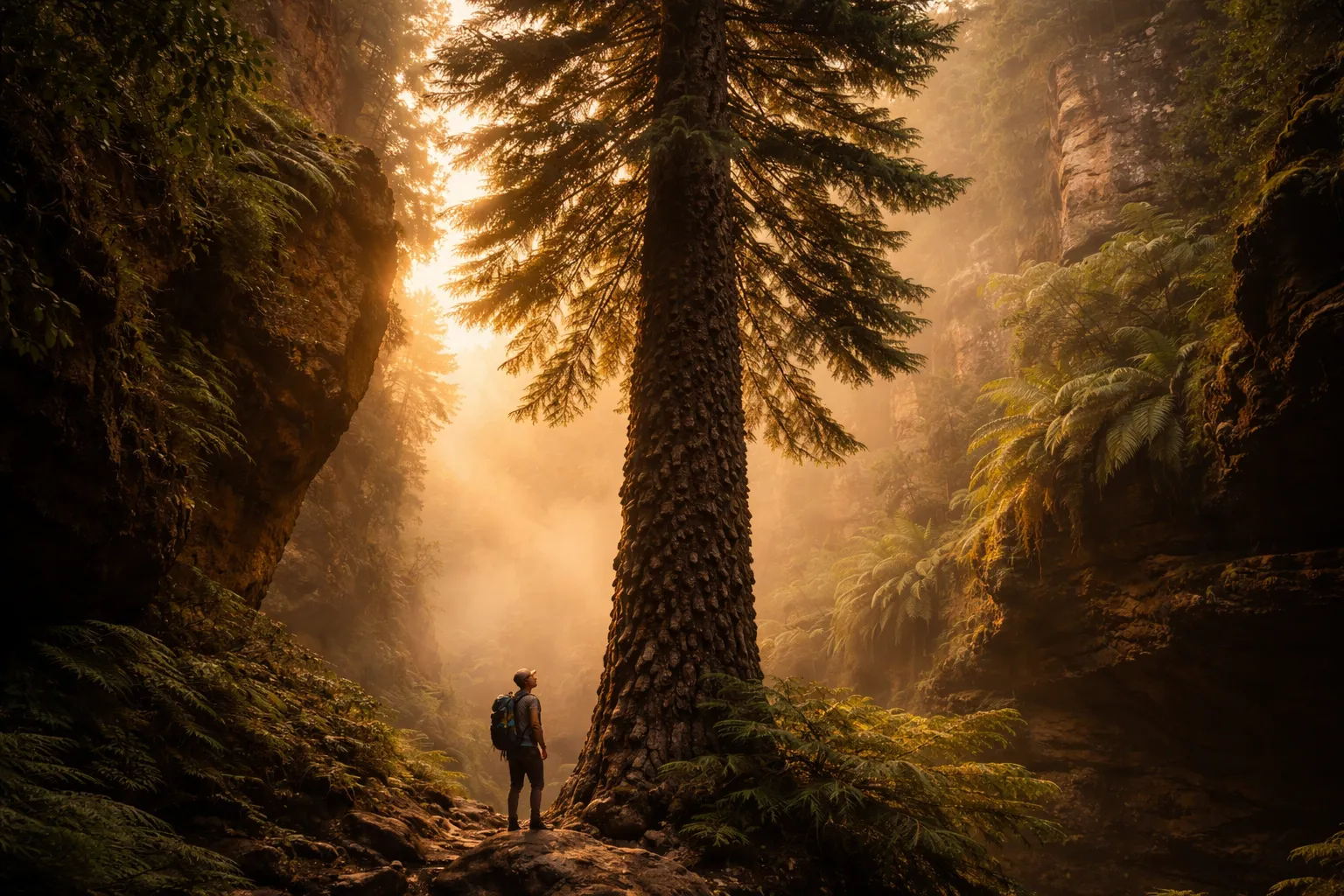
Nothing about the specimen in front of me looked like it belonged on this continent, in this century, or in this century’s understanding of botany. Knobbly bark like a bubble-wrap fever dream, branches whorled into stacked architectural tiers, a whole silhouette so prehistoric it made the surrounding sandstone buildings — themselves 19th-century — look freshly poured. This was the Royal Botanic Garden Sydney, and the tree was a Wollemi pine living fossil, part of a genus that shared the planet with Brachiosaurus. The jaw-dropping part wasn’t only the 200-million-year pedigree, though. It was the small plaque beside the trunk explaining, almost casually, that this species — every last wild individual of it — was entirely unknown to science before September 1994. Under 100 mature trees survive in the wild, all tucked into one hidden canyon fewer than 150 kilometres from one of Australia’s biggest cities. For nearly the whole of human history, nobody had a clue it was there.
What Exactly Is the Wollemi Pine Living Fossil — and Why Does It Matter?
Botanically, the Wollemi pine (Wollemia nobilis) is a conifer in the Araucariaceae family, and until recently its genus existed only as fossil impressions roughly 200 million years old, dating to the Jurassic. When a living version turned up in 1994, botanists reached for the dinosaur comparison — and unusually, that wasn’t marketing exaggeration. The scientific consensus beforehand had the entire Wollemia genus extinct for at least 2 million years. That consensus was wrong, spectacularly so.
It came down to one afternoon in September 1994, when David Noble — a bushwalker who also worked for the National Parks and Wildlife Service — rappelled into an unnamed canyon inside Wollemi National Park, deep in the Blue Mountains of New South Wales. Down in that misty, sheltered gorge sat trees he couldn’t place — trees, in fact, that no living person had ever documented. He grabbed samples. Once those samples reached botanists at the Royal Botanic Garden Sydney, jaws hit the floor collectively: the foliage matched 200-million-year-old fossil impressions almost exactly. The Wollemi pine discovery 1994 was quickly ranked among the most important botanical finds of the entire 20th century.
A few figures make the scale of this find easier to grasp:
- Genus age: roughly 200 million years — old enough to predate the breakup of Gondwana
- Confirmed wild adult population: under 100, confined to one remote canyon system
- Tallest recorded specimen: 40 metres (130 feet), comparable to a 13-storey building
- Distance from the wild grove to Sydney’s CBD: roughly 150 kilometres (93 miles)
- Year the site was sealed off from public knowledge: 1994, the same year it was found
- Length of time it stayed hidden near a major world city: at least 2 million years, likely longer
Some context for that 200-million-year number: Wollemia nobilis was already a settled species by the time the first true dinosaurs showed up. It beat flowering plants to existence by roughly 75 million years. It sat through the Cretaceous extinction and kept going. It shrugged off every megafauna die-off of the Pleistocene. And through all of it, the species held on inside one concealed New South Wales gorge, staying completely off the radar of the most botanically obsessed civilisation in history — until a park ranger glanced downward on a mild spring day in 1994.
Inside the Biology: What Let Wollemia nobilis Outlast 200 Million Years
Three things explain the Wollemi pine’s improbable survival: brutal geographic isolation, a microclimate that barely wavers, and a biological trick almost too efficient to be real. The canyon sheltering the wild grove — its precise coordinates among the tightest-held secrets in botany — is a deep sandstone ravine that regulates its own temperature and moisture. Damp air settles at the bottom. High sandstone walls keep out the drying winds that scour the wider Blue Mountains plateau. What results is a refuge that has stayed climatically steady for millions of years, meaning the trees inside never really had to adapt.
Genetically, the species is odd in another way entirely: the wild population shows next to no genetic variation. Post-discovery studies found the surviving trees are basically clones of one another, the product of self-coppicing and clonal spread over thousands of years. New trunks sprout from a shared root system, so a “grove” of Wollemi pines in a botanic garden might actually be a single genetic individual that’s been copying itself for millennia. That’s an impressive survival mechanism, but it’s also a serious weak point — one airborne pathogen could, in theory, wipe out the entire wild population in one stroke.
Visually, the bark is the giveaway — botanists describe it as “chocolate bubbly,” like an uneven field of dark cobblestones. Pair that with the tree’s habit of growing flat, glossy leaves in double rows across four ranks per stem, and Wollemia nobilis becomes unmistakable once you’ve seen it once.
On the conservation front, the IUCN classifies the Wollemi pine as Critically Endangered. During Australia’s catastrophic 2019–2020 bushfire season, the fire front came within a few kilometres of the wild grove. In a rescue operation kept quiet for months, crews used water-bombing helicopters alongside ground-based drip irrigation set up directly in the canyon. Every wild Wollemi pine made it through. It’s one of the more remarkable conservation stories in botanical history — and one that almost nobody heard about at the time.
Back in 2005, the Australian government tried something genuinely smart: mass-propagate the tree and sell it commercially. The reasoning holds up — scatter the species across thousands of private gardens worldwide, and no single disaster in one canyon can erase it. These days, buying a dinosaur tree Wollemi pine seedling for your own backyard is entirely legal. More on that later.
Where to Actually Find a Wollemi Pine — Best Spots for Living Fossil Fans
One thing needs saying plainly upfront: the wild grove is off-limits. The New South Wales government keeps the location classified, no public map shows it, and anyone caught trying to reach it risks steep penalties. This isn’t red tape for its own sake — it’s a genuine biosecurity precaution. The wild population has zero genetic backup against pathogens like Phytophthora cinnamomi (root rot), and a single contaminated boot sole could carry something no treatment exists for. So skip the search. You don’t need to find it anyway.
Royal Botanic Garden Sydney — Your One-Stop Answer
For nearly everyone asking where to see Wollemi pine, this garden is the answer. It’s free to enter, spread across 30 hectares of prime waterfront land at Farm Cove right next to the Opera House, with harbour views that make the whole visit feel unreasonably scenic. The specimens here are clearly labelled with the discovery story and mature enough that you get a real sense of the species’ scale and character. Budget a minimum of two hours — the temperate house and succulent garden are worth folding into the visit. Hours run daily, 7am until dusk.
Blue Mountains National Park — The Setting, Minus the Access
You won’t lay eyes on the wild grove here, but the Blue Mountains deserve a visit regardless — and the landscape alone justifies it. From Echo Point, looking across the sandstone canyons with blue eucalyptus haze rolling over the Three Sisters valley, the geography starts making sense: this is exactly the kind of terrain that could hide a whole tree genus for 2 million years. Nothing gentle about these hills. The canyon systems twist and fold with sheer drops, sealed-off gorges, and microclimates that shift dramatically within short distances. The Grand Canyon Walk near Blackheath — a 6.4-kilometre loop, budget 3 to 4 hours — drops you straight into the same kind of deep, sheltered ravine habitat that kept the Wollemi pine alive. Valley of the Waters, near Wentworth Falls, delivers a similarly haunting version of the same landscape.
Getting there means roughly a 90-minute train ride from Sydney Central Station, with Katoomba serving as the main base town. Go between March and May for autumn colour and cooler air, or July through September for genuinely dramatic misty mornings — just pack layers, since winter nights at elevation regularly drop to 4–5°C.
Mount Annan Australian Botanic Garden — Worth the Extra Drive
About 65 kilometres southwest of Sydney — roughly an hour by car — sits Mount Annan Australian Botanic Garden, the living collections arm of the Royal Botanic Garden Sydney, complete with its own dedicated Wollemi pine planting. This is where you go if your interest runs deeper than a casual look. Spanning 416 hectares almost entirely given over to native Australian species, it ranks among the most concentrated collections of living fossil plants you can visit anywhere in the Southern Hemisphere. Entry is free, and gates open daily at 8am.
Beyond Australia
Kew Gardens in London keeps a specimen, and so do botanical gardens in San Francisco, Edinburgh, and a scattering of institutions across Europe and North America. If Australia isn’t on your near-term itinerary but you still want this on your botanical list, check whatever major garden is closest to you — since 2005, Wollemi pines have been distributed worldwide as part of the species’ conservation strategy.
Growing Your Own Living Fossil (And Not Killing It Like I Nearly Did)
Standing in front of a tree that’s been around since the Cretaceous does something to a person — I left obsessed with the idea of owning one, though a 200-million-year-old species surviving my Australian apartment sounded like a disaster waiting to happen. If you’re similarly hooked but live somewhere with real seasons and central heating, a Norfolk Island Pine is the practical substitute: it looks ancient, it’s genuinely sculptural, and it can actually survive normal household conditions.
The upside
- The Jurassic look is real — those layered, architectural branches catch light in a way that makes guests pause mid-sentence to ask what it is.
- Unlike high-maintenance exotics, it handles ordinary indoor conditions fine, no humidifier or grow light required, which means you can leave town without arranging plant-sitting.
- Its slow growth works in your favor — repotting isn’t a constant chore, and it stays elegant without turning into something that scrapes the ceiling.
The catch
- It ships small — nothing like the gnarled 65-foot giant I saw in Sydney — so you’re signing up for a 15-plus-year wait before it looks properly ancient.
- Sloppy watering will kill it faster than almost anything else in your plant collection — I skipped watering mine for three weeks and only noticed the crispy bottom branches once the damage was done.
I nearly abandoned the whole thing after that crispy-branch incident and seriously considered just pressing my face against the Botanic Garden’s fence every few months instead. But I adjusted the routine, and now it’s thriving—and if I can keep a living fossil alive after nearly killing it, anyone can. Arcadia Garden Products Live Norfolk Island Pine Evergreen Tree
Frequently Asked Questions
Where can I see a Wollemi pine near Sydney?
The Royal Botanic Garden Sydney is your best option—it’s free to enter, spread across 30 hectares at Farm Cove next to the Opera House, with clearly labelled specimens. Hours run daily from 7am until dusk. Budget a minimum of two hours for your visit, which is enough to see the tree and explore the temperate house and succulent garden.
When was the Wollemi pine discovered?
The Wollemi pine was discovered in September 1994 when David Noble, a bushwalker working for the National Parks and Wildlife Service, rappelled into an unnamed canyon in Wollemi National Park in the Blue Mountains of New South Wales and found trees no living person had ever documented before.
How many wild Wollemi pines are left?
Under 100 mature trees survive in the wild, all confined to one remote hidden canyon fewer than 150 kilometers from Sydney. The precise location is classified by the New South Wales government as a biosecurity precaution, and the site is off-limits to the public.
How old is the Wollemi pine species?
The Wollemi pine genus is roughly 200 million years old, dating to the Jurassic period and predating the breakup of Gondwana. The species beat flowering plants to existence by roughly 75 million years and survived the Cretaceous extinction.
About This Article

Written by Elena Vasquez. Elena Vasquez is a full-time traveler and the founder of Witty Passport. Over fifteen years and more than 50 countries across six continents — including a stretch spent leading groups professionally through Southeast Asia and the remote highlands of South America — she's written the kind of destination guides she always wished existed: practical, specific, and built on real experience rather than recycled itineraries. More about this site.
Scope and limits. Elena is a full-time traveler, not a licensed travel agent or immigration adviser. Entry requirements, visa rules, and advisories change without notice — always confirm against the official government source for your destination and passport before booking.
Verify this against a primary source
Specifics change, and your situation may differ from the one described here. These are the authorities worth checking directly:
- U.S. Department of State — entry requirements and travel advisories
- CDC Travelers' Health — vaccination and health notices by destination
- TSA — current carry-on and screening rules