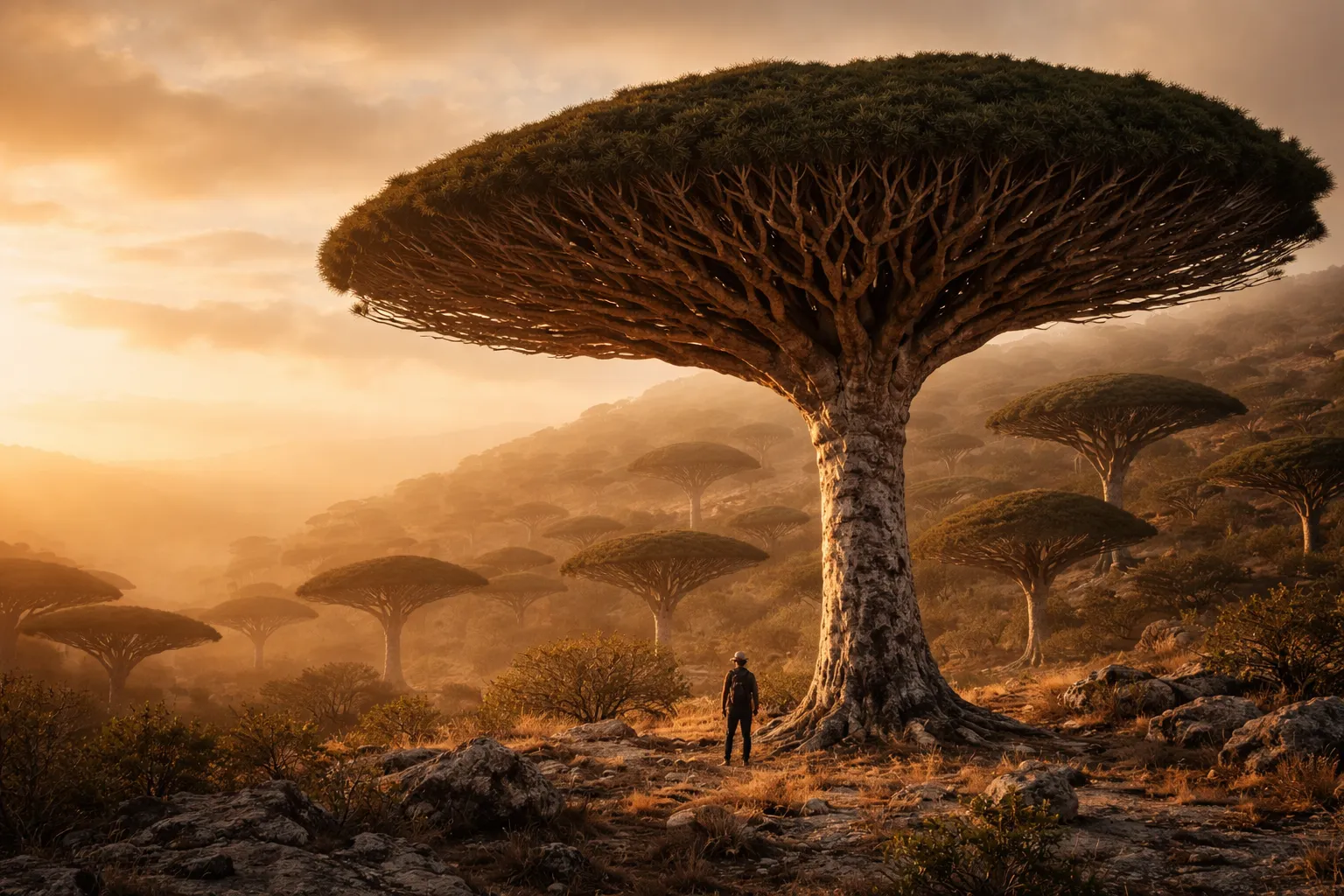
What actually looks like this in nature? Nothing else, anywhere, which is exactly the point. Your first glimpse of a dragon blood tree short-circuits whatever mental filing system you use for “trees” — it reads instead like a botanist handed a sketch artist a secondhand description and asked for their best guess. The canopy fans out flat and dead-level, a solid dark-green disc suspended over a bulging, pale trunk, the whole arrangement resembling an umbrella turned inside out by some giant gust. No low limbs. No gradual taper. Nothing your eye files under “familiar.” Just this blunt, ancient, mushroom-domed shape cutting into a sky so blue it looks retouched. Then somebody mentions it could be 600 years old. That its bloodline goes back 20 million years. That a cut releases something red. The dragon blood tree of Socotra Island isn’t a special effect and it isn’t a figure of speech. It’s a living organism rooted in real ground you can fly to — and of everything I’ve stood beside in fifteen years of travel, this is the strangest.
What Is the Dragon Blood Tree and Where Does It Grow?
Dracaena cinnabari grows in exactly one place on the planet — Socotra Island, off Yemen in the Arabian Sea — and that’s the whole map. This isn’t a “you’ll get the best view here” situation. It’s total, uncompromising endemism. Zero wild populations exist beyond this one island — no scattered mainland groves, no sister colony one island over. It’s Socotra or it doesn’t exist.
Socotra floats about 240 kilometers off the Horn of Africa and roughly 380 kilometers from the southern edge of the Arabian Peninsula — isolated enough that evolution here basically threw out the rulebook. It’s home to one of the planet’s densest concentrations of endemic plant life: around 37% of everything growing on Socotra exists nowhere else. UNESCO added the Socotra Archipelago to its World Heritage list in 2008 for exactly this reason. People love calling it “the Galápagos of the Indian Ocean,” but honestly, I’d argue Socotra wins that comparison outright. The Galápagos gave us giant tortoises. Socotra gave us trees that look pulled straight out of a Dr. Seuss illustration.
A mature Dracaena cinnabari usually stands somewhere between 3 and 9 meters (10 to 30 feet), and its crown often spreads as wide as the tree is tall, sometimes wider. Pinning down an exact age is a genuine scientific headache — this species doesn’t produce the annual growth rings that dendrochronologists rely on for most temperate trees. Based on growth-rate modeling, researchers land on a working range of 400 to 600 years per individual, with some experts open to the possibility that the biggest specimens push past that. The lineage, though, dwarfs any single tree’s lifespan — the Dracaena group traces back an estimated 20 million years, a survivor of the old Tethys Sea flora that once blanketed a much larger region before continental drift and shifting climate wiped it out everywhere except this one holdout island.
“Dragon blood” isn’t a marketing flourish. Cut into the bark and the tree seeps a dark red resin that thickens and clots like real blood as it dries. Traders have moved this resin for more than 2,000 years — Roman merchants shipped it in from Socotra for use as medicine, as a dye in varnishes and lacquers, and as a sealant for wounds. Pliny the Elder even documented it in the first century AD. Socotri healers still use it today, and the same resin now ships worldwide as incense — which is precisely where this ancient story becomes something you can actually pack in your carry-on.
Why This Tree Looks Nothing Like Anything Else on Earth
That umbrella-shaped canopy didn’t happen by accident of design. It’s one of the plant kingdom’s cleaner examples of form built entirely by necessity, shaped over millions of years to answer one narrow question: how does anything survive on a scorched, rocky, fog-reliant island with thin soil and merciless seasonal winds?
The canopy is the answer to that question. Dracaena cinnabari’s flat, tightly packed crown pulls double duty. First, it shades the ground directly below the trunk, cutting soil-moisture evaporation dramatically in Socotra’s punishing heat and building a small pocket of cooler, damper air right underneath the tree. Second, that same canopy catches the moisture-heavy monsoon fog that drifts across the Dixsam Plateau from May through September, guiding condensed droplets down the leaves toward the trunk and straight into the root system. This tree essentially built its own irrigation system out of its own shape.
Since Dracaena cinnabari doesn’t lay down the growth rings scientists normally use for dating trees, researchers instead turn to growth-rate studies and structural models to estimate age. One frequently cited study of the Firmihin forest puts the oldest surviving trees somewhere between 300 and 600 years old, though that figure still carries real uncertainty. The lineage’s age, on the other hand, is settled science: molecular phylogenetics places the Dracaena split at roughly 20 million years ago — meaning these trees were already ancient history by the time anatomically modern humans first stepped out of Africa around 300,000 years back.
The conservation reality here is genuinely unsettling. The IUCN Red List classifies Dracaena cinnabari as Vulnerable, and multiple studies have documented that natural regeneration has almost entirely stalled across most existing groves. Two forces are driving this: shifting climate patterns are disrupting the monsoon fog these trees depend on to survive, and feral goats graze seedlings down before they ever get a chance to establish. In plenty of Socotra’s groves, researchers have surveyed the adult trees and found practically no successful young seedlings anywhere nearby. It’s entirely possible the trees standing today are the final generation of certain groves — with nothing coming up behind them.
The resin itself carries a compound called dracorubin, plus assorted flavonoids and diterpenoids. Modern pharmacological research has looked into its antimicrobial, antifungal, and wound-healing potential, and it turns out the Romans weren’t entirely wrong about its medicinal value. This tree has mattered scientifically, commercially, and culturally for two thousand years — and it may not make it through the next two hundred without direct intervention.
Where to Find Dracaena Cinnabari — and How to Plan a Trip to Socotra
There’s really just one location on Earth where you can see Dracaena cinnabari in the wild — Socotra Island. The real question is which part of Socotra.
Firmihin Forest, Dixsam Plateau — The Non-Negotiable Stop
The Firmihin forest, up on the eastern side of the Dixsam Plateau, holds the island’s thickest cluster of dragon blood trees — thousands of them spread across a limestone plateau sitting around 700 to 900 meters above sea level, their flat crowns forming a landscape that looks like a discarded set from a sci-fi film. This is the shot everyone’s seen online. This is the place that shot was taken. The plateau’s height and its exposure to incoming fog create exactly the conditions these trees need, and if you walk through Firmihin on a fog-thick morning, watching the canopies dissolve into low cloud while the red earth glows between pale trunks — that’s the kind of moment that resets what you consider “extraordinary.”
Getting Yourself to Socotra Island
Reaching Socotra is genuinely part of the challenge, and I don’t mean that as a romantic exaggeration. Flights run mainly out of Abu Dhabi (Yemenia airline, occasionally supplemented by other carriers) and out of Cairo. Schedules are seasonal, unreliable, and prone to cancellation with little notice. From Abu Dhabi, the flight itself takes about 2.5 hours. There’s no direct route from Europe or North America — you’re connecting no matter what.
Your best window is October through April. From May through September, the Khareef monsoon brings winds strong enough to shut the airport down completely, cutting the island off from outside visitors for roughly five months. Structure your entire trip around this window. Book early, and pad both ends of your itinerary with buffer days, because cancellations are common, not rare.
If Abu Dhabi is your connection point, consider stretching your layover into a day or two in the UAE — our guides on what to do in Dubai and Dubai travel essentials cover a solid stopover before the real trip begins.
What the Island Is Actually Like Once You Land
Socotra rewards adventure travelers, not resort travelers. Lodging is minimal: sleeping under the dragon blood trees in a tent (which is every bit as magical as it sounds), plain guesthouses in Hadibo (the main town, population roughly 8,000), and now and then semi-permanent tented camps set up by tour operators. No international hotel brands here. No conventional tourist infrastructure at all. That absence is exactly the reason to go.
Hiring a local guide isn’t a nice-to-have — treat it as mandatory. The ground is rough, signage doesn’t exist, and moving between the Dixsam Plateau, the Detwah Lagoon on the west coast, Hoq Cave (a 2.5-kilometer limestone cave holding Socotri inscriptions that date back 2,000 years), and other key sites all depends on someone who actually knows the terrain. Arrange this through a trusted ground operator before you land. Give yourself at least 5 to 7 days — trying to rush Socotra defeats the purpose of coming at all.
Away from the dragon blood trees, you’ll run into bottle trees (Adenium obesum socotranum), a strange cross between a baobab and a cactus in appearance; cucumber trees (Dendrosicyos socotranus), the only tree in the entire cucumber family; and frankincense trees sprouting straight out of bare limestone. This island is its own self-contained ecosystem, full stop.
Can’t Touch the Trees? Here’s How to Actually Catch Their Scent
Socotra’s dragon blood trees are strictly protected — no harvesting resin, no breaking off branches, and you can barely get close enough to touch one. But scent is such a core part of this tree’s legend that standing there without smelling anything feels like watching a live show with the volume turned all the way down.
What actually works
- It burns slow and quiet, giving you actual space to think about why people have prized this resin for thousands of years, without thick smoke crowding out the experience.
- The granular form skips charcoal tablets and special gear entirely — a small brass dish or even a bowl of raw rice does the job, so you’re not lugging a delicate incense burner through airport security.
- A tiny amount stretches for months of casual burning, making it a compact, lightweight souvenir that connects the memory of seeing the tree to actually understanding why it matters culturally.
Where it falls short
- It smells nothing like the forest itself — burned resin comes across sweeter and softer, almost perfumed, compared to the raw, ancient smell that hangs in the air around the living trees.
- Overdoing it is easy, and too much quickly fills a room with an overwhelming amber haze rather than a gentle hint; you need restraint, which isn’t always what you’ve got left after a long-haul flight.
I burned through half the package my first week home, convinced I wasn’t using enough, before realizing I’d been transforming my apartment into an incense fog chamber. Dragons Blood Resin Incense 1 oz. — 100% Pure Natural Granular Daemonorops Draco — Sangre De Grado
Frequently Asked Questions
Where in the world do dragon blood trees naturally grow?
Dragon blood trees grow in exactly one place on Earth—Socotra Island, off Yemen in the Arabian Sea. Zero wild populations exist beyond this one island, making it a case of total, uncompromising endemism. Socotra floats about 240 kilometers off the Horn of Africa.
How tall do dragon blood trees typically get?
A mature Dracaena cinnabari usually stands somewhere between 3 and 9 meters (10 to 30 feet), and its crown often spreads as wide as the tree is tall, sometimes wider. The flat, umbrella-like canopy is one of the plant kingdom’s clearest examples of form shaped entirely by necessity.
Why is the dragon blood tree shaped like an umbrella?
The flat, tightly packed canopy serves two critical functions in Socotra’s harsh climate. First, it shades the ground below, cutting soil-moisture evaporation dramatically in punishing heat. Second, it catches moisture-heavy monsoon fog drifting across the Dixsam Plateau from May through September, guiding condensed droplets down into the root system.
What’s the best time to visit Socotra Island?
Your best window is October through April. From May through September, the Khareef monsoon brings winds strong enough to shut the airport down completely, cutting the island off from outside visitors for roughly five months. Book early and pad both ends of your itinerary with buffer days, because cancellations are common.
About This Article

Written by Elena Vasquez. Elena Vasquez is a full-time traveler and the founder of Witty Passport. Over fifteen years and more than 50 countries across six continents — including a stretch spent leading groups professionally through Southeast Asia and the remote highlands of South America — she's written the kind of destination guides she always wished existed: practical, specific, and built on real experience rather than recycled itineraries. More about this site.
Scope and limits. Elena is a full-time traveler, not a licensed travel agent or immigration adviser. Entry requirements, visa rules, and advisories change without notice — always confirm against the official government source for your destination and passport before booking.
Verify this against a primary source
Specifics change, and your situation may differ from the one described here. These are the authorities worth checking directly:
- U.S. Department of State — entry requirements and travel advisories
- CDC Travelers' Health — vaccination and health notices by destination
- TSA — current carry-on and screening rules