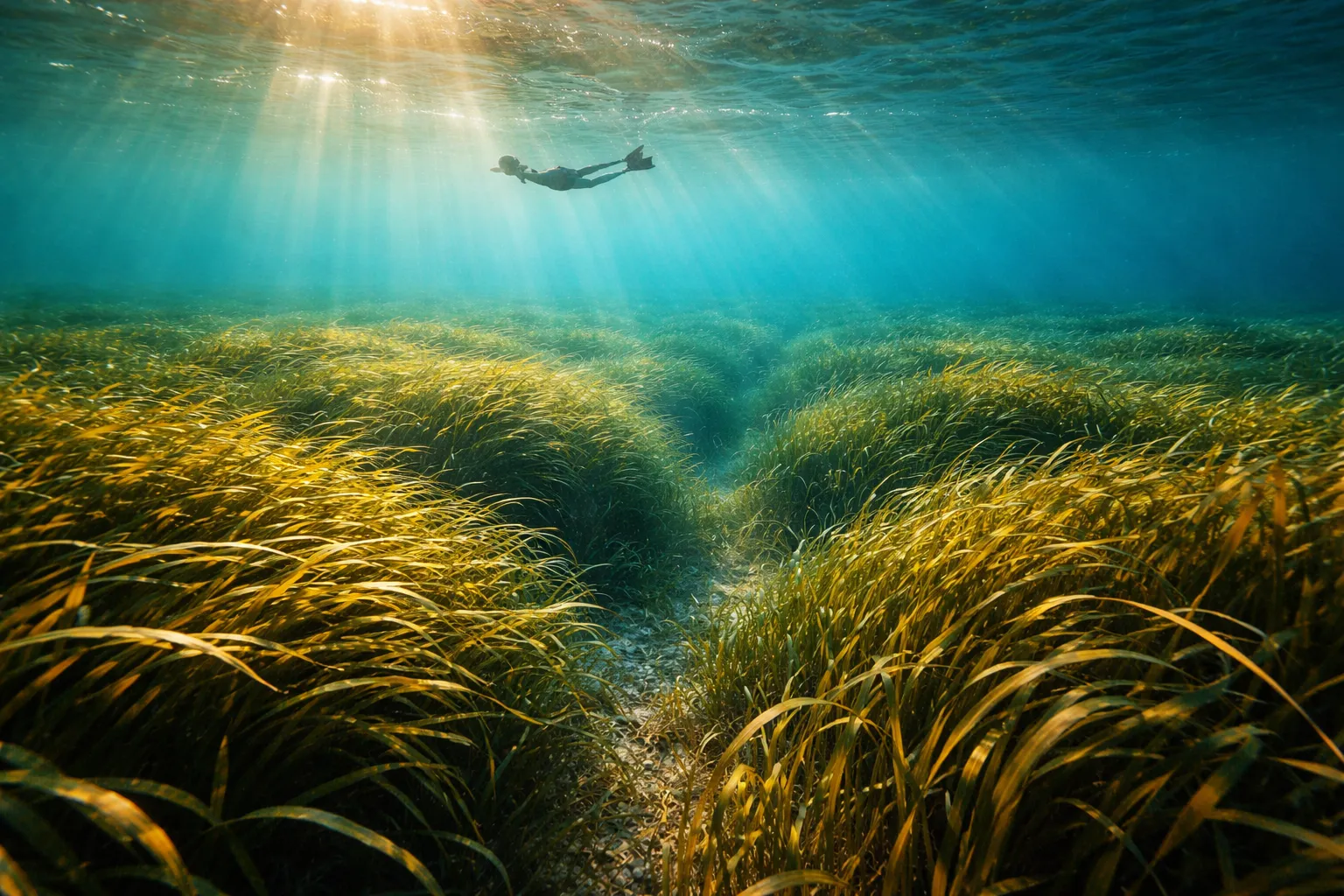
Roughly 100,000 years old, spread across 8 kilometers of seafloor between Ibiza and Formentera, and reachable with nothing more than a mask and a boat ride — that’s the seagrass meadow currently holding the title of oldest living organism on the planet. One hundred thousand years. This isn’t a colony of separate plants but a single genetic individual, one clonal organism that copied itself outward across the Balearic shallows long before Homo sapiens had a foothold in Europe. It was already growing before the last Ice Age. Neanderthals were still around when it took root. And on some ordinary Tuesday in September, you can slide off the back of a boat and drift right above it. Forget museum displays or roped-off monuments — the oldest thing alive on Earth sits about 3 meters under some of the clearest water anywhere, still doing what it’s done for a hundred millennia: cleaning the sea, sustaining everything that lives in it, and simply refusing to die.
What Is the Oldest Living Organism in the World?
The record-holder is a Posidonia oceanica seagrass meadow in Spain’s Balearic Islands, dated to somewhere between 80,000 and 100,000 years old. You’ll find it inside Ses Salines Natural Park, in the strait separating Ibiza and Formentera, spanning about 8 kilometers (5 miles) of ocean floor. Crucially, it’s one clonal individual — every single shoot across that entire span carries identical DNA, all of it traced back to one original plant that spread through vegetative growth rather than seed-based reproduction.
The age comes from a 2012 paper in PLOS ONE, produced by a University of Western Australia team that tested genetic diversity at multiple points across the meadow — finding almost none — and then worked backward using the plant’s documented spread rate of about 1 to 2 centimeters per year. Stretch that math across 8 kilometers and the resulting number is almost hard to process.
Some perspective: the oldest single tree on record is Methuselah, a bristlecone pine tucked into California’s White Mountains, verified at 4,855 years. Utah’s Pando aspen grove — often the go-to answer for “oldest living organism” — checks in around 80,000 years, close to the Ibiza meadow’s age but currently in sharp decline. Among non-clonal organisms, Methuselah almost certainly takes the crown. But once you accept that a clonal organism — a single genetic lineage propagating through identical copies of itself — still counts as one living thing, this seagrass meadow pulls well ahead of everything else.
That distinction isn’t trivial — biologists genuinely argue over whether clonal life counts as a single organism. Here’s the straightforward take: this particular patch of Posidonia oceanica is one unbroken genetic entity, has never split off a genetically distinct offspring through sexual reproduction, and has kept living, continuously, for roughly 100,000 years. Under any fair definition, that puts it at the top of the list.
Put the timeline in context: 100,000 years ago, humans hadn’t yet spread out of Africa in any real numbers. Farming was still 90,000 years away. The Pyramids of Giza date back roughly 4,500 years — meaning this seagrass had already been growing for 95,500 years before the first block was set at Giza.
How This Seagrass Pulled Off Near-Immortality
Posidonia oceanica — often nicknamed Neptune grass — isn’t a seaweed at all. It’s a flowering plant, an angiosperm, with closer ties to land grasses than to algae. Its family tree stretches back at least 70 million years, meaning relatives of this plant were already rooted in shallow coastal water while non-avian dinosaurs still roamed dry land.
What sets the Ibiza meadow apart is how it multiplies. Posidonia oceanica spreads mostly through cloning — pushing horizontal underground stems, or rhizomes, outward at that painfully slow 1-to-2-centimeter annual crawl, generating shoots that are genetically identical copies of the original. Seed-based reproduction does occur in the species, but in this specific meadow, cloning has so thoroughly dominated the process that sexual reproduction appears to be rare to nonexistent — leaving the genome nearly uniform across the full 8 kilometers.
Researchers pinned down the age using a two-step process: first checking genetic variation among samples pulled from different spots in the meadow (the near-total absence of variation confirmed it was one clone), then running the known growth rate backward to estimate when the original plant first sprouted. That calculation landed somewhere between 80,000 and 100,000 years ago.
This plant also does heavy lifting ecologically. A single square meter of Posidonia oceanica can release up to 14 liters of oxygen daily, and the Ses Salines meadows are a major reason the water around Ibiza and Formentera stays so remarkably clear. The meadows trap sediment, lock away carbon, hold the seafloor in place, and serve as a nursery for hundreds of species of Mediterranean fish and invertebrates. UNESCO’s 1999 World Heritage listing for Ibiza’s natural and cultural sites isn’t just ceremonial — it reflects the real ecological weight these meadows carry, since the surrounding coastal ecosystem functions far worse without them.
These meadows are also in real trouble. Anchoring boats has done more mechanical damage than anything else — a single dropped anchor can wipe out a patch of seagrass that took 500 years to establish. Ibiza outlawed anchoring within Posidonia zones back in 2018, and Formentera has been tightening enforcement of its eco-buoy mooring system. Even a modest 1–2°C rise in water temperature puts real stress on the plant. Depending on the region, scientists estimate Mediterranean Posidonia coverage has dropped somewhere between 13% and 50% in recent decades.
Here’s a small detail worth knowing: Posidonia generates what’s called “Neptune balls” — dense clumps of decomposed leaf fiber, typically 4 to 15 cm across, known as egagropiles, that wash ashore on Mediterranean beaches. Most visitors nudge them aside with a foot, assuming they’re litter. In reality, they’re a sign of a healthy underwater system — beaches littered with them tend to sit near flourishing seagrass meadows.
Where to Actually Go: Ibiza, Formentera, and Shark Bay
Formentera and Ibiza, Balearic Islands, Spain
Formentera is the smarter base for seagrass snorkeling, though getting there takes some effort. It sits roughly 7 km south of Ibiza, and the ferry crossing from Ibiza Town’s harbor runs about 30 minutes (departures every 30–60 minutes in summer, tickets around €25–€35 round trip). The island is smaller, calmer, and — this is the part that matters — the water along its northern shore facing Ibiza is the clearest anywhere in the western Mediterranean, with visibility that routinely tops 30 meters. Ask any local why, and they’ll point straight to the Posidonia.
For snorkeling directly above the Posidonia oceanica meadows, your best access point is Ses Illetes, a slim strip of peninsula on Formentera’s northern edge. The seagrass starts as close as 20 meters from shore, in water just 2 to 4 meters deep — shallow enough for anyone comfortable in the water, and clear enough that you can pick out individual blades from the surface. The canopy spreads dark green in every direction beneath you, and if you stay still, you’ll likely share the water with sea bream, octopus, pipefish, and the occasional passing turtle.
On Ibiza’s side of the protected area, Playa de ses Salines — down at the island’s southern tip inside Ses Salines Natural Park — also gives you access to the meadow’s edges, though the beach draws bigger crowds and the water is a notch less transparent than what you’ll find on Formentera’s north coast. The park spans 2,800 hectares of land and sea combined, and getting in costs nothing.
For seagrass snorkeling in this part of the Mediterranean, aim for May through June or September through October. Water sits at a comfortable 20–24°C — no wetsuit needed for most swimmers — and the crowds thin out considerably compared to the July–August rush. That peak stretch gets genuinely rough: Formentera’s population balloons from around 12,000 residents to over 80,000 visitors, parking spots vanish, and Ses Illetes is packed shoulder-to-shoulder by 10 a.m.
Shark Bay, Western Australia — Home of the World’s Biggest Plant
For a different flavor of deep-time biology travel, Shark Bay in Western Australia delivers something entirely separate from Ibiza. Researchers confirmed in 2022 that a Posidonia australis meadow there is one single clonal organism spanning roughly 200 square kilometers (77 square miles) — the largest known plant on the planet by surface area. Its estimated age is around 4,500 years, far younger than the Ibiza meadow, but it dwarfs it in raw size.
Getting to Shark Bay takes commitment — it’s about 800 km north of Perth, roughly a 9-hour drive, or a short flight to Monkey Mia — but it earns its place on any ancient-life itinerary. The same bay is home to Hamelin Pool, where you’ll find the world’s largest living stromatolites: rock-like formations built layer by layer by cyanobacteria from a lineage stretching back 3.5 billion years, making them the oldest complex life on the planet. Walk the Hamelin Pool boardwalk and you’re staring at organisms whose ancestors predate a young Moon. Shark Bay carries its own UNESCO World Heritage status, granted in 1991.
Gear That Won’t Fail You While You Float Over 100,000 Years of History
Trying to get a proper look at something older than human civilization is not the moment to be dealing with a leaking mask or a snorkel that pops loose every time you adjust your position. The shallows around the Balearics are clear and misleadingly still, which tends to keep you out there far longer than you planned — so your equipment has to hold up under that extra time.
What holds up
- The seal holds firm without clamping down on your face hard enough to give you a headache an hour in — which matters when you’re trying to stay locked in on a seagrass meadow, not distracted by discomfort.
- The fins offer enough steering to hover precisely over a chosen section of meadow without stirring up sediment clouds that wreck visibility in shallow water.
- The snorkel keeps water out on the inhale, which counts for a lot when you’re bobbing in open water with a little swell and standing up isn’t an option to clear it.
What falls short
- That translucent aquamarine finish photographs beautifully but shows off every trace of salt buildup and grime — expect to rinse it down constantly across a multi-day snorkeling stretch.
- The fins run tight right out of the packaging, and if your feet aren’t used to that kind of pressure, the break-in stretch drags on longer than you’d like before a full day in the water.
I almost turned back on day two when my mask felt slightly loose after a night of rinsing, convinced something had warped—but a proper dry and adjustment proved I was just overthinking it. Grab the Cressi Bonete Pro Dry Set (Mask + Snorkel + Fins, Translucent Aquamarine, S/M) and spend your energy on what actually matters: staring down at a living fossil.
Frequently Asked Questions
How old is the seagrass meadow between Ibiza and Formentera?
The Posidonia oceanica meadow in Ses Salines Natural Park is roughly 100,000 years old, with researchers dating it somewhere between 80,000 and 100,000 years ago. The age was determined in a 2012 PLOS ONE paper by a University of Western Australia team that tested genetic diversity and worked backward using the plant’s documented spread rate of about 1 to 2 centimeters per year.
Where exactly can you snorkel the ancient seagrass in Spain?
Ses Illetes, a slim strip of peninsula on Formentera’s northern edge, offers the clearest access. The seagrass starts as close as 20 meters from shore in water just 2 to 4 meters deep. Playa de ses Salines on Ibiza’s southern tip inside Ses Salines Natural Park also provides meadow access, though with slightly less transparent water and bigger crowds.
What is the best time to snorkel Posidonia oceanica near Ibiza?
Aim for May through June or September through October, when water sits at a comfortable 20–24°C without needing a wetsuit for most swimmers. July–August brings roughly 80,000 visitors to Formentera, which normally has around 12,000 residents, creating crowded conditions and packed beaches by morning.
How do you get from Ibiza to Formentera for seagrass snorkeling?
The ferry crossing from Ibiza Town’s harbor to Formentera runs about 30 minutes with departures every 30–60 minutes in summer. Round trip tickets cost around €25–€35. Formentera sits roughly 7 km south of Ibiza and offers the clearest water, with visibility that routinely tops 30 meters.
About This Article

Written by Elena Vasquez. Elena Vasquez is a full-time traveler and the founder of Witty Passport. Over fifteen years and more than 50 countries across six continents — including a stretch spent leading groups professionally through Southeast Asia and the remote highlands of South America — she's written the kind of destination guides she always wished existed: practical, specific, and built on real experience rather than recycled itineraries. More about this site.
Scope and limits. Elena is a full-time traveler, not a licensed travel agent or immigration adviser. Entry requirements, visa rules, and advisories change without notice — always confirm against the official government source for your destination and passport before booking.
Verify this against a primary source
Specifics change, and your situation may differ from the one described here. These are the authorities worth checking directly:
- U.S. Department of State — entry requirements and travel advisories
- CDC Travelers' Health — vaccination and health notices by destination
- TSA — current carry-on and screening rules