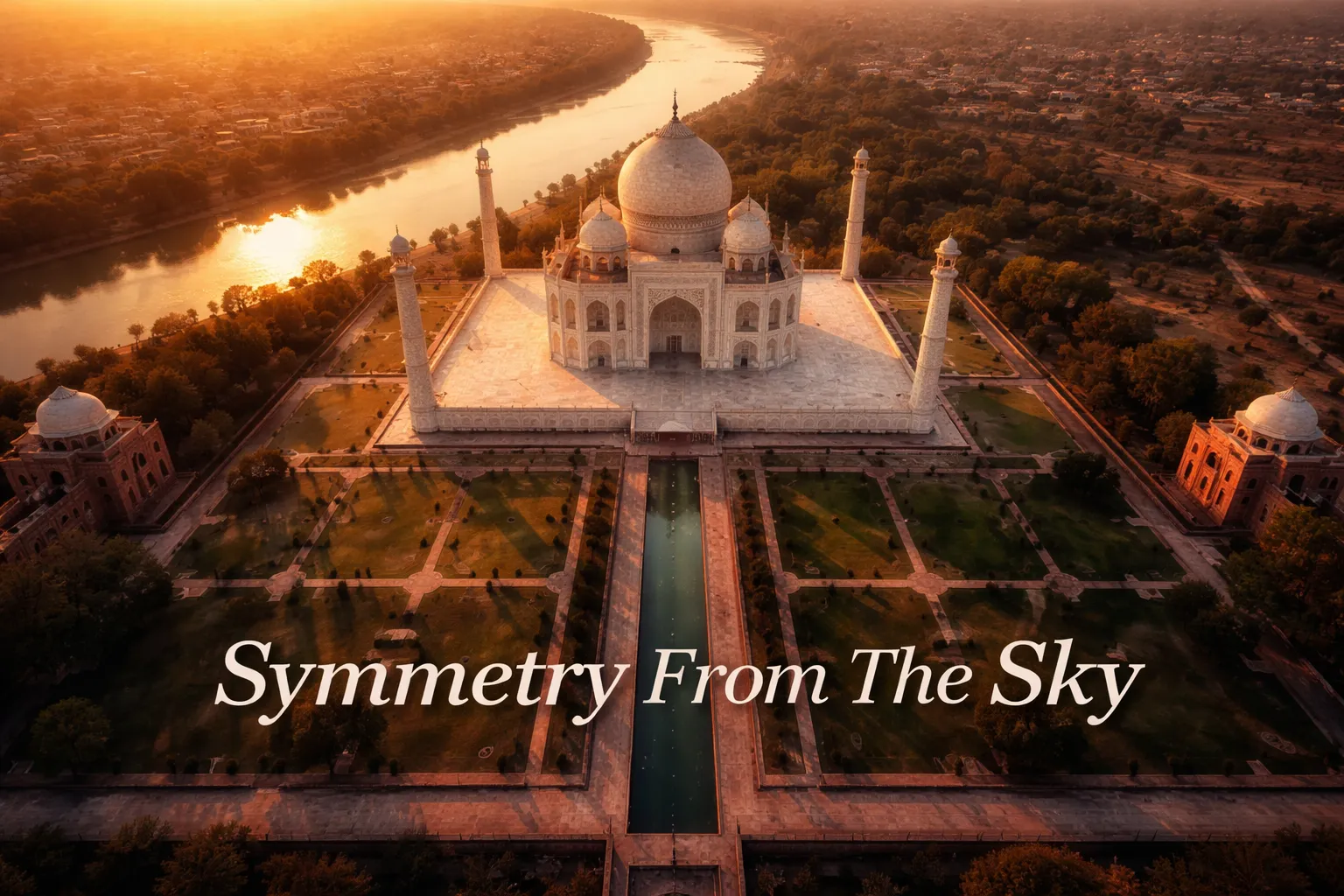
Every backpacker forum has that one comment buried in a thread somewhere: “just launch at 5am before the guards show up, nobody’s watching that early.” I heard some version of that advice repeated at three separate guesthouses in Agra, and each time I wanted to ask the person saying it whether they’d actually tried — because they hadn’t, and the travelers who did got their drones confiscated within minutes of takeoff. Here’s what that advice completely misses: the real payoff at the Taj isn’t smuggling a drone past a checkpoint, it’s what satellite imagery already hands you, legally, for free. Pull up an aerial view of the monument and you stop scrolling mid-swipe. This isn’t just a handsome building seen from above — it reads like a mathematical proof, a philosophical statement laid out in white marble across the Agra floodplain with a precision that makes you wonder if Shah Jahan had a drone of his own and simply never mentioned it. Taj Mahal drone photography aerial content dominates travel photography circles for exactly this reason: the monument was engineered to hold symmetry from every angle imaginable, straight down included. Four minarets, a central dome, a long reflecting pool, and a charbagh garden split into four quarters combine into something that, from the sky, stops resembling architecture and starts looking like a living mandala. I’ve studied aerial photography of monuments on six continents, and nothing quite prepares you for how deliberate this one looks once you’re above it.
Drone Flight Brief: Taj Mahal Aerial Photography Quick Reference
| GPS Coordinates | 27.1751° N, 78.0421° E (Taj Mahal central dome) |
| Recommended Altitude Range | N/A — drones are strictly prohibited. For context, authorized satellite and media imagery is typically captured at 300–600m+ above ground level. |
| Best Time of Day | Dawn (pink marble effect) or 45 minutes before sunset (golden tone). Full moon nights produce a silvery-white illumination. |
| Best Season | October through March — clear skies, low haze, cooler temperatures. Avoid June–August (monsoon reduces visibility dramatically). |
| Drone Regulations Summary | STRICTLY PROHIBITED. The Archaeological Survey of India (ASI) bans all drone flights over the Taj Mahal and surrounding Agra monuments. Flying without authorization carries criminal penalties under India’s Unmanned Aircraft System Rules 2021. Do not attempt. |
| Skill Level Required | N/A (prohibited) — Legal riverside alternatives require intermediate-to-advanced skill due to wind off the Yamuna River and populated surroundings. |
| Legal Aerial Alternatives | Yamuna River bank viewpoints (north side), authorized media/government aerial surveys, and publicly available high-resolution satellite imagery. |
Is Drone Flight Over the Taj Mahal Actually Legal?
I want zero ambiguity here, because too many travel blogs hedge around this exact question: drone flying over Taj Mahal India is illegal, full stop. The Archaeological Survey of India enforces a blanket ban on unmanned aircraft over every ASI-protected site, and the Taj sits right at the top of that list. India’s Unmanned Aircraft System (UAS) Rules 2021 go further, designating the entire Taj Mahal precinct a Red Zone — meaning no drone operation of any kind without direct authorization from the central government, and that authorization essentially never reaches individual photographers or tourists.
The fallout for ignoring this is real. ASI security and local police maintain constant watch over both the monument grounds and the airspace above them. Get caught operating a drone in or near the complex and you’re facing confiscated equipment, steep fines, and possibly criminal charges. I’ve spoken with photographers who tried launching from the Yamuna riverbank just north of the site and were stopped by authorities before their drones even cleared head height. The restricted zone extends well past the monument’s outer walls. This isn’t the kind of gray area where you quietly try your luck and apologize afterward.
What genuinely exists — and what makes this whole subject worth digging into — is a substantial archive of legally obtained aerial material: high-resolution satellite captures, sanctioned media flyovers, and government survey photography, all of it exposing the Taj’s geometry from above in remarkable detail. Understanding what that imagery actually shows, and knowing where to find it, is the real substance of aerial photography at this site.
What Aerial Views of the Taj Mahal Really Show You
Standing at ground level, the Taj Mahal overwhelms you with scale, marble, crowds, and heat — total sensory overload. But that vantage point conceals the monument’s biggest secret. Climb to altitude and the Taj Mahal from above drone view, or its satellite equivalent, uncovers something no guidebook fully prepares you for: the entire complex functions as a cosmological diagram.
The charbagh — that four-quartered formal garden running from the main gateway to the mausoleum’s raised platform — splits along two primary water channels meeting at a central fountain pool. Viewed from above, those channels align with the cardinal directions, and the precision is sharp enough to read as deliberate celestial mapping. Each garden quadrant then subdivides again, forming a 4×4 grid of planting beds that only becomes legible once you’re looking down from altitude. This is Islamic paradise garden design pushed to its most mathematically refined form, and the full structure simply doesn’t register from the ground.
The mausoleum itself rests on a square plinth measuring 95 meters per side — a fact that lands differently from above, where the sharp-edged square base plays against the circular dome rising out of its center. Here’s something that genuinely caught me off guard the first time I studied high-resolution aerial imagery closely: none of the four minarets stand perfectly upright. Each one tilts outward from the central structure by roughly 2.7 degrees, a deliberate engineering choice so that an earthquake would send them toppling away from the tomb rather than crashing onto it. Seen straight from above, that outward lean produces a faint but unmistakable star-burst pattern around the central dome, almost as though the minarets are being pushed away from whatever sits at the center.
The most striking discovery from above, though, sits across the river. On the Yamuna’s northern bank, directly facing the Taj Mahal, satellite photography reveals the excavated foundation of what historians now call the “Black Taj Mahal” — a mirrored mausoleum Shah Jahan reportedly intended for his own burial, built in black marble and connected to the white Taj by a bridge. Construction never got underway — his son Aurangzeb had him imprisoned before ground could break — but the foundation platform remains plainly visible from altitude, hinting that the original vision was a matched pair of monuments reflected across the water: Mumtaz’s white tomb and Shah Jahan’s black one, symmetrical across the river itself.
Taj Mahal Symmetry Aerial Photography: Why the Geometry Matters
The Taj Mahal’s celebrated symmetry aerial photography draws its power from bilateral symmetry — the complex mirrors itself perfectly along both its north-south and east-west axes. But viewed from altitude, you realize this symmetry operates at several scales at once. The arabesque inlay patterns carved into the marble mirror each other. The garden beds mirror across both axes. The entrance gateway mirrors the mausoleum. The mosque and guesthouse buildings flanking the main tomb are exact twins of one another. The result is almost fractal — symmetry repeating at every zoom level — which is exactly why aerial shots of the Taj Mahal grab attention even shrunk down to thumbnail size.
The marble’s appearance shifts dramatically with the light, which matters enormously for timing an aerial shoot. At dawn, the white stone takes on a deep rose-pink cast as it catches the low angle of early sun — the origin of that old line about the Taj “changing color like a mood ring.” By mid-morning it turns cool and nearly blinding white. At sunset, it warms into a burnished amber-gold. Under a full moon, it shifts again into a ghostly silver-blue. For aerial photography purposes, dawn and the final hour before sunset deliver the richest tonal range and the longest shadows — shadows that, seen straight down, trace the building’s geometry in dark relief against glowing marble.
Agra Drone Photography Guide: What’s Actually Legal to Shoot
Even with the ban on flying over the Taj itself, an agra drone photography guide still has real options worth knowing about. The Yamuna River forms a natural buffer along the complex’s northern edge, and a handful of riverside spots outside the ASI-restricted perimeter have hosted authorized shoots. Authorized is the operative word — before flying anywhere in Agra, you need clearance from the Directorate General of Civil Aviation (DGCA) through India’s Digital Sky Platform, plus separate written sign-off from the ASI if your flight path comes within visual range of protected monuments. It’s a multi-step process that usually takes weeks, and realistically it’s only within reach of professional media outlets, documentary teams, or commercial operators holding the right credentials.
So what’s left to shoot without a drone? More than you’d expect. The Taj Mahal’s north gate — a short walk from the main ticket office — opens right onto the Yamuna riverbank and delivers the celebrated “Moon Gate” view looking south along the water toward the Taj. It’s one of the finest ground-level compositions anywhere, and with a telephoto lens it becomes something close to spectacular. Agra Fort, roughly a 20-minute drive west, gives you elevated rampart views looking east across the river toward the Taj — the same sightline Shah Jahan relied on during his imprisonment. Neither is technically aerial, but both offer raised perspectives that expose geometry the main entrance approach never shows you.
If aerial imagery specifically is what you’re after, Google Earth Pro gives you the easiest access to high-resolution satellite views, complete with historical layers that let you compare the site season by season, year by year. ISRO (the Indian Space Research Organisation) also releases high-resolution survey imagery of the Taj complex from time to time, and at full resolution it’s honestly stunning.
The Filter Setup That Kept My Taj Mahal Footage From Blowing Out at Midday
Agra’s white marble bounces sunlight like a mirror, and by noon the glare gets so intense your drone footage turns into a blown-out, detail-less blob. I found this out the hard way — a solid ND/PL filter combination is what separates footage you can actually publish from a folder of shots you delete in frustration.
Where it delivers
- The ND16 cuts down glare just enough to bring detail back into the marble, without darkening the sky so much that the whole frame feels flat and underexposed.
- The polarizer earns its place in the kit — it kills the harsh reflection bouncing off the Yamuna and the site’s water features that would otherwise wash everything out.
- Having three filters in one kit lets you shoot the entire day — dawn, midday, golden hour — without constantly swapping hardware or missing the light while you fumble with gear.
Where it falls short
- The magnetic mount holds fine — until it doesn’t. I’ve had a filter shift slightly mid-pan, which is unsettling when you’re 200 feet above solid marble.
- If your drone model doesn’t already use a compatible mount, you’ll need to buy a separate magnetic adapter ring, which means extra cost and one more piece of gear to keep track of.
I almost ditched the filters entirely on the second day because I couldn’t get the ND32 setting right and thought I was just bad at exposure compensation, but swapping to the ND16 immediately made the difference—turns out I was just overthinking it. Grab the NEEWER Filter Set Compatible with Insta360 Ace Pro 2 US Version Only and actually use them.
Frequently Asked Questions
Is it legal to fly a drone over the Taj Mahal?
No. Drone flying over the Taj Mahal is illegal. The Archaeological Survey of India enforces a blanket ban on unmanned aircraft over every ASI-protected site, and India’s Unmanned Aircraft System Rules 2021 designate the entire Taj Mahal precinct a Red Zone. Getting caught operating a drone carries confiscated equipment, steep fines, and possibly criminal charges.
What legal alternatives exist for aerial Taj Mahal photography?
You can access high-resolution satellite imagery through Google Earth Pro or ISRO (Indian Space Research Organisation) releases. For ground-level elevated perspectives, visit Yamuna River bank viewpoints on the north side or Agra Fort, roughly a 20-minute drive west, which offers rampart views looking east across the river toward the Taj.
What do aerial views of the Taj Mahal actually reveal?
Aerial views expose the monument’s function as a cosmological diagram. The charbagh garden splits along two water channels aligned with cardinal directions, subdividing into a 4×4 grid of planting beds. The four minarets tilt outward by roughly 2.7 degrees, creating a star-burst pattern around the central dome. Satellite photography also reveals the excavated foundation of the “Black Taj Mahal” on the Yamuna’s northern bank.
What time of day shows the Taj Mahal marble best from above?
Dawn produces a deep rose-pink cast on the marble, while 45 minutes before sunset delivers a burnished amber-gold tone. Both times offer the richest tonal range and longest shadows that trace the building’s geometry in dark relief. Full moon nights produce silvery-white illumination.
About This Article

Written by Elena Vasquez. Elena Vasquez is a full-time traveler and the founder of Witty Passport. Over fifteen years and more than 50 countries across six continents — including a stretch spent leading groups professionally through Southeast Asia and the remote highlands of South America — she's written the kind of destination guides she always wished existed: practical, specific, and built on real experience rather than recycled itineraries. More about this site.
Scope and limits. Elena is a full-time traveler, not a licensed travel agent or immigration adviser. Entry requirements, visa rules, and advisories change without notice — always confirm against the official government source for your destination and passport before booking.
Verify this against a primary source
Specifics change, and your situation may differ from the one described here. These are the authorities worth checking directly:
- U.S. Department of State — entry requirements and travel advisories
- CDC Travelers' Health — vaccination and health notices by destination
- TSA — current carry-on and screening rules