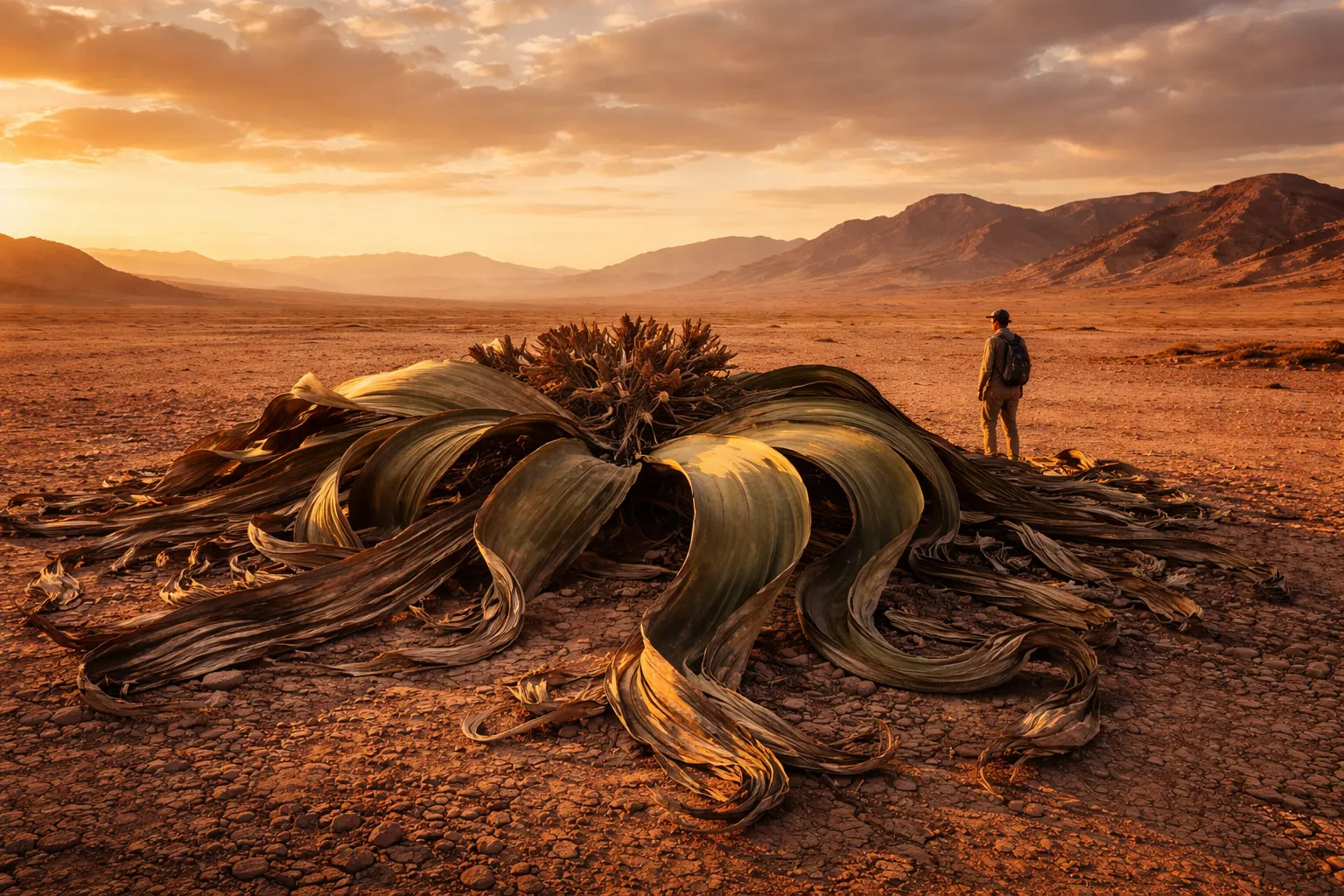
I’m crouched in the gravel outside Swakopmund, camera hanging forgotten around my neck, trying to figure out why my guide is grinning at what looks like a pile of leather scraps someone ran over with a truck. That’s the honest first impression of welwitschia mirabilis, the oldest plant species still clinging to life in the Namib Desert — a sprawling, torn heap of straps splayed across the sand like something that lost a serious argument with a lawnmower. Then comes the number that changes everything: this exact specimen has occupied this exact patch of dirt for roughly 1,500 years, and in all that time it has grown precisely two leaves. Two. That’s the whole story, and it’s the reason I’m still kneeling here longer than any guide has patience for. The welwitschia mirabilis oldest plant story starts right here, dust on my knees, jaw somewhere down near the gravel.
How Old Is Welwitschia Mirabilis — And Does It Really Only Grow Two Leaves?
It’s true — welwitschia mirabilis grows exactly two leaves across its entire life, and those same two leaves can persist for more than 2,000 years. That’s not a rounded-off figure for the sake of a good story. It’s arguably the strangest structural and reproductive quirk anywhere in the plant world.
The mechanics go like this: the seedling starts with two cotyledons, which eventually wither away. Beneath them, a growth zone at the stem’s base pushes out two strap-like leaves, and those two keep extending outward from that same base for as long as the plant lives. They never drop. They’re never swapped out for new ones. Instead, they split along their length at the tips as decades pass, get shredded by desert wind, and curl back over themselves — which is exactly why a mature welwitschia reads as a tangled mess rather than a single plant. The dozens of “leaves” you think you’re looking at on a big specimen are really just two leaves that have spent centuries growing and tearing apart.
So — welwitschia age how old, exactly? It varies by plant. The ones you’ll typically spot along guided routes run somewhere between 500 and 1,000 years. The record-holder — nicknamed “The Big Welwitschia,” sitting near Messum Crater in Namibia — has been carbon-dated to somewhere between 1,500 and 2,000 years old. Do the math and that plant was already alive when Rome’s western empire collapsed. It predates the first Viking landing in North America. It was already growing before Angkor Wat was built.
Its scale plays against expectations too. The main stem barely lifts off the ground — rarely more than 50 centimeters in height — yet the oldest specimens can spread past 1.4 meters across, with individual leaves trailing as far as 4 meters from the central core. Carbon-14 testing on these larger plants routinely comes back in the 1,000-to-2,000-year range, which puts welwitschia far ahead of anything else in the Namib as the region’s longest-surviving non-clonal species.
Some context helps here: Crete’s oldest documented living olive tree is roughly 3,000 years old. A mature English oak rarely makes it past 800. Which means the welwitschia specimens standing behind the fencing along Namibia’s Welwitschia Drive — clearly labeled with interpretive panels — have been alive longer than most of the cathedrals scattered across Europe.
What Makes Welwitschia the Oddest Plant on the Planet
Friedrich Welwitsch — the Austrian-Portuguese botanist credited with introducing this species to Western science back in 1863 — is said to have dropped to his knees in front of the first specimen he encountered in Angola and simply stared, unable to write anything down for several minutes. Given what he was looking at, that reaction tracks. Describing welwitschia as merely “strange” undersells it about as much as calling the Grand Canyon a gully.
Welwitschia mirabilis stands entirely alone taxonomically — the only species in its family, Welwitschiaceae, and the only member of its order, Welwitschiales. Its nearest living cousins aren’t other desert survivors — they’re ginkgo trees and cycads. Genetically, this lineage split off from the rest of the plant kingdom around 86 million years ago, back in the Cretaceous, while dinosaurs still ran the show on land. Everything else related to it exists only in the fossil record now. Call it a living fossil and you’re not reaching for a metaphor — you’re stating its actual classification.
Its approach to water is just as unlikely. The oldest desert plants in the Namib are up against a brutal baseline: most of the central Namib gets under 25 millimeters of rain annually. Welwitschia gets around this mainly by drinking fog. Cold air moving off the Benguela Current — the chilly Atlantic current tracking up southern Africa’s coastline — sweeps inland as heavy morning fog roughly between August and November, and the plant’s sprawling leaf surface pulls that moisture straight in through thousands of tiny stomata. Its taproot, capable of pushing 3 meters or deeper into the gravel and sand, backs this up during the occasional real rainfall, but fog does the heavy lifting.
It’s also dioecious — individual plants are strictly male or strictly female, never both. Each sex produces its own cone-like structures. Pollination falls largely to Probergrothius sexpunctatis, a small true bug drawn to the plant’s resinous secretions, which ends up carrying pollen from one specimen to another in the process. This particular bug-and-plant partnership has almost certainly been running for millions of years.
Namibia rates this plant highly enough to put it on the national coat of arms, and the IUCN currently lists welwitschia as Least Concern — though that label comes with caveats. The entire species survives within one narrow coastal strip of the Namib, about 1,000 kilometers long and 100 to 200 kilometers wide. Off-road vehicles tearing up habitat, people collecting seeds, and shifting climate patterns that could disrupt fog frequency are all real, documented threats. The fences around the oldest specimens on the Welwitschia Drive aren’t decorative — stay on the correct side of them.
Best Places in Namibia to Find Welwitschia in the Wild
Namibia is where you go if you actually want to see welwitschia growing wild. Angola technically shares part of the plant’s natural range, but between infrastructure, ease of access, and safety, Namibia wins for nearly every traveler. Below are the three main ways to see it, ordered from easiest to hardest.
Welwitschia Drive, Namib-Naukluft National Park
Most people who come see welwitschia do it here, and it doesn’t disappoint. The Namibia Welwitschia Drive is a signposted 4WD loop starting about 15 kilometers east of Swakopmund off the B2 highway. It runs roughly 60 kilometers over gravel and washboard desert track, fits comfortably into half a day, and winds through some genuinely striking Namib scenery — black lichen fields, lunar-looking flats, dried-up riverbeds — before reaching the fenced specimens out on the Welwitschia Plains.
You’ll need a permit before driving the route, issued by the NWR (Namibia Wildlife Resorts) office in Swakopmund at 18 Bismarck Street, open weekdays 8am to 5pm and Saturday mornings. As of 2024, permits run about NAD 100–150 per person per day (roughly USD 5–8), though rates shift periodically, so double-check before you go. The permit itself functions as a self-guided brochure too, with numbered stops matching the signage you’ll pass along the way.
The centerpiece of the drive is the large fenced plant on the Welwitschia Plains — roughly 1,500 years old, its leaves fanning out nearly 4 meters from the crown. The interpretive signage lays out the biology simply enough that you’ll be able to explain it to a curious kid by the end of the visit. On the way, you’ll also cross lichen fields so delicate that one careless footprint can wipe out 200 years’ worth of growth — stick to the marked paths only.
Messum Crater
About 100 kilometers north of the Welwitschia Drive sits Messum Crater, home to “The Big Welwitschia” — the roughly 2,000-year-old specimen widely considered the oldest individual plant in the Namib. This is real 4WD terrain: deep sand, zero marked tracks, zero facilities. Getting there generally means booking a guided tour out of Swakopmund or having serious overlanding chops of your own — high-clearance vehicle, a backup car, recovery gear, and a GPS route pre-loaded before departure. Skip this one solo if it’s your first trip to Namibia.
When to Go
The Welwitschia Drive works year-round if you’ve got the right 4WD vehicle. April through October, Namibia’s dry season, gives you the smoothest roads and clearest skies. But if you want to actually watch welwitschia do the thing it’s famous for — pulling moisture out of cold Atlantic fog — aim for August through November, when the Benguela fog reliably rolls in during the mornings. Showing up at the plains by 7am on a foggy day is a completely different experience than arriving at noon under dry, clear conditions. Pack layers — that fog carries real cold.
The Resource That Kept Me From Getting Lost in the Namib
Try self-driving Namibia without a solid route planner and you’ll likely find yourself parked on a gravel stretch at dusk, no signal, squinting at a GPS screen like it’s some kind of ancient script. A thorough guide covering real 4×4 logistics and genuine Etosha knowledge is what separates a smooth safari from an expensive wrong turn.
What holds up
- The section on 4×4 rentals genuinely breaks down which vehicles handle gravel terrain without wrecking your budget, rather than defaulting to “just get the biggest truck.”
- The camping advice tells you where water is actually available and which rest camps run generators — the practical details you need at 6pm when you’re exhausted and hungry, not vague “embrace the wilderness” filler.
- Etosha routes come mapped with concrete wildlife hotspots and honest drive-time estimates, so you’re not chasing a herd based on secondhand gossip from a hostel common room.
Where it falls short
- It’s thick enough that flipping to a random page mid-drive won’t cut it — read the relevant sections ahead of time instead of trying to absorb them roadside with your phone out.
- Prices and road conditions change quickly enough that even a 2026 edition may feel a little dated if you’re planning more than a year in advance.
I almost ditched it halfway through Day 2 because I thought my own instincts would be faster, and I nearly missed the turn-off to the welwitschia grove entirely. Get the Namibia Self-Drive Safari Guide 2026: The Ultimate Road Trip Planner with 4×4 Rental Advice, Etosha Wildlife Secrets, Camping Tips, Budget Breakdown before you leave home and actually read it.
Frequently Asked Questions
How many leaves does welwitschia mirabilis grow in its lifetime?
Welwitschia mirabilis grows exactly two leaves across its entire life. Those same two leaves can persist for more than 2,000 years, splitting along their length at the tips as decades pass and getting shredded by desert wind rather than being replaced by new ones.
How old is the oldest welwitschia plant in Namibia?
The Big Welwitschia, located near Messum Crater in Namibia, has been carbon-dated to somewhere between 1,500 and 2,000 years old. Specimens along guided routes typically run between 500 and 1,000 years, while carbon-14 testing on larger plants routinely comes back in the 1,000-to-2,000-year range.
What is the Welwitschia Drive permit cost in Namibia?
As of 2024, permits for the Welwitschia Drive run about NAD 100–150 per person per day, roughly USD 5–8. They’re issued by the NWR office in Swakopmund at 18 Bismarck Street, open weekdays 8am to 5pm and Saturday mornings.
How deep can welwitschia roots grow into the ground?
Welwitschia’s taproot is capable of pushing 3 meters or deeper into the gravel and sand. This backs up the plant’s primary moisture-gathering strategy of drinking fog through its leaves during the occasional real rainfall.
About This Article

Written by Elena Vasquez. Elena Vasquez is a full-time traveler and the founder of Witty Passport. Over fifteen years and more than 50 countries across six continents — including a stretch spent leading groups professionally through Southeast Asia and the remote highlands of South America — she's written the kind of destination guides she always wished existed: practical, specific, and built on real experience rather than recycled itineraries. More about this site.
Scope and limits. Elena is a full-time traveler, not a licensed travel agent or immigration adviser. Entry requirements, visa rules, and advisories change without notice — always confirm against the official government source for your destination and passport before booking.
Verify this against a primary source
Specifics change, and your situation may differ from the one described here. These are the authorities worth checking directly:
- U.S. Department of State — entry requirements and travel advisories
- CDC Travelers' Health — vaccination and health notices by destination
- TSA — current carry-on and screening rules