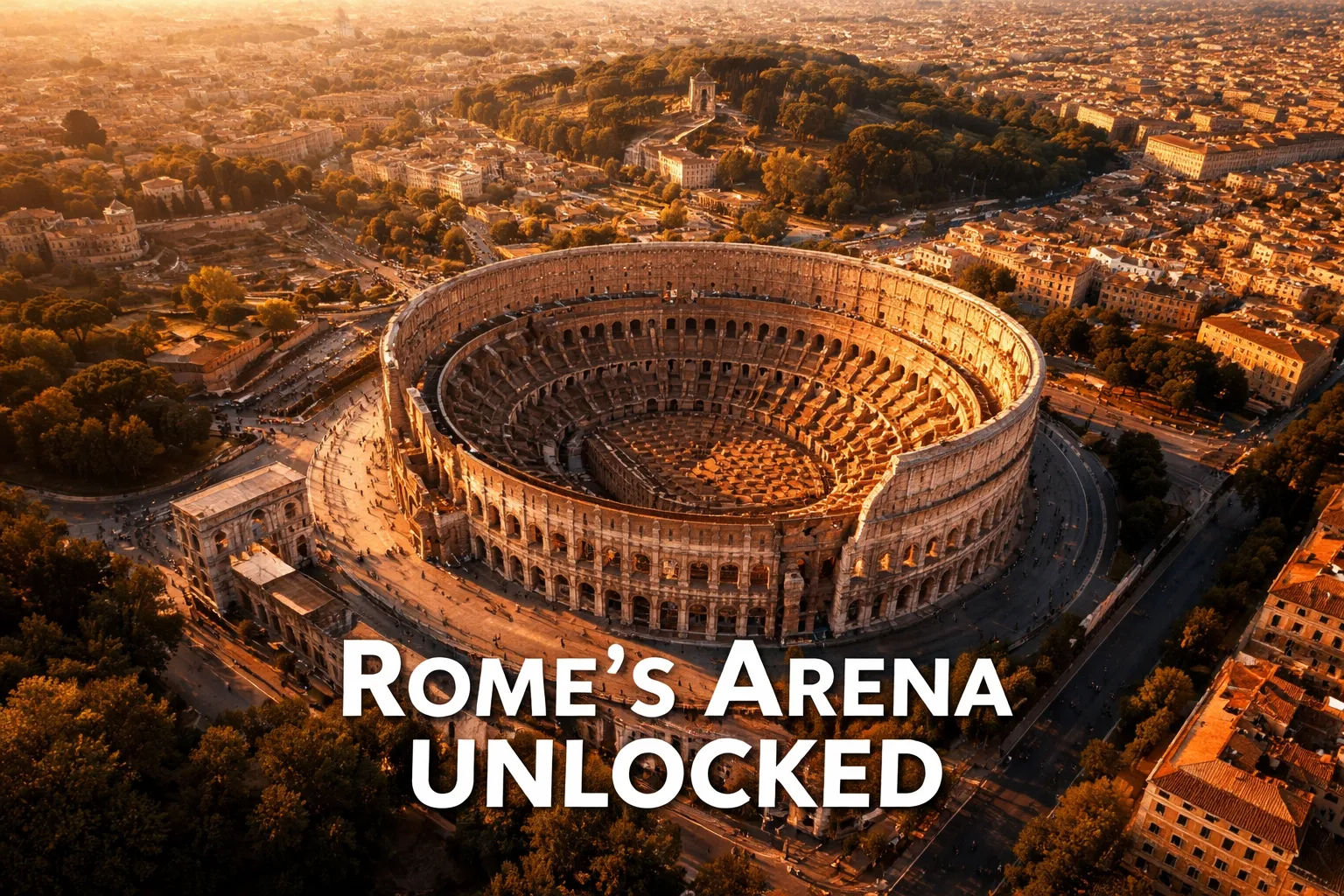
| GPS Coordinates | 41.8902° N, 12.4922° E |
| Recommended Altitude Range | 100–300m for structure overview; 50–80m for architectural detail shots (professional permits only) |
| Best Time of Day | Golden hour (6:00–7:30 AM in summer) — low angle light rakes across the stone arches and creates dramatic shadow relief |
| Best Season | Late March to May; late September to October — lower tourist density, softer light, less heat haze |
| Drone Regulations Summary | BANNED for recreational use. Central Rome is a designated no-fly zone under ENAC (Italy’s Civil Aviation Authority) rules. Professional aerial photography requires authorization from ENAC, the Italian Ministry of Cultural Heritage (MiC), and coordination with the Rome Film Commission. Violations carry significant fines. |
| Skill Level Required | Advanced (permit-holding professionals only for legal flight over the site) |
| Legal Alternatives | Elevated viewpoints from Palatine Hill, Aventine Hill, and the terrace of the Roman Forum — all permit-free and worth every minute |
Can You Fly a Drone Over the Colosseum? The Honest Answer
A few trip-planning sites frame this as a timing problem — fly at dawn, they say, before anyone’s around to notice, and you’ll walk away with your shot. That advice will get your drone confiscated. There’s no quiet-hours loophole here: the entire historic core of Rome — the Colosseum, the Roman Forum, Palatine Hill, and the archaeological zones surrounding them — sits inside restricted airspace enforced around the clock by ENAC, Italy’s national civil aviation authority. This isn’t a fuzzy rule that depends on who happens to be on duty that day. It’s an absolute no-fly designation covering one of the most closely guarded heritage sites on the planet.
Even for professionals, getting the paperwork cleared is a project in itself. You file with ENAC under Italy’s U-Space airspace framework, secure cultural heritage clearance from the Ministero della Cultura (MiC), and — in almost every case — route the whole request through the Rome Film Commission, the body that manages professional film and photo operations inside the archaeological zone. Plan on 4 to 8 weeks minimum for approval, sometimes more. That’s exactly why the aerial Colosseum shots you’ve seen in big-budget documentaries and network broadcasts look so different from everything else out there — what you’re watching is as much a logistical win as a technical one. The scarcity of properly licensed colosseum aerial view rome footage is a story in its own right.
Get caught flying recreationally in this zone and Italian aviation law allows for fines running into several thousand euros, on top of your equipment being seized. The airspace around Rome’s major monuments isn’t loosely watched — authorities keep active tabs on it. Don’t gamble on it. What you can count on instead are legitimate elevated vantage points that still deliver genuinely striking views of the Colosseum, and I’ll walk through those below.
Why an Aerial View of the Colosseum Shows You a Different Building Entirely
It’s worth understanding what drone flying over colosseum footage actually reveals, even if you’ll never hold a professional permit yourself — because it changes how you read this building once you’re standing in front of it in person. Here’s what altitude exposes that street level simply cannot.
A Perfect Ellipse, Not Just an Oval
Calling it oval undersells it — the Colosseum is a mathematically exact ellipse built around two focal points. From the ground, all you register is curving wall. Get above it, past 200 meters, and the four concentric rings of seating — the ima, media, and summa cavea tiers — snap into a nested geometry so precise it looks almost computer-generated. The outer ring’s 80 arched openings, repeated across four stories and a 527-meter circumference, stop reading as individual arches and resolve into a single continuous system. This is colosseum architecture from above at its most revealing.
Looking Straight Down Into the Hypogeum
The single most affecting aerial frame of the Colosseum — arguably one of the more striking architectural photographs you’ll find anywhere — comes from shooting straight down into the arena. The timber floor that once covered it is long gone, and in its place sits the hypogeum, fully exposed: two underground levels of corridors, holding cells, and shaft-and-pulley systems that once hoisted gladiators, animals, stagehands, and prisoners up into the arena. Seen directly from above, it reads almost like a circuit diagram — stone passages laid out in a grid, split by the main axial corridors, all contained inside the curve of the outer walls. No amount of walking the site at ground level gives you this particular cross-section of Roman engineering.
How the Colosseum Fits Into Ancient Rome’s Layout
Gain enough height and the Colosseum stops looking like a standalone monument and starts reading as the hinge point of an entire ancient street plan. The Roman Forum unfolds to the northwest, its broken columns and triumphal arches tracing what was once a processional route. The Arch of Constantine sits just to the southeast, placed with obvious intent at the end of the Via Sacra. Palatine Hill climbs to the south, its stacked imperial palace ruins showing up as layered terraces. Seeing rome landmarks from above drone perspective makes the entire spatial logic of the ancient city click into place almost instantly — something that simply doesn’t happen from the pavement.
Compositions Worth Capturing: Altitudes and Angles That Work
For anyone with proper authorization already in hand, these are the specific setups that separate forgettable footage from the shots that actually define exceptional Roman Colosseum drone photography.
- The Pure Nadir (Straight Down, 250–300m): Hover directly above the arena’s center and point the camera straight down at 90 degrees. At this height, the entire elliptical ring system fits inside one frame and the hypogeum’s layout reads clearly. It’s the definitive architectural shot. Shoot before 8 AM — early light keeps shadows from swallowing the underground passages.
- The 45-Degree Northwest Oblique (180–220m): Come in from the northwest with the gimbal tilted 45 degrees and you’ll frame the Colosseum with the Roman Forum receding behind it and Palatine Hill sitting along the right edge. This is the angle that sets the monument inside its ancient surroundings, and it’s the one you’ll recognize from most broadcast documentaries.
- The Damaged Southern Arc (100–130m): Centuries of medieval stone-stripping left the southern outer wall gone, exposing the seating structure beneath it. Shoot from a low oblique angle on that south side and you get a dramatic slice through all four seating tiers at once — not unlike cutting into an orange and seeing the segments laid bare. It calls for lower-altitude clearance and precise positioning.
- The Arch of Constantine Relationship (150m, Southeast Position): From the southeast at mid-altitude, you can frame the full ellipse of the Colosseum alongside the Arch of Constantine sitting in the foreground below. The deliberate sequencing the Romans built between these two structures becomes obvious the moment you view it from the air.
Permit-Free Elevated Views Around Rome Worth Using Instead
Here’s what I tell any photographer who brings this up with me: Rome’s hills do the job for free. Palatine Hill sits right beside the Colosseum and is included on the combined Forum-and-Colosseum ticket — from its southwestern side you get real elevation above the arena floor. Aventine Hill, reached through the well-known Giardino degli Aranci (Orange Garden), gives you a more distant panorama of the Colosseum set against its southeastern surroundings. Neither one substitutes for genuine aerial photography, but both go well beyond anything street level offers. For telephoto work at ground level, get yourself onto the Via Sacra inside the Forum at dawn, before the crowds show up — that’s where you’ll land the strongest long-lens composition, framing the Colosseum through the Arch of Titus.
If you’re building out Italy content and want to pair this with other aerial-worthy destinations where the drone rules are actually workable, our guide to Italian aerial photography locations covers spots across the country where recreational drone flight is legally achievable, provided you’ve got registration and insurance sorted.
A Compact Drone That Clears Italian Security Without Landing You in Trouble at the Colosseum
Here’s the bottom line: flying a drone over the Colosseum is illegal without permits that take months to clear. But if you’re scouting spots just outside the restricted perimeter, or planning a legal shoot from one of the hills, you want gear small enough to clear airport security without a second look, yet sharp enough to capture the architectural detail that makes Rome worth the effort in the first place.
Where it delivers
- Collapses small enough for a backpack — mine cleared Fiumicino’s carry-on scan without a raised eyebrow, and now it rides in my camera bag next to the rest of my gear.
- The 4K stabilization shrugs off the heat shimmer and wind gusts you’ll get shooting near the Forum in summer, so your footage doesn’t come out shaky or soft.
- Battery life holds up long enough to chase golden hour across several vantage points before you’re swapping cells — which matters a lot when you’ve got exactly one legal shooting window per trip.
Where it falls short
- The controller screen washes out in direct sun, so you’ll spend more time squinting at your framing and second-guessing the composition than you’d like.
- It picks up wind at altitude sooner than a larger drone would, which means the already narrow shooting windows around the Colosseum area shrink even further on gusty days.
I nearly lost footage to a gust near the Palatine Hill and had to restart the whole sequence, which taught me the hard way that “compact” sometimes means “vulnerable.” Still, if you’re serious about capturing Rome legally and smartly, the Mini Drone with 4K Camera and Six-Axis Stabilization Mini Shuttle Foldable FPV Drone earns its place in your kit.
Frequently Asked Questions
Can I fly a drone over the Roman Colosseum?
No. Recreational drone use is banned over the Colosseum—it sits inside a no-fly zone enforced by ENAC, Italy’s Civil Aviation Authority. Only professionals with authorization from ENAC, the Italian Ministry of Cultural Heritage, and the Rome Film Commission can legally fly there. Violations carry fines running into several thousand euros and equipment seizure.
What are the best times to photograph the Colosseum from above?
For legal aerial photography with proper permits, golden hour between 6:00–7:30 AM in summer works best, with low angle light creating dramatic shadow relief across the stone arches. The ideal seasons are late March to May and late September to October, when tourist density is lower and light is softer.
What legal elevated viewpoints show the Colosseum without a drone?
Palatine Hill, included on the combined Forum-and-Colosseum ticket, offers real elevation above the arena floor from its southwestern side. Aventine Hill, accessed through Giardino degli Aranci (Orange Garden), provides a more distant panorama. The Via Sacra inside the Forum at dawn also yields strong long-lens compositions framing the Colosseum through the Arch of Titus.
How long does it take to get drone permission over the Colosseum?
Plan on 4 to 8 weeks minimum for approval, sometimes more. Professional aerial photography requires filing with ENAC under Italy’s U-Space airspace framework, securing cultural heritage clearance from the Ministero della Cultura, and routing the request through the Rome Film Commission, which manages professional operations in the archaeological zone.
About This Article

Written by Elena Vasquez. Elena Vasquez is a full-time traveler and the founder of Witty Passport. Over fifteen years and more than 50 countries across six continents — including a stretch spent leading groups professionally through Southeast Asia and the remote highlands of South America — she's written the kind of destination guides she always wished existed: practical, specific, and built on real experience rather than recycled itineraries. More about this site.
Scope and limits. Elena is a full-time traveler, not a licensed travel agent or immigration adviser. Entry requirements, visa rules, and advisories change without notice — always confirm against the official government source for your destination and passport before booking.
Verify this against a primary source
Specifics change, and your situation may differ from the one described here. These are the authorities worth checking directly:
- U.S. Department of State — entry requirements and travel advisories
- CDC Travelers' Health — vaccination and health notices by destination
- TSA — current carry-on and screening rules