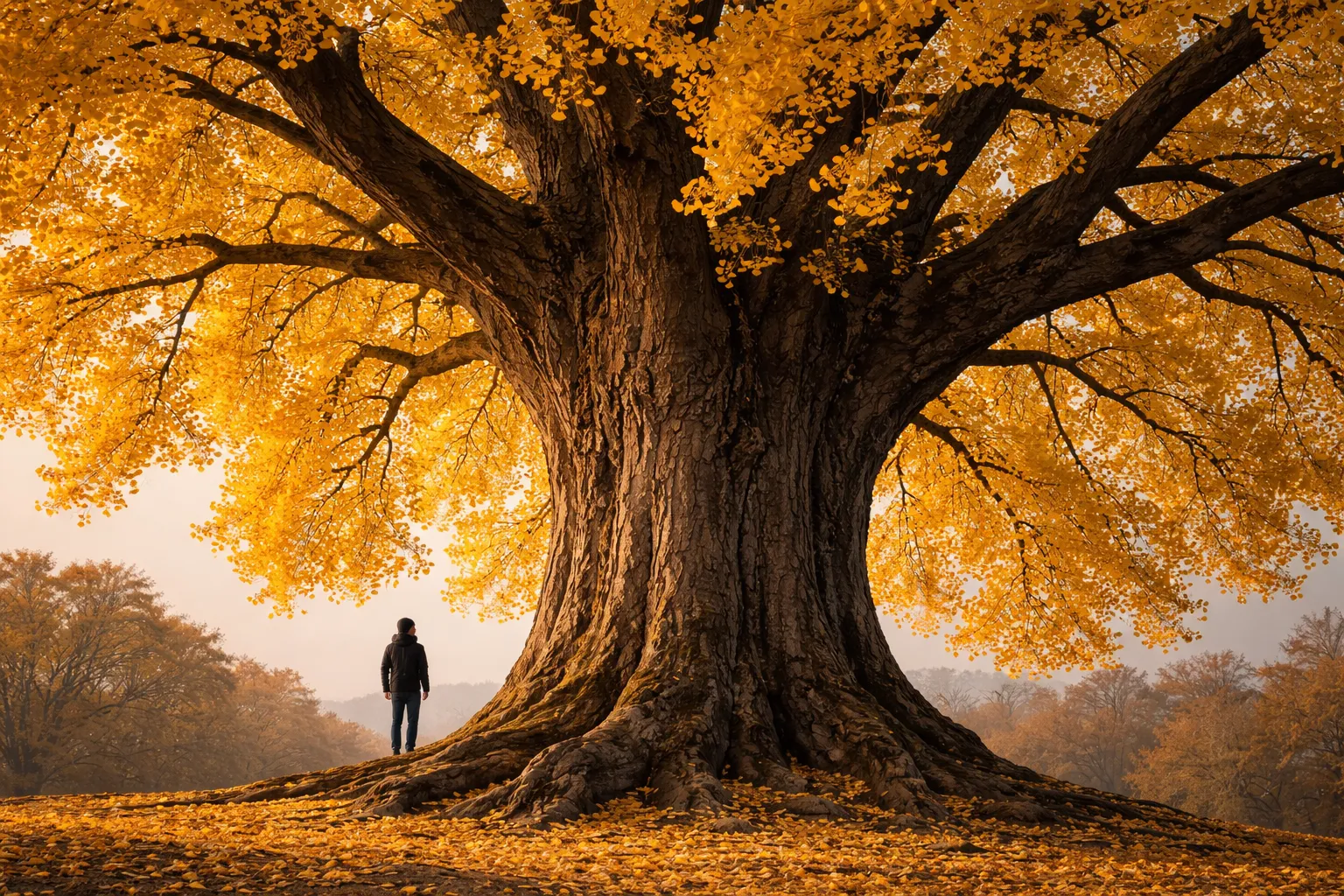
Just six trees stood within range of the hypocenter and made it through. On August 6, 1945, an atomic bomb detonated 600 meters over Hiroshima, killing roughly 70,000 people instantly and reducing nearly everything inside a two-kilometer radius to ash and rubble. Wooden structures simply vanished. Concrete split apart. And yet, a few hundred meters from ground zero, six ginkgo trees — charred, leafless, scarred black — pushed out new buds the following spring anyway. Nobody nursed them back. No intervention, no special care. Just 200 million years of evolutionary persistence doing exactly what it’s built to do. Learning that those same six trees are still rooted in place today, still leafing out each autumn, still drawing schoolchildren and pilgrims to their trunks, reframed something for me about what resilience actually looks like. The ginkgo tree oldest tree species label isn’t a quirky trivia fact — it belongs to a living organism that outlasted the dinosaurs, multiple ice ages, and a nuclear weapon, and still puts on a flawless gold display every November.
How Old Is the Ginkgo Tree? The Oldest Tree Species on Earth, Explained
Ginkgo biloba the species clocks in around 200 million years old, placing it among the oldest tree lineages on the planet — very likely the oldest to reach the modern era essentially unchanged. Some context helps here: 200 million years back, dinosaurs were only just beginning to show up. Pangaea was in the process of splitting apart. Mammals hadn’t evolved yet. Ginkgo trees, meanwhile, were already shedding those same fan-shaped leaves onto forest floors, looking almost identical to how they look now.
Fossilized ginkgo leaves pulled from Jurassic rock layers — roughly 170 million years old — are barely distinguishable from the leaves scattered across sidewalks in Tokyo or New York this coming November. A 170-million-year design that never really changed is why paleobotanists reach for the phrase “ginkgo biloba living fossil” — language Charles Darwin himself applied to organisms that seem to have simply stopped evolving because the original blueprint already worked.
People asking how old are ginkgo trees are usually really asking one of two separate questions: how old is the species overall, or how old can a single tree get? The species clocks in at roughly 200 million years. The individual-tree answer is just as staggering: the oldest confirmed living ginkgo is around 3,500 years old, rooted at the Gu Guanyin Buddhist Temple in the Zhongnan Mountains outside Xi’an, China. A tree that age was already fully grown when Tutankhamun sat on Egypt’s throne.
Here’s the detail that makes ginkgo’s age even wilder: Ginkgo biloba is the last surviving member of an entire plant division, Ginkgophyta. Not just the sole surviving species in its genus — the sole surviving species in its whole evolutionary division. Every relative it ever had is gone. Functionally, the ginkgo is a one-species phylum, arguably more isolated on the tree of life than any other organism alive today. It isn’t a conifer, isn’t a flowering plant — it sits on its own ancient branch with zero living relatives anywhere.
A lifespan of 1,000 to 2,000 years is fairly ordinary for individual ginkgos. Numerous trees across China and Japan have confirmed ages past the millennium mark. Some researchers suspect certain specimens in eastern China could top even 3,500 years, though nailing down precise ages gets tricky once a tree is too sacred locally to core-sample.
Inside the Biology of Earth’s Toughest Tree
Aging a ginkgo relies on the same technique used for most large trees: dendrochronology, or counting the annual growth rings inside a core sample. Researchers bore a slim, pencil-width channel into the trunk and pull out a sample without doing lasting damage to the tree. Every ring marks one year of growth. The complication with truly ancient ginkgos is that the most revered, oldest specimens — precisely the ones researchers most want to date — tend to be temple trees that communities understandably won’t let anyone drill into. The 3,500-year figure attached to the Gu Guanyin tree blends ring data pulled from the outer wood with the temple’s own historical records.
What sets ginkgo biloba apart biologically stretches far beyond raw age. Its cellular repair systems are unusually resilient — studies published in outlets like GigaScience show that older ginkgo trees don’t display any more signs of senescence, or biological aging, than younger ones do. A ginkgo that’s a millennium old produces seeds and lays down new wood at nearly the same pace as one only a century old. Most living things build up cellular damage as time passes; ginkgos seem to have evolved a way to keep repairing it indefinitely.
Hiroshima puts this on full, dramatic display. The Hiroshima ginkgo trees that lived through the atomic bomb took in a thermal blast strong enough to scorch permanent scars into the trunk faces pointed toward the hypocenter — then leafed out again within months anyway. Scientists studying these trees have found unusually high levels of antioxidant flavonoids (ginkgo flavone glycosides specifically), which some believe help explain the tree’s remarkable resistance to radiation and oxidative stress. Those very compounds, incidentally, are the reason ginkgo biloba extract is taken seriously in medical research circles.
Every ginkgo alive now is thought to trace back to a small pocket population in eastern China that made it through the last ice age some 12,000 years ago. Outside of China, the species had essentially vanished in the wild until people started cultivating and spreading it deliberately. It first reached Europe in 1730, planted at Utrecht Botanic Garden in the Netherlands, and made it to North America by the late 1700s. Every ginkgo standing in Philadelphia, Paris, or Tokyo today descends from those Chinese mountain survivors — the species’ entire modern footprint is basically a human-assisted comeback story.
Where to Find Ancient Ginkgos: Best Spots Across Japan, China, and Elsewhere
If reading about the ginkgo tree oldest tree species has you wanting to actually stand next to one, here’s where to go — arranged loosely from most historically significant to most visually stunning.
Hiroshima, Japan — the Six Survivor Trees
The six ginkgos that lived through the August 6, 1945 bombing carry the collective title hibakujumoku, meaning “survivor trees.” Hiroshima has mapped the location of all six, each marked with a metal plaque at its base confirming hibakujumoku status. The nearest one stands a mere 1.1 kilometers from the hypocenter, at Housenbou Temple in the Nakajima district. On the oldest of these trunks, you can still faintly make out the burn scars on the blast-facing side. All six are alive and thriving today, leafing every spring, turning gold every fall. Start at Hiroshima Peace Memorial Park — the A-Bomb Dome is essential viewing — then set aside a second afternoon to trace the hibakujumoku map, which the city’s tourism office hands out free; several trees sit an easy walk or bike ride from the park. Fall color peaks mid to late November.
Meiji Jingu Gaien, Tokyo — Japan’s Signature Ginkgo Boulevard
Central Tokyo’s Meiji Jingu Gaien holds a 300-meter avenue lined with 146 ginkgo trees, and it’s one of the most photographed autumn scenes anywhere in Japan — a golden corridor that frames the Meiji Memorial Picture Gallery in the distance. Color peaks somewhere between late November and early December, typically November 20–30. The Jingu Gaien Ginkgo Festival runs alongside peak season, bringing food stalls and cheerful crowds along with it. Go on a weekday morning if you want the avenue without 3,000 fellow photographers crowding your shot. It’s a five-minute walk from Aoyama-Itchome station on the Tokyo Metro.
Gu Guanyin Buddhist Temple, Xi’an, China — Home to the World’s Oldest Ginkgo
For those chasing the real pilgrimage, the oldest ginkgo tree on Earth grows in the Zhongnan Mountains, about 70 kilometers south of Xi’an. This 3,500-year-old tree at Gu Guanyin Temple rises roughly 26 meters, its trunk wide enough that it takes several people linking arms to circle it. When its leaves fall each autumn, they blanket the temple courtyard in gold several centimeters deep — a sight dramatic enough that it floods Chinese social media every November and pulls in thousands of visitors daily. You’ll need a taxi or hired car from Xi’an to get there, since it isn’t on major transit routes. Plan on losing a full day to the trip. Color peaks early to mid-November.
Tsurugaoka Hachimangū, Kamakura, Japan — the Tree That Wouldn’t Quit
A storm toppled a 1,000-year-old ginkgo at Kamakura’s most significant Shinto shrine in February 2010 — national news at the time, mourned as a genuine cultural loss. Within months, though, a fresh shoot pushed up from the stump. That regrown tree now stands several meters tall and keeps climbing, an unplanned but fitting symbol of what this species does best. Kamakura sits 50 minutes by train from Tokyo and pairs naturally with the Great Buddha at Kotoku-in and Engaku-ji temple — one of the strongest day trips from Tokyo you’ll find.
Central Park, New York City — Ginkgo Color Without Leaving the Country
Skipping Japan and China this year? Central Park still holds hundreds of ginkgo trees, clustered thickly along the Mall and near the 72nd Street transverse. New York’s ginkgo foliage typically peaks in the final two weeks of October into the first week of November — noticeably earlier than Japan’s timing. The ginkgos lining 161st Street in the Bronx near Yankee Stadium are just as impressive and far less crowded with cameras. One practical warning for urban ginkgo-spotting anywhere: female trees produce fruit with a genuinely awful smell, somewhere between spoiled butter and something you’d report to animal control. Most cities plant almost exclusively male trees to avoid this, so it’s rarely an issue in parks — but worth knowing if you wander into a neighborhood with older, unmanaged trees.
Why I Bring Ginkgo Along for Long Museum-Heavy Days in Japan
A visit to Hiroshima’s Peace Memorial Park takes more out of you mentally than physically — hours spent reading plaques, absorbing survivor accounts, standing before the ginkgo trees themselves will wear you down faster than a full day of hiking ever could. By the middle of my second day there, I noticed my concentration had thinned out, and I was skimming past details I’d traveled specifically to absorb.
What worked for me
- Takes effect within a couple of hours — I found my afternoon museum focus noticeably sharper and less scattered after dosing that morning.
- No refrigeration or special storage needed, which is useful when you’re hopping between ryokans and hotels across several prefectures.
- The 20:1 extract is potent enough that the bottle stays small — it doesn’t eat up luggage space the way tablets would in an already-full carry-on.
Where it falls short
- The flavor is sharply bitter and grassy — cutting it into juice or tea isn’t optional unless your stomach can handle it straight.
- It’s not a cure-all — if jet lag has already flattened you, no supplement is going to substitute for a real 12 hours of sleep.
I’ll admit I was skeptical the first morning I mixed it in—the instructions seemed almost too simple, and I wondered if I was just paying for expensive placebo. But by the time I reached the memorial cenotaph that afternoon, I genuinely felt present in a way I hadn’t the day before, and that mattered. Zazzee USDA Organic Ginkgo Biloba 20:1 Extract
Frequently Asked Questions
How many ginkgo trees survived the Hiroshima atomic bomb?
Six ginkgo trees survived the atomic bomb detonated on August 6, 1945, over Hiroshima. All were located a few hundred meters from ground zero, became charred and leafless from the blast, yet pushed out new buds the following spring with no intervention or special care. All six are still alive today, leafing every spring and turning gold every fall.
What is the oldest ginkgo tree in the world?
The oldest confirmed living ginkgo is approximately 3,500 years old and grows at Gu Guanyin Buddhist Temple in the Zhongnan Mountains outside Xi’an, China. The tree rises roughly 26 meters tall with a trunk wide enough to require several people linking arms to circle it.
When did ginkgo trees first arrive in Europe and North America?
Ginkgo trees first reached Europe in 1730, when they were planted at Utrecht Botanic Garden in the Netherlands. The species made it to North America by the late 1700s. Every ginkgo standing in Philadelphia, Paris, or Tokyo today descends from a small pocket population in eastern China.
Where can I see ginkgos in peak fall color in Japan?
Meiji Jingu Gaien in Tokyo features 146 ginkgo trees lining a 300-meter avenue, with color peaking between late November and early December, typically November 20–30. In Hiroshima, the six survivor trees peak in mid to late November. In Kamakura, Tsurugaoka Hachimangū also offers autumn ginkgo viewing.
About This Article

Written by Elena Vasquez. Elena Vasquez is a full-time traveler and the founder of Witty Passport. Over fifteen years and more than 50 countries across six continents — including a stretch spent leading groups professionally through Southeast Asia and the remote highlands of South America — she's written the kind of destination guides she always wished existed: practical, specific, and built on real experience rather than recycled itineraries. More about this site.
Scope and limits. Elena is a full-time traveler, not a licensed travel agent or immigration adviser. Entry requirements, visa rules, and advisories change without notice — always confirm against the official government source for your destination and passport before booking.
Verify this against a primary source
Specifics change, and your situation may differ from the one described here. These are the authorities worth checking directly:
- U.S. Department of State — entry requirements and travel advisories
- CDC Travelers' Health — vaccination and health notices by destination
- TSA — current carry-on and screening rules