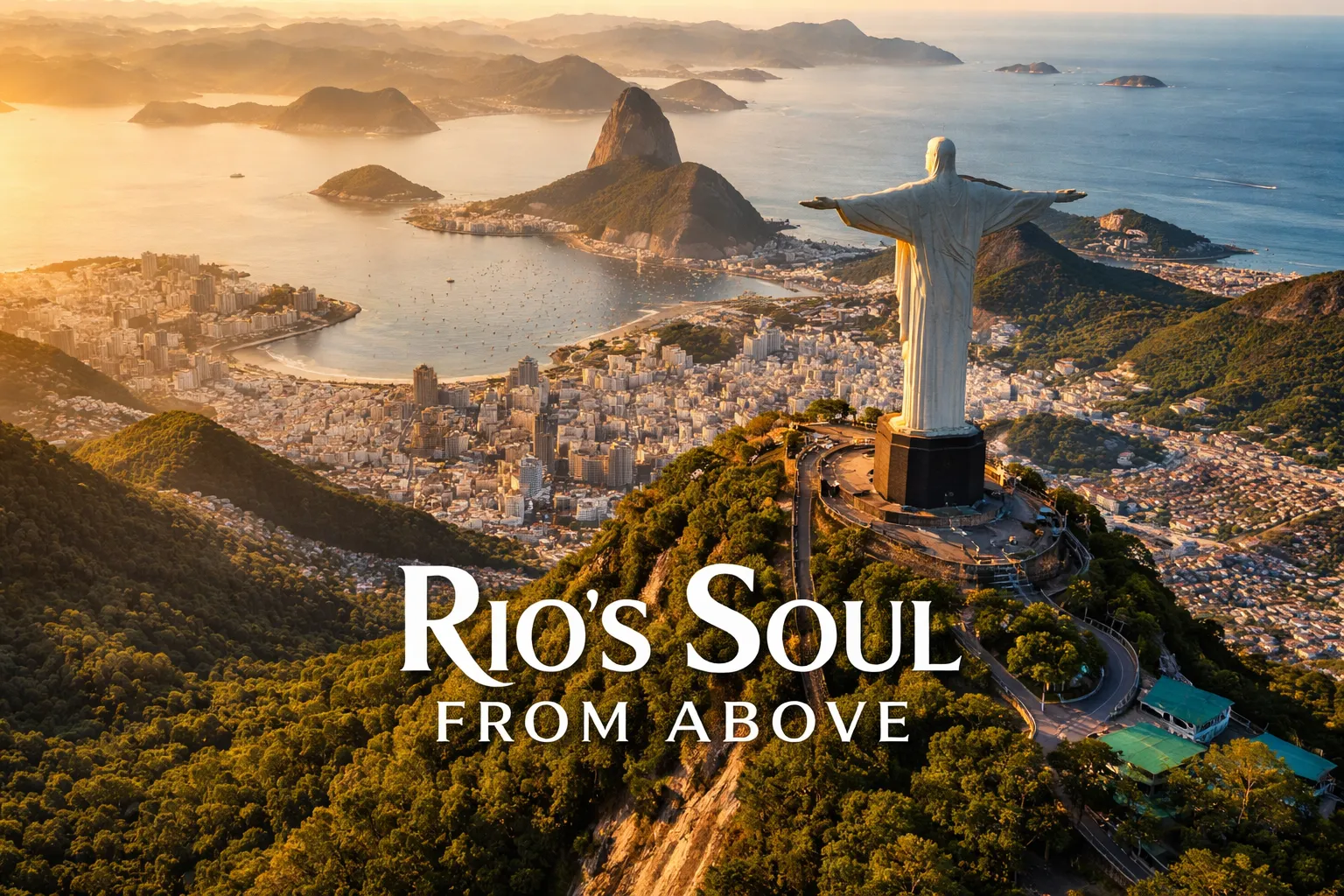
Ask around any hostel common room or drone forum thread about Rio and someone will eventually tell you the same thing: just launch from wherever you’re standing near the statue, grab the shot, and worry about permissions later if anyone even asks. That piece of “advice” collapses the moment you actually check the airspace map over Tijuca National Park — which is exactly what I was thinking about the first time I sent my own drone climbing above the forest canopy and watched the screen fill with something no shortcut could have prepared me for. There he was, Cristo Redentor with his arms flung wide, Guanabara Bay glinting behind him, Sugarloaf Mountain standing guard to the south, and the entire sprawling shape of Rio de Janeiro compressed into one impossible frame. If you’re hunting for a real christ the redeemer drone video guide — one that tells you what’s actually legal, where you’re allowed to launch, and which angles make working cinematographers pause their scrolling — this is it. This isn’t a composition you accidentally back into. It demands planning, patience, and a clear-eyed grasp of how Brazil actually regulates its airspace.
Drone Flight Brief: Christ the Redeemer at a Glance
| GPS Coordinates (Corcovado Summit) | 22°57′06″S, 43°12′38″W |
| Legal Flying Zone (Mirante Dona Marta) | 22°57′28″S, 43°11′10″W |
| Recommended Altitude Range | 80–180m AGL from Mirante Dona Marta launch point |
| Best Time of Day | 6:30–9:00 AM (golden hour light, minimal cloud build-up) |
| Best Season | May through September (dry season, consistent visibility) |
| Drone Regulations Summary | Drones are BANNED at Corcovado Mountain and the immediate statue area (restricted airspace, Tijuca National Park). ANAC SISANT registration required for all drones over 250g. Flying from Mirante Dona Marta is the accepted legal alternative for distant aerial framing. |
| Skill Level Required | Advanced — high-altitude wind gusts, complex airspace, forest obstacles |
| Difficulty Rating | 8/10 |
So Is a Drone Flight Over Christ the Redeemer Actually Legal?
Short answer, no hedging: you’re not permitted to fly a drone over or anywhere close to Corcovado Mountain and the Christ the Redeemer statue. The whole site falls inside Tijuca National Park, a permanently protected zone under Brazilian environmental law, and separately, DECEA — Brazil’s airspace authority — has locked down restricted airspace directly over the summit and its surroundings. Layer on top of that ANAC’s (Agência Nacional de Aviação Civil) requirement that every drone over 250g be registered through the SISANT system before it ever leaves the ground anywhere in the country — that registration has to happen online, before you fly, no exceptions. Get caught ignoring any of this and you’re looking at fines and possibly having your equipment seized outright. I’ve talked with production teams who tried pulling strings for special access to the statue itself, and IBAMA (the national environmental agency) has turned down recreational operators and nearly every commercial one, consistently, no exceptions carved out.
Here’s the part that makes all of this bearable: flying directly over the statue was never required to get a killer christ redeemer aerial photography rio shot. Mirante Dona Marta, a public overlook roughly 1.8 kilometers northeast of Corcovado sitting around 396m up, has become the go-to legal launch site for crews shooting the statue by the book. From this vantage, your drone can still frame Cristo against Guanabara Bay at a distance that produces genuinely striking images, especially if your setup includes a telephoto option. One habit worth building: check current airspace status before you launch every single time through DECEA’s SARPAS authorization system, since temporary flight restrictions get issued often, particularly around Rio’s big events.
Rio’s Landmarks Reassemble Themselves Once You’re Airborne
Even from a legal distance at Mirante Dona Marta, what a drone uncovers about this city changes how you see it entirely. Standing at ground level, Christ the Redeemer reads as a single towering, vertical thing you tilt your head back to take in. Get above it, and the statue transforms into a geographic hinge point. Suddenly the 1931 site selection makes complete sense — Corcovado sits dead-center in what amounts to a city-sized amphitheater. Sugarloaf Mountain (Pão de Açúcar) balances the composition to the south, rising from where Guanabara Bay meets the sea. The bay itself stretches east toward Niterói, its surface shifting color with the hour. North and west, the Tijuca Forest — at 32 km², the largest urban rainforest anywhere on Earth — spreads out as an improbable green blanket, broken only by the gray grid of the neighborhoods underneath it.
What actually halts aerial photographers mid-flight, though, is the favela topography. Santa Marta, the community climbing the slope directly beneath Mirante Dona Marta, exposes a density from above that ground-level shots simply can’t capture — thousands of rooftops crammed against one another in color combinations invisible from street level. Stack that against the untouched forest canopy, the formal grid of the lower city, and the Atlantic beyond it, and you get a layered composition that has no real equivalent anywhere else. This is what makes the rio de janeiro landmarks from above so visually dense — arguably one of the most complex drone subjects on the planet.
Compositions Worth Chasing: Drone Flying from Corcovado Mountain Viewpoints
Working cinematographers keep coming back to a handful of specific setups around Corcovado. Build your session around these:
Compressing the Frame with Telephoto
Hovering around 120–150m AGL from Mirante Dona Marta, switch your drone’s camera to a medium telephoto setting and let it flatten the distance between the statue and Sugarloaf behind it. At that focal length, Cristo dominates the foreground while the bay and Pão de Açúcar stack neatly behind him. Aim for the 7:00–8:30 AM window, when eastern sunlight rakes across the statue’s face. It’s the composition most requested in commercial drone flying corcovado mountain work, and it holds up equally well as a still or as video.
The Slow Circle at Eye Level with the Statue
Worth mentioning even though it needs a permit and clearance from an authorized operator — I’m including it because it’s the shot every serious production is chasing. At roughly 710m, the elevation of the summit itself, a slow orbit that holds altitude steady reveals the statue changing shape as you move: arms outstretched head-on, then the three-dimensional profile from the side, then the rear view looking out over the Atlantic. The shift from favela-covered hillside to open ocean happens within a single 180-degree sweep. For a licensed commercial shoot with DECEA authorization in hand, plan the orbit at 50–60 meters out from the statue’s base, moving at 5–7 km/h for a smooth, cinematic pace.
Pulling Back to Reveal the Whole City
Start close on the statue from your legal position at Dona Marta, then ease backward and climb at the same time while tilting the camera down. As you rise from 100m to 180m AGL, Rio’s full geography unfurls beneath the frame — neighborhoods, the lagoon, Ipanema and Copacabana’s beaches, and finally the Atlantic meeting the sky. This is the defining christ the redeemer drone video move for travel content because it carries the viewer from monument, to city, to ocean in one continuous motion. Fly it between 6:45–7:30 AM during the dry season for the warmest light and the best odds of a clean horizon.
Where the Rainforest Gives Way to the City
Take off from Mirante Dona Marta and head west over the Tijuca Forest canopy at 80–100m AGL, then swing back east toward the city. The line where the rainforest stops and the urban grid begins is about as sharp a contrast between nature and city as you’ll find anywhere, and from 100m up, it all fits inside one wide frame with Cristo visible along the ridge behind you. Shoot it late in the dry season, August or September, when haze is at its lowest and the canopy glows a saturated green.
Timing Your Shot: When to Photograph Christ the Redeemer From the Air
The variable that matters most for aerial work at Corcovado isn’t lighting — it’s cloud cover. Rio sits inside a tropical convergence zone, and the orographic lift generated by Corcovado’s 710m peak means clouds form on the mountain fast, especially between October and March, the wet season. On a typical summer day, Cristo is already partly or fully swallowed by cloud by 10:00 AM. The dry-season stretch from May through September gives you your best odds of a clear morning sky. Inside that window, launch from Mirante Dona Marta between 6:30–9:00 AM — that’s when golden-hour light from the east hits the statue’s face directly, winds haven’t picked up ahead of the afternoon thermal cycle, and clouds haven’t started building yet.
Wind deserves real respect at this elevation. Corcovado and the ridgelines around it channel gusts that can spike past 40 km/h with almost no warning, even when the day looks perfectly still down below. Flying at 180m AGL from Dona Marta puts you essentially level with the upper slopes of Corcovado, right where ridge-effect wind acceleration tends to kick in. Skip surface wind readings and check WindyApp or Windy.com at the 850hPa pressure level instead (roughly 1,500m) — those numbers track much closer to what you’ll actually feel at drone altitude over Rio’s hills.
Beyond Corcovado: More of the Best Drone Spots in Rio de Janeiro
Corcovado earns its reputation, but Rio has plenty more to offer anyone willing to explore beyond it. Here’s where else to add to your list of best drone spots rio de janeiro has to offer:
- Mirante Dona Marta — Still the legal sweet spot for framing Corcovado. It’s a public lookout with parking and reliable cell signal for checking your SARPAS authorization. Get there before sunrise if you want the good position.
- Prainha Beach (west of Barra da Tijuca) — One of the rare Rio beaches with airspace that isn’t jammed with other operators. Quieter and less built-up than Copacabana, with dramatic cliffs that look great from low altitude.
- Pedra Bonita (Tijuca Forest) — Better known as a hang-gliding launch site, but drones can legally fly here too, and the framing of city plus forest is extraordinary. At 696m up, you can capture Barra da Tijuca’s coastline with the Atlantic horizon sitting right at camera level.
- The Niterói shoreline, looking back across Guanabara Bay — Shoot westward from here and you get the entire Rio skyline, Sugarloaf, and Corcovado in one wide frame with the bay as foreground. It’s the setup professional travel campaigns lean on to show off Rio’s full geography.
- Lagoa Rodrigo de Freitas — The lagoon, framed by Ipanema on one side and the Corcovado ridge on the other, makes for a striking composition — just check NOTAM notices often, since this area regularly hosts major events that trigger restrictions.
The Drone Setup That Actually Holds Up in Rio’s Mountain Winds
Flying near Cristo Redentor is nothing like a lazy beach launch in Bali. The Tijuca Forest funnels wind straight at the statue, and you need a machine steady enough to hold your composition while you’re still correcting for a gust you didn’t see coming.
What earns its keep
- The RC 2 screen remote controller stays readable in direct sunlight — a detail that saved me the day glare off Guanabara Bay would have made a standard phone mount useless.
- The Fly More Combo’s three batteries earn their keep when you’re racing light in a forest canyon and burn 20 minutes to wind delays — golden hour doesn’t give you a second attempt.
- The dual camera setup (48MP main plus medium tele) lets you capture the full monument-and-city frame without repositioning and risking your spot on a packed viewing platform.
What doesn’t hold up
- The remote controller is legitimately bulky and hard to stash in a daypack, especially once you’re also juggling camera gear and a drone case on a packed cable car ride up the mountain.
- Wind warnings pop up constantly around Corcovado, and while the drone rides it out fine, you’ll burn half your flight time just fighting for stability instead of composing anything creative.
I nearly aborted my entire flight when a sudden downraft hit at 200 feet and the remote stuttered for a moment—but the redundant transmission and GPS hold locked it back in place instantly. That’s the feature that made me trust it enough to push higher. If you’re serious about capturing Rio from above, grab the DJI Air 3S Fly More Combo with RC 2 Screen Remote Controller.
Frequently Asked Questions
Can I fly a drone directly over Christ the Redeemer statue?
No. Drones are banned at Corcovado Mountain and the immediate statue area because it falls inside Tijuca National Park, a permanently protected zone under Brazilian environmental law, and DECEA has locked down restricted airspace directly over the summit and surroundings. Get caught ignoring this and you’re looking at fines and possibly equipment seizure.
Where is the legal launch site for Christ the Redeemer drone shots?
Mirante Dona Marta, a public overlook roughly 1.8 kilometers northeast of Corcovado at around 396m elevation, is the accepted legal launch site. From this vantage, your drone can frame Cristo against Guanabara Bay at a distance that produces striking images, especially with a telephoto option.
What altitude should I fly at from Mirante Dona Marta?
The recommended altitude range is 80–180m AGL from Mirante Dona Marta launch point. Working cinematographers commonly hover around 120–150m AGL when using medium telephoto settings to compress the frame between the statue and Sugarloaf Mountain.
What is the best time of day to photograph Christ the Redeemer from a drone?
Launch between 6:30–9:00 AM during the dry season from May through September. Golden-hour light hits the statue’s face directly from the east, winds haven’t picked up yet, and clouds haven’t started building, giving you the best odds of a clear morning sky.
About This Article
Written by Elena Vasquez. Elena Vasquez is a full-time traveler and the founder of Witty Passport. Over fifteen years and more than 50 countries across six continents — including a stretch spent leading groups professionally through Southeast Asia and the remote highlands of South America — she's written the kind of destination guides she always wished existed: practical, specific, and built on real experience rather than recycled itineraries. More about this site.
Scope and limits. Elena is a full-time traveler, not a licensed travel agent or immigration adviser. Entry requirements, visa rules, and advisories change without notice — always confirm against the official government source for your destination and passport before booking.
Verify this against a primary source
Specifics change, and your situation may differ from the one described here. These are the authorities worth checking directly:
- U.S. Department of State — entry requirements and travel advisories
- CDC Travelers' Health — vaccination and health notices by destination
- TSA — current carry-on and screening rules