Ninety minutes at Muir Woods, one glance at a cross-section bolted to a trail kiosk, and I walked away needing to sit down for a second — that’s the actual timeline of how this particular obsession started. I wasn’t craning my neck at the canopy. I was staring at a stump slice where some volunteer had pinned a little marker reading “Shakespeare born” to a ring that already sat centuries deep in the grain. The tree kept living for another 700 years past that point. I redid the arithmetic twice, convinced I’d made an error, because the number didn’t feel plausible. These aren’t simply tall trees. The oldest redwood trees in the world function like living archives — organisms that were already elderly when Rome was still figuring itself out, and they’re still upright, still adding rings, still siphoning fog out of the California sky as though the passage of centuries is somebody else’s problem.
That mild vertigo — the sense that your internal clock just got recalibrated — is precisely what this post means to set you up for. We’ll cover the biology, name the specific groves worth your time, walk through the logistics that actually matter, and flag the one item worth packing before you head out.
How Old Are Redwood Trees? Here Are the Oldest Redwood Trees in the World
The oldest verified coast redwoods (Sequoia sempervirens) clock in around 2,200 years, with a handful of Northern California specimens topping 2,000 based on ring counts pulled from fallen giants and cores drilled from living ones. That puts them behind giant sequoias for maximum confirmed age — though the gap is smaller than most people assume, and untangling the comparison takes some nuance.
Here’s how the two actually stack up:
- Coast redwoods (Sequoia sempervirens) — the tallest organisms alive anywhere — generally live somewhere between 1,200 and 2,200 years. The oldest one on record is pegged at roughly 2,200. Their range is a slim 450-mile fog corridor running from southern Oregon down into central California.
- Giant sequoias (Sequoiadendron giganteum) — unmatched in sheer volume — commonly push past 3,000 years. The record-holder, a Sierra Nevada specimen, is estimated at approximately 3,266 years old. General Sherman, in Sequoia National Park and the largest tree on the planet by volume at around 52,500 cubic feet, is thought to be somewhere between 2,100 and 2,700 years old.
Translated into something you can actually picture: a 2,200-year-old coast redwood took root somewhere around 200 BCE, right around the peak of China’s Han Dynasty and about a century and a half before Julius Caesar’s birth. A 3,000-year-old giant sequoia was already a young tree while Greece’s Bronze Age was winding down.
The tallest living tree on the planet, of any species, is Hyperion — a coast redwood found in Redwood National Park back in 2006. It measures 380.3 feet (115.92 meters), which beats the Statue of Liberty, pedestal included, by more than 70 feet. The National Park Service has intentionally kept Hyperion’s exact coordinates off the record, and in 2022 they shut down the network of unofficial trails leading toward it, citing root compaction and soil erosion from the sheer number of people trying to track it down. Hiking to Hyperion simply isn’t an option anymore. That’s the correct decision.
What sets coast redwoods apart from nearly every other long-lived species is how they reproduce clonally. Cut one down, or let fire take it, and it responds by throwing up aggressive new growth from the root collar — forming rings of genetically identical trees known as “fairy rings” or “cathedral rings” circling the original stump. The trunk you see above ground might only be 500 years old, while the root system underneath could predate it by millennia. Suddenly “how old is this tree” and “how old is this organism” become two entirely different questions.
The Biology Behind It: Why Redwoods Don’t Go Down Easy
Nothing about redwood longevity is a fluke. It’s the output of a genuinely remarkable biological toolkit, refined over roughly 240 million years of evolutionary trial and error — the redwood lineage predates the breakup of Pangaea, which gives you some sense of the timescale involved.
Tannin does most of the heavy lifting. Redwood bark carries such high concentrations of tannic acid that it’s practically inedible to insects and shrugs off fungal decay. On mature trees that bark can thicken to a foot deep, doubling as a built-in firebreak — coast redwoods aren’t merely tolerant of fire, they’re built around it, with some regeneration actually kicked off by post-fire conditions.
Unlike most conifers, coast redwoods have no resin canals — which in other trees serve as highways for bark beetles to move in. Pair that with the tannin load, and the kind of mass pest die-off currently chewing through millions of acres of Western pine forest is basically a non-starter in established redwood groves.
Scientists date living trees through increment core sampling — a hollow bit draws out a slim pencil-width cylinder of wood that researchers can count and study without harming the tree. Fallen trees allow for something more dramatic: full cross-sections, several of which parks display for the public. The Muir Woods slice has actual date pins pushed into specific rings — the Norman Conquest in 1066, Columbus’s landing in 1492, Shakespeare’s birth in 1564. Honestly, it might be the single most effective piece of environmental education I’ve come across anywhere.
On the threat side: coast redwoods sit on the IUCN Red List as Endangered, though inside protected areas the populations are holding steady or even growing. Around 96% of the original old-growth coast redwood forest — once sprawling across roughly 2.2 million acres — was cut down between the 1850s and the tail end of the 20th century. What survives inside park boundaries today is a sliver of what used to exist. Climate change is the newer worry: the coastal fog these trees rely on for something like 30–40% of their annual water supply has been shrinking and shifting, with measurable declines in fog frequency across Northern California over the last hundred years.
Where the Biggest Redwoods Actually Are: Northern California’s Best Groves
Think of redwood-viewing as coming in three tiers, each suited to a different kind of trip. Here’s the breakdown:
1. Redwood National and State Parks (Orick Area) — The Genuine Article
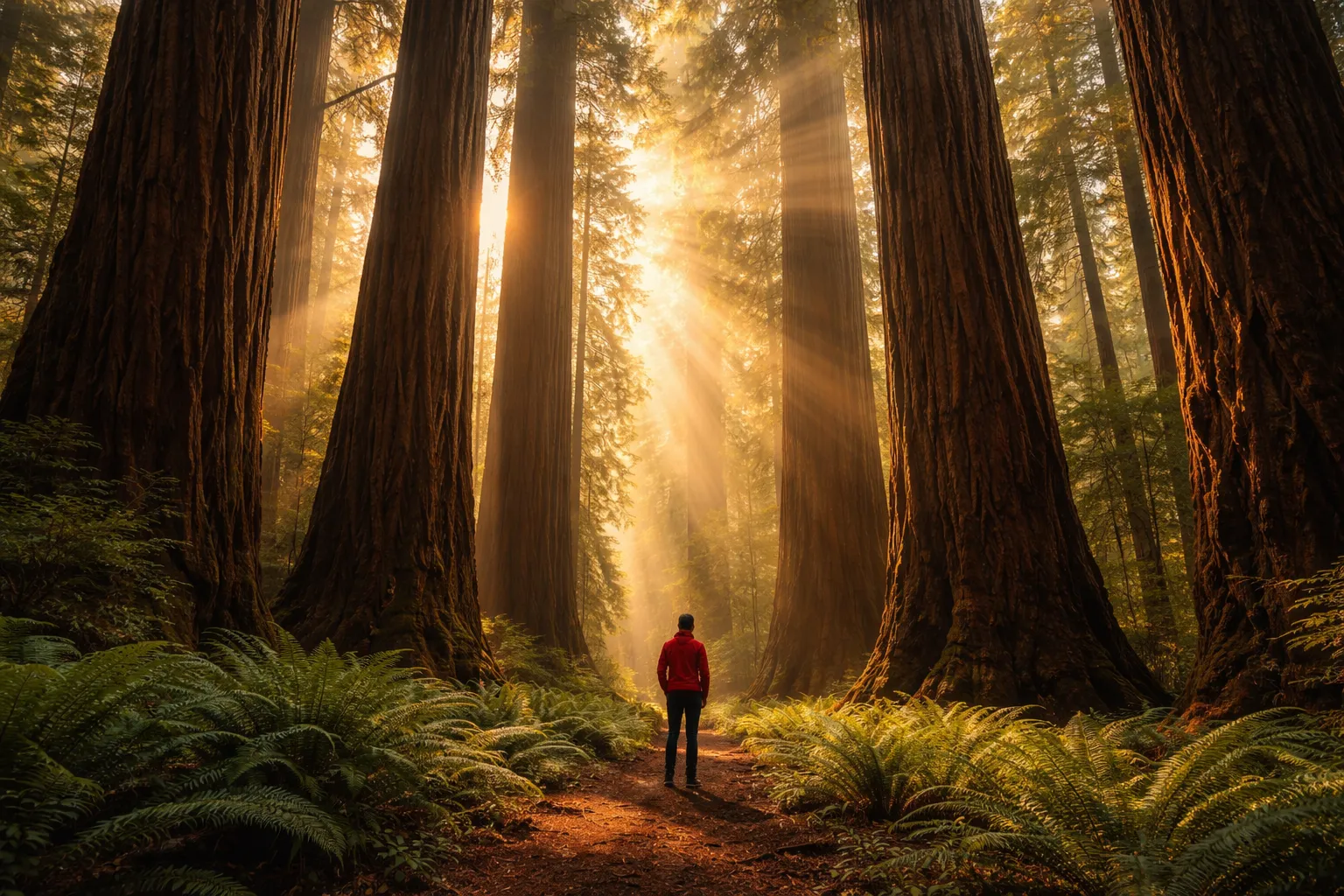
This is the real deal, ancient-tree-wise. The joint NPS/California State Parks complex here covers roughly 139,000 acres and holds the densest concentration of old-growth coast redwoods anywhere on Earth — including Hyperion’s grove (off-limits) and several trails that put you among 300-foot-plus giants with no permit required and no real crowds.
Lady Bird Johnson Grove is the low-effort option: a 1.5-mile loop through old-growth forest, barely any elevation change, open all year, and genuinely striking without turning into a photo-op bottleneck. Tall Trees Grove needs a free permit from the Orick visitor center (daily quantities are capped) plus a 4-mile round trip, but rewards you with a cathedral-dense stand most visitors never bother reaching. Fern Canyon, reached via the Gold Bluffs Beach road, is really more about creek geology than tree age — but walls thick with five-fingered ferns in a canyon Prairie Creek carved out are strange and beautiful enough to justify the detour.
For the northern stretch, camp out in Crescent City, roughly 45 minutes north of Orick. It’s not glamorous — a functional little town rather than a resort — but it sits within half an hour of Trees of Mystery, Del Norte Coast Redwoods, and Jedediah Smith Redwoods State Park, where the Simpson-Reed Grove trail counts among the best half-mile walks anywhere in the state.
2. Humboldt Redwoods State Park — Avenue of the Giants
About 90 miles south of Eureka along the old Highway 254 sits Humboldt Redwoods State Park, guardian of the largest surviving stretch of old-growth coast redwood on the planet — 17,000 acres of it, packed with trees that routinely clear 300 feet. The Avenue of the Giants runs 32 scenic miles through the groves — gorgeous from a car window, remarkable once you get out and walk one of the side trails.
The Founders Grove Nature Loop (0.6 flat miles) leads past what remains of the Dyerville Giant — a coast redwood that once stood 362 feet, the tallest known tree on Earth in its day, before a windstorm toppled it in 1991. The trunk still stretches 370 feet along the forest floor. There’s something instructive about standing beside a tree that’s been dead for three decades and is still that colossal.
3. Muir Woods National Monument — The Easy San Francisco Add-On
Muir Woods sits 17 miles north of San Francisco in Marin County, and it’s absolutely worth the trip — provided you calibrate your expectations first. Trees here top out around 258 feet and roughly 1,000 years old, impressive by any normal standard but noticeably shorter and younger than what’s waiting further north. Its real value is convenience, plus that interpretive cross-section I mentioned up top — a legitimate lesson built directly into the trail.
Reservations are required (book through recreation.gov), the parking lot fills by 9 AM on weekends, and the main canyon path can turn into something resembling a crowded sidewalk come summer. Show up early on a weekday, or climb onto the Panoramic Trail toward Mount Tamalpais State Park — within ten minutes the crowds vanish. Best window for the northern parks overall: May through September, when trails stay dry and passable; winter brings fog-drenched mornings that make the forest feel legitimately prehistoric, worth the occasional soaked boot.
The Field Guide I Wish I’d Packed Before Getting Lost, Botanically Speaking, at Muir Woods
Standing under a 2,000-year-old coast redwood, it hit me that I couldn’t identify a single thing around me — not the tree in front of me, not any of its neighbors. The kiosk volunteers were patient about it, but I still felt a little silly asking “wait, is that one old too?” about trees I probably should’ve been able to name on sight.
What worked for me
- Compact enough to toss in a day pack without it feeling like extra weight alongside your water and snacks.
- The ID keys hold up in real time — bark texture, leaf shape, needle arrangement — no need to snap thirty photos and sort it out later at home.
- Sorted by California region, so you’re not wading through Sierra Nevada species while standing in coastal redwood territory looking for a match.
What didn’t
- The images and illustrations run small — manageable with sharp eyes, annoying if you’re squinting through dappled forest light trying to match bark to a thumbnail.
- It’s aimed squarely at beginners, so anyone already deep into dendrology will find it thin — the detail just doesn’t go far enough for serious enthusiasts.
I hesitated buying a physical field guide when I could just use my phone, but forest data is spotty and my battery was already half-dead by mile two. Pick up Trees of California: A Beginner’s Field Guide to Identifying Common California Trees before your next hike.
Frequently Asked Questions
How old are the oldest coast redwood trees?
The oldest verified coast redwoods clock in around 2,200 years, with a handful of Northern California specimens topping 2,000 years based on ring counts pulled from fallen giants and cores drilled from living ones. A 2,200-year-old coast redwood took root somewhere around 200 BCE.
Can you still hike to see Hyperion the tallest tree?
No. Hyperion, a coast redwood found in Redwood National Park that measures 380.3 feet, is no longer accessible to hikers. The National Park Service shut down the network of unofficial trails leading toward it in 2022, citing root compaction and soil erosion from excessive foot traffic.
What is the best redwood grove near San Francisco?
Muir Woods National Monument sits 17 miles north of San Francisco in Marin County and is absolutely worth the trip. Trees here top out around 258 feet and roughly 1,000 years old. Reservations are required through recreation.gov, and the parking lot fills by 9 AM on weekends.
When should I visit Northern California redwood parks?
The best window for the northern parks is May through September, when trails stay dry and passable. Winter brings fog-drenched mornings that make the forest feel legitimately prehistoric, though you should expect occasional soaked boots.
About This Article

Written by Elena Vasquez. Elena Vasquez is a full-time traveler and the founder of Witty Passport. Over fifteen years and more than 50 countries across six continents — including a stretch spent leading groups professionally through Southeast Asia and the remote highlands of South America — she's written the kind of destination guides she always wished existed: practical, specific, and built on real experience rather than recycled itineraries. More about this site.
Scope and limits. Elena is a full-time traveler, not a licensed travel agent or immigration adviser. Entry requirements, visa rules, and advisories change without notice — always confirm against the official government source for your destination and passport before booking.
Verify this against a primary source
Specifics change, and your situation may differ from the one described here. These are the authorities worth checking directly:
- U.S. Department of State — entry requirements and travel advisories
- CDC Travelers' Health — vaccination and health notices by destination
- TSA — current carry-on and screening rules