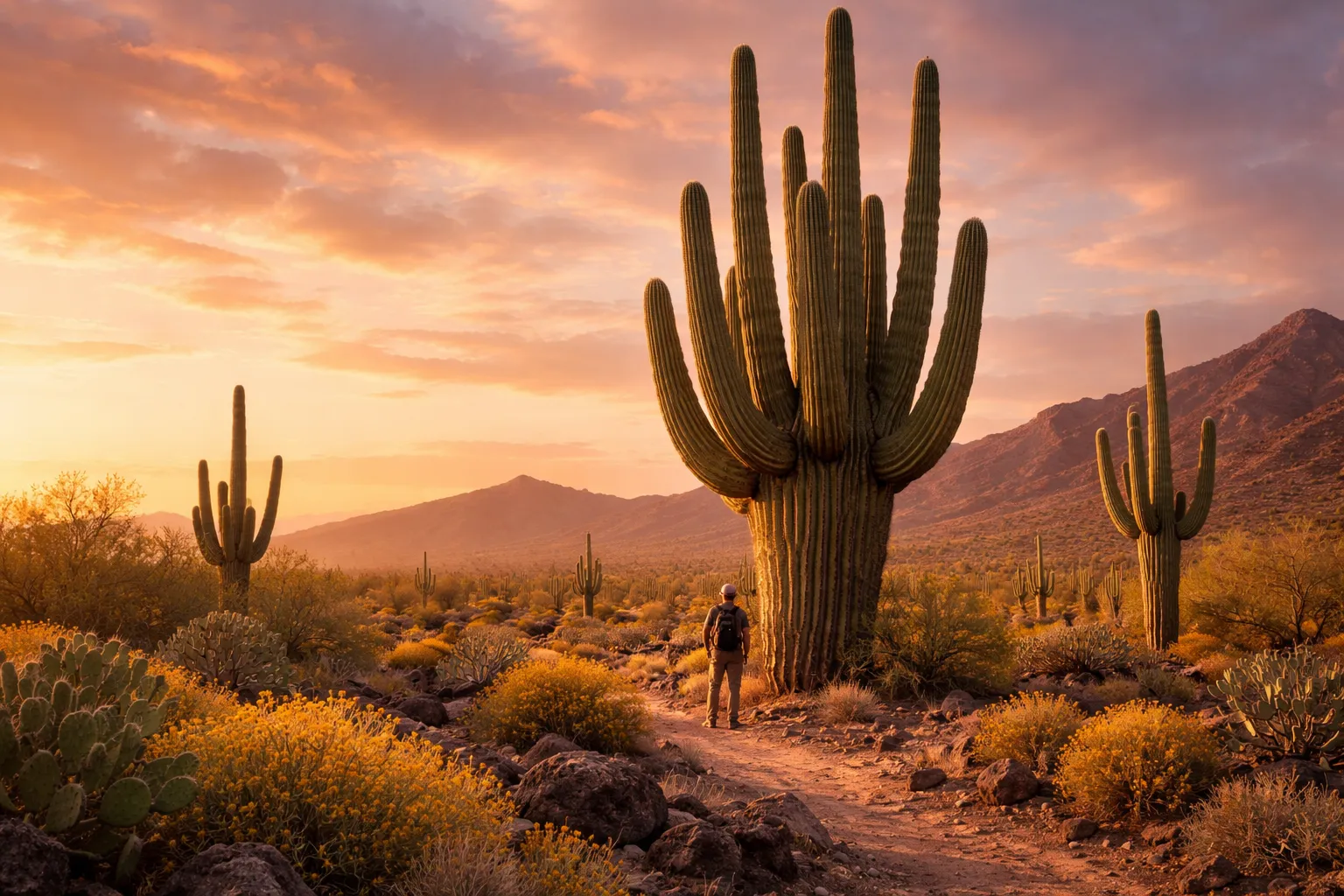
Somewhere on a trail near Tucson, a fellow hiker once told me you could age a saguaro the same way you’d age a tree — slice it open, count the rings, done. It sounds tidy. It’s also completely wrong, and believing it will send you home with a made-up number instead of the real story. Picture yourself on the Cactus Forest Loop Drive in the Rincon Mountain District of Saguaro National Park, face to face with a saguaro taller than a two-story house, seven arms thick as your torso, its skin folded like weathered leather. Most visitors snap a photo and keep driving, never registering that the plant they just passed was already a grown, branching adult back when Thomas Jefferson was still walking around. Working out how to tell how old a cactus is turns out to be one of the genuinely stubborn puzzles in desert botany — and the ring-counting myth is exactly the wrong place to start. The real method is stranger and more interesting than that, and it’ll change how you see every saguaro you pass after this.
How to Tell How Old a Cactus Is (The Honest, Science-Backed Answer)
Height, not rings, not trunk width, not spine count, is the field method desert botanists actually trust for estimating a saguaro’s age. Here’s what those height brackets translate to in years — and why nailing down an age at all is trickier than it seems.
A saguaro (Carnegiea gigantea) spends its first eight years crawling forward at an almost comical pace — somewhere around 1 to 1.5 inches annually. Most seedlings never make it that far, since germination odds in the wild are brutally low, and the ones that do survive a decade are still only about coffee-mug height. Growth does pick up after that juvenile stretch, but “picks up” is relative: a saguaro doesn’t reach 6 feet until it’s roughly 70 years old. Sit with that — a cactus no taller than a standard doorway has been standing there since the 1950s.
Those branching arms that make a saguaro look like a saguaro don’t show up until the plant hits somewhere between 75 and 100 years old, and exactly when depends heavily on rainfall, soil, and elevation. One arm on a saguaro usually signals it’s past the century mark. Four or five arms puts you in the 125-to-200-plus-year range. The towering, many-armed specimens that show up in every Arizona postcard? A lot of them were still saplings while the Civil War was being fought.
A Cheat Sheet: Saguaro Height Versus Age
- Shorter than a foot: Probably 8–10 years old
- Around 3 feet: Roughly 35–50 years old
- Around 6 feet: Roughly 70 years old
- 10–12 feet, still armless: Roughly 75–95 years old
- 15+ feet with one or two arms: Roughly 100–150 years old
- 20+ feet, multiple arms: Roughly 150–200+ years old
So here’s the question everyone eventually asks: can you just count cactus rings and get a real age? Not reliably, and that’s the annoying part. Cacti do form internal rings you can see in a cross-section, but unlike tree rings, they’re not tied to the calendar. They respond to rainfall, not seasons — so a heavy monsoon might stamp several rings into a single year, while a drought year leaves none at all. Scientists will sometimes use ring counts as a rough gauge on specimens that have already died, but no field botanist treats it as trustworthy for a living plant.
For specimens that are already dead or held in collections, radiocarbon dating can offer an age estimate — but it’s destructive, pricey, and needs a lab, which rules out doing it on the spot along the Cactus Forest Loop with your phone camera. Smaller species like barrel cacti have it worse: there’s no dependable field technique at all. You can eyeball weight, diameter, or rib count for a rough guess, but growing conditions swing so wildly that two barrel cacti of the exact same girth might be 40 years apart in actual age.
The record for oldest documented saguaro belongs to a plant researchers nicknamed “Old Granddaddy,” growing in the west district of Saguaro National Park. It died in 1990 at an estimated 300 years old, meaning it sprouted around 1690 — decades before Arizona was anything beyond Spanish colonial frontier. Nothing older has been confirmed since.
Why Aging a Cactus Is So Much Harder Than Aging a Tree
To understand why cactus age estimation methods stay so imprecise, you have to understand what makes cacti almost unique among plants. Trees produce readable rings because their growth follows the seasons — active in spring and summer, dormant in winter, with a clean boundary marking each year. Cacti don’t play by that rulebook. Water, not temperature, drives their growth. In the Sonoran Desert, a saguaro might catch two wet seasons in a single year — winter storms off the Pacific and the July-through-September monsoon — or it might sit through years of drought that basically stall its growth entirely.
The Desert Laboratory on Tumamoc Hill, one of North America’s oldest ecological research sites, founded in 1903, along with researchers at the University of Arizona, have tracked saguaro populations for over a hundred years. Their long-term records show growth rates can vary by up to 40% purely based on local conditions — which way a slope faces (north-facing holds moisture better), how deep the soil runs, how close a plant grows to a nurse tree like the palo verde, and elevation. A saguaro rooted in loamy soil at 3,000 feet near a seasonal wash will outgrow its genetic twin stuck on a rocky, south-facing ridge at 2,000 feet — by years, sometimes decades.
One promising newer approach is counting spine clusters — each areole, the small pad that sprouts spines, produces them at fairly predictable intervals in certain species, letting researchers tally areoles and estimate elapsed time from there. It works better on some columnar cacti than others, and it still needs to be checked against plants of known age before it’s trustworthy. It hasn’t become a standard field technique yet.
As for how far back the cactus family itself stretches: fossil records suggest the Cactaceae family split off from close relatives like portulacas and lewisias somewhere around 35 million years ago, with the columnar cacti of the Sonoran Desert settling into their present form roughly 5 to 10 million years ago. The saguaro itself is believed to have existed in something close to its current form for at least 10,000 years, having made it through the shift from the cooler, wetter late Pleistocene into today’s arid conditions. A 200-year-old saguaro belongs to a lineage older than the Himalayas reaching their current elevation. That’s the sort of fact that changes how a walk through the desert feels.
Saguaros currently carry conservation-concern status because of climate change. Longer droughts are dragging down seedling survival, and warmer conditions are pushing frost-free zones outward — theoretically expanding where saguaros could grow, while simultaneously piling heat and water stress onto the populations already established. The east district of Saguaro National Park, the Rincon Mountain District, holds one of the healthiest, densest surviving stands of Carnegiea gigantea anywhere on the planet.
Where the Oldest Cacti Actually Stand: Saguaro National Park and the Wider Sonoran Desert
If your goal is standing next to a legitimate ancient cactus species specimen, the Rincon Mountain District of Saguaro National Park — about 15 miles east of downtown Tucson off Old Spanish Trail — beats every other option in the country. Saguaros here run noticeably older and taller on average than in the park’s western Tucson Mountain District, thanks to slightly higher rainfall in the Rincon foothills and terrain that shelters pockets of microclimate where these plants have grown undisturbed for centuries.
Driving (and Actually Stopping On) the Cactus Forest Loop
The Cactus Forest Loop Drive runs 8 miles, one-way, paved, and you could technically finish it in 45 minutes without leaving the car — but don’t. Get out. Walk the Cactus Forest Trail or the Freeman Homestead Nature Trail, either of which drops you among saguaros that read as ancient at a glance. Watch for the ones carrying seven, eight, nine arms. Watch for trunks so wide you couldn’t circle them with both arms. Watch for old scarring on the arms — healed damage from lightning strikes or hard freezes — marking out centuries of survival. That plant in front of you has been doing exactly this since before the Civil War, and it’s roughly 150 years old.
Farther Afield: Other Corners of the Sonoran Desert
If you want columnar cacti even older than the saguaro, look to the cardón (Pachycereus pringlei) growing across Baja California, Mexico. Some cardón specimens are believed to top 300 years in age and stretch up to 63 feet tall, making them the tallest cacti anywhere. The Catavina Desert in Baja California Norte holds some of the most striking cardón forests you’ll find, though getting there means a real Baja road trip — Mexican auto insurance, extra planning, more than a day-trip commitment from Tucson. Not far behind in age, the organ pipe cactus (Stenocereus thurberi) found in Organ Pipe Cactus National Monument, roughly 140 miles southwest of Tucson, includes individuals estimated at 150 years or older.
When to Go and the Basics Worth Knowing
Go between October and April — that’s really the whole rule. In June and July, the Tucson basin routinely climbs to 105–110°F, and hiking through cactus country at that temperature is a genuine safety issue, not just an uncomfortable one. Late February through April hits the sweet spot: temperatures sit around 65–80°F, wildflowers carpet the desert floor, and saguaro blooming begins (running April through June, producing the white blossoms that happen to be Arizona’s official state flower). Tucson has plenty of direct flights from major U.S. cities, no shortage of hotels and rentals, and a food scene that gets overlooked. Plan on the Arizona-Sonora Desert Museum, just west of the Tucson Mountain District on Kinney Road, as a required stop — part zoo, part botanical garden, part natural history museum, with a living cactus collection alone worth a solid two hours.
The Field Guide I Wish I’d Packed Before the Cactus Forest Loop
Standing under a seven-armed saguaro that predates the country it’s growing in, you’ll realize your phone’s GPS pin tells you nothing about whether you’re looking at a 150-year-old plant or a 300-year-old one. A solid desert plant guide is what turns that moment from a quick photo into actual noticing.
Where it earns its keep
- The ID keys are precise enough that you can actually tell a saguaro apart from a cardón or an organ pipe, instead of just nodding at anything tall and spiny.
- It’s small enough to toss in a backpack without adding real weight, and the laminated pages hold up against desert dust and sweat.
- Once you know the real growth rates and age tells — arm timing, height, areole spacing — those old saguaros stop looking like scenery and start looking like individuals with a history.
Where it falls short
- It’s narrowly focused on the Southwest, so if this stop is part of a longer Arizona or California itinerary, you’re lugging around a book that’s only useful for one park.
- Don’t expect pretty illustrations — this is a working naturalist’s reference, not something you’ll casually flip through on the flight home.
I almost left this guide at my hotel because I was trying to travel light, which would’ve meant missing the moment I realized the tallest saguaro on the loop was probably older than my grandparents’ house. Desert Tree Finder: Identifying Trees and Tree-Like Cacti of the Desert Southwest (Nature Study Guides)
Frequently Asked Questions
How tall is a saguaro when it’s 70 years old?
A saguaro reaches roughly 6 feet tall by the time it’s about 70 years old. That’s approximately the height of a standard doorway, which means a cactus that size has been standing in one spot since the 1950s.
When do saguaro arms start growing?
Saguaro branching arms appear somewhere between 75 and 100 years old, though exactly when depends heavily on rainfall, soil, and elevation. One arm usually signals the plant is past the century mark, while four or five arms suggest it’s in the 125-to-200-plus-year range.
Why can’t you count rings to age a saguaro?
Cacti form internal rings, but unlike tree rings, they’re not tied to the calendar—they respond to rainfall instead. A heavy monsoon might create several rings in one year, while a drought year leaves none, making ring counts unreliable for dating living plants.
How old was Old Granddaddy the saguaro?
Old Granddaddy, growing in the west district of Saguaro National Park, died in 1990 at an estimated 300 years old, meaning it sprouted around 1690. Nothing older has been confirmed since.
About This Article

Written by Elena Vasquez. Elena Vasquez is a full-time traveler and the founder of Witty Passport. Over fifteen years and more than 50 countries across six continents — including a stretch spent leading groups professionally through Southeast Asia and the remote highlands of South America — she's written the kind of destination guides she always wished existed: practical, specific, and built on real experience rather than recycled itineraries. More about this site.
Scope and limits. Elena is a full-time traveler, not a licensed travel agent or immigration adviser. Entry requirements, visa rules, and advisories change without notice — always confirm against the official government source for your destination and passport before booking.
Verify this against a primary source
Specifics change, and your situation may differ from the one described here. These are the authorities worth checking directly:
- U.S. Department of State — entry requirements and travel advisories
- CDC Travelers' Health — vaccination and health notices by destination
- TSA — current carry-on and screening rules