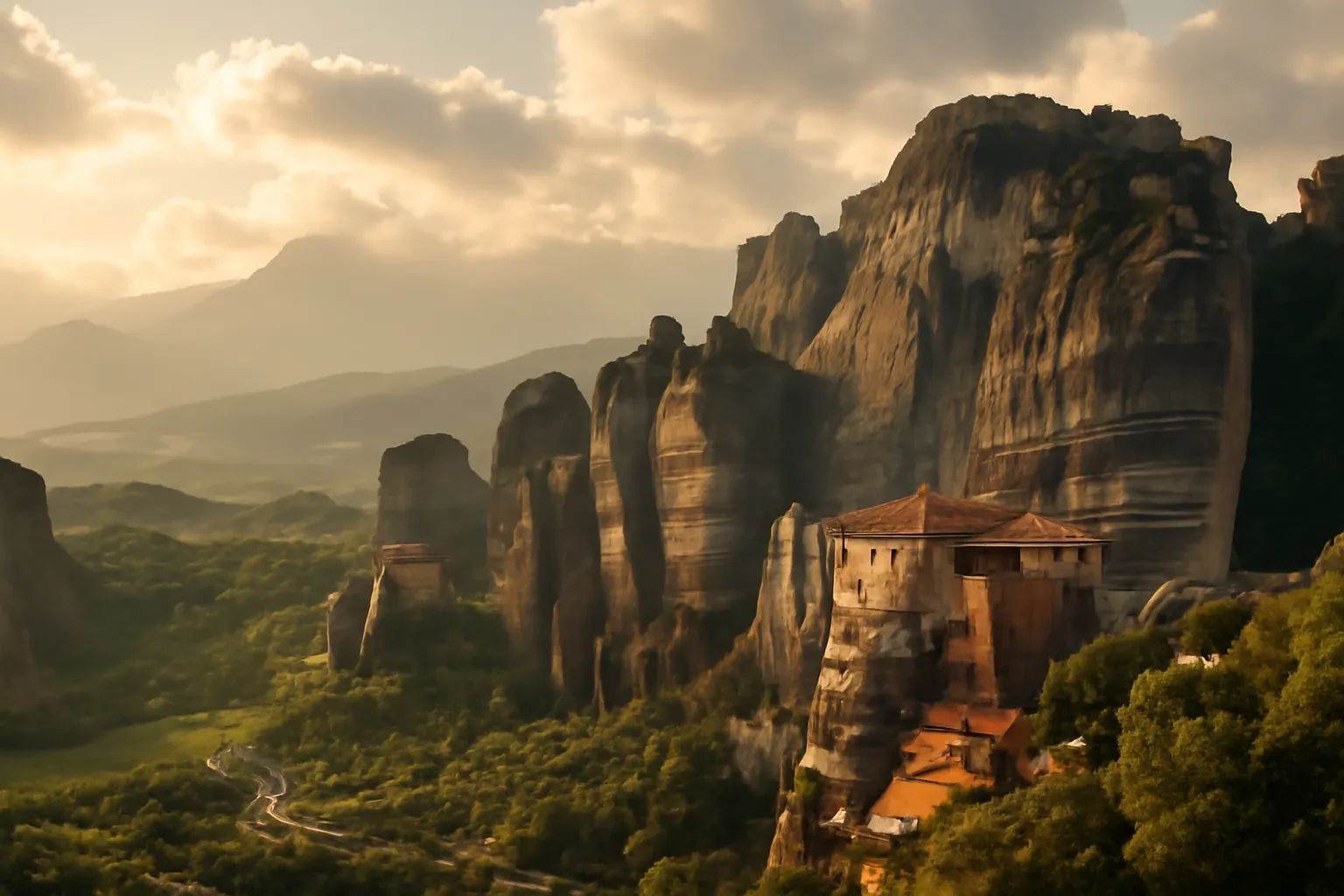
Figuring out how to access and explore Meteora monasteries properly makes or breaks the trip. These jaw-dropping religious complexes balance atop sandstone pillars that shoot up more than 400 meters from the Thessaly plain, so getting there isn’t quite as simple as pulling up to a typical landmark. The reassuring part is that once you know the logistics, moving through this landscape is far easier than it looks from the photos.
This guide covers everything required to map out your Meteora visit — the best driving routes, where to leave your car, the footpaths linking each monastery, and the smartest order to tackle them in. Whether you roll in by rental car, flag down a taxi, or hike out from Kalambaka on your own two feet, what follows will keep you moving through the area without wasted time or wrong turns.
Right now, standing at the base looking up, there’s a queue forming near the ticket booth at Great Meteoron, the smell of dust and pine drifting off the trail behind me, and a cluster of tour groups already checking watches for their bus back — this is Meteora on an ordinary morning. When I first saw pictures of this place years ago, I genuinely thought they’d been doctored. Monasteries balanced on top of towering rock columns in the middle of Greece? Seemed like a stretch. Then I stood right here, craned my neck back, and my brain simply refused to process it. It’s so strange it almost tips back into looking fake — except your burning calves from the climb are proof this is entirely real. If you’re wondering how to see these monasteries without getting tangled up in shifting schedules, dress code confusion, and figuring out which trails actually deserve your energy, you’re exactly where you need to be. Let’s work through it.
Getting to Meteora: Trains, Buses, and Road Trips
The launch point for any Meteora trip is Kalambaka, and getting there is easier than most travelers assume. You’ve got three main routes in from Athens — train, bus, or driving — each delivering its own version of the journey.
By Train
This is the one I always choose, and it’s by far the prettiest ride. Trains depart Athens’ Larissa station bound for Kalambaka, with a transfer at Palaiofarsalos along the way. Total travel time lands somewhere between four and five hours, depending on how the connection lines up. Grab tickets ahead of time through Hellenic Train, particularly if you’re traveling in summer. The line drops you straight into Kalambaka itself, so you’re essentially already in position the moment you step off. As entrances go, it’s a solid 10 out of 10.
By Bus (KTEL)
KTEL coaches leave from Athens’ Kifissos terminal for Kalambaka, covering the distance in roughly four and a half hours. Fares are low and the service runs like clockwork. The catch is that the Kifissos terminal sits well outside the city center, so factor in extra travel time just to reach the departure point.
By Car or Rental
Self-driving gives you the freedom to chase golden light at either end of the day instead of syncing with a tour bus timetable. Expect around three and a half hours from Athens along the E75 motorway. There’s roadside parking near the monastery entrances, but during high season those spots vanish quickly. Arrive early, or accept that you might be walking up from further down the hill than you’d like.
Getting From One Monastery to the Next
Once you’ve settled into Kalambaka, several options exist for shuttling between the six functioning monasteries spread across the rock formations.
The footpaths linking the monasteries are honestly one of the best parts of being here. The main network climbs out of Kalambaka into the rocks and circles the plateau. Covering the whole loop on foot takes roughly three to four hours and hands you views no car window can match. Real footwear is non-negotiable — the paths are rocky, uneven, and steep in stretches, and I mean that as a serious warning, not a suggestion.
Driving yourself or hiring a taxi between sites works fine if a full day of hiking isn’t what you’re after. The main road threads past nearly every monastery entrance, letting you park, tour, then drive on to the next stop in order. A taxi out of Kalambaka won’t break the bank for a half-day loop, as long as you settle on a fare before you climb in.
Guided day trips departing Athens or Thessaloniki are an option if you’d rather leave the planning to someone else. They’re painless but move fast — expect two or three monasteries plus a photo-stop, then straight back onto the coach. If Meteora is the actual point of your trip rather than a box to tick, I’d steer you toward spending a night in Kalambaka instead.
Which Monasteries Are Worth It (And Their Actual Opening Days)
Here’s what catches people off guard: closure days rotate, and not every monastery shuts on the same day of the week. Climbing 300 steps only to find the gate padlocked is a uniquely deflating experience, so a bit of homework beforehand pays off.
Tight on time? Put Great Meteoron (the biggest and oldest of the bunch) and Varlaam (visually the most striking from below, with frescoes that steal the show inside) at the top of your list. These two aren’t optional. The remaining four — Roussanou, St. Nicholas Anapausas, Holy Trinity, and St. Stephen’s — reward a visit if your schedule allows, but with just a single day, build your plan around Meteoron and Varlaam first.
Opening hours generally fall between 9:00 AM and 5:00 PM, with minor seasonal shifts. Nearly every monastery takes one or two days off weekly, and the specific day varies — Meteoron usually shuts on Tuesdays, Varlaam on Fridays. Confirm the current schedule before you set out, since it’s known to change. The complete guide to visiting Meteora monasteries lays out opening days and other practical details worth saving for reference.
The Smartest Order for Visiting the Monasteries From Kalambaka
Starting out from Kalambaka (or its smaller neighbor Kastraki up the road), there’s a tried-and-true sequence, and it comes down to one principle: head straight for the top and descend from there. Tour buses do the reverse, which is precisely the reason you shouldn’t copy them. Here’s the route worth following:
- Great Meteoron — hit this one first, right when it opens around 9:00 AM. It’s the largest, draws the biggest crowds, and is exactly where every coach tour lands mid-morning. Arrive ahead of them and you’ll nearly have the place to yourself.
- Varlaam — practically around the corner, just a two-minute drive or a brief walk away. Go here second, before the crowds shift over from Meteoron.
- Roussanou — on your way back down, this small convent sits lower on its pillar and gives you one of the most camera-ready moments of the day.
- St. Nicholas Anapafsas — the lowest of the six on the Kastraki side, compact, often peacefully empty, and home to frescoes that punch above its size.
- St. Stephen — cross over to the eastern side of the loop for this one. It’s the simplest of all six to reach — a flat footbridge instead of a staircase — making it a welcome fifth stop once fatigue sets in.
- Holy Trinity — save this for last if your knees can take it. The roughly 140 steps up are the hardest climb of the day, but it’s the monastery famous from the James Bond film, and the view back toward Kalambaka makes a fitting closer.
One important note: since closure days rotate among the monasteries, the perfect route shifts depending on the day of your visit. As of this writing, Great Meteoron is shut on Tuesdays, Varlaam and St. Nicholas Anapafsas on Fridays, Roussanou on Wednesdays, and Holy Trinity on Thursdays — though these details are subject to change, so double-check before finalizing your plan. If a closure interrupts the order above, just skip that one and continue the same top-to-bottom approach.
Narrowing It Down If You Can’t See All Six
Pressed for time? Here’s a simple way to decide which Meteora monasteries make the cut. With room for only two, go with Great Meteoron and Varlaam — the heavyweights, sitting right next to each other, together covering the history, the museum exhibits, and the frescoes. Got time for three? Fold in Roussanou for the photo opportunities and an easier climb. If stairs are a concern for anyone traveling with you, substitute St. Stephen, which requires no climbing whatsoever to enter. And if drama matters more to you than ease, Holy Trinity offers the most striking perch of the entire group — just make sure your legs are up for it.
What You Need to Wear: The Meteora Dress Code, Explained
Now for the dress code, since this catches more visitors off guard than anything else about the visit. These are working religious sites, and the rules get enforced right at the entrance gate — no wiggle room, no arguing your way past it.
Here’s what the Meteora dress code actually requires:
- Shoulders need to stay covered — tank tops and sleeveless tops are out
- Legs need coverage too — shorts and short skirts won’t fly
- Women are expected to wear skirts or long pants (most monasteries lean toward skirts specifically, and some hand out wrap skirts at the door)
- Men need long trousers — shorts aren’t permitted
Most entrances keep spare fabric wraps on hand for anyone who shows up unprepared, but they tend to be thin, clumsy to wear, and occasionally run out during busy periods. My honest advice is to just plan ahead — a lightweight, long-sleeved linen shirt paired with loose, breathable trousers does the job perfectly and keeps you comfortable through the summer heat. For the full breakdown of what works and what to skip, the Meteora monasteries dress code guide covers every situation, including exactly what’s acceptable for each gender.
Timing Your Visit Right: Sunrise Spots and Photo Tips
Spring (April–May) and early fall (September–October) hit the ideal balance. Temperatures stay comfortable, crowds thin out, and the light turns something close to magical. Summer still delivers, but expect heat, packed viewpoints, and standing in direct sun in a line with forty other people all angling for the exact same photo.
For sunrise, head to the Psaropetra viewpoint just above Kalambaka — one of the finest lookout spots around, though you’ll need to drive or hike up before daybreak. The mist settling between the rock towers in that first light is the kind of image that stays your phone wallpaper for years. Sunset delivers just as much from the road above Varlaam, looking back at Meteoron as the last light hits the cliff faces.
Rules on photography inside the monasteries differ by site — some are relaxed about it, others limit or ban it in specific rooms. Flash is a no-go everywhere, full stop. Out on the trails, though, shooting the exterior views is completely fair game and honestly stunning.
Why I Stopped Sliding Down Meteora’s Stone Steps Halfway Through Day One
Those monastery staircases are old, uneven, and worn glassy-smooth by centuries of footsteps — meaning they turn slippery the second they’re damp, and genuinely dangerous when you’ve got a backpack on and you’re trying not to glance down 400 meters. My first pair of sneakers taught me this lesson the hard way, and I switched to something with real grip before my legs made the choice for me.
What works
- The waterproof membrane kept my feet dry across the damp stone sections, which noticeably improved traction on the slickest staircases.
- The mid-height ankle support earns its keep once you’re six-plus hours into uneven terrain and your legs have already started to fade.
- They carry enough weight to feel steady on shaky footing without turning into dead weight by the time you reach the topmost monastery.
What doesn’t
- Breathability isn’t their strong suit compared to lighter hiking shoes, so if you’re tackling this in peak summer, your feet will let you know come afternoon.
- Plan on a genuine break-in period — walk around town in them for a few days before subjecting them to six hours of monastery stairs, or you’ll regret skipping that step.
I almost turned back halfway up the Grand Meteora stairs because I was second-guessing whether a mid-height boot was worth the extra weight, but honestly, that ankle support saved me from a wobble I definitely felt. Merrell Women’s Moab 3 Mid Waterproof
Frequently Asked Questions
How long does the train from Athens to Kalambaka take?
The train from Athens’ Larissa station to Kalambaka takes between four and five hours total, including a transfer at Palaiofarsalos. You can book tickets ahead through Hellenic Train, especially during summer travel season.
What is the dress code at Meteora monasteries?
Shoulders must be covered—no tank tops or sleeveless tops. Legs require coverage—shorts and short skirts are not permitted. Women should wear skirts or long pants, and men must wear long trousers. The rules are enforced at the entrance gate with no exceptions.
How long does the full footpath loop around Meteora take?
Covering the entire main footpath network linking the monasteries takes roughly three to four hours on foot. The paths are rocky, uneven, and steep in stretches, making proper footwear non-negotiable for safety and comfort.
Which two Meteora monasteries should I prioritize if short on time?
Visit Great Meteoron first when it opens around 9:00 AM—it’s the largest and oldest. Then go to Varlaam, practically a two-minute drive or brief walk away, which is visually striking with impressive frescoes inside.
About This Article

Written by Elena Vasquez. Elena Vasquez is a full-time traveler and the founder of Witty Passport. Over fifteen years and more than 50 countries across six continents — including a stretch spent leading groups professionally through Southeast Asia and the remote highlands of South America — she's written the kind of destination guides she always wished existed: practical, specific, and built on real experience rather than recycled itineraries. More about this site.
Scope and limits. Elena is a full-time traveler, not a licensed travel agent or immigration adviser. Entry requirements, visa rules, and advisories change without notice — always confirm against the official government source for your destination and passport before booking.
Verify this against a primary source
Specifics change, and your situation may differ from the one described here. These are the authorities worth checking directly:
- U.S. Department of State — entry requirements and travel advisories
- CDC Travelers' Health — vaccination and health notices by destination
- TSA — current carry-on and screening rules