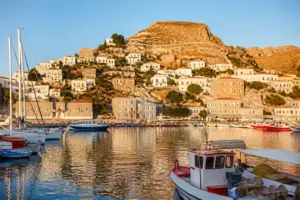

Nobody warned me about the white. I mean, everyone tells you Santorini is white — you’ve seen the postcards, the Instagram feeds, the travel magazine covers. But there is a profound difference between knowing a place is white and standing inside it at noon in July when the temperature has climbed to 34°C (93°F), the sky is the specific shade of blue that belongs only to the Aegean, and every single surface around you — walls, stairs, church domes, cobblestones, garden walls, bougainvillea pots — is throwing sunlight directly into your face from every conceivable angle simultaneously. I was forty minutes into a walk through Oia when my eyes started streaming. An hour in, I had a headache building behind my temples that felt less like dehydration and more like someone was slowly pressing their thumbs into my eye sockets. By the time I reached the famous blue-domed church for the photo I’d been planning for six months, I was squinting so hard in every single shot that I looked less like a happy traveler and more like someone being interrogated under a lamp. That evening, back at my hotel, my eyes ached with a deep, specific pain I’d never felt before. It took me an embarrassingly long time to connect the dots. This is the story of what I learned — about santorini sun protection eyes skin tips, about photokeratitis, about polarized lenses, and about why the most photographed village in the world is also, quietly, one of the most optically brutal environments on earth.
Why Santorini’s White Buildings Sun Glare Is Unlike Anything You’ve Encountered Before
Here’s the thing about Santorini that the travel brochures skip right past: the iconic white-wash isn’t just aesthetic. The tradition of painting buildings with asvestis — a locally produced lime wash — dates back centuries on the Cycladic islands, originally used as a natural antiseptic and a way to reflect heat during brutal Greek summers. The Venetians, who occupied the islands from the 13th century, reinforced the practice. The Greek government later formalized it into building codes for the Cyclades. The result is that every surface you see in Oia, Fira, and Imerovigli has been specifically, deliberately engineered to be as reflective as possible. That’s a feature, architecturally. It’s a problem, optically.
White surfaces reflect between 80 and 90 percent of visible light and UV radiation. For context, fresh snow — the surface that causes ski goggle-mandatory conditions and literal snow blindness on Alpine slopes — reflects about 80 percent. You are walking through the visual equivalent of a ski slope. Except instead of a single flat surface below you, the reflection is coming from every direction. Walls to your left. Stairs below you. The church dome at eye level. The garden terrace above you. A 360-degree reflective bowl.
The caldera geography makes it worse. Santorini sits in the collapsed crater of one of history’s most violent volcanic eruptions — the caldera that remains is a near-circular cliff face, and the famous villages cling to its western edge. The sea inside the caldera is extraordinarily still compared to open-ocean beaches, which means it acts as a mirror. So you have white cliffs above reflecting light down, white buildings around you reflecting light sideways, and the caldera sea below reflecting light up. There is genuinely nowhere to look that isn’t a light source.
The medical term for what happens to your eyes after sustained exposure to reflected UV is photokeratitis — essentially a sunburn on your corneas. The insidious thing about photokeratitis is that it’s delayed. You won’t feel the damage while it’s happening because your corneas have no real-time pain receptors for UV. The symptoms — deep eye ache, sensitivity to light, excessive tearing, the feeling that someone has sprinkled sand under your eyelids — appear four to twelve hours later. Which is why so many Santorini visitors spend the most romantic sunset in the Aegean lying in a dark hotel room wondering why their eyes feel like they’ve been marinated in salt.
Most tourists spend six to eight hours walking through these villages on a typical day. The caldera path from Fira to Oia alone is a three-hour exposed hike along white limestone cliffs with zero shade. Standard cheap sunglasses reduce brightness — they darken the image — but they do absolutely nothing to block polarized reflected glare, which is the specific type of light bouncing off flat horizontal surfaces. For Greece island sun glare eye protection, you need polarization, not just tinting. The difference, when you finally experience it, is almost absurd.
The Sunglasses That Made Santorini’s Glare Tolerable (Not Just Fashionable)
The reflected white light in Santorini doesn’t just make you squint—it genuinely hurts. By hour three of walking through Oia, my eyes felt like they’d been sandpapered, and I realized my regular sunglasses were doing almost nothing against the relentless bounce-back glare off every surface.
What works
- The polarized lenses actually cut the bounce-back glare rather than just darkening everything—you can see the cobblestones without that painful white veil anymore.
- They don’t slip down your face when you’re sweating through the village heat, and they’re light enough that you forget you’re wearing them after a while.
- The metal frame doesn’t get hot to the touch against your skin the way cheap plastic does, which matters when you’re wearing them for six straight hours in 34°C heat.
What doesn’t
- They’re dark enough that navigating ancient narrow staircases becomes genuinely risky—I nearly missed a step because I couldn’t see the depth of the shadows properly.
- The frame scratches easily if you’re tossing them in a backpack without a case, and once you get a scratch on the lens, you’ll notice it every single time.
I almost ditched them halfway through day two when the darkness felt too limiting, but stepping back into that unfiltered white glare reminded me exactly why I brought them. ATTCL Polarized Sunglasses (UV400, AL-MG Metal Frame, Style 8587 in black-gray)
This post contains affiliate links. As an Amazon Associate, I earn from qualifying purchases at no extra cost to you.