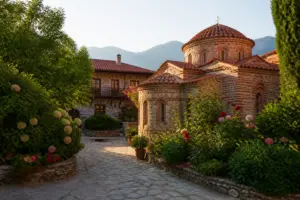
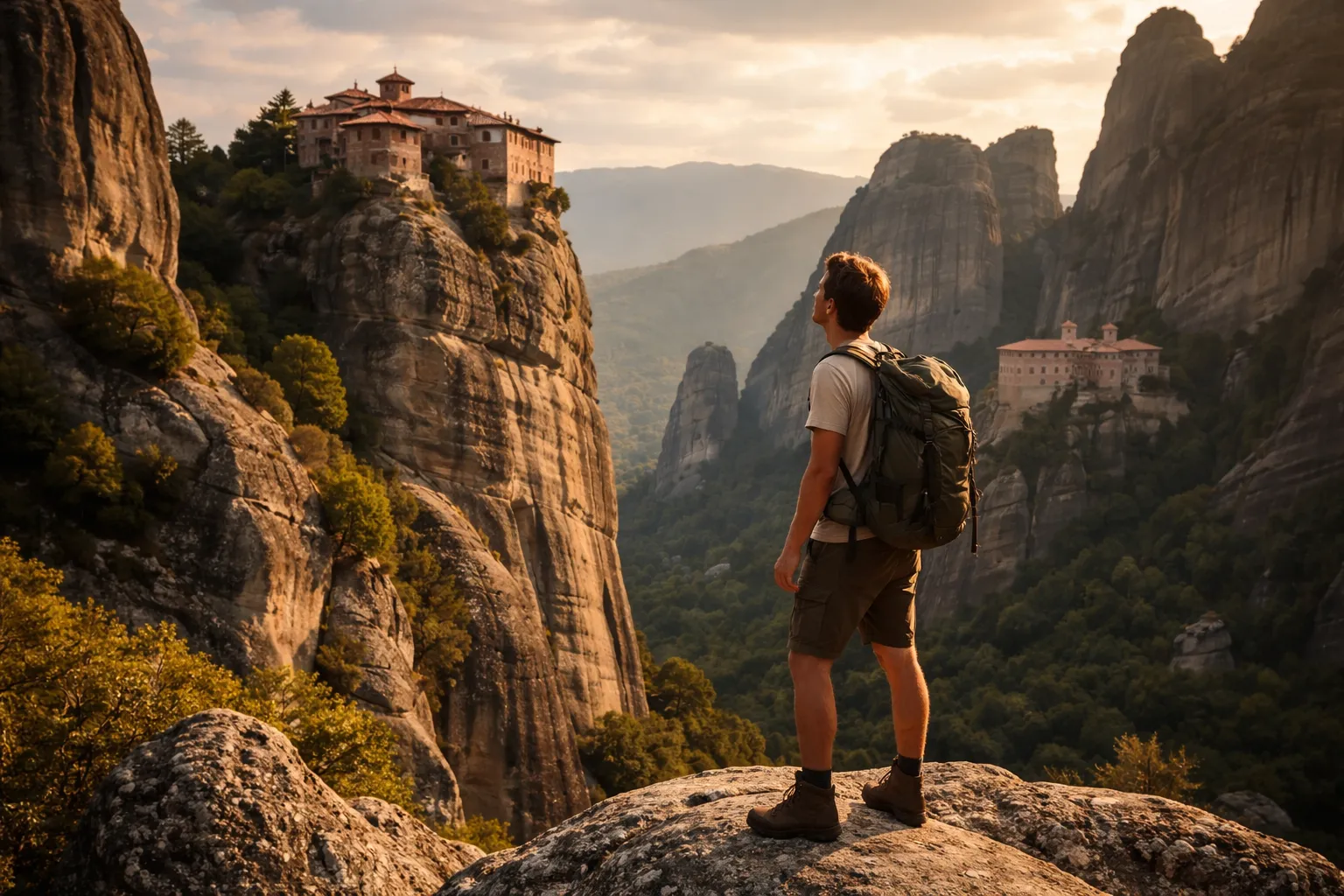
Most people walk into Meteora assuming the view does all the work — that six monasteries balanced on 400-meter sandstone towers will explain themselves just by being visually stunning. They won’t. I found that out standing in the courtyard of the Great Meteoron monastery, high above the Thessalian plains, staring at something I couldn’t actually interpret.
Every inch of wall around me was covered in fresco work — halo-crowned saints, martyrdom scenes, layers of theological symbolism — and none of it registered. The paintings had that unmistakable weight of age, but honestly, they could have been done last year or six hundred years ago for all I could tell. Somewhere in that silence was the fact that monks had hauled every stone and beam up sheer cliff faces using nothing but rope and pulley, and I couldn’t see that achievement either. Six centuries of context — hermits escaping Ottoman advances, isolated communities carving out religious life, the wreckage of war followed by slow, careful rebuilding — sat there completely locked away from me.
I was just another visitor gaping at old stone buildings perched on tall rocks.
The moment that really exposed the gap came when I turned to another traveler and asked about the fresco showing a man riddled with arrows. She just shrugged. “No clue. Our guide said something like Saint Sebastian, but I couldn’t tell you why he matters.” A monastery worker nearby gave me a founding date that contradicted what I’d read elsewhere. The rental audio guide from the front desk kept dying mid-sentence. None of these sources, patched together, could explain why this particular impossible place mattered — not to Orthodox Christianity, not to Byzantine history, not even to Greece’s broader story.
By the time the sun dropped that evening, I’d toured three monasteries and had nothing to show for it besides the scenery. I’d burned a good day of travel simply because I hadn’t done the homework beforehand.
What changed everything was one straightforward find — the right best guidebook for visiting meteora monasteries — which turned Meteora from a scenic backdrop into one of the most quietly overwhelming spiritual places I’ve encountered anywhere.
Why Visiting Meteora Without Context Is Uniquely Disorienting
Greece generally forgives a lack of preparation. Athens still works if you don’t know a thing about Pericles — the Acropolis is impressive on sight alone. Crete’s beaches don’t require a history lesson to enjoy. Meteora plays by different rules. Those monasteries balanced on 400-meter sandstone pillars function as spiritual, architectural, and historical documents, and if you can’t read them, you’re only getting a fraction of what’s actually there.
A few reasons this particular gap hits harder at Meteora than almost anywhere else in Greece:
The backstory has real depth. This is 14th-century hermits fleeing Ottoman conquest, building monastic life inside near-vertical caves, developing dense theological traditions, surviving destruction during WWII, and going through painstaking restoration afterward. None of that is throwaway trivia — it’s the actual reason these structures exist in this shape, in this location. Unfortunately, the plaques on-site barely scratch the surface. You’ll get something like “Founded 1356” and nothing more. Founded by whom? Why then, specifically? What crisis pushed monks toward living on top of sheer rock?
Each monastery has its own personality. Great Meteoron, the biggest of the group, tells one story. Varlaam tells a different one entirely. Holy Trinity — the one rumored to have hosted a James Bond rappelling scene in “For Your Eyes Only” — has its own history again. Without some kind of framework going in, there’s no obvious way to know which to prioritize, why they diverge, or what actually makes each one worth your time. It’s easy to burn your morning at the least compelling monastery while skipping the one that would’ve stayed with you.
The artwork inside needs translating. Byzantine frescoes don’t explain themselves to a modern Western eye. Saint Basil the Great isn’t a random figure — he represents something specific. The Pantocrator imagery carries deliberate theological weight. Where figures sit within the dome tells a whole story about Orthodox cosmology. Skip the explanation and you’re just clocking colors and shapes, not actually seeing the monks’ worldview laid out in paint.
Support on the ground for solo travelers is thin. Kalambaka has guided tours, sure, but the quality swings hard — some guides genuinely know their material, others are just herding people through on a schedule. Audio guides exist, but they’re unreliable. English is limited among monastery staff. And most of the printed visitor material is generic tourist copy that skips right past what actually matters.
You can walk through Meteora and leave with nothing but photos, or you can walk in already understanding what you’re seeing and leave with your view of faith, endurance, and human ingenuity genuinely shifted. It’s not the rocks that make the difference. It’s what you know before you get there.
The Guide That Finally Got Meteora to Click
Meteora punishes improvisation. Monasteries stacked on impossible stone towers need context behind them — without it, you’re just looking at old paint on old rock. I learned this firsthand, baffled inside a 14th-century courtyard with no idea what was actually in front of me.
Where it delivers
- The sections covering history and spiritual meaning turn those baffling frescoes into genuine windows into Byzantine theology and monastic life — the whole site suddenly reorganizes itself into something coherent.
- Logistics are laid out clearly and kept current — which monasteries are open on a given day, whether advance permission is needed, how much time to realistically budget across multiple sites — so you’re not left standing at a locked gate wondering where the afternoon went.
- The map suggestions and local tips steer you toward the quieter monasteries and viewpoints, which counts for a lot when you’re hoping for a moment of stillness instead of a shoulder-to-shoulder crowd of tour groups.
Where it falls short
- It’s thick enough that you actually need to read the relevant chapters ahead of time — there’s no skimming it on the spot once you’re already standing in the courtyard.
- A handful of the hotel and restaurant picks for the smaller towns read a bit stale, and in a place like Kalambaka, that can mean landing somewhere that’s slipped noticeably since the guide was printed.
I almost skipped reading ahead entirely, figuring I’d just “see what happens” when I arrived—a decision that would have cost me the entire depth of the visit. The Lonely Planet Greece: 2025-2026 Travel Guide changed that calculation entirely.
Frequently Asked Questions
What are the sandstone towers at Meteora and how tall are they?
Meteora features six monasteries balanced on 400-meter sandstone towers above the Thessalian plains. These structures function as spiritual, architectural, and historical documents that require context to fully understand. The monks hauled every stone and beam up sheer cliff faces using nothing but rope and pulley, an achievement that spans six centuries of construction and rebuilding.
Why is visiting Meteora without preparation so disorienting?
Meteora plays by different rules than most Greek sites. The monasteries serve as spiritual, architectural, and historical documents rooted in 14th-century hermits fleeing Ottoman conquest, WWII destruction, and painstaking restoration. Byzantine frescoes require understanding of theological symbolism, each monastery has distinct historical significance, on-site plaques barely scratch the surface, and ground support for solo travelers is thin.
What’s the history behind why monks built monasteries at Meteora?
Meteora’s monasteries were founded starting in the 14th century by hermits fleeing Ottoman conquest. Monks built monastic life inside near-vertical caves, developed dense theological traditions, survived destruction during WWII, and underwent painstaking restoration afterward. The biggest monastery, Great Meteoron, was founded in 1356 and represents just one of several monasteries, each with its own distinct history and spiritual purpose.
Which Meteora monastery is rumored to have a James Bond connection?
Holy Trinity is the monastery rumored to have hosted a James Bond rappelling scene in “For Your Eyes Only.” Each of Meteora’s monasteries—including Great Meteoron and Varlaam—has its own distinct personality and history. Without a framework going in, it’s easy to miss which monasteries are most compelling or worth prioritizing during your visit.
About This Article

Written by Elena Vasquez. Elena Vasquez is a full-time traveler and the founder of Witty Passport. Over fifteen years and more than 50 countries across six continents — including a stretch spent leading groups professionally through Southeast Asia and the remote highlands of South America — she's written the kind of destination guides she always wished existed: practical, specific, and built on real experience rather than recycled itineraries. More about this site.
Scope and limits. Elena is a full-time traveler, not a licensed travel agent or immigration adviser. Entry requirements, visa rules, and advisories change without notice — always confirm against the official government source for your destination and passport before booking.
Verify this against a primary source
Specifics change, and your situation may differ from the one described here. These are the authorities worth checking directly:
- U.S. Department of State — entry requirements and travel advisories
- CDC Travelers' Health — vaccination and health notices by destination
- TSA — current carry-on and screening rules