Zhangjiajie Avatar Mountains Drone Photography: What It’s Like to Fly Above the Floating Pillars
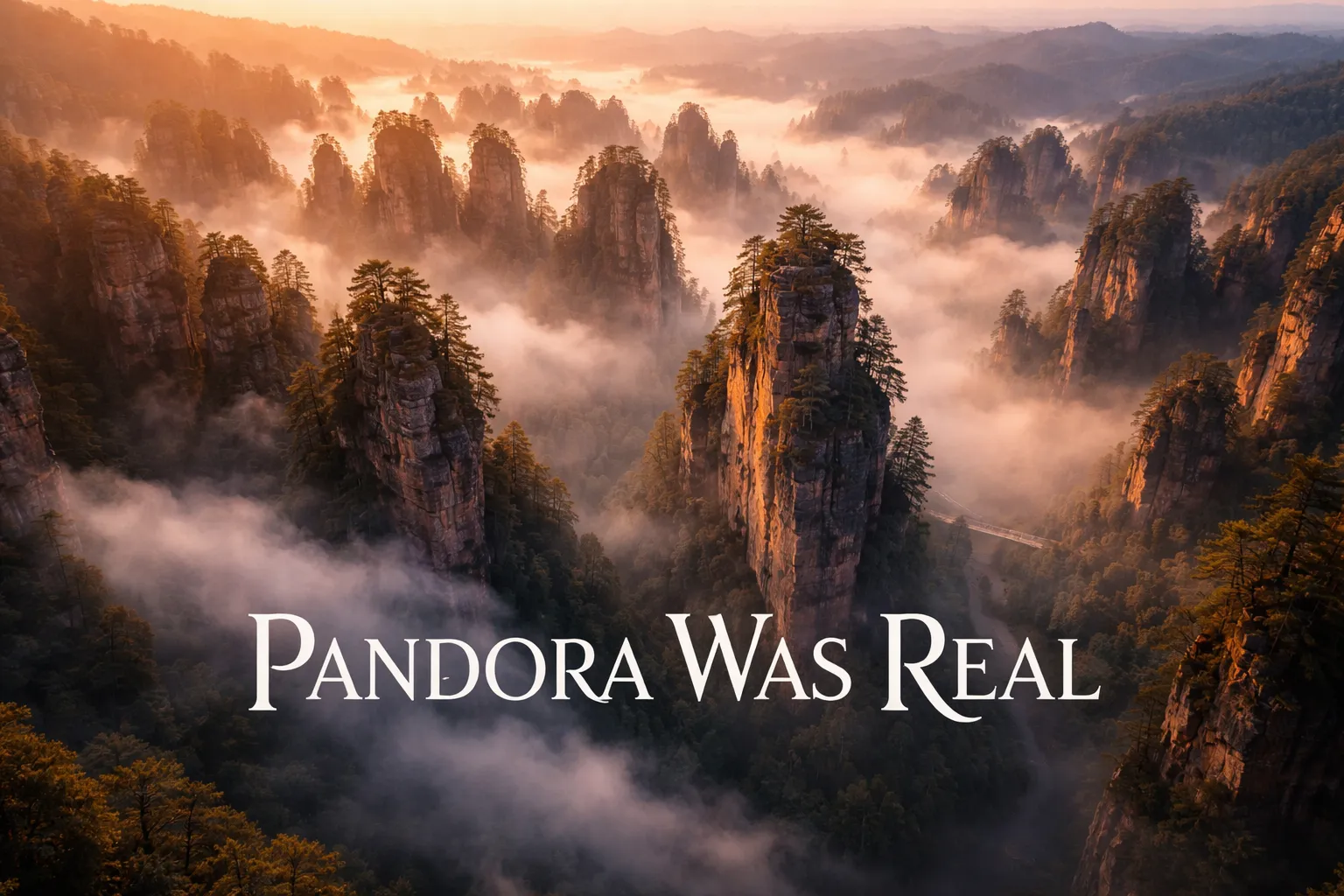
The moment my drone cleared the treeline above Yuanjiajie Scenic Area and I looked down at my controller screen, I genuinely forgot to breathe. Nothing — no photograph, no film clip, no description — had prepared me for what zhangjiajie avatar mountains drone photography actually looks like in real time. More than 3,000 quartzite sandstone pillars, some soaring 200 meters from the valley floors, stretched across the landscape in every direction like a frozen army of stone giants. It was a Tuesday morning in late October, and the mist was doing exactly what it’s famous for: pooling between the pillars at mid-elevation so that the upper columns appeared to be hovering in white cloud. James Cameron didn’t imagine Pandora’s Hallelujah Mountains. He barely had to. The real thing is already there, in Hunan Province, China — and from altitude, it is genuinely one of the most disorienting and spectacular sights in aerial photography.
This guide covers everything you need to plan a legal, safe, and visually extraordinary drone photography session at Zhangjiajie National Forest Park — including the specific compositions that professional filmmakers use, the technical challenges nobody warns you about, and the honest truth about China’s drone regulations in this area.
Drone Flight Brief: Zhangjiajie National Forest Park Quick-Reference Data
| Parameter | Details |
|---|---|
| GPS Coordinates (Tianzi Mountain Viewpoint) | 29.3716° N, 110.4536° E |
| GPS Coordinates (Yuanjiajie Scenic Area) | 29.3253° N, 110.4378° E |
| Recommended Altitude Range | 80–180m AGL for pillar-level shots; 200–350m for full forest canopy overview |
| Best Time of Day | 6:00–9:00 AM for morning mist; golden hour at 5:00–6:30 PM for warm pillar light |
| Best Season | Late September–November (autumn mist); March–May (spring fog); January–February (snow-capped pillars) |
| Drone Regulations Summary | CAAC registration mandatory for drones over 250g; commercial filming requires advance permits from park authorities; flying within the core scenic zones is heavily restricted — see full regulations section below |
| Skill Level Required | Advanced — unpredictable mountain thermals, GPS signal interference between pillars, extreme vertical terrain |
| Nearest Major Airport | Zhangjiajie Hehua International Airport (DYG), approx. 35 km from park entrance |
Can You Fly a Drone at Zhangjiajie National Forest Park? Regulations & Practical Reality
Let me be completely honest with you here, because this is the section most aerial photography blogs gloss over: flying a drone inside Zhangjiajie National Forest Park’s core scenic areas without prior authorization is prohibited, and enforcement has increased significantly since 2019. China’s Civil Aviation Administration (CAAC) requires all drones weighing more than 250 grams to be registered and flown by a licensed operator. The park itself — a UNESCO Global Geopark since 1992 — has its own additional layer of rules, and the two sets of regulations stack on top of each other.
Here is what the regulations actually require as of the most recent published guidance: (1) Your drone must be registered with CAAC’s UAS Cloud system before it enters Chinese airspace with you. (2) Commercial or media drone operations inside the park require a filming permit (影视拍摄许可证) applied for through the Zhangjiajie National Forest Park Administration Bureau — applications typically require 15–30 days of lead time. (3) The area around Tianzi Mountain and Yuanjiajie is classified as a sensitive flight zone, meaning automated geo-fencing on DJI drones will restrict or alert you in these areas. (4) Even with all paperwork in order, flights must be coordinated with local park rangers and are typically restricted to designated launch points outside the pedestrian trail corridors.
The practical reality for independent travelers: the vast majority of stunning drone footage you see of Zhangjiajie online was either shot by credentialed film crews with advance permits, captured from positions just outside the strict restricted boundary, or — frankly — shot without authorization and in violation of park rules. I am not recommending the latter. What I am saying is that the permit process, while bureaucratically demanding, is achievable. Several local tour operators in Zhangjiajie City specialise in facilitating filming permits for international crews, and engaging one of these operators is the most reliable legal pathway for avatar mountains china drone flying. Budget a minimum of three weeks for the permit process and expect to submit a detailed flight plan, crew credentials, and a shoot schedule.
What the Aerial View of Zhangjiajie Reveals That You Can’t See From the Trails
The trails inside Zhangjiajie are genuinely breathtaking — but they show you the pillars one at a time, always with your neck craned upward and your perspective limited to whatever gap in the forest you happen to be standing in. The zhangjiajie national park aerial view is a completely different comprehension of the landscape. From 150 meters above the valley floor, the pillar forest stops being a collection of individual formations and becomes a system — a geological organism that stretches from horizon to horizon. You can see for the first time how the natural stone bridges connect the pillar tops like gangways, how the twisted Huangshan pines cling to the summits of columns with no apparent ground to grow in, and how the entire formation is actually the eroded remnant of a vast sandstone plateau. The valleys are where the rock wasn’t — the pillars are what survived.
At dawn, when the mist pools at 800–1,000 meters elevation (the mid-point of the taller pillars), the aerial view produces the exact visual effect that made Avatar’s floating mountain sequences so iconic: the pillar tops emerge from a white sea of cloud, completely disconnected from the ground below. This is not a trick of post-processing or camera angles. It is just what it looks like at 7 AM on a humid autumn morning from 200 meters up. The Tianzi Mountain drone photography positions specifically capture the densest cluster of pillars in the entire park — an area called the “Tianzi Mountain Sea of Clouds” — where over a dozen major formations rise above 1,200 meters and the mist behavior is most consistent and dramatic.
One thing that genuinely surprised me from the air: the scale of the green. From the ground, the rock dominates. From above, the pillars are almost entirely clothed in forest — the rock only reveals itself at the sheer vertical faces, which from altitude appear as thin grey lines separating masses of deep green canopy. The color contrast between weathered sandstone and subtropical pine forest, shot in early morning light, produces tones that are almost unrealistic in their saturation.
The Best Shots to Capture: Specific Compositions for Zhangjiajie Aerial Photography
The Mist-Layer Shot (Altitude: 180–250m, Early Morning)
Position your drone just above the top of the mist layer so that the pillar summits protrude above a white plane of cloud. The most effective framing places three to five pillar tops in the foreground at varying distances, with the cloud extending to the horizon behind them. Shoot at 24mm equivalent with a slight downward tilt (10–15 degrees) to maintain the sense of height. Best achieved from the Tianzi Mountain area between 6:30 and 8:30 AM in October or November. Exposure: prioritize highlight protection on the mist — it will blow out fast as the sun rises.
The Glass Bridge From Above (Altitude: 100–150m, Midday)
The Zhangjiajie Grand Canyon Glass Bridge — 430 meters long and suspended 300 meters above the canyon floor — is one of the world’s most photographed structures, but the glass bridge zhangjiajie from above perspective is almost never seen outside professional productions. From directly overhead at 120 meters, the bridge appears as an impossibly thin thread crossing the abyss, with the canyon walls dropping symmetrically on either side. The glass floor panels are invisible from altitude, which makes the human figures walking across it look as though they are simply levitating above the gorge. This shot requires precise hover stability in a canyon environment where updrafts are significant — not a beginner maneuver. The bridge coordinates are 29.2447° N, 110.3941° E, and it sits in its own management zone with separate permit requirements from the national forest park.
The Winter Snow Pillars (Altitude: 150–200m, January–February)
If you can time a shoot for the two to four weeks per year when snow settles on the pillar tops, you are looking at perhaps the rarest and most visually arresting version of this landscape from the air. The white snow caps on dark sandstone pillars against a pale winter sky creates a monochromatic palette that is completely unlike the summer and autumn shots. Tianzi Mountain receives the most reliable snowfall. Cold-weather battery performance is a serious concern here — lithium batteries lose 20–30% of their capacity at 0°C, so carry extra cells kept warm in an inner jacket pocket until needed.
The “Avatar Tree” Pillar (Hallelujah Mountain Reference, Altitude: 120m)
Pillar No. 3015, officially renamed “Avatar Hallelujah Mountain” in 2010 following the film’s release, is a 150-meter sandstone column with a distinctive leaning profile. From ground level it looks impressive. From 120 meters and slightly below its summit, looking up along its face with the valley behind, it is the single most recognizable shot in Zhangjiajie aerial photography. The GPS reference point for the closest legal launch position to this pillar is approximately 29.3178° N, 110.4312° E, though this will need to be confirmed with your permit coordinator on the ground.
Technical Challenges: What Makes Zhangjiajie Drone Flying Genuinely Difficult
I want to be specific about this because the technical environment at Zhangjiajie is unlike any other landscape I have flown in. First: wind. The canyon system between the pillars creates localized thermals and directional wind changes that bear no relationship to what your weather app told you on the ground. I logged wind speeds of 4 km/h on my controller while watching a pillar-top pine thrashing in what was clearly a 25+ km/h gust 80 meters away. Always keep 40% battery in reserve for fighting unexpected wind on the return flight. Second: GPS signal interference. The quartzite sandstone pillars contain ferrous mineral deposits, and flying in the narrow corridors between them causes genuine GPS positioning instability in some drones. Several professional operators I spoke with in Zhangjiajie report that their aircraft switched to ATTI mode (no GPS stabilization) when flying close to pillar faces — a situation that demands manual pilot skill and is not recoverable by a beginner. Third: depth perception. When everything in your frame is vertical and there are no horizontal reference surfaces, judging your actual distance from a pillar face on a 5-inch monitor is genuinely difficult. I recommend using the automatic obstacle avoidance features of your drone as a hard safety limit, not as a crutch, and maintaining at least 15 meters clearance from any rock face at all times.
This post contains affiliate links. As an Amazon Associate, I earn from qualifying purchases at no extra cost to you.
Gear Worth Packing for Zhangjiajie Avatar Mountains Drone Photography
If you are flying in the early morning hours — which you absolutely should be for the mist effect — or extending into twilight for golden-hour shots, a quality strobe light is essential both for safety and for legal compliance. The VIFLY Drone Strobe Light Anti Collision Light is the unit I now carry on every mountain shoot, and it proved its value at Zhangjiajie specifically in low-visibility conditions. When the mist is at its most photogenic — thick enough to create the floating-mountains effect — it also makes your drone nearly invisible to other aircraft and to your own eyes during a rapid repositioning move. This strobe pulses at 12,000 mcd, making the drone visible at over a mile in low light, and it weighs just 8 grams so it has zero meaningful impact on your flight time. It clips onto most DJI models including the Mini 3 Pro, Mini 4 Pro, Air 3, and Mavic 3 without any tools. I have also found that having visible strobes on the aircraft makes interactions with park rangers considerably less confrontational — it signals that you are operating in a professional and safety-conscious manner rather than trying to sneak a quick flight.
The mountain environment at Zhangjiajie is genuinely punishing on drone hardware, and propeller damage from unexpected wind gusts or minor contact with vegetation is a realistic risk even for experienced pilots. Carrying a spare propeller kit like the Black Accessory Kit with Spare Propellers, Protective Cover, and Landing Gear has saved entire shoot days for me more than once. At Zhangjiajie, you are often a 45-minute cable car and bus ride from the nearest equipment shop, so a bent prop blade discovered at the launch point means a lost morning unless you have spares in your bag. This kit covers the full replacement cycle — props, protective covers for transport, and landing gear components — which matters particularly on this terrain where you are frequently landing on uneven rocky surfaces or damp wooden viewing platform boards. The landing gear extensions in this kit also raise the drone’s ground clearance, which protects the gimbal from contact on rough surfaces. Think of this as your insurance policy against the most common mechanical failure mode in field drone photography.
For the narrow-corridor flying between pillar faces — the shots that produce the most viscerally impressive footage of this landscape — propeller guards are a genuinely important safety layer. The BONKZEBU 4pcs Drone Propeller Protectors Blade Guards offer quick-release attachment so you can put them on for the close-proximity pillar shots and remove them for high-altitude overview work without any tools or significant time cost. In the GPS-unstable corridors between the sandstone columns — where the aircraft can drift unpredictably even with experienced input — having a physical guard that absorbs minor contact rather than allowing it to reach the blade root can be the difference between a drone that flies home and one that doesn’t. I treat these guards as mandatory equipment any time I am flying within 10 meters of a rock face. They add a small amount of drag that reduces maximum flight efficiency by roughly 5%, which is an entirely acceptable trade-off in a location where replacing the aircraft is both expensive and logistically complicated.
Best Time to Visit Zhangjiajie for Aerial Photography
The single best window for zhangjiajie avatar mountains drone photography is late September through mid-November. Autumn brings consistent morning mist, moderate temperatures (10–22°C), lower humidity than summer, and the addition of turning foliage on the pillar slopes — gold and orange against grey sandstone and green pine. The sea-of-clouds effect is most reliable during this period because the temperature differential between night and day is large enough to produce dense low-lying fog that burns off by mid-morning, giving you a defined window of approximately 90 minutes in which the conditions are at their visual peak. Spring (March–May) is the second-best option, with similar mist dynamics and cherry blossom coloring in the lower valleys. Summer (June–August) brings heavy rain, high humidity, and frequent afternoon thunderstorms that make flying risky and muddy the aerial color palette. Winter is a specialist opportunity: fewer tourists, potential snow on the pillar tops, and dramatic low-angle winter light — but cold temperatures demand careful battery management.
Frequently Asked Questions About Zhangjiajie Drone Photography
Is drone photography allowed inside Zhangjiajie National Forest Park?
Recreational drone flying without permits is prohibited inside the core scenic areas of Zhangjiajie National Forest Park. Authorized commercial and media drone operations are possible with advance filming permits obtained from the Zhangjiajie National Forest Park Administration Bureau, which requires a minimum of 15–30 days lead time and a detailed flight plan submission. All drones over 250g must be registered with China’s CAAC UAS Cloud system before operation. Travelers who wish to capture aerial imagery without navigating the permit process should consider using the park’s own authorized aerial media, or engaging a licensed local production company that already holds standing permits.