
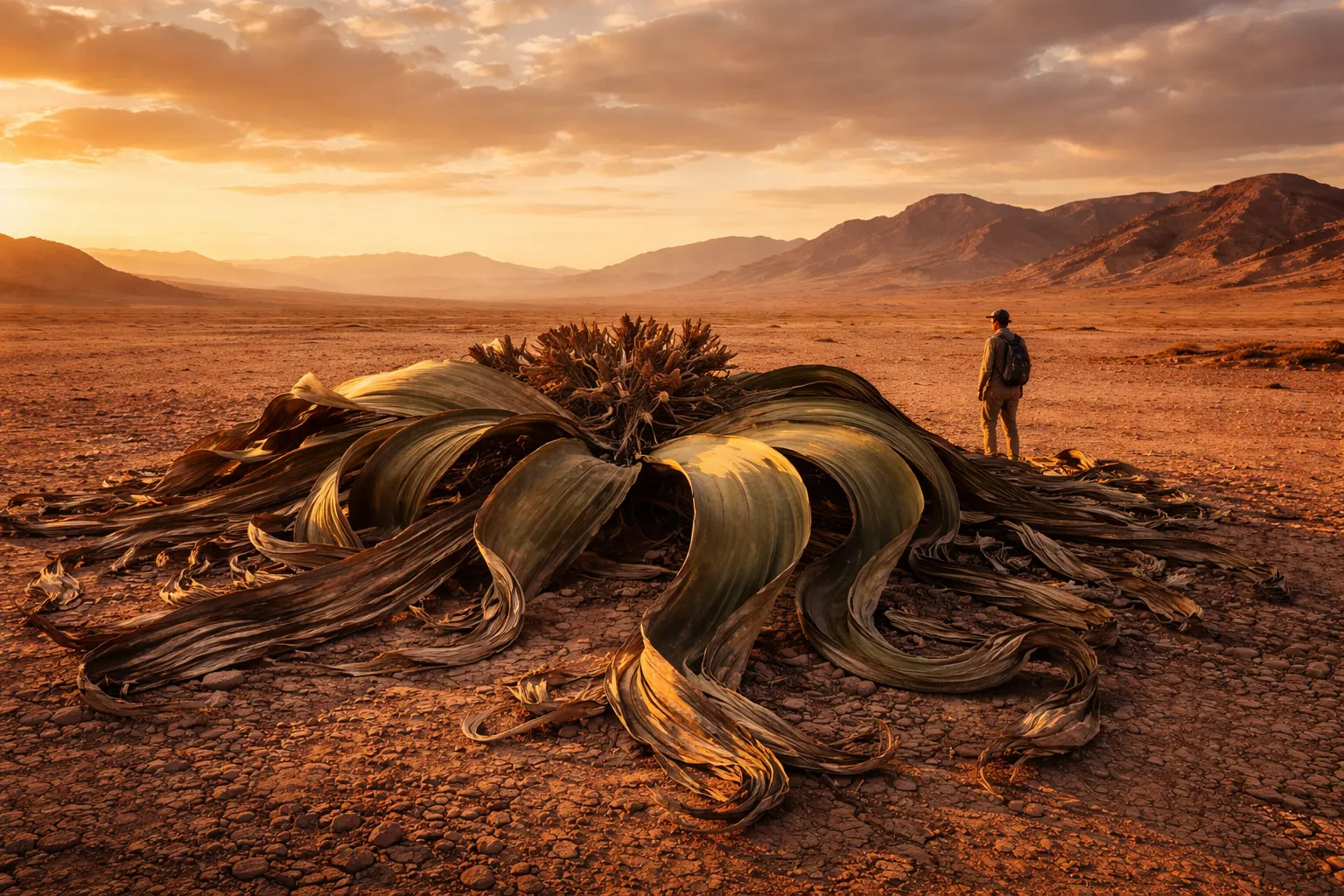
The first time you crouch down in front of a welwitschia mirabilis — the oldest plant species still living in the Namib Desert — you’ll probably say something embarrassing out loud. I did. Something between a laugh and a gasp, because nothing prepares you for the visual: a sprawling, shredded tangle of leathery straps heaped on the gravel like a creature that lost a fight with a lawnmower. And then your guide tells you it’s been sitting in that exact spot for roughly 1,500 years, growing exactly two leaves the entire time — just two — and you realize you’re looking at one of the most extraordinary living things on Earth. The welwitschia mirabilis oldest plant conversation starts here, in the Namib, in the dust, with your jaw somewhere near the ground.
This post contains affiliate links. As an Amazon Associate, I earn from qualifying purchases at no extra cost to you — at no additional cost to you whatsoever.
How Old Is Welwitschia Mirabilis — And Does It Really Only Grow Two Leaves?
Yes. Welwitschia mirabilis produces exactly two leaves in its entire lifetime — and those two leaves can live for over 2,000 years. This is not a simplification. It is the single strangest reproductive and structural fact in all of botany.
Here’s how it works: the plant germinates with two seed leaves (cotyledons), which eventually die. Behind them, a growth plate at the base of the stem produces two strap-shaped leaves that then grow continuously — outward from the base — for the entire life of the plant. Those leaves never fall off. They never get replaced. They split lengthwise at their tips as they age, fray in the wind, and curl back on themselves, creating the visual chaos that makes welwitschia look like a pile of debris rather than a single organism. What appears to be dozens of leaves when you first see a large specimen is actually two leaves that have been growing and shredding for centuries.
When you ask “welwitschia age how old,” the answer depends on the specimen. Most welwitschias you’ll encounter on guided routes are between 500 and 1,000 years old. The largest known specimen — “The Big Welwitschia,” located near the Messum Crater in Namibia — has been carbon-dated and is estimated at between 1,500 and 2,000 years old. That means it was alive during the fall of the Western Roman Empire. It was alive before the first Viking set foot in North America. It was alive before the construction of Angkor Wat.
Sizing welwitschia is also counterintuitive. The plant stays low to the ground — the main stem rarely rises more than 50 centimeters above the surface — but its diameter can exceed 1.4 meters in the oldest specimens, and those trailing leaves can extend up to 4 meters from the central crown. Carbon-14 dating of large specimens consistently returns ages of 1,000 to 2,000 years, making welwitschia the longest-lived non-clonal plant species in the Namib Desert by an enormous margin.
For comparison: the world’s oldest known living individual olive tree (in Crete) is approximately 3,000 years old. A mature English oak rarely exceeds 800 years. The welwitschia plants you can walk up to on the Namibia Welwitschia Drive — behind their protective fencing, well-marked with interpretive signs — are older than most of Europe’s ancient cathedrals.
The Science Behind Why Welwitschia Is the Strangest Plant in the World
Friedrich Welwitsch, the Austrian-Portuguese botanist who first described this species to Western science in 1863, reportedly knelt beside the first specimen he found in Angola and stared at it in complete disbelief before he could take a single note. That reaction is entirely justified. Calling welwitschia unusual is like calling the Grand Canyon a large ditch.
Welwitschia mirabilis is the sole living member of its entire family, Welwitschiaceae, and its entire order, Welwitschiales. Its closest living relatives are not other desert plants — they are ginkgo trees and cycads. The welwitschia lineage diverged from the rest of the plant kingdom roughly 86 million years ago, during the Cretaceous period, when dinosaurs were still the dominant vertebrates on Earth. All of its direct relatives are fossils. It is, in the truest scientific sense, a living fossil — not a metaphor, but a classification.
Its water strategy is equally bizarre. The oldest desert plants Namib face a foundational challenge: the central Namib Desert receives fewer than 25 millimeters of rainfall per year in most areas. Welwitschia survives primarily by harvesting fog. Cold air from the Benguela Current — a cold ocean current running up the Atlantic coast of southern Africa — rolls inland as dense morning fog between roughly August and November, and welwitschia’s enormous leaf surface absorbs that moisture directly through thousands of microscopic stomata. Its taproot, which can extend 3 meters or more into the gravel and sand below, supplements this during rare rain events but is not the primary water source.
The plant is also dioecious — meaning male and female plants are entirely separate organisms. Both produce cone-like structures. Pollination is carried out largely by Probergrothius sexpunctatis, a small true bug that feeds on the plant’s resin-like secretions and transfers pollen between specimens. This specific insect-plant relationship has likely existed for millions of years.
Namibia takes this plant seriously enough to feature it on the national coat of arms, and welwitschia is currently listed as Least Concern by the IUCN — but that status is conditional. The species exists only within a narrow coastal band of the Namib Desert, roughly 1,000 kilometers long and between 100 and 200 kilometers wide. Off-road vehicle damage, seed collection, and climate shifts threatening fog frequency are all documented concerns. Fencing around the oldest specimens on the Welwitschia Drive exists for a reason — do not step over it.
Where to See Welwitschia Plants — The Best Destinations in Namibia
If you want to see welwitschia in the wild, Namibia is the destination. Angola technically hosts part of the species’ range, but accessibility, infrastructure, and safety make Namibia the practical choice for almost every traveler. Here are your three main options, ranked by accessibility.
The Welwitschia Drive, Namib-Naukluft National Park
This is the primary route for most visitors, and it delivers. The Namibia Welwitschia Drive is a marked 4WD loop that begins approximately 15 kilometers east of Swakopmund on the B2 highway. The route covers roughly 60 kilometers of gravel and corrugated desert track, is doable in a half-day, and passes through genuinely dramatic Namib terrain — black lichen fields, moon landscapes, dry riverbeds — before arriving at the fenced specimens on the Welwitschia Plains.
To access the drive, you need a permit from the NWR (Namibia Wildlife Resorts) office in Swakopmund. The office is located at 18 Bismarck Street and is generally open Monday through Friday, 8am to 5pm, and Saturday morning. Permit fees as of 2024 are approximately NAD 100–150 per person per day (roughly USD 5–8), though prices adjust periodically — confirm current rates before you go. The permit document also doubles as a self-guided brochure with numbered stops corresponding to signage along the route.
The highlight of the drive is the large fenced specimen on the Welwitschia Plains — approximately 1,500 years old, with leaves spreading nearly 4 meters from the center. Interpretive signs explain the biology clearly enough that you could explain it to a curious eight-year-old afterward. You’ll also pass lichen fields so fragile that a single footprint can destroy growth that took 200 years to accumulate — tread only on the marked paths.
Messum Crater
The Messum Crater, located roughly 100 kilometers north of the Welwitschia Drive area, is where you’ll find “The Big Welwitschia” — the 2,000-year-old specimen that is arguably the oldest individual plant in the Namib. This is serious 4WD territory: deep sand, no marked tracks, and no facilities. Access typically requires either a guided tour arranged through Swakopmund operators or substantial overlanding experience with a high-clearance vehicle, a second car, recovery gear, and a GPS track loaded before you leave. Do not attempt Messum solo on your first Namibia trip.
Best Time to Visit
The Welwitschia Drive is accessible year-round in a suitable 4WD vehicle. April through October — Namibia’s dry season — offers the best road conditions and clearest skies. However, if you want to see welwitschia doing what it actually does — harvesting fog from the cold Atlantic air — plan for August through November, when the Benguela fog rolls inland most reliably in the mornings. Arriving at the plains by 7am on a foggy morning is a different experience entirely from arriving at noon in dry air. Bring layers; the fog is cold.
The One Thing Worth Packing for This Trip
Namibia rewards preparation more than almost any destination I’ve traveled. It is vast — about twice the size of California — and its major attractions are separated by hundreds of kilometers of gravel road. The difference between a smooth Namibia self-drive and a stressful one comes down almost entirely to how well you planned before you left home.
The single most useful item I’d recommend packing is the Namibia Self-Drive Safari Guide 2026: The Ultimate Road Trip Planner with 4×4 Rental Advice, Etosha Wildlife Secrets, Camping Tips, Budget Breakdown. This guide is built specifically for the kind of trip you’re planning — independent travel, gravel roads, national park permits, and decisions about where to camp versus lodge. It covers 4×4 rental considerations in detail (a decision that can easily cost you $500 in unnecessary upgrades or, alternatively, leave you stuck in sand if you get it wrong), Etosha National Park strategy, and the practical budget breakdowns that most travel books either skip or get badly wrong.
It’s particularly useful for first-time Namibia visitors who are calibrating the gap between what looks reasonable on Google Maps and what is actually a four-hour corrugated gravel drive. The Welwitschia Drive itself is relatively gentle by Namibia standards, but if you’re combining it with Sossusvlei, Damaraland, and Etosha — as most visitors do — the logistical complexity increases quickly. Having a single resource that maps the decisions before you’re standing in a Windhoek car rental lot at 6am is worth considerably more than its price.
Honest limitation: this is a 2026 edition, so permit costs and campsite booking procedures (which changed significantly after Namibia’s post-COVID reopening) are more current than most alternatives. That said, always verify NWR permit prices directly before travel — costs in Namibia adjust regularly with the exchange rate.
Planning Your Welwitschia Visit — What Most Travel Guides Won’t Tell You
Most travel articles about the Welwitschia Drive tell you to get a permit at the NWR office and follow the signs. That’s accurate but incomplete. Here’s what actually matters on the ground.
Vehicle Requirements
A high-clearance 4WD is not strictly mandatory for the Welwitschia Drive in dry conditions — some sections of the route can be managed in a robust AWD crossover. However, after rain, sections of the track become soft enough to strand a two-wheel-drive vehicle, and the corrugations can damage low-clearance cars. Budget for a 4WD rental if the Welwitschia Drive is part of a larger Namibia itinerary. You’ll need it for Sossusvlei anyway.
Timing the NWR Office Visit
The NWR office in Swakopmund can have queues on weekend mornings during peak season (July–September). Arrive by 8am or collect your permit the afternoon before. The office does not currently offer online permit purchase for day trips, so do not assume you can handle this remotely before arrival.
Common Mistakes
The most common mistake on the Welwitschia Drive is rushing it. Visitors who treat it as a half-day box-tick miss the lichen fields, which are as scientifically remarkable as the welwitschia itself — some of those black crust formations are between 200 and 500 years old. Step off the marked paths and you’ll destroy decades of growth in a single footprint. The second mistake is arriving mid-day in summer: temperatures on the gravel plains can exceed 40°C by noon between December and February, and the harsh overhead light makes photography difficult.
Combining with Nearby Destinations
Swakopmund is the natural base — it’s Namibia’s adventure capital, offering sandboarding, quad biking, and sea kayaking with fur seals within 20 minutes of the town center. From Swakopmund, the Sossusvlei dunes (a 4–5 hour drive south) and the Skeleton Coast (2 hours north) anchor a classic central Namibia loop. If you’re planning to extend your journey into southern Africa, our posts on South Africa travel, wildlife destinations in southern Africa, southern Africa road trip planning, and what to know before visiting southern Africa cover the broader regional picture in detail.
Why Standing Next to a 2,000-Year-Old Plant Changes How You See Time
The welwitschia mirabilis oldest plant argument is really an argument about perspective. When you stand in front of a specimen that germinated somewhere around the year 100 CE — before the Colosseum in Rome was completed, before the first written record of Japanese history, before the word “Europe” existed as a geographic concept — and you realize it has been growing those same two leaves continuously ever since, something recalibrates in you. Two leaves. Two thousand years. No second chances, no replacement parts. Just the same two straps of cellulose, growing outward from the same crown, catching fog in the same desert, absolutely indifferent to everything that has happened on this planet since the reign of Trajan.
That recalibration is, I’d argue, the actual reason to go. Namibia offers extraordinary wildlife, extraordinary landscapes, and extraordinary light — but the welwitschia offers something rarer: a tangible encounter with deep time. You can’t photograph your way into that feeling. You have to stand there.
If you’re planning the trip, the Namibia Self-Drive Safari Guide 2026 will get you there better prepared than most visitors. And once you’re standing in front of something that was alive before the fall of Rome — you’ll know the preparation was worth it.