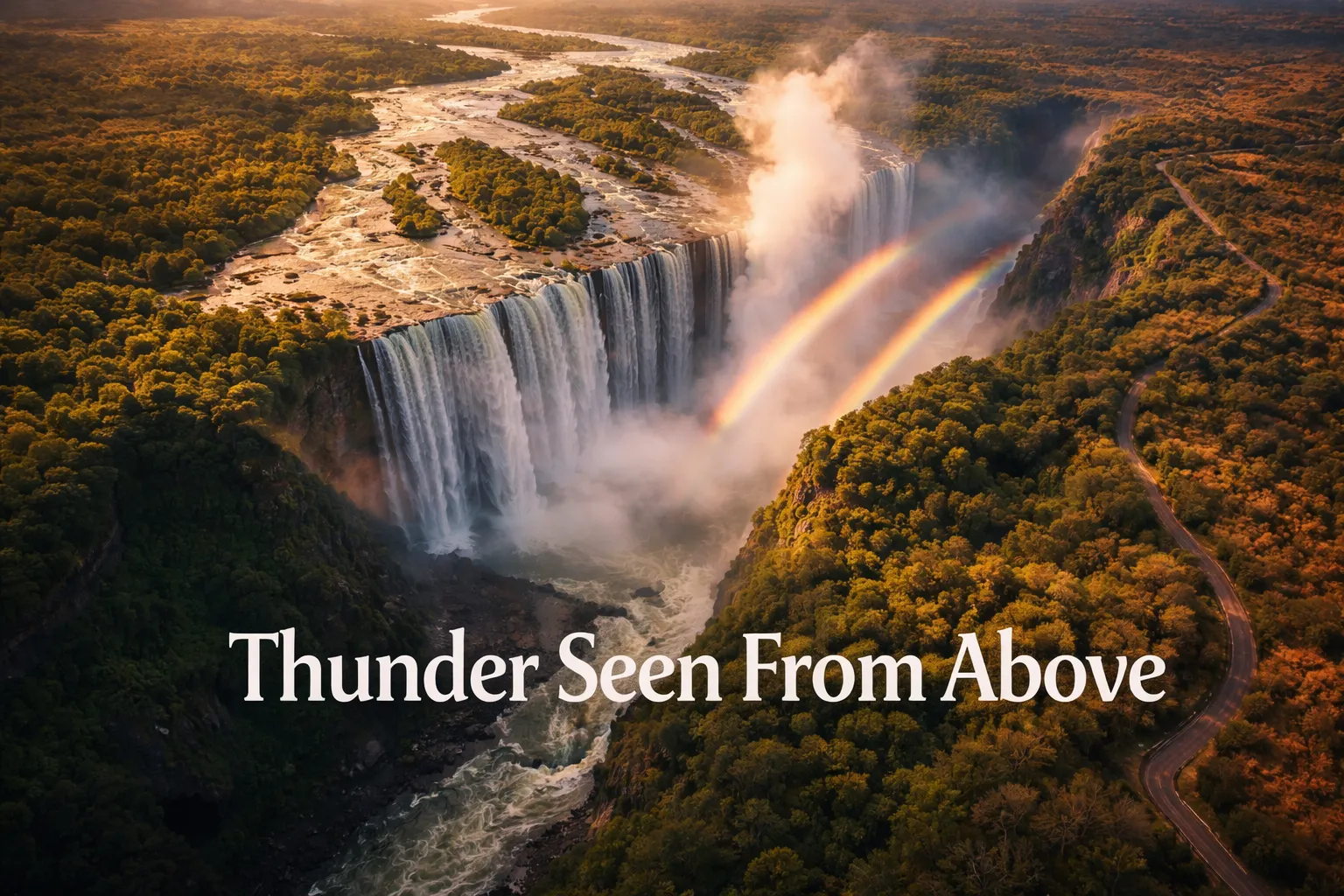
Right now, standing on either riverbank, the air here is thick enough to taste — cool mist beading on your skin, a low continuous roar that seems to come from underground, a handful of other travelers squinting up at rainbows that never quite hold still. I’ve flown drones over this exact stretch of the Zambezi more times than I can count, and even after all those launches, watching the feed climb past 150 metres still catches me off guard. The river up there is wide, glassy, almost unhurried — right until it simply vanishes into a single violent sheet of white. From that height the sheer geological absurdity of the place hits differently: a kilometre and a half of water plunging 108 metres into a gap so tight it reads like a scar cut into the earth. If you’ve been digging around for real victoria falls drone footage zambia zimbabwe content — something beyond the polished tourism-board clips — this is the breakdown I wish someone had handed me before I crossed into either country.
Victoria Falls Drone Flight Brief
| GPS Coordinates (falls centre) | 17.9244° S, 25.8567° E |
| Country Borders | Zambia (north bank) / Zimbabwe (south bank) |
| Recommended Altitude Range | 80–250 m AGL depending on spray conditions and season |
| Best Time of Day | 06:30–09:00 (golden light, low wind) or 15:30–17:30 |
| Best Season for Aerial Photography | October–December (low water, rock detail visible, manageable spray) |
| Peak Flow Season | March–May (maximum drama, maximum spray — 400 m plumes possible) |
| Zambia Drone Regulations | Permit required from Zambia Civil Aviation Authority (ZCAA); recreational flyers need registration; commercial operators need additional authorisation; national park airspace rules apply — obtain written permission from ZAWA (Zambia Wildlife Authority) |
| Zimbabwe Drone Regulations | Strictly controlled; Civil Aviation Authority of Zimbabwe (CAAZ) permit required; Victoria Falls National Park is a protected area — separate NP permit required; enforcement is active and penalties are serious |
| Skill Level Required | Advanced — mist, wind turbulence, gorge updrafts, permit complexity |
| Difficulty Rating | 🔴 Advanced / Expert |
What an Aerial View of Victoria Falls Shows That the Gorge Rim Never Will
Down at ground level, Victoria Falls is a sensory experience more than a visual one — the noise, the soaking mist, a rainbow bending across the gorge. What escapes you entirely is the actual shape of the place. Get airborne and the full 1.7-kilometre curtain finally fits inside one frame, and the geometry of it is stunning. The Zambezi arrives from the east as this improbably wide, flat sheet of river — nearly 2 kilometres across in stretches — dotted with tree-covered islands, before it narrows, funnels, and drops. That shift from calm upstream sprawl to violent downstream chaos only makes sense once you’re looking down on both at the same time.
The second thing that reveals itself only to victoria falls aerial photography is the Batoka Gorge network below the falls. From the rim, you’re lucky to see one bend of it. From 200 metres, the whole zigzagging pattern lays itself out like a diagram of deep time — every hard right-angle turn marks where the falls used to sit before they cut backward through cracks in the basalt over hundreds of thousands of years. At least eight of these older gorges are visible from up there, a visible record of erosion that no photo taken from the ground could ever hint at.
The constant rain cloud — the “Smoke That Thunders” that gave Mosi-oa-Tunya its name — is another thing altitude explains better than the ground ever could. During peak flow, that spray plume climbs 400 metres or higher and builds its own weather. From above, the boundary between mist and dry bush is razor-sharp — you can watch exactly where the perpetually green rainforest hugging the falls gives way to parched savanna. That line is invisible when you’re standing in it, but from 150 metres up, it’s obvious.
Drone Laws at Victoria Falls: What Zambia and Zimbabwe Actually Require
I’m going to skip the hedging on this one, because so much of what’s online about drone rules here is half-right at best. Neither Zambia nor Zimbabwe lets you show up and fly casually, unpermitted, at Victoria Falls. Both banks sit inside protected park land — Mosi-oa-Tunya National Park on the Zambian side, Victoria Falls National Park on the Zimbabwean side — and both governments require a civil aviation permit on top of separate national park clearance before your drone so much as leaves your hand.
Zambia is the friendlier of the two systems. The Zambia Civil Aviation Authority (ZCAA) handles both recreational and commercial drone permits, and while there’s paperwork involved, it’s a process you can actually get through. You’ll register the aircraft, apply for airspace clearance, and get written sign-off from the Zambia Wildlife Authority (ZAWA) to fly inside the park. Budget 2–4 weeks for this before you travel. From what I’ve heard on the ground, ZAWA rangers at Mosi-oa-Tunya are reasonable and even helpful once you’ve got the right documents in hand.
Zimbabwe demands a permit from the Civil Aviation Authority of Zimbabwe (CAAZ) plus a second authorisation from Zimbabwe Parks and Wildlife Management Authority (Zimparks). Enforcement here is noticeably tighter, and there are documented cases of gear being confiscated when paperwork wasn’t in order. Don’t even think about flying on the Zimbabwe side without permits already secured. For most people, the smarter move is simply booking a licensed local operator who already holds the authorisations — the footage comes out legal, and you skip the risk of a hefty fine or losing your drone altogether.
A practical warning: a lot of the drone footage circulating online of Victoria Falls sits in a legal grey area. Plenty of it was shot before the rules tightened up, or by operators who flew without bothering with permits at all. Don’t take a viral clip as proof that flying here is fine — it isn’t proof of anything except that someone got away with it.
When to Shoot the Smoke That Thunders From the Air
Timing decides almost everything with Zambezi river drone photography, and the trade-offs swing harder here than with nearly any other aerial subject I’ve flown. Depending on the month, you’re essentially photographing two different waterfalls.
October to December (Low Water Season) is the window I’d personally push you toward. Water levels bottom out, exposing sections of the basalt face in full. You can pick out the rock strata, spot individual plunge pools at the base, and deal with far less spray — usually 80 to 150 metres instead of the 400-metre plumes of peak season. The light behaves itself, skies tend to run clear blue, and the contrast between white water and dark rock is about as clean as it gets. This is your window for detail shots that actually show how the falls are built.
March to May (Peak Flow Season) gives you the full, raw spectacle but turns drone flying into a genuine challenge. Flow can top 500,000 cubic metres a minute, the mist column stretches 400 metres skyward and is visible from 50 kilometres out, and the spray will soak into anything electronic, your drone included. Your only real option is wide shots from high altitude — 200 to 250 metres — because dropping low into the spray zone is a good way to lose your aircraft. The payoff is that the rainbows are massive and constant, and from up high they’re honestly spectacular.
The Moonbow: On full moon nights between February and May, a lunar rainbow appears in the spray under the falls. It’s one of the rarest, most photogenic night phenomena you’ll find anywhere in wildlife photography, and a drone with a decent low-light sensor, flown at 100–150 metres and kept clear of the spray zone, can pull off a frame that’s essentially impossible to get from the ground. It demands solid night-flying chops, real familiarity with how the spray moves, and full night-operation permits — an extra layer of paperwork in both countries.
Shots Worth Getting: Drone Angles That Work at Victoria Falls
The Full-Width Frame (200–250 m, Nadir Plus 30° Tilt)
Set up on the Zambian side, roughly 300 metres back from the lip of the falls, at 200–250 metres altitude with the camera angled 30–45 degrees toward the drop. This is the money shot — the entire 1.7-kilometre curtain caught in one frame, with the placid Zambezi trailing off upstream behind it. Shoot just after sunrise, when the spray picks up warm light and shadows carve out the gorge edges. It’s strongest between October and December, when the whole width of the falls is exposed.
The Gorge’s Zigzag (150–200 m, Facing Downstream)
Track downstream along the Batoka Gorge at 150–200 metres, camera pitched roughly 45 degrees toward the gorge floor. The chain of right-angle bends carved by the retreating falls forms a natural leading line that drags the eye downstream, straight through millions of years of erosion. There’s no ground-level equivalent of this shot — it simply doesn’t exist without altitude. Early morning light works best, when shadows carve definition into the gorge walls.
The Upstream Approach (80–100 m, Facing Upstream)
Set up downstream of the falls facing back toward them, keeping the Zambezi’s islands in the foreground and the falls themselves behind. The calm of the forested islands against the violence of the falls makes for a striking before-and-after composition. It works best from October to November, when low water exposes enough of the basalt islands to give the shot real texture.
The Spray Column From Above (250 m, Straight Vertical Tilt)
During peak flow, climb to whatever your permit allows and point the camera straight at the rising spray column. The mist itself has structure — dense near the bottom, feathering out toward the top — that photographs beautifully from height. Around the falls, the rainforest glows vivid green against the dry-season brown of the surrounding bush, and rainbows show up reliably between 09:00 and 11:00, when the sun sits at the right angle.
Bringing a Drone Down Safely Through Mist and Wind at Victoria Falls
Getting a drone up over Victoria Falls is the easy part. Bringing it back down through spray, gusting unpredictable wind, and a landing zone littered with loose volcanic rock is a different problem entirely. The second you drop back through that mist layer, you lose your visual reference completely, and having a stable, visible landing surface is what separates a clean shot from a $1,200 paperweight jammed between two boulders.
What actually holds up
- The weighted build stays put in the katabatic gusts that rip up through the gorge — I’ve set down in wind that would’ve sent a lighter pad sliding straight off the rock.
- It folds down small enough to disappear into a camera bag, which matters more than you’d think once you’re hauling gear on foot to a remote overlook.
- The high-contrast markings still cut through the mist on your FPV feed — not a small thing when you’re landing half-blind and a plain dark pad would simply vanish into the spray.
Where it falls short
- It isn’t actually waterproof — the constant mist off the falls works its way into the seams eventually, and after three straight days of heavy spray, mine started feeling damp and honestly a little suspect.
- The internal weights can shift around if you pack it carelessly — I once dug it out of my bag half-collapsed after a particularly rough minibus ride out of Livingstone.
I nearly lost my nerve on the final landing attempt when a sudden cross-wind caught the drone 20 metres up and the pad looked impossibly small through the spray, but the weighted construction held firm and the drone touched down exactly where I needed it. If you’re serious about capturing drone footage in challenging conditions, grab the Hoodman Weighted Trifold UAV Drone Landing Pad LP21.
Frequently Asked Questions
What drone permits do I need to fly at Victoria Falls?
You need a civil aviation permit from either the Zambia Civil Aviation Authority (ZCAA) or Civil Aviation Authority of Zimbabwe (CAAZ), plus separate written permission from the national park authority. Zambia requires clearance from ZAWA; Zimbabwe requires authorization from Zimparks. Budget 2–4 weeks for Zambia’s process. Zimbabwe’s enforcement is noticeably tighter, with documented cases of gear confiscation.
What altitude is safe for flying drones at Victoria Falls?
The recommended altitude range is 80–250 meters AGL depending on spray conditions and season. During peak flow season (March–May), stay at 200–250 meters because spray plumes can reach 400 meters. In low water season (October–December), you can fly as low as 80–100 meters safely while maintaining distance from the mist zone.
When is the best time to photograph Victoria Falls from a drone?
October–December offers the best conditions for detail photography, with low water exposing basalt faces and spray reaching only 80–150 meters. March–May delivers peak drama but turns flying into a genuine challenge, with spray plumes climbing 400 meters. Best times daily are 06:30–09:00 or 15:30–17:30 for light and wind conditions.
Can I see the moonbow at Victoria Falls from a drone?
Yes, on full moon nights between February and May, a lunar rainbow appears in the spray. Drones with decent low-light sensors flown at 100–150 meters and kept clear of the spray zone can capture it, but this requires solid night-flying skills, full familiarity with spray movement, and extra night-operation permits from both countries.
About This Article

Written by Elena Vasquez. Elena Vasquez is a full-time traveler and the founder of Witty Passport. Over fifteen years and more than 50 countries across six continents — including a stretch spent leading groups professionally through Southeast Asia and the remote highlands of South America — she's written the kind of destination guides she always wished existed: practical, specific, and built on real experience rather than recycled itineraries. More about this site.
Scope and limits. Elena is a full-time traveler, not a licensed travel agent or immigration adviser. Entry requirements, visa rules, and advisories change without notice — always confirm against the official government source for your destination and passport before booking.
Verify this against a primary source
Specifics change, and your situation may differ from the one described here. These are the authorities worth checking directly:
- U.S. Department of State — entry requirements and travel advisories
- CDC Travelers' Health — vaccination and health notices by destination
- TSA — current carry-on and screening rules