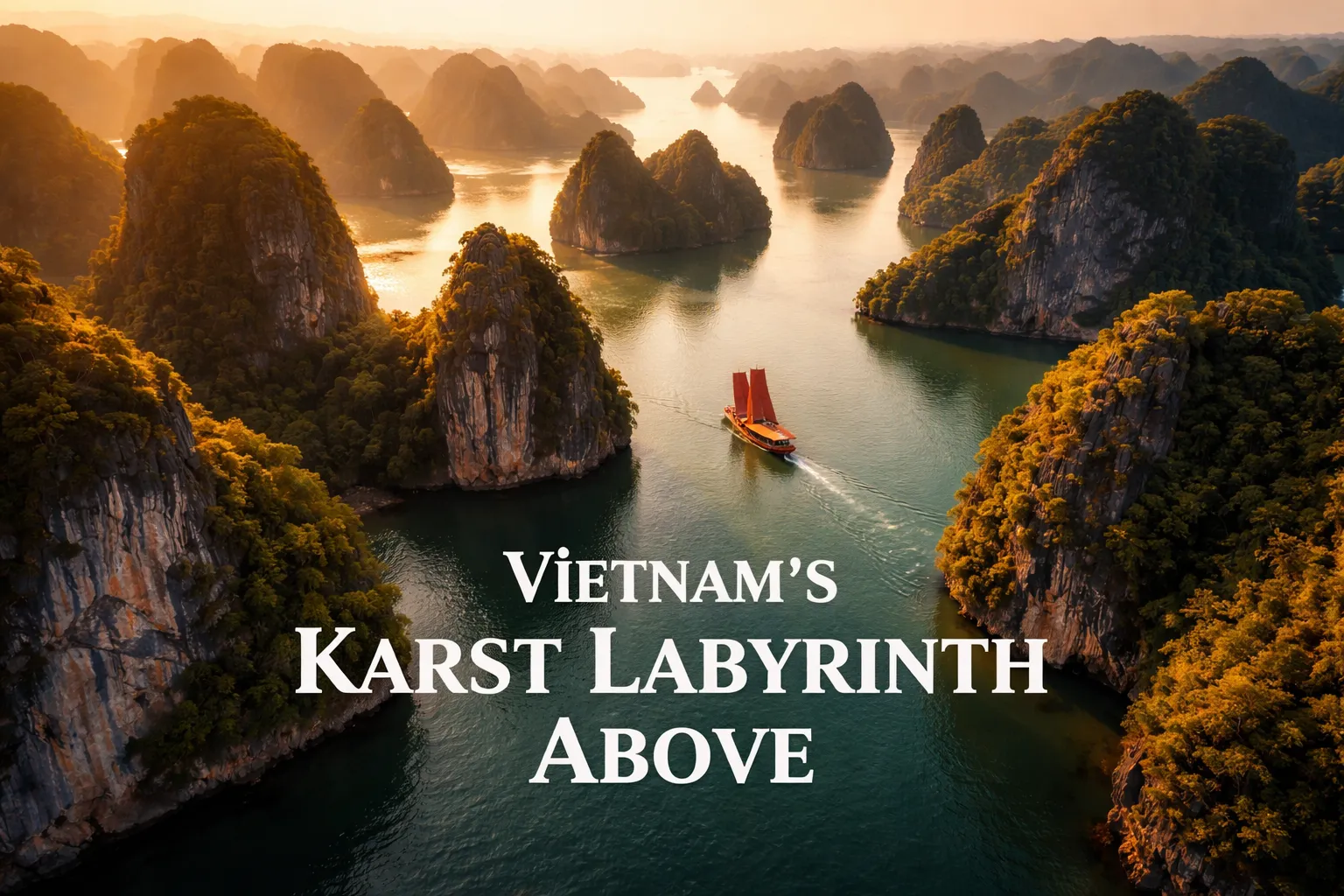
Half the articles I read before this trip insisted you could get by shooting Ha Long Bay from a boat deck with a decent zoom lens; the other half swore altitude was non-negotiable. The zoom-lens crowd is wrong, and here’s why: ha long bay drone photography in Vietnam doesn’t just improve on the ground-level view, it replaces your entire mental model of what a “bay” even is. From 150 meters, the water isn’t framing a coastline anymore — it’s threading between thousands of dark green stone columns that look like a flooded plateau some geological force punched skyward, each one crowned with jungle, channels of emerald running between them clear to the horizon. Nothing I’d seen in photographs came close to preparing me for the scale once I was hovering above it. That first sunrise flight — flat, glassy water, not a breath of wind, low gold light sliding across the karst peaks — is still the single most disorienting, best aerial moment I’ve had a camera for.
Ha Long Bay Drone Photography Vietnam: Drone Flight Brief
| GPS Coordinates (central bay) | 20.9101° N, 107.1839° E |
| Recommended Altitude Range | 80–250 m (varies by zone; stay under 120 m near vessels and fishing villages) |
| Best Time of Day | 30 minutes before sunrise to 90 minutes after; golden hour before sunset |
| Best Season | October–April (clearest skies, calmest winds, lowest humidity haze) |
| Drone Regulations Summary | Registration and a flight permit required through Vietnam’s Civil Aviation Authority of Vietnam (CAAV); military exclusion zones exist throughout the bay; flying from cruise boats requires operator permission; enforcement is inconsistent but penalties are real — budget 2–4 weeks for permit processing |
| Skill Level Required | Intermediate to Advanced (sea winds, salt air, limited landing zones, complex airspace) |
| Difficulty Rating | 7/10 |
What You Only See From Above the Bay, Never From the Deck
From a junk boat railing, Ha Long Bay is pretty in the expected way — a handful of striking towers, some green water, a fishing boat chugging past. Fine for a postcard. Send a drone up to 200 meters and the whole thing stops making sense in the best way. The ha long bay aerial view karst islands spread out in every direction with no gaps: over 1,600 limestone formations crowded so tightly that the water threading through them reads, from up there, like silver cracks running through dark stone rather than an actual sea you could sail. Your eyes simply can’t process that scale from sea level — the vantage point is the whole trick.
What caught me most off guard was the hidden lagoons. A number of the bay’s larger karst islands — Cat Ba and Dau Be to the south, in particular — are essentially hollow. Tucked inside them are enclosed tidal lagoons you’d never guess existed from any boat-level angle. Only from the air do you catch the oval of turquoise water sitting inside the island, like the limestone’s been sitting on a secret for twenty million years. The geology behind it is straightforward: erosion cut sea caves through the rock walls over time, eventually punching through and letting the tide flood the interior. Visually, though, it’s something else — dark jungle walls wrapping around a pool of water so blue it looks fake.
The floating fishing villages — Cua Van, Vung Vieng, Ba Hang — look like an entirely different subject once you’re airborne. Up close, they read as a scatter of floating platforms and bright rooftops, a bit chaotic. From 100 meters, the logic snaps into focus: fish cages arranged in tight concentric circles, walkways linking houses in neat grids, boats fanned out like spokes around a hub. There’s an order to these communities that’s simply not visible unless you’re looking straight down at it. A floating village shot against the karst backdrop is one of the more genuinely original compositions you’ll find anywhere in drone photography.
The thing that surprised me most, though, was the color gradient in the water itself. From the surface, it reads as a single shade of green. From above, you watch it shift — deep navy in the main channels, aquamarine over the shallow limestone shelves, and a startling pale turquoise inside the enclosed lagoons where sunlight bounces off white sand and limestone sediment. Those transitions become natural leading lines on their own, the aerial equivalent of realizing the bay’s been hiding its best feature just below where you were looking the whole time.
The Best Drone Spots in Ha Long Bay for Compositions That Hold Up
Across several flights in different conditions, a handful of setups kept delivering consistently strong results. Here’s what to actually build your flight schedule around.
Straight-Down Channel Shot (60–80 m altitude)
Hover directly over one of the narrow channels running between two large karst formations and point the camera straight down. At this height, the channel walls fall into shadow at the frame’s edges while the water glows green in the middle — it’s especially strong in the half hour after sunrise, when the low light catches the tops of the karst walls but the channel itself stays in soft shadow. October through January is the window to chase this one, since morning haze is at its lowest and the contrast between lit stone and shadowed water is at its sharpest.
Wide Karst Establishing Shot (200–250 m altitude)
At the top of the legal altitude range (in open water, well clear of military zones), tilt the gimbal to roughly 45 degrees and frame the nearest karst formation in the lower third while the rest of the island field fades to the horizon behind it. This works best west of the main tourist zone, shooting back east into the rising sun. Backlighting turns the channels silver and throws the nearer towers into silhouette, building natural depth layers that actually communicate how enormous the bay is. The best drone spots ha long bay offers for this establishing shot are the open stretches between the Bai Chay area and Dau Go Island — fewer boats cluttering the frame, more open sky to work with.
The Junk Boat Leading Line (100–150 m altitude)
This is the shot most people picture when they think “Ha Long Bay photography,” and it earns that reputation — it works reliably every single time. Place a traditional red-sailed junk boat in the lower third of the frame as it moves through a channel between two large karst formations. Its wake becomes a leading line, dragging the eye from the foreground back into the karst maze. The detail most people miss: fly ahead of the boat and shoot back toward it, so it’s sailing into the karst rather than out of frame. That small choice gives the image a story — the boat is going somewhere, not leaving.
Overhead on the Hollow Island Lagoon (straight down, 120–180 m)
Aim for the enclosed lagoons on the south side of Cat Ba Island or inside Dau Be Island. Fly straight over the island and hover above the point where the sea breaches into the lagoon — you’ll get dark open sea on one side, pale lagoon water on the other, and jungle walls framing the whole thing. The color contrast here is unlike anything else you’ll find in aerial travel photography. Midday actually beats sunrise for this one, since you need the sun directly overhead to light up the lagoon floor through the shallow water.
Is Flying a Drone at Ha Long Bay Even Legal? Vietnam’s Drone Rules, Plainly
Here’s where I owe you the unvarnished version, because the honest answer isn’t a clean yes or no — and getting it wrong can mean confiscated gear, real fines, or worse. Drone flying over ha long bay is technically legal, but it requires paperwork most visitors have no idea they need until it’s too late.
Vietnam’s Civil Aviation Authority of Vietnam (CAAV) requires every foreign drone operator to register their aircraft and secure an operating permit before takeoff. That means submitting your drone specs, your planned flight area, and your passport details to the CAAV — and the processing time typically runs two to four weeks. This is not something you can sort out after landing in Hanoi. If legal drone photography in Ha Long Bay matters to you, start the paperwork at least a month out from your departure date.
Inside the bay itself, there’s another layer of restriction to account for. The Vietnamese military maintains installations scattered across the bay and several of its islands — these are strictly no-fly zones, and the boundaries aren’t reliably marked on the maps tourists actually use. Flying within 8 km of a military zone without explicit clearance breaks Vietnamese law. The floating fishing villages also operate under informal no-fly agreements with tour operators, and those deserve respect on both legal and ethical grounds.
In practice, plenty of travelers fly without permits and nothing happens to them — enforcement is patchy at best. I’m not suggesting you do the same. I’m just laying out the reality so you can decide with open eyes. If you’d rather have a legal, lower-anxiety option with scenery that’s just as jaw-dropping, look at Bai Tu Long Bay, immediately northeast of Ha Long Bay. It falls under the same national rules but pulls a fraction of the tourist traffic, and — critically — far fewer boat operators inclined to report a drone in the air. The karst there is every bit as dramatic, the water’s often cleaner, and you’ll get compositions with nobody else’s drone in them. From a vietnam drone photography guide standpoint, Bai Tu Long is honestly the smarter pick for anyone who wants both legal peace of mind and shots that don’t look like everyone else’s.
When to Actually Shoot Ha Long Bay From the Air
The best season for ha long bay drone photography vietnam is, without much debate, October through April — dry season. October and November hit the sweet spot: clear skies, mild temperatures around 20–25°C, and the calm, post-typhoon sea conditions that give you that mirror-flat water surface every reflective shot depends on. December through February trades a bit of that clarity for haze but also gives you the lowest odds of a flight session getting rained out. March and April heat things up considerably and can deliver spectacular golden-hour color, right before the wet season shuts things down from May through September.
Within a single day, the first 90 minutes after sunrise beats every other window by a wide margin. Wind in Ha Long Bay tends to build as the day warms — by 10 AM you’re often fighting gusts of 15–25 km/h that hurt both stability and image sharpness, and flying close to the karst walls in that wind gets genuinely dicey. Launching before sunrise off your junk boat, into the stillness before anyone else is awake, mist still rising off the water between the towers — that’s the shot that makes the whole trip worth it. Your second usable window is the 45 minutes before sunset, when the light turns the karst faces amber and long shadows from the western towers cut dramatic contrast across the bay.
The Drone That Holds Up Against Ha Long Bay’s Salt Spray
Flying over Ha Long Bay means dealing with salt-heavy humidity, unpredictable wind funneling between the limestone towers, and that low hum of dread that your gear is one bad gust away from a 300-meter drop into the rock. You want equipment tough enough to take that punishment but agile enough to chase shifting light between the karsts without missing the shot.
Where it delivers
- A 46-minute flight time means you can genuinely work multiple limestone towers and circle back without landing to swap batteries mid-session — which matters enormously when the light’s perfect and you’re chasing one specific angle.
- The Fly More Combo comes with spare batteries and a car charger, which is exactly what you need anchored on a junk boat with unreliable shore power and only an hour of good light left.
- Build quality genuinely stands up to salt corrosion better than lighter drones — I saw zero gimbal drift or sensor problems even after three straight days of coastal flying, which is more than I can say for the cheaper models I’ve watched fail out there.
Where it falls short
- At 907 grams, it’s heavy enough that gusts funneling between the towers will genuinely knock it around — expect to spend nearly as much time wrestling it steady as you do actually composing shots.
- The RC-N2 remote is fairly bare-bones, and the screen glare in strong sunlight is rough — you’ll end up squinting and half-guessing your framing more than you’d like, especially during golden hour.
I nearly lost signal twice when I flew too close to the karst walls and let overconfidence override logic, but the Return-to-Home feature actually worked and brought it back safely. If you’re serious about capturing Ha Long Bay from the air, the DJI Air 3 Fly More Combo with RC-N2 Remote Controller is the gear that won’t let you down.
Frequently Asked Questions
Do I need a permit to fly a drone at Ha Long Bay?
Yes. Vietnam’s Civil Aviation Authority of Vietnam (CAAV) requires every foreign drone operator to register their aircraft and secure an operating permit before takeoff. Processing time typically runs two to four weeks, so you should start paperwork at least a month before your departure date.
What’s the best time of year to shoot Ha Long Bay with a drone?
October through April is ideal—dry season with clear skies and calm winds. October and November hit the sweet spot with mild temperatures around 20–25°C and mirror-flat water. December through February offers lower odds of rain but more haze.
What altitude should I fly at in Ha Long Bay?
Stay within 80–250 meters depending on zone, but maintain under 120 meters near vessels and fishing villages. For specific compositions: 60–80 meters for channel shots, 200–250 meters for wide establishing shots, and 120–180 meters over hollow island lagoons.
What’s the best time of day to fly a drone at Ha Long Bay?
The first 90 minutes after sunrise beats every other window by a wide margin—wind is calmer and conditions are stable. Your second usable window is the 45 minutes before sunset, when light turns the karst faces amber.
About This Article

Written by Elena Vasquez. Elena Vasquez is a full-time traveler and the founder of Witty Passport. Over fifteen years and more than 50 countries across six continents — including a stretch spent leading groups professionally through Southeast Asia and the remote highlands of South America — she's written the kind of destination guides she always wished existed: practical, specific, and built on real experience rather than recycled itineraries. More about this site.
Scope and limits. Elena is a full-time traveler, not a licensed travel agent or immigration adviser. Entry requirements, visa rules, and advisories change without notice — always confirm against the official government source for your destination and passport before booking.
Verify this against a primary source
Specifics change, and your situation may differ from the one described here. These are the authorities worth checking directly:
- U.S. Department of State — entry requirements and travel advisories
- CDC Travelers' Health — vaccination and health notices by destination
- TSA — current carry-on and screening rules