
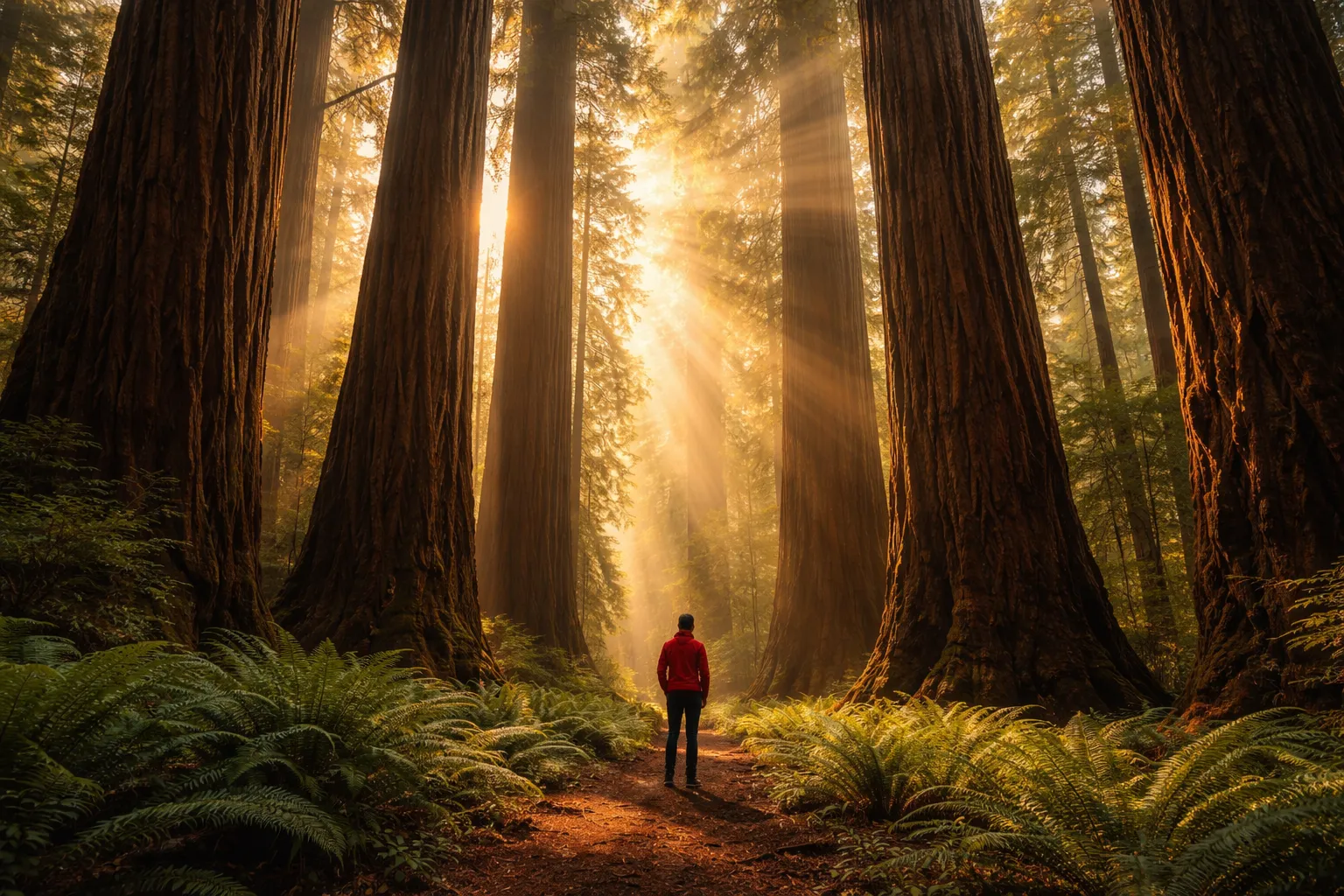
The first time the scale of a coast redwood actually hit me, I wasn’t looking up. I was looking at the base — specifically at a cross-section mounted on a trail kiosk at Muir Woods, where a volunteer had pinned a label reading “Shakespeare born” to a ring that was already centuries deep into the wood. The tree had been alive for another 700 years after that. I did the math slowly, twice, because the first answer felt wrong. These are not just big trees. The oldest redwood trees in the world are living archives — organisms that were already ancient when the Roman Empire was new, still standing, still growing, still pulling fog out of the California air as if time is an inconvenience that doesn’t apply to them.
That feeling — that specific, slightly humbling recalibration of your sense of time — is exactly what this post is designed to prepare you for. We’re going deep on the science, the specific groves, the practical logistics, and the one thing worth throwing in your pack before you go.
This post contains affiliate links. As an Amazon Associate, I earn from qualifying purchases at no extra cost to you — at no extra cost to you, and never for anything I wouldn’t bring myself.
How Old Are Redwood Trees? Here Are the Oldest Redwood Trees in the World
The oldest confirmed coast redwoods (Sequoia sempervirens) are approximately 2,200 years old, with several specimens in Northern California exceeding 2,000 years of age based on ring counts from fallen trees and core samples from living ones. That makes them younger than giant sequoias in terms of maximum confirmed longevity — but not by as much as most people assume, and the comparison gets complicated fast.
Here’s the breakdown that actually answers the question:
- Coast redwoods (Sequoia sempervirens) — the tallest living organisms on Earth — typically live between 1,200 and 2,200 years. The oldest documented individual is estimated at approximately 2,200 years old. They grow along a narrow 450-mile coastal fog belt stretching from southern Oregon to central California.
- Giant sequoias (Sequoiadendron giganteum) — the most massive trees by volume — regularly exceed 3,000 years. The oldest confirmed giant sequoia, a specimen in the Sierra Nevada, is estimated at approximately 3,266 years old. General Sherman in Sequoia National Park, the largest tree on Earth by volume at roughly 52,500 cubic feet, is estimated at 2,100–2,700 years old.
To put those numbers into human-scaled context: a 2,200-year-old coast redwood sprouted around 200 BCE, during the height of the Han Dynasty in China and roughly 150 years before Julius Caesar was born. A 3,000-year-old giant sequoia was already a sapling when the Bronze Age was ending in Greece.
The tallest known living tree of any species is Hyperion, a coast redwood discovered in 2006 in Redwood National Park. It stands at 380.3 feet (115.92 meters) — taller than the Statue of Liberty including its pedestal by more than 70 feet. Hyperion’s precise location has been deliberately kept out of public records by the National Park Service, and in 2022, the NPS officially closed all social trails leading to it to prevent root compaction and soil damage from the thousands of people who were attempting to find it. You cannot hike to Hyperion. This is the right call.
What separates coast redwoods from almost every other long-lived species is their clonal reproduction strategy. When a redwood is cut down or burned, it sprouts aggressively from the root collar — creating rings of genetically identical trees called “fairy rings” or “cathedral rings” around the original stump. The visible trunk above ground may be 500 years old, but the root system beneath it could be thousands of years older. The age of the individual and the age of the organism become genuinely different questions.
The Science Behind Redwood Longevity: Why These Trees Refuse to Die
Redwood longevity isn’t accidental. It’s the product of a specific and rather extraordinary biology that has been refined over roughly 240 million years of evolutionary history — the redwood lineage is that old, predating the breakup of Pangaea.
The primary defense mechanism is tannin. Redwood bark contains extremely high concentrations of tannic acid, which makes the wood essentially unpalatable to insects and resistant to fungal rot. That bark can grow up to 12 inches thick on mature specimens, acting as a fire buffer — coast redwoods are not just fire-resistant, they’re fire-adapted, with some regeneration actually triggered by post-fire conditions.
Coast redwoods also lack the resin canals found in most conifers, which would otherwise provide pathways for bark beetle infestation. Combined with the tannin content, this makes large-scale pest die-offs — the kind currently destroying millions of acres of pine forest across the American West — essentially a non-issue for established redwood groves.
Aging is determined in living trees through increment core sampling: a hollow drill extracts a pencil-thin cylinder of wood that scientists count and analyze without killing the tree. For fallen specimens, full cross-sections can be examined — and several parks display these publicly. The cross-section at Muir Woods has date markers pressed into specific rings: the Norman Conquest (1066), Columbus reaching the Americas (1492), the birth of Shakespeare (1564). It is, genuinely, one of the most effective pieces of environmental education I’ve ever encountered.
As for threats: coast redwoods are listed as Endangered on the IUCN Red List, though populations within protected areas are stable and in some cases expanding. Roughly 96% of the original old-growth coast redwood forest — which once covered approximately 2.2 million acres — was logged between the 1850s and the late 20th century. What remains in protected parks represents a fraction of what existed. Climate change presents an emerging concern: the fog belt that redwoods depend on for approximately 30–40% of their annual water intake has been shifting and thinning, with fog frequency in Northern California declining measurably over the past century.
Where to See the Biggest Redwoods: The Best Destinations in Northern California
There are three tiers of redwood experience, and they suit different trips. Here’s how to think about them:
1. Redwood National and State Parks (Orick Area) — The Real Thing
This is where the ancient trees live. The Redwood National and State Parks complex — a collaboration between the NPS and California State Parks covering roughly 139,000 acres — contains the highest concentration of old-growth coast redwoods on Earth, including Hyperion’s grove (inaccessible) and several trails that will put you among trees topping 300 feet without a permit or a crowd.
Lady Bird Johnson Grove is the easiest entry point: a 1.5-mile loop through old-growth forest with minimal elevation gain, accessible year-round, and genuinely impressive without being the “Instagram trail.” Tall Trees Grove requires a free permit from the Orick visitor center (limited daily) and a 4-mile round-trip hike, but delivers a cathedral-density stand of old-growth that most park visitors never reach. Fern Canyon, accessible via the Gold Bluffs Beach road, is technically a detour for creek geology rather than redwood age — but the walls of five-fingered ferns in a canyon carved by Prairie Creek are singular enough to be worth the extra hour.
Base yourself in Crescent City, about 45 minutes north of Orick, for the northern section. It’s a small, practical town — not a resort destination — but it puts you within 30 minutes of the Trees of Mystery, Del Norte Coast Redwoods, and Jedediah Smith Redwoods State Park, where the Simpson-Reed Grove trail through old-growth is among the finest half-mile walks in California.
2. Humboldt Redwoods State Park — Avenue of the Giants
Located about 90 miles south of Eureka along the old Highway 254, Humboldt Redwoods State Park protects the largest remaining stand of old-growth coast redwood in the world: 17,000 acres of it, with trees routinely exceeding 300 feet. The Avenue of the Giants is a 32-mile scenic road threading through the groves — beautiful by car, extraordinary on foot via the trails that branch off it.
The Founders Grove Nature Loop (0.6 miles, flat) passes the site of the Dyerville Giant — a coast redwood that stood 362 feet tall, once the tallest known tree in the world, until it fell during a windstorm in 1991. Its fallen trunk still measures 370 feet in length along the ground. Standing next to a tree that’s been dead for 30 years and is still that massive is its own kind of lesson.
3. Muir Woods National Monument — The San Francisco Day Trip
Muir Woods is located 17 miles north of San Francisco in Marin County, and it is absolutely worth doing — with clear expectations. The trees here max out around 258 feet and approximately 1,000 years in age, which is impressive by any measure but notably younger and shorter than what you’ll find further north. What Muir Woods offers is accessibility and the interpretive cross-section I mentioned in the opening — a genuine teaching moment built into the trail.
Reservations are mandatory (through recreation.gov), parking fills by 9 AM on weekends, and the main canyon trail can feel like a busy sidewalk in summer. Go early on a weekday, or hike up to the Panoramic Trail connecting to Mount Tamalpais State Park to escape the crowds within 10 minutes. Best time overall for the northern parks: May through September for dry, navigable trails; winter visits offer fog-filled mornings that make the forest look genuinely prehistoric — worth a wet boot or two.
The One Thing Worth Packing Before You Walk Into an Ancient Forest
Forest floors in old-growth redwood groves are soft, damp, and rooty in ways that catch you off-guard — particularly in the areas north of Eureka where trail maintenance is less intensive than at Muir Woods. Good traction and ankle support matter more than most people expect when they show up in sneakers.
But here’s the thing I recommend just as strongly: a field guide. Not a phone app — a physical guide you can handle with muddy fingers and leave open on the page you need. Because standing inside a redwood grove, you will inevitably start noticing other things: the Douglas fir competing for canopy, the tanoak below it, the California bay laurel releasing its sharp eucalyptus scent. The redwoods become more interesting when you understand what they’re competing with and what depends on them.
The one I’d actually recommend for this trip is Trees of California: A Beginner’s Field Guide to Identifying Common California Trees. It’s compact, genuinely beginner-friendly without being condescending, and covers the mix of conifers, hardwoods, and riparian species you’ll encounter across the redwood parks. If you’re visiting multiple California destinations on the same trip — the Sierra Nevada, the coast, the wine country oak woodlands — it covers the full range rather than specializing in one region.
Honest limitation: it’s a beginner guide, so experienced botanists will outgrow it quickly. If you’re already identifying trees by cone morphology and bark texture, you’ll want something more technical. But for most travelers walking into a redwood forest for the first time and wanting to understand what they’re looking at? It earns its space in the pack.
Planning Your Visit — What Most Redwood Guides Won’t Tell You
Entry fees and permits: Redwood National Park has no entry fee. The adjacent California State Parks (Prairie Creek, Del Norte, Jedediah Smith) require a day-use fee of $8–$12 per vehicle or are covered by a California State Parks annual pass ($195 as of 2024). Muir Woods charges $15 per adult, requires advance reservations, and shuttle service from Sausalito is a genuinely better option than driving. Tall Trees Grove in Redwood National Park requires a free permit picked up at the Kuchel Visitor Center in Orick — call ahead to confirm availability in peak season.
Physical demands: Most redwood grove trails are rated easy to moderate — flat to gently rolling, well-maintained, and under 3 miles round trip. Fern Canyon involves wading across Prairie Creek multiple times (bring waterproof boots or accept wet feet). The trail to Tall Trees Grove involves 600 feet of elevation loss on the way in, which means 600 feet of gain on the way out — manageable for most people, but not the flat stroll it appears on a map.
Combining destinations: The classic road trip pairs Redwood National and State Parks with the Lost Coast (one of the most remote and undervisited coastlines in the lower 48), then south along the Avenue of the Giants before cutting inland to the Napa Valley or over to the Oregon coast. Budget a minimum of 3 full days in the parks if you want to move beyond the car-accessible viewpoints.
The mistake most first-timers make: spending the majority of time at Muir Woods because it’s easiest to reach from San Francisco, then running out of time for the northern parks where the genuinely ancient, undisturbed old-growth lives. Muir Woods is worth doing — but it is not the destination. It is the preview.
Cell service: Essentially nonexistent north of Eureka and in most grove areas. Download offline maps before you go. The Gaia GPS app with California topo maps downloaded is more reliable in these parks than Google Maps.
Why Standing Next to the Oldest Redwood Trees in the World Changes Something
There’s a specific thought that happens in old-growth redwood forest — I’ve heard versions of it from nearly everyone who visits — which is roughly: I am very temporary. Not in a frightening way. In the way that looking at a clear night sky is not frightening, even though the math is similarly humbling. A tree that sprouted before the Roman Empire, that survived the logging era because loggers happened to miss this particular canyon, that is still adding 6 to 7 inches of girth per decade — it puts the human scale of worry and planning into an interesting perspective. Not smaller, exactly. Just better proportioned.
The oldest redwood trees in the world are not in a museum. They are not behind glass. You can stand next to a 2,000-year-old tree and put your hand on bark that is older than every country in the Western Hemisphere. That is an unusual thing to be able to do, and it is worth planning a trip around.
If you go, bring something to help you pay attention. A notebook. A good camera. And if you want to understand what you’re walking through — not just the redwoods, but the whole layered community of the Northern California forest — Trees of California: A Beginner’s Field Guide to Identifying Common California Trees will give you the vocabulary to ask better questions of a forest that has been around a very long time and has a great deal to say.
Go north. Stay longer than you planned. Look up.