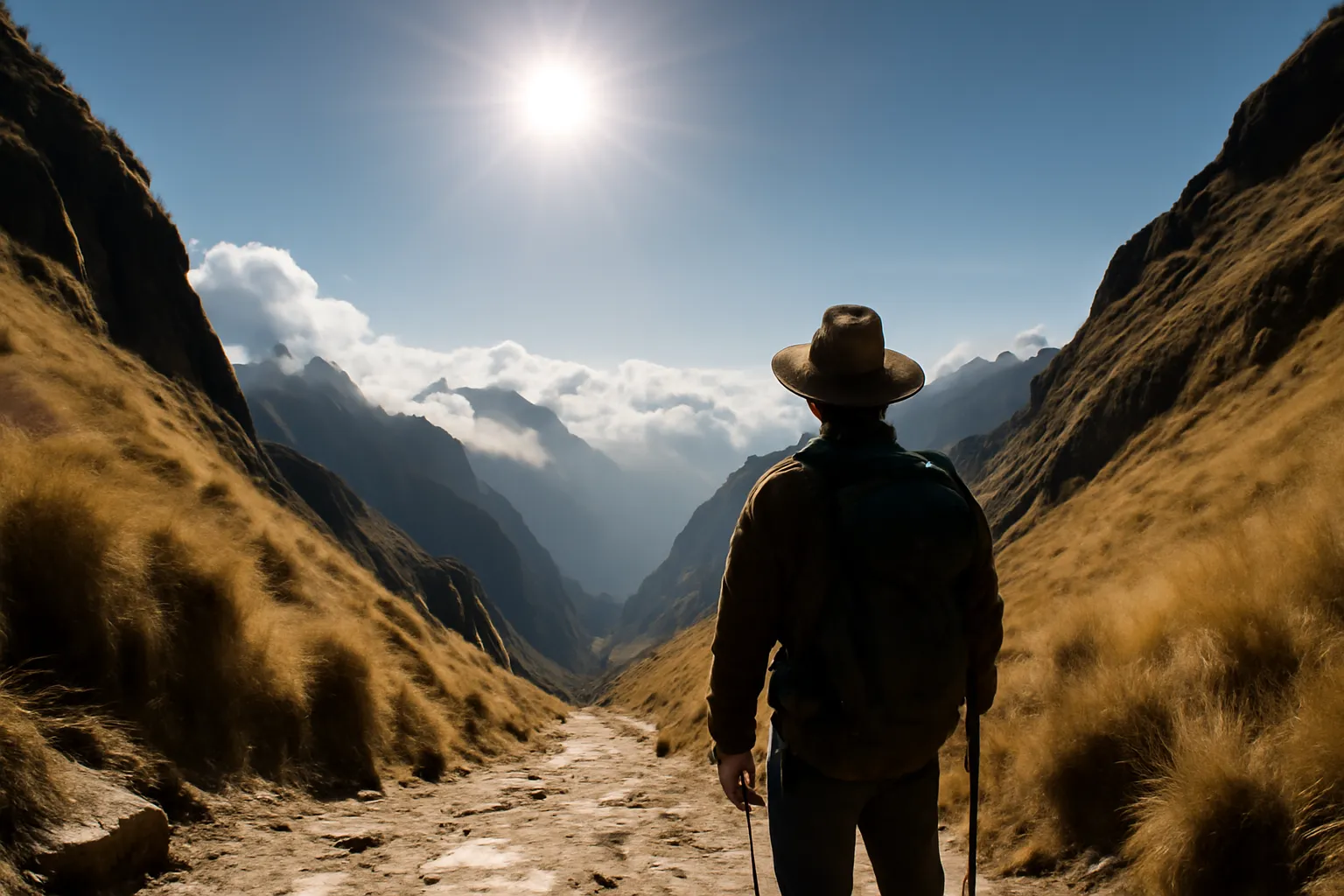
No elevation profile on any trekking website marks the point where your face starts cooking. Every itinerary will show you the switchbacks, the campsite locations, the exact meters you’ll gain before reaching Warmiwañusqa — but nobody overlays the UV curve onto that topography. I learned this the hard way at 4,215 meters, arms raised at the summit of Dead Woman’s Pass on Day 2, striking the exact triumphant-hiker pose you’ve seen in a hundred trip reports, while underneath it my skin was quietly being wrecked. The air sat at a mild 15°C. A breeze moved steadily across the puna grass. My breathing had settled by then, the worst of the climb already behind me, so I wasn’t sweating much anymore. I snapped seventeen photos, ate half a protein bar, and told my trail companion this counted among the best moments of my life. It did. It also handed me the worst sunburn of fifteen years traveling through some genuinely unforgiving climates. By the time we reached camp that evening, my face looked like it had lost a fight with a blowtorch. My lips hadn’t just chapped — they’d split, bled at the corners, and blistered completely across the bow of my upper lip. The bridge of my nose had gone past red into territory better suited for a dermatology textbook. And I’d applied SPF 30 that morning. I genuinely believed I’d covered myself. What almost nobody spells out about inca trail sun protection high altitude is exactly how much the rules shift once you’re that far above sea level.
Why UV Exposure Is a Completely Different Beast at High Altitude in Peru
Here’s the part of the science that never makes it into the polished brochures: ultraviolet radiation climbs roughly 10 to 12 percent for every 1,000 meters of elevation gained. Run those numbers for Dead Woman’s Pass at 4,215 meters and you land somewhere between 40 and 50 percent more UV exposure than you’d absorb at sea level. That’s not a marginal bump — it’s nearly half again the dose. Your SPF 30, which normally filters out about 97 percent of UVB rays down at sea level, is suddenly operating in conditions nobody ever tested it for. Picture packing a rain jacket built for a light drizzle and then walking straight into a monsoon.
Peru piles onto this problem in ways that feel almost unfairly designed. Sitting near the equator’s edge means the sun sits nearly straight overhead at solar noon, with none of the low-angle winter light that gives skin elsewhere a break. Those rays land perpendicular to almost every upward-facing surface — including the back of your neck while you’re hunched forward grinding through a five-hour climb. Add to that the fact that the Inca Trail runs through a stretch of climate where the dry season (May through September) delivers mostly clear skies, and cloud cover isn’t coming to rescue you either.
The nastiest trick altitude plays on trekkers is a kind of thermal con job. Up around 4,000 meters, the thin air can’t hold heat the way sea-level atmosphere does, so your skin reads the conditions as cool and comfortable. Meanwhile you’re breathing harder because there’s less oxygen to go around, which usually pushes you into mouth-breathing — and that steady stream of dry Andean air dries out your lips faster than any water bottle can keep pace with. On top of that, the physical grind of climbing is producing sweat, and sweat is sunscreen’s natural enemy. Most standard formulas rinse away with perspiration within roughly 45 to 60 minutes of moderate effort. Gaining 1,200 meters of elevation over five hours does not qualify as moderate. By the time I reached the pass, I’d probably gone effectively unprotected for a solid three hours without ever noticing.
There’s also a lip-specific problem that almost every hiker misses entirely. Lip skin carries virtually no melanin, the pigment responsible for your body’s built-in UV defense — which means your lips show up at altitude with almost zero natural protection. They’re also thinner-skinned than any other exposed patch of your face. Combine that with dry air, hard breathing, and relentless UV, and your lips become the early-warning system for what altitude sun actually does. Mine gave out completely on Day 2, and that night they kept me awake far more than the ache in my thighs ever did.
The Lip Protection I Wish I’d Packed Before Dead Woman’s Pass
Up there, lips don’t simply dry out — they crack, split, and bleed, turning into a raw, physical lesson in underestimating the Andes. By Day 3 of the trail, I was still paying for skipping this one small item, and my mouth was footing the actual bill in pain.
What actually works
- SPF 50 genuinely holds up at elevation — my lips came through Day 2 undamaged even while the rest of my face got scorched.
- The “Sport” version sticks around through sweat and water breaks, which counts for a lot when you’re topping off your bottle at mountain streams every couple of hours.
- Buying the twin pack lets you keep one tube in your daypack and another in your pocket, so you’re not unpacking your whole bag at 4,200 meters just to reapply.
Where it falls short
- The texture runs thick, so layering it onto lips already dried out by altitude can feel heavy — better to wipe off the old layer before reapplying.
- A single tube won’t stretch across a full four-day trek if you’re reapplying every couple of hours, which you genuinely should be — though grabbing the twin pack solves that math.
I nearly bought some overpriced tourist-trap lip balm at a lodge on Day 3 because I thought I’d made a terrible mistake leaving mine behind. Banana Boat Sport Ultra SPF 50 Lip Sunscreen Twin Pack is worth tossing in your pack before you leave home.
Frequently Asked Questions
How much stronger is UV exposure at Dead Woman’s Pass elevation?
UV radiation climbs roughly 10 to 12 percent for every 1,000 meters of elevation gained. At Dead Woman’s Pass, which sits at 4,215 meters, you absorb somewhere between 40 and 50 percent more UV exposure than you’d absorb at sea level. That’s nearly half again the dose compared to lower altitudes.
Why does high altitude sun on the Inca Trail feel deceptively mild?
Around 4,000 meters, the thin air can’t hold heat the way sea-level atmosphere does, so your skin reads the conditions as cool and comfortable even while UV exposure is extremely high. Meanwhile, dry Andean air dries out your lips faster than water bottles can keep pace with, creating a false sense of safety.
Why are lips especially vulnerable to sun damage at high altitude trekking?
Lip skin carries virtually no melanin, the pigment responsible for your body’s built-in UV defense, leaving lips with almost zero natural protection. They’re also thinner-skinned than any other exposed patch of your face, and when combined with dry air and hard breathing at altitude, lips become the early-warning system for sun damage.
How long does standard sunscreen last when hiking the Inca Trail?
Most standard sunscreen formulas rinse away with perspiration within roughly 45 to 60 minutes of moderate effort. Gaining 1,200 meters of elevation over five hours means you can go effectively unprotected for several hours without noticing, even if you applied SPF 30 that morning.
About This Article
Written by Elena Vasquez. Elena Vasquez is a full-time traveler and the founder of Witty Passport. Over fifteen years and more than 50 countries across six continents — including a stretch spent leading groups professionally through Southeast Asia and the remote highlands of South America — she's written the kind of destination guides she always wished existed: practical, specific, and built on real experience rather than recycled itineraries. More about this site.
Scope and limits. Elena is a full-time traveler, not a licensed travel agent or immigration adviser. Entry requirements, visa rules, and advisories change without notice — always confirm against the official government source for your destination and passport before booking.
Verify this against a primary source
Specifics change, and your situation may differ from the one described here. These are the authorities worth checking directly:
- U.S. Department of State — entry requirements and travel advisories
- CDC Travelers' Health — vaccination and health notices by destination
- TSA — current carry-on and screening rules