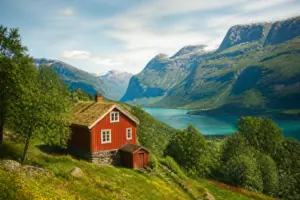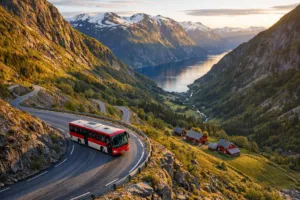
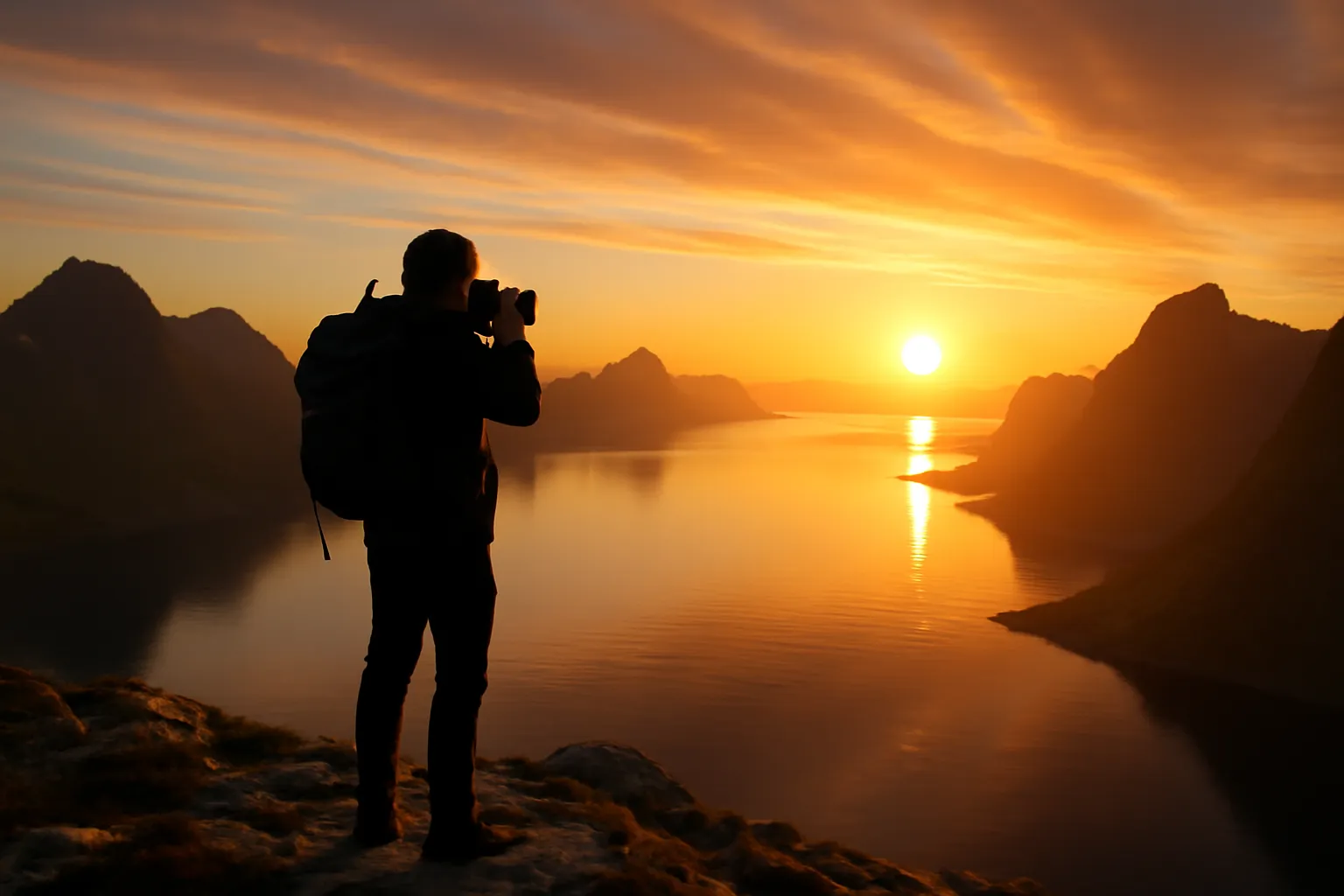
What actually happens to your skin when the sun refuses to set for two straight months? I found out the hard way at 1:17 in the morning, scrambling up a rocky ridge in the Lofoten Islands wearing sunglasses — not as some poetic flourish, but because the sun was genuinely still up there, hovering on the horizon like it was thinking about leaving but hadn’t decided. The color was this absurd amber-rose wash that turns every casual snapshot into something that looks stolen from a gallery show. Camera in hand, boots laced tight, and my face carrying essentially zero sunscreen, because my brain — shaped by a lifetime of normal daylight rules — kept telling me 1am equaled night. It did not equal night. It wasn’t even in the neighborhood of night. By the time I stumbled back into my rorbuer cabin around 3am, admiring a sky the color of the Norwegian flag and feeling smug about my little midnight excursion, I’d stacked roughly six more hours of bare-faced UV exposure on top of the fourteen I’d already racked up earlier that day. Two days later my cheeks had the texture of an ancient, overworked leather satchel. By day five I was shedding skin like some kind of molting reptile well north of the Arctic Circle — an experience exactly as glamorous as that sentence makes it sound. Nobody warned me about any of this before I went, and it’s exactly what I want to warn you about now.
Why UV Damage Is Uniquely Dangerous During Norway’s Midnight Sun
Here’s the trap nearly every summer visitor above the Arctic Circle falls into: the midnight sun simply doesn’t register as threatening. Northern Norway’s UV index in June typically sits between 4 and 6, which meteorologists file under “moderate” — noticeably milder than what you’d get lying on a beach in Spain or Thailand. So naturally, your brain shrugs it off as harmless. That shrug is the mistake.
Strength was never the real danger. Time was. Endless, uninterrupted, never-blinking time.
Tromsø, up at 69°N, holds its midnight sun without a break from May 20th through July 22nd. The Lofoten Islands, sitting at 68°N, give you a marginally shorter window that’s no less disorienting. And at Nordkapp — the North Cape, the northernmost point of mainland Norway at 71°N — the sun refuses to dip below the horizon for an even longer run. Add up the cumulative UV exposure across a stretch like that and the numbers get unsettling fast. A UV index of 5 held steady for 20 hours adds up to the same total UV dose as a UV index of 10 held for just 10 hours — essentially a full tropical sun-day, repeating every single day of your visit. Even while you’re supposedly asleep, assuming you manage much sleep at all, which — fair warning — you probably won’t.
A handful of local conditions make Norway’s midnight sun burn risk worse than the numbers alone suggest. Because the sun sits so low on the horizon, its rays hit your face nearly head-on — the opposite of tropical latitudes, where the sun sits overhead and a hat brim actually earns its keep. The fjords act like mirrors. Leftover June snow on the mountaintops bounces back an extra 80% of UV radiation from below. And the thin, clear Arctic air has no haze in it to soften any of this. You’re basically standing inside a reflector dish aimed straight at the sun.
Then there’s the behavioral side nobody flags for you. Under midnight sun conditions, people naturally stretch their waking hours — often to 18 or 20 hours a day — because the light keeps insisting the day isn’t finished yet. You go hiking at midnight because the trail is finally empty and the light is unreal. You photograph the sun at 2am because it’s doing something you’ve never seen it do before. You’re up again by 6am, wide awake, because it’s bright out and your blackout mask gave up on you again. Every hour of that is UV exposure, even though none of it feels like “sun time.” Sunscreen habits built for a single beach afternoon don’t translate here — Arctic summer demands a completely different system.
The Sámi, northern Norway’s Indigenous people who’ve lived alongside this light for millennia, historically kept their skin covered and understood the accumulating weight of Arctic sun far better than any tourist arriving with a travel app ever could. Meanwhile the rest of us show up from temperate climates armed with SPF 15 tinted moisturizer and a sense of adventure, and get thoroughly schooled.
The Sunscreen I Left in My Bag at 1 AM in Lofoten
Midnight sun doesn’t feel like actual sunlight — it feels like an endless golden hour, which is precisely why it’s so easy to forget it can still burn you. I learned that lesson mid-hike, at an hour my brain was convinced no UV index should exist, and spent the following three days looking like my face had scheduled a business meeting with a sunburned tomato.
What actually works
- Light enough texture that you’ll genuinely reach for it at 11 PM when the sun’s still blazing, unlike heavier formulas that feel suffocating during endless daylight
- Built on a moisturizer base, so it doesn’t feel like a grease layer while you’re working up a sweat on a ridge at 2 AM
- SPF 30 gives honest coverage — nothing overkill, but solid enough that reapplying between photo stops isn’t a debate
Where it falls short
- Reapplication every couple of hours is non-negotiable in midnight sun, meaning it has to live in your day pack, not just get swiped on once at breakfast
- It can’t stop you from doing what I did — hiking for three hours at 1 AM with none on your face at all, which was really the actual failure
I bought this after the fact, skeptical that a moisturizer would actually protect skin that was already screaming in protest, but three weeks later my face had mostly forgiven me. CeraVe AM Facial Moisturizing Lotion with SPF 30
Frequently Asked Questions
How long is the midnight sun in Tromsø Norway?
Tromsø, at 69°N, experiences midnight sun without a break from May 20th through July 22nd. During this period, the sun never dips below the horizon, meaning you’re exposed to UV radiation around the clock, even during hours your brain registers as nighttime.
Why does midnight sun cause worse sunburn than tropical sun?
A UV index of 5 held steady for 20 hours delivers the same total UV dose as a UV index of 10 for just 10 hours—essentially a full tropical sun-day repeating daily. Additionally, low-angle rays hit your face nearly head-on, fjords act as mirrors, and June snow bounces back an extra 80% of UV radiation.
What’s the UV index in northern Norway during midnight sun?
Northern Norway’s UV index in June typically sits between 4 and 6, which meteorologists classify as moderate. However, this seemingly mild number becomes dangerous when exposure stretches across 18 to 20 waking hours daily under midnight sun conditions.
What SPF sunscreen should I use for Lofoten Islands hiking?
The article recommends CeraVe AM Facial Moisturizing Lotion with SPF 30, which offers light texture suitable for reapplication every couple of hours during extended daylight. Reapplication between photo stops is non-negotiable in midnight sun conditions.
About This Article

Written by Elena Vasquez. Elena Vasquez is a full-time traveler and the founder of Witty Passport. Over fifteen years and more than 50 countries across six continents — including a stretch spent leading groups professionally through Southeast Asia and the remote highlands of South America — she's written the kind of destination guides she always wished existed: practical, specific, and built on real experience rather than recycled itineraries. More about this site.
Scope and limits. Elena is a full-time traveler, not a licensed travel agent or immigration adviser. Entry requirements, visa rules, and advisories change without notice — always confirm against the official government source for your destination and passport before booking.
Verify this against a primary source
Specifics change, and your situation may differ from the one described here. These are the authorities worth checking directly:
- U.S. Department of State — entry requirements and travel advisories
- CDC Travelers' Health — vaccination and health notices by destination
- TSA — current carry-on and screening rules