Salt air, the groan of old wooden pilings, water so clear you could count individual stones on the bottom — this weathered red hytte in the Lofoten Islands matched every image I’d carried in my head of Norway for years. What no image had prepared me for was the cabin’s single electrical outlet.
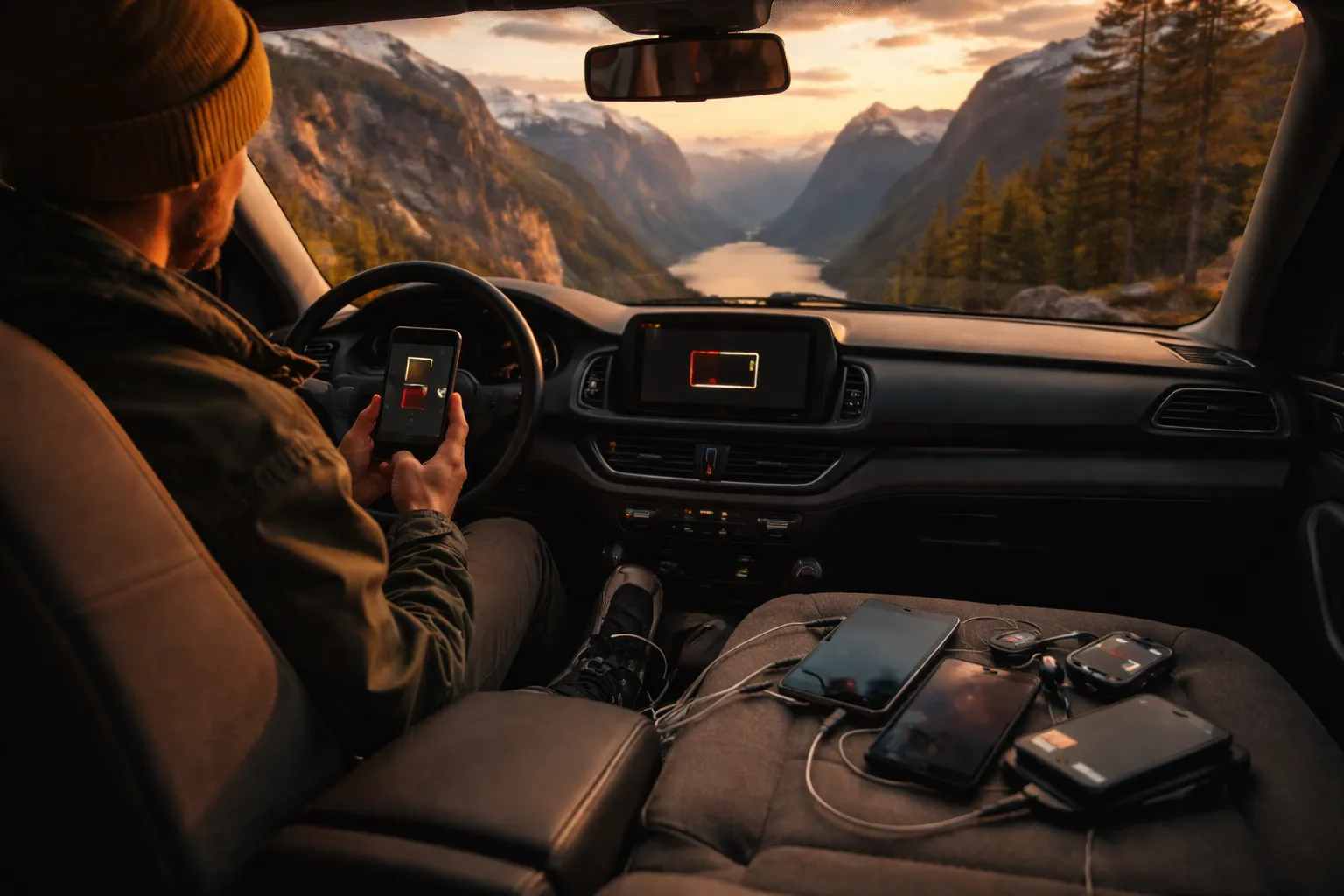
I’d covered six hours of road from Tromsø that day, the last two of them on a slim coastal route without a flicker of cell signal. My phone — the only thing standing between me and getting lost, since it held my offline maps to the next speck of a fishing village — sat at 3%. My mirrorless camera, which had just finished capturing that unbeatable fjord light an hour before, had gone completely flat. And my drone battery, which would’ve handed me an aerial view of this exact scene, had somehow dropped to 12%, like it was doing it on purpose.
I planted myself in the cabin’s kitchen, eyes fixed on that lone outlet. It was already spoken for by the refrigerator (not up for debate), a lamp (also non-negotiable), and an electric kettle (fine, tea could wait). Knut, who owned the place, gave me an apologetic shrug. “The generator’s a bit temperamental,” he said. “Best to go easy on it.”
With three dead devices in my hands and nothing to plug them into, it hit me that this wasn’t some one-off inconvenience — it was woven straight into the fabric of traveling Norway’s back country. And at that point, I didn’t have a fix for it yet.
Why Keeping Your Electronics Charged Is Uniquely Brutal in Norway
Norway’s real issue isn’t power itself — it’s *distance*. And *isolation*. And the simple fact that *infrastructure just doesn’t stretch this far*.
Here’s the math on it. The stretch from Tromsø to the Lofoten Islands runs about 400 kilometers (248 miles), and depending on your route, that’s anywhere from 5 to 7 hours behind the wheel. Much of it cuts through country where the closest petrol station sits 80-plus kilometers off. No charging stations along the way. No rest stops with a wall socket waiting for you. Just the E8, the landscape, and your eyes drifting to that battery percentage more often than you’d like.
That’s rural Norway in a nutshell: huge gaps between destinations, almost nothing in the way of services along those gaps, and a battery that’s bleeding out the entire time just from the effort of getting you there. Your phone isn’t for calls out here — there’s no signal for that anyway — it’s your only way to navigate terrain that has an unsettling habit of looking the same mile after mile. Lose your maps and you’re properly lost. And even with maps running, you’re losing 15 to 20 percent battery an hour just from the screen fighting Arctic daylight and GPS chewing through power nonstop.
Then comes the housing situation. Norway does the hytte thing beautifully — simple, rustic cabins built around the idea of unplugging and reconnecting with nature. That same philosophy, unfortunately, applies to the wiring. Some of these places have roughly the outlet count you’d expect from a cabin built in 1978. I’ve stayed somewhere with three outlets covering an entire four-room building. Budget stays, self-catering chalets, and remote farm lodgings tend to be even sparser. Campsite hookups do exist, but they’re frequently 6-amp European circuits (around 1,400 watts) — meaning plugging in something like a hair dryer becomes a small act of electrical risk-taking.
And it compounds from there: you’re rarely just charging one phone. You’ve got a phone running navigation, a mirrorless camera or a solid smartphone (fjords and mountains basically demand it), maybe a drone for the aerial shots the scenery keeps begging for, plus power banks as backup insurance. Summer’s nearly round-the-clock daylight means your screen is working overtime just to stay visible, draining power fast. Winter cold does its own damage, knocking out 20 to 30 percent of battery capacity almost instantly.
Last piece of the puzzle: the sockets themselves. Norway runs on Type F (Schuko) outlets, with the round European pins. Most adapters marketed to American and British travelers either fit poorly or fall apart under real use. What you actually need is something reliable, quick to charge, and able to power multiple devices off that single precious outlet a place like Knut’s cabin might offer you.
Solving Norway’s Single-Outlet Problem: The 4-Port Charger I Now Bring to Its Most Remote Cabins
A cabin with one outlet, six hours from anything resembling civilization, stops being a charming quirk fast when three devices are all begging for power at once. In Lofoten, I learned firsthand that a single outlet forces a choice — your phone’s GPS, your camera’s battery, or whatever else you actually need charged to make it through the day out there.
Where it earns its keep
- The USB-C port genuinely fast-charges — my phone climbed from red-alert territory to 80% in under an hour, which counts for a lot when the next available outlet might be days off.
- With four ports running at once, phone, camera, power bank, and headlamp all charge together instead of the sad one-at-a-time shuffle I used to deal with.
- Small enough to disappear into a daypack pocket, which matters once you’re hiking out from that same cabin and need a charger that isn’t dead weight.
Where it falls short
- At 55W, it’s solid but not limitless — try charging a laptop and two phones together and something will end up waiting its turn.
- Plug adapters come bundled in, sure, but that’s still one more piece of gear crammed into an already overstuffed kit, and one more thing you could easily forget on a café table.
I almost didn’t buy this before that trip—I convinced myself one outlet was “fine” and that I’d manage—but sitting in that hytte with a dead camera battery and a phone at 2%, I would have traded my hiking boots for one of these. European Travel Plug Adapter USB-C, 55W USB-C European Charger 4-Port Fast Charger
Frequently Asked Questions
How far is it from Tromsø to the Lofoten Islands?
The stretch from Tromsø to the Lofoten Islands runs about 400 kilometers (248 miles), taking anywhere from 5 to 7 hours behind the wheel depending on your route. Much of it cuts through country where the closest petrol station sits 80-plus kilometers off, with no charging stations along the way.
What type of electrical outlets does Norway use?
Norway runs on Type F (Schuko) outlets with round European pins. Most adapters marketed to American and British travelers either fit poorly or fall apart under real use, so you’ll need something reliable if you’re bringing devices from home.
How fast does battery drain while driving in Norway?
You’re losing 15 to 20 percent battery an hour just from your phone’s screen fighting Arctic daylight and GPS chewing through power nonstop. Winter cold compounds this, knocking out 20 to 30 percent of battery capacity almost instantly.
What are typical outlet counts in Norwegian hyttes?
Remote Norwegian cabins often have very limited outlets. Some have roughly the outlet count you’d expect from a cabin built in 1978, with some places offering as few as three outlets covering an entire four-room building.
About This Article

Written by Elena Vasquez. Elena Vasquez is a full-time traveler and the founder of Witty Passport. Over fifteen years and more than 50 countries across six continents — including a stretch spent leading groups professionally through Southeast Asia and the remote highlands of South America — she's written the kind of destination guides she always wished existed: practical, specific, and built on real experience rather than recycled itineraries. More about this site.
Scope and limits. Elena is a full-time traveler, not a licensed travel agent or immigration adviser. Entry requirements, visa rules, and advisories change without notice — always confirm against the official government source for your destination and passport before booking.
Verify this against a primary source
Specifics change, and your situation may differ from the one described here. These are the authorities worth checking directly:
- U.S. Department of State — entry requirements and travel advisories
- CDC Travelers' Health — vaccination and health notices by destination
- TSA — current carry-on and screening rules