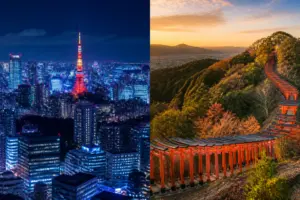
Forty handwritten pages beat four thousand photographs every time — I know this because I came home from Japan with both, and six months later only one of them still meant anything. The photos were all there on my phone, all 3,847 of them, and I scrolled through them one gray afternoon with a coffee gone cold in my hand: the vermillion gates at Fushimi Inari catching that first pink light, the bowl of ramen in a cramped Shinjuku alley lit by a single red lantern where the old owner never once spoke to me in English, my own goofy grin in front of Kinkaku-ji with the Golden Pavilion doubled in the still water below.
What I couldn’t do was recall a single feeling attached to any of it.
Not the flavor of that ramen. Not whatever the old man muttered when I mangled my chopstick technique. Not the reason standing alone among thousands of gates while Tokyo stirred awake below the mountains had wrecked me emotionally. I’d spent two weeks documenting Japan through glass and forgotten to document it anywhere else. The images were sharp, well-framed, technically fine. My actual memory of being there was close to empty.
That’s the moment it clicked for me: better photography wasn’t the fix. What I actually needed was the best travel journal for japan trip — something that would make me sit still long enough to feel something and hang onto it. What I ended up with turned out to be more than a notebook. It became a way to walk back through Japan on my own terms, months later, using nothing but what I’d written down myself.
Here’s how I broke the habit of losing Japan the moment I put the camera down.
Why Memory Gaps Are Uniquely Bad in Japan
Japan overwhelms the senses in the best possible way, and that’s precisely the problem — the more input flooding in, the faster memory starts leaking out.
Tokyo announces itself immediately through sheer scale — 35 million residents, 168 separate train lines, neighborhoods that reinvent themselves block by block. Step out of Shibuya station and you’re swallowed by a wall of bodies and neon, and by the time you’ve covered the six blocks to your hotel, your brain has logged more distinct stimuli than a full week most other cities. Grilled yakitori smoke tangles with the jangle of pachinko parlors. One of those parlors sits directly beside a temple that predates it by four centuries. Vending machines hum on every corner, and somewhere past midnight you realize a machine just handed you hot coffee like it was nothing. It’s exhilarating, and it scrambles your sense of orientation completely.
Board the shinkansen to Kyoto, though, and the entire register shifts. Quiet takes over. Tatami-floored temples replace the noise. There’s a particular scent of hinoki wood and incense — not generic incense, but a specific blend some temple has been burning for two hundred years running. A geisha slips past on a side street as dusk falls, her white-painted face almost luminous in the low light. These moments sit at a lower volume, which, oddly, makes them more likely to slip away — there’s no adrenaline spike like Tokyo gives you to burn them into memory. Instead you get subtlety, restraint, and a quiet dread that you may never come back this way again.
Then there’s the food, which deserves its own paragraph and then some. Few places on the planet pack in as many distinct eating experiences per square mile as Japan does. An ¥800 bowl of tonkotsu ramen from a six-stool shop tucked in an alley. A convenience-store onigiri at 11 p.m. that tastes better than it has any right to. A seventeen-course kaiseki meal stretched across three unhurried hours, each plate a small study in seasonality and restraint. Skip the writing it down part, the real, on-paper documentation, and these experiences don’t just soften at the edges — they melt together into one vague memory of “the food was good.”
The cultural texture is the first casualty. The particular angle of an onsen attendant’s bow as she hands over your key. The exact choreography of a tea ceremony, unchanged for four hundred years. Temple bells ringing at 6 a.m. The strange comfort of folding yourself into a capsule hotel bunk, absurdly compact yet perfectly engineered. None of that survives in a photograph. A picture can’t reproduce a bow. It can’t explain why a tea ceremony felt like meditation. And it certainly can’t carry the taste of umami with it.
Japan somehow runs at two speeds at once, frantic and unhurried in the same afternoon. A single day there can hand you more distinct, mutually unrecognizable versions of the country than a full week does most places. Skip writing any of it down, skip pausing long enough to actually process it, and it disappears. What’s left is a folder of gorgeous photos and the unshakeable sense that something profound happened to you that you can no longer reach.
The Journal That Stopped Japan From Turning Into Just Another Feed
Move through Japan the way most visitors do — temple to temple, district to district — and the details that give a place its texture get buried under the next photo op before you’ve even noticed them. Somewhere around the midpoint of my trip I realized I had zero written record of what the old ramen shop owner had actually said, how that tea had tasted, or why one particular Shinjuku alley felt unlike anywhere else in the city.
What earns its keep
- Compact enough to disappear into a jacket pocket between shrine visits, but with enough heft that you actually reach for it instead of defaulting to your phone.
- The leather ages as you travel — by the end of two weeks it’s scuffed and softened in a way that feels earned, which nudges you toward actually reopening it and reading back through what you wrote.
- Because the pages are refillable, you can hand off a finished insert in a Tokyo café or swap one with someone in a hostel common room without risking the whole trip’s worth of notes.
Where it falls short
- The pages have zero water resistance — a sudden downpour near Arashiyama turned an entire page of notes about the bamboo grove into a smeared purple mess.
- It’s yet another item to keep tabs on — I misplaced mine for a full day in Kyoto (it turned up at the ryokan eventually, but that hour of panic was very real).
I almost ditched the whole journaling experiment on day four when my handwriting felt clumsy and slow compared to just snapping a photo, but by the final week I was writing in it every evening, and those scribbles became the actual trip—not the pictures. newestor Refillable Leather Journal Travelers Notebook
Frequently Asked Questions
How many train lines does Tokyo have?
Tokyo has 168 separate train lines. The sheer scale of the city—with 35 million residents and neighborhoods that reinvent themselves block by block—can overwhelm visitors quickly, making it easy to forget details without written documentation of your experiences.
Why does Kyoto feel different from Tokyo?
Kyoto operates at a different sensory register than Tokyo’s frenetic pace. Tatami-floored temples replace neon, and the specific scent of hinoki wood and incense—blends some temples have burned for two hundred years—creates a quieter, more subtle atmosphere that paradoxically makes memories slip away faster without written record.
What is a typical cheap ramen experience in Japan?
An ¥800 bowl of tonkotsu ramen from a six-stool shop tucked in an alley represents the authentic, affordable eating experiences Japan offers. Without writing these moments down, distinct culinary memories tend to melt together into one vague recollection of “the food was good.”
What happened to the author’s journal during rain in Arashiyama?
A sudden downpour near Arashiyama turned an entire page of notes about the bamboo grove into a smeared purple mess. The pages have zero water resistance, which is a significant drawback of handwritten journaling as a travel documentation method.
About This Article

Written by Elena Vasquez. Elena Vasquez is a full-time traveler and the founder of Witty Passport. Over fifteen years and more than 50 countries across six continents — including a stretch spent leading groups professionally through Southeast Asia and the remote highlands of South America — she's written the kind of destination guides she always wished existed: practical, specific, and built on real experience rather than recycled itineraries. More about this site.
Scope and limits. Elena is a full-time traveler, not a licensed travel agent or immigration adviser. Entry requirements, visa rules, and advisories change without notice — always confirm against the official government source for your destination and passport before booking.
Verify this against a primary source
Specifics change, and your situation may differ from the one described here. These are the authorities worth checking directly:
- U.S. Department of State — entry requirements and travel advisories
- CDC Travelers' Health — vaccination and health notices by destination
- TSA — current carry-on and screening rules