Don’t expect a clean winner here — chasing one is how people end up burning two of their precious ten days shuttling between cities that never needed to compete in the first place. I get some version of this question at least twice a week now, usually from someone standing exactly where I once stood: paper map in hand, jet lag setting in, utterly convinced there’s a single correct city. My answer’s the same every time, and it comes with a look — the kind that says, oh, you sweet optimistic traveler, sit down. If you’ve been googling “Tokyo vs Kyoto which is better” hoping for a tidy verdict, I’ve got good news and mildly annoying news. The good news: I actually have an answer. The mildly annoying news: it hinges on about three very specific factors, and I’m about to spell out exactly what they are.
The ¥800 Mamachari That Made Kyoto Worth the 5:45am Alarm
I’d been warned that Arashiyama’s bamboo grove turns into a selfie queue by 9am, so I wanted to be there at first light — which meant I needed a bike, not a taxi. Most rental shops near our ryokan in Fushimi didn’t open until 8 or 9, which defeated the whole point. BikesBooking let me filter by pickup location and time, and I found a mamachari-style city bike available for collection at 6am, about four minutes’ walk from where we were staying. The booking took maybe ten minutes the night before, cost ¥800 for the full day, and there was no “show up and hope for the best” element to it — the bike was tagged with my name when I arrived.
Cycling the bamboo-lined paths before 7am with almost no one around was genuinely one of those moments that justifies getting out of bed in the dark. The mamachari wasn’t fast or fancy — it had a basket and a bell and that’s about it — but it was exactly right for the pace of the morning. If you’re doing Kyoto and want to actually see the famous spots rather than photograph crowds at them, this approach works. I sorted the rental through BikesBooking, and the early-opening filter alone was worth it.
Two separate trips, two full weeks apiece — one in Tokyo, one in Kyoto, months apart, no group tour rushing me along. Solo, unhurried, with enough slack in the schedule to properly lose my way in both cities more than once. What follows is my unapologetically opinionated, occasionally self-mocking, hopefully genuinely useful take on these two remarkable places.
| Category | Tokyo | Kyoto |
|---|---|---|
| Population/Scale | 14 million residents | Former imperial capital |
| Temples & Shrines | Not specified | 1,600+ |
| Ryokan Cost | Not applicable | $80-150 per person (with dinner) |
| Mid-Range Hotel Cost | $60-100 per night | $50-80 per night |
| Ramen Bowl Cost | $6-8 | Not specified |
| Conveyor-Belt Sushi Cost | $1.50-3 per plate | Not specified |
| Bike Rental Cost | Not specified | ¥800 for full day |
| Distance from Kansai Airport | Not specified | 75 minutes |
| Pace of City | 1.5x normal speed, efficient chaos | Deliberately slow, like steeping tea |
Tokyo vs Kyoto: Two Different Versions of Japan
Here’s the blunt version: Tokyo and Kyoto aren’t merely two different cities — they’re two different renderings of Japan entirely, each built for a completely different kind of traveler.
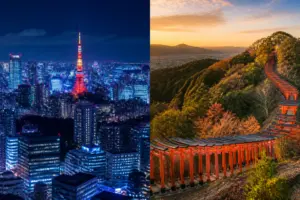
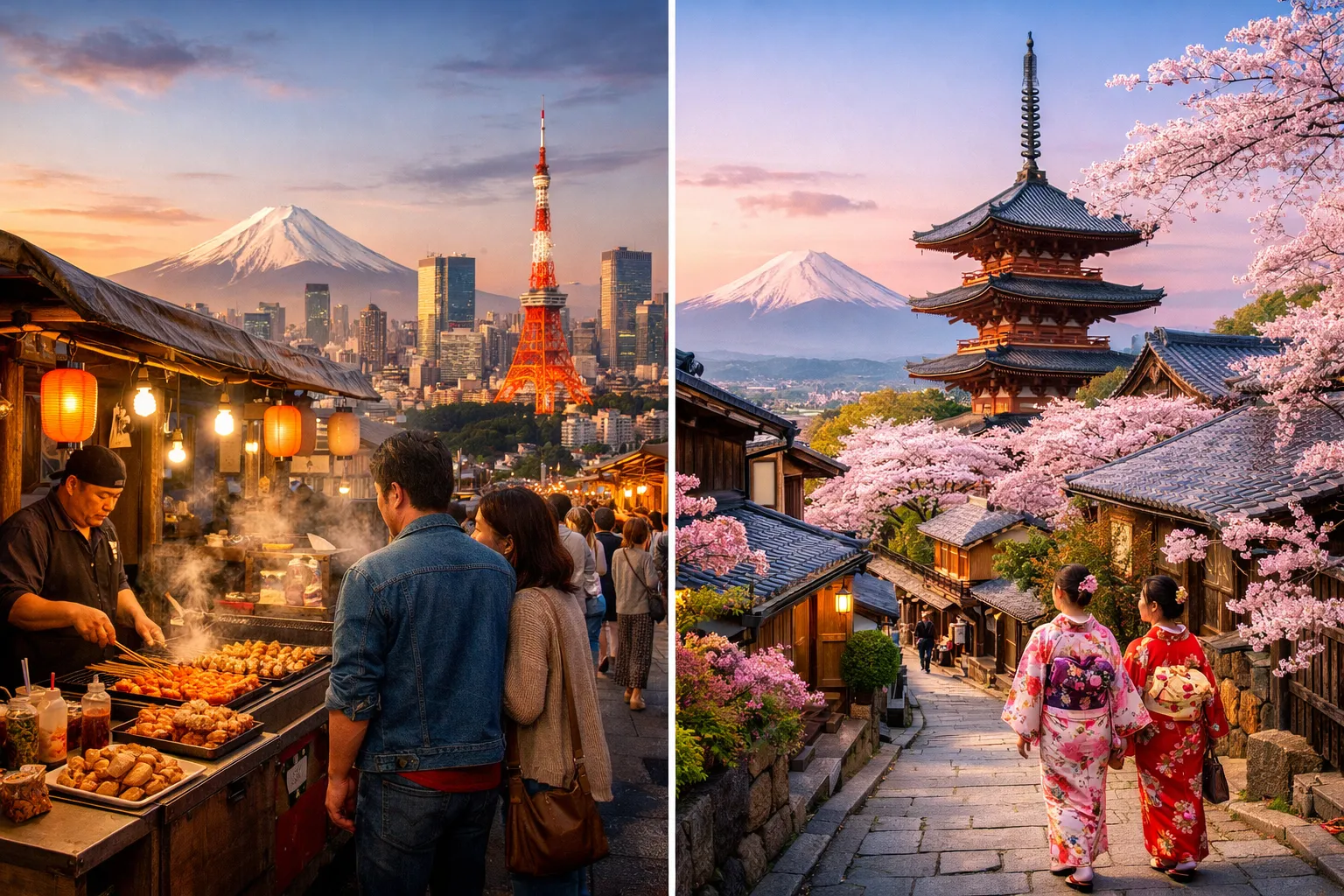
Tokyo runs on efficient chaos. Fourteen million residents living inside a system that somehow keeps organized pandemonium functional. Think neon signs and conveyor-belt sushi joints still packed at 2 AM, Akihabara’s full-volume anime subculture, vending machines dispensing everything from cold beer to Kit Kat flavors that have no business existing (matcha, wasabi, and sake versions — I’ve tried all three), and Shibuya Crossing, where you get to watch humanity move as one concentrated organism. Everything in Tokyo happens at roughly 1.5x normal speed and never lets up. It’ll overwhelm you, and that’s not a flaw — that’s the entire point of the place.
Kyoto is what you get when a city chooses heritage over hustle. As the former imperial capital, it holds more than 1,600 temples and shrines, wooden machiya townhouses folded into narrow lanes, geisha who are genuinely working (not performing for cameras, though you might catch a glimpse), and bamboo groves striking enough that you’ll finally understand why they’re protected as heritage sites. Kyoto operates at the pace of steeping tea — deliberately, unhurriedly slow. It doesn’t try to overwhelm you; it wins you over instead. Turn down the right narrow street and you’ll stumble onto a temple gate that wasn’t on any map. Fushimi Inari’s 10,000 vermillion torii gates catch fire-orange light at sunrise. Gion after dark looks like it was built as a film set.
Which loops back to those three factors I mentioned. Deciding which city goes first really comes down to: how many actual days you’re working with, which flavor of Japan you’re chasing (the electric future or the contemplative past), and where your budget stretches furthest. Let’s go through each one.
Breaking Down the Costs: Where Your Yen Actually Disappears
Here’s where Tokyo pulls a fast one on budget-conscious travelers: the food is shockingly affordable. A genuinely great bowl of ramen runs $6-8. Conveyor-belt sushi, where you rack up plates and pay by the stack? $1.50-3 each. Even convenience store meals — which somehow beat sit-down restaurants in plenty of other countries — land at $4-7. Tokyo built its entire food culture around feeding enormous crowds fast and cheap.
Accommodation runs higher — figure $60-100 a night for a solid mid-range hotel — but the sheer volume of options keeps prices from spiraling the way they might in other global capitals.
Kyoto’s beauty isn’t free. Ryokan stays (the traditional inns) start around $80-150 per person, dinner included, and those kaiseki spreads — elaborate multi-course traditional meals — are basically edible art. Mid-range hotels sit at $50-80 a night. Meals cost more across the board because Kyoto’s food culture prioritizes ingredient quality and traditional technique over speed. You’re paying for the real thing, and I’d argue it earns every yen.
Experiences You Won’t Find Outside Tokyo
- Breakfast at Tsukiji’s Outer Market: organized bedlam at its finest. Show up by 7 AM, eat sushi fresher than anything you’ve had, and watch vendors haggle over fish using nothing but hand signals. Pure distilled Tokyo.
- Shibuya Crossing after dark: touristy, sure, but do it anyway. Step off the curb alongside roughly 3,000 strangers moving in perfect unison. Nothing captures Tokyo quite like it.
- Akihabara’s tech-and-anime sprawl: entire eight-story buildings devoted solely to anime figures, vintage games, and gadgets that haven’t hit the rest of the world yet. This is where Japan’s love of both cuteness and bleeding-edge tech collide.
- teamLab’s digital art spaces: less museum, more immersive experience — rooms that shift and react to your movement. Surreal, gorgeous, and thoroughly modern Tokyo.
- Catching a sumo tournament: if the calendar lines up, watching sumo wrestlers live hits differently than any video ever could. The ceremony, the sheer mass, the hush before contact — it’s primal stuff.
- Treating convenience stores like a competitive sport: Japan’s 7-Elevens and FamilyMarts stock things that make no sense on paper yet somehow just work — limited-run drinks, seasonal snacks, pre-made meals that taste far better than they should.
Experiences Reserved for Kyoto (And Why They Matter)
- Arashiyama’s bamboo grove at first light: get there before the tour buses roll in and you’ll find 10,000 stalks standing in green quiet (see my ¥800 rental-bike confession above for how to actually manage this). The way light filters through explains why Japanese poetry never stops talking about nature.
- Fushimi Inari before the sun’s up: climbing through vermillion torii gates while fog settles between the shrine buildings. Equal parts meditative and eerie, and absolutely worth the early alarm.
- Spotting real geisha in Gion: skip the staged photo sessions — the real thing is catching geisha in full traditional dress rushing to an evening appointment. You’ll spot maybe one or two, and you’ll know instantly it was the genuine article.
- Nishiki Market, Kyoto’s kitchen: a covered arcade selling everything from fresh wasabi root to family pickle recipes generations old. The whole place smells like concentrated umami.
- A private tea ceremony inside a machiya: sitting inside a 200-year-old wooden townhouse, watching matcha get prepared with the kind of concentration most people reserve for bomb disposal. Quiet, deliberate, and it reshapes how you think about ritual.
- The Philosopher’s Path in cherry blossom season: a canal walk lined with hundreds of sakura trees. Once they bloom, it stops being merely pretty and becomes something closer to transcendent — locals and visitors alike just standing there, stunned.
Day Trips: Widening the Radius
From Tokyo
Tokyo’s geography sets you up nicely for side trips. Nikko, two hours out, delivers mountain waterfalls and temples. Hakone, an hour and a half away, pairs hot springs with Mt. Fuji views. Kamakura, just an hour out, is a beach town packed with temples that somehow dodges feeling like a tourist trap. Any of these stretches your Japan trip further without ever leaving the region.
From Kyoto
Kyoto’s spot right on the Shinkansen line is genuinely convenient. Nara, 45 minutes away, has literal thousands of docile deer wandering the temple grounds. Osaka, 75 minutes out, is all street food and late nights. Hiroshima and Miyajima, a two-hour trip, deserve the day if your schedule has room. Each one feels distinctly different and is easy enough to reach.
Getting There: What Actually Happens Logistically
Which airport you land at quietly decides this for you. Come in through Kansai International near Osaka and Kyoto’s a mere 75 minutes away, while Tokyo means roughly two and a half hours on the Shinkansen. Land at Haneda or Narita instead and the equation flips — you’re dropped straight into the megacity, and Kyoto becomes the two-hour bullet-train payoff waiting for you mid-trip.
The Shinkansen ride itself deserves a mention: you show up at the station, board right on schedule (the punctuality borders on absurd), and watch the Japanese countryside streak past while working through a bento box. It’s genuinely a little magical.
So Which City Actually Goes First?
Time to stop hedging and actually take a position:
For first-timers with fewer than 10 days: make Kyoto your home base.
Here’s my reasoning: Tokyo will still be exactly Tokyo in five years, ten years, fifty years from now. It’s the future, and the future isn’t going anywhere. Kyoto’s temples, traditions, and culture, though — those are the elements that make Japan genuinely unlike anywhere else you’ve been. A week based in Kyoto, with side trips to Nara and Osaka folded in, gives you the real, textured version of Japan. You’ll come away actually understanding the aesthetics and the philosophy behind modern Japan, not just the surface of it.
Think of Tokyo as the payoff for a return trip. Once Kyoto’s given you a feel for Japan’s underlying character, Tokyo’s relentless push toward the future actually clicks into place. You’re comparing it against something real instead of grabbing at a cultural baseline you haven’t built yet.
The exception: with 10+ days on the ground, do both — no question. Spend four to five days around Kyoto and its surroundings, then ride the Shinkansen into Tokyo for three or four more. That split is the sweet spot — traditional and modern Japan both, without either city feeling rushed.
The One Guidebook That Actually Resolves This Debate
Standing at that particular fork between two of Japan’s biggest draws, you need something sturdier than forum threads contradicting each other. A thorough guide that lays both cities out side by side, with actual practical context on what each delivers, turns an overwhelming decision into a manageable one.
Where it delivers
- The Tokyo and Kyoto chapters go deep enough to actually weigh neighborhood atmosphere, temple density, and whether you lean nightlife or garden-stroll — not the usual “both are wonderful” shrug.
- It nails the practical details — train links, price ranges for places to stay, seasonal crowd patterns — the stuff that actually tells you whether to visit one city first or bypass it altogether.
- The suggested itineraries for varying trip lengths finally answer the question everyone’s actually asking: how many days do I really need in each city?
Where it falls short
- This isn’t a slim pocket guide — it’s a legitimate brick of a book, so pack the digital version if you’re traveling light or sticking to a single daypack.
- A handful of the restaurant and hotel picks lean toward safer, well-established names, so if you’re after the newest ramen pop-up or a hidden indie ryokan, you’ll need to dig up extra sources.
I almost sent this book back after the first chapter because it felt overwhelming—too much information when I just wanted someone to tell me what to do—but that’s exactly when it clicked that the point isn’t to be prescriptive; it’s to give you enough intel to make your own call. Frommer’s Japan (Complete Guide)
Frequently Asked Questions
How much does a mamachari bike rental cost in Kyoto?
A mamachari-style city bike costs ¥800 for a full day in Kyoto. You can book early-opening rentals through BikesBooking to arrange pickup as early as 6 AM, which works well if you want to visit popular spots like Arashiyama’s bamboo grove before the crowds arrive.
How far is Kyoto from Kansai International Airport?
Kyoto is roughly 75 minutes from Kansai International Airport near Osaka. This makes it convenient if you’re planning to visit Kyoto early in your trip, whereas landing at Tokyo’s Haneda or Narita means it’s about two and a half hours on the Shinkansen to reach Kyoto from the capital.
What are typical ryokan prices in Kyoto?
Ryokan stays in Kyoto start around $80-150 per person with dinner included. Mid-range hotels without traditional meals run $50-80 a night. Kyoto’s accommodation and food costs more overall because the city prioritizes ingredient quality and traditional technique.
How many temples and shrines does Kyoto have?
Kyoto holds more than 1,600 temples and shrines. The city was the former imperial capital and operates at a deliberately slow pace, offering experiences like private tea ceremonies in 200-year-old machiya townhouses and the Philosopher’s Path during cherry blossom season.
About This Article

Written by Elena Vasquez. Elena Vasquez is a full-time traveler and the founder of Witty Passport. Over fifteen years and more than 50 countries across six continents — including a stretch spent leading groups professionally through Southeast Asia and the remote highlands of South America — she's written the kind of destination guides she always wished existed: practical, specific, and built on real experience rather than recycled itineraries. More about this site.
Scope and limits. Elena is a full-time traveler, not a licensed travel agent or immigration adviser. Entry requirements, visa rules, and advisories change without notice — always confirm against the official government source for your destination and passport before booking.
Verify this against a primary source
Specifics change, and your situation may differ from the one described here. These are the authorities worth checking directly:
- U.S. Department of State — entry requirements and travel advisories
- CDC Travelers' Health — vaccination and health notices by destination
- TSA — current carry-on and screening rules