The Real Reason I Quit Asking Strangers to Borrow a Charger in Southeast Asia
Eleven. That’s the number of travel adapters I burned through, lost, or watched die a slow death in gutters between 2009 and the year I finally solved this problem for good. Vietnam runs on Type A chaos, Thailand mixes A and B without warning, and Cambodia operates on what I can only call electrical improvisation — carry one region-specific plug through this part of the world and you’re gambling on a 4% battery at midnight, every single time.
The lesson cost me plenty of evenings. Early on, six months deep into a Southeast Asia loop, I’d check into a new guesthouse, flip the light switch, and then burn twenty minutes tracking down whoever on staff had the adapter that actually fit. Sounds minor until it adds up: sunset shots missed because the camera never charged, nights cut short babysitting a phone crawling toward 50%, and one too many awkward knocks on a stranger’s door asking to borrow their charger yet again.
Then it clicked — the problem was never just the shape of the outlet. Voltage swung wildly from building to building, sketchy wiring in cheaper guesthouses sent the occasional surge through the line, and small-town lodges routinely had three outlets serving twelve rooms. What I actually needed was one piece of gear that worked on any continent, fed several devices at once, and could take a beating without quitting on me.
What Actually Works
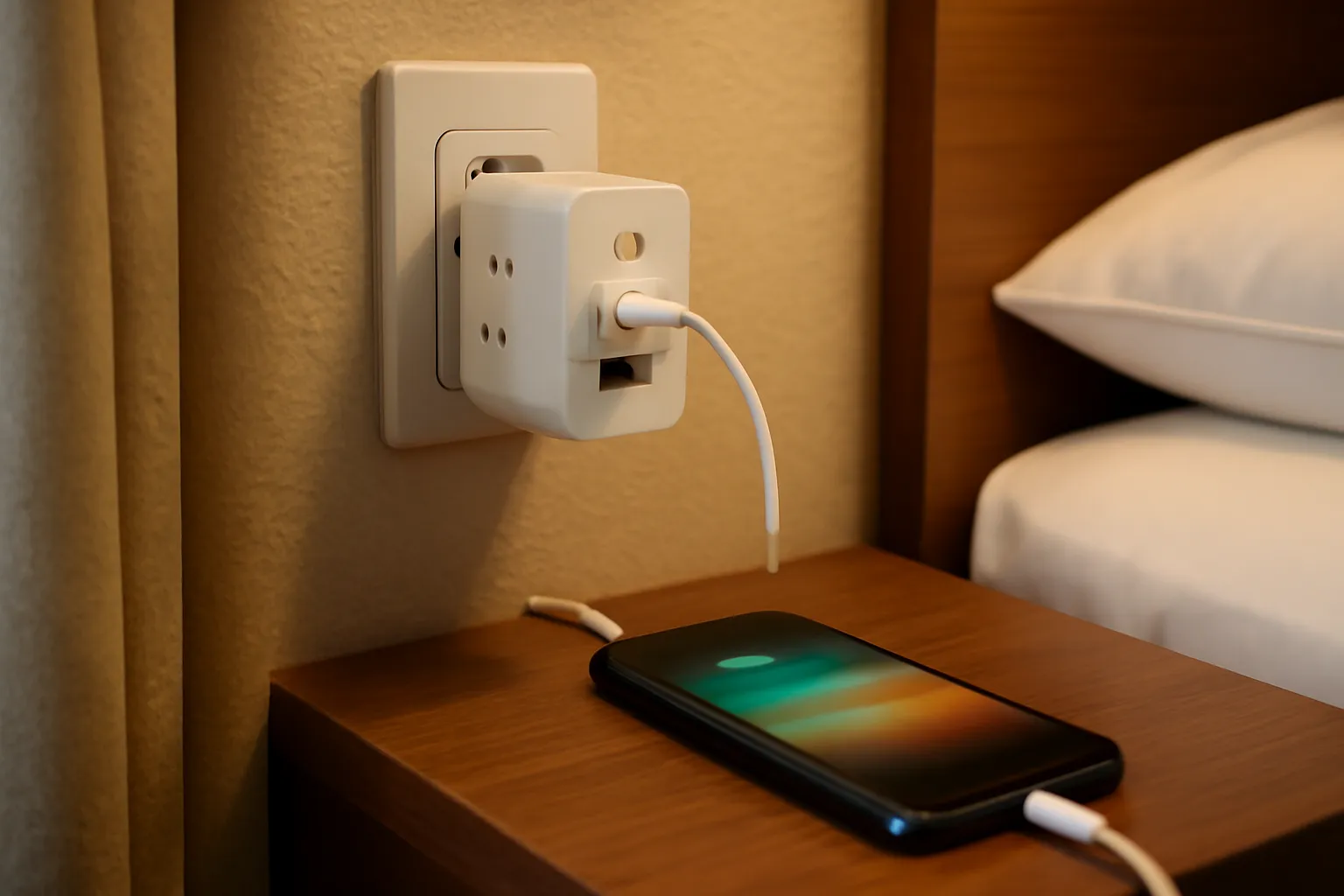
- Three built-in USB ports let you juice your phone, a battery pack, and your headphones all at once — a real advantage in a dorm room where six people are fighting over a single outlet.
- It’s small enough to disappear into a day pack without eating the space of a shoe, so it’s actually in your bag at the guesthouse, not sitting forgotten in a locker three countries back.
- The swappable plug heads still snap in and out cleanly after months on the road — no jamming, no forcing, none of that nagging fear you’re about to snap the thing.
That last detail carries more weight than it sounds like it should. Across 50-plus countries, I’ve watched plenty of adapters go soft — the fit loosens, the connection turns unreliable, and eventually you’re scared to trust it in a pricier socket. This one has taken daily abuse across continents without blinking: Southeast Asian humidity, Middle Eastern heat, European cold — none of it has made a dent.
For anyone traveling light, the size alone changes things. It barely registers in carry-on weight, tucks into a small tech pouch without complaint, and because it’s never left behind, you’re never stuck without a way to charge. I’ve used it in hostels, Airbnbs, hotels, homestays, and the odd airport lounge at 3 a.m. Those three USB ports match how most of us actually travel now — a phone, usually a battery pack, and almost certainly a set of wireless earbuds.
Where It Falls Short
- Misplace one of the interchangeable heads and the entire adapter turns into dead weight — there’s no generic backup plug, and hunting down a replacement head in a small town isn’t easy.
- All three USB ports draw from a shared pool of power, so plugging in three devices at once slows everything down — fine for phones and small gadgets, but don’t expect anything close to laptop charging speeds.
That modular head system is what makes this thing so versatile, but it comes with a catch: you have to stay organized. My rule now is simple — the heads live in a small zip pouch inside my electronics bag, always. Left loose in a backpack, they vanish. A friend traveling with me through Hanoi lost his Type C head and burned two frustrating days tracking down a replacement. It’s the trade-off baked into the design: global compatibility in exchange for keeping close tabs on the pieces.
That shared power draw is a real drawback if you’re someone charging a laptop alongside other gadgets. For phones, battery packs, and smaller electronics, though, it does the job just fine. The charging speed won’t impress anyone, but you’ll get a solid, useful charge within an hour — plenty for the length of a breakfast or a coffee-shop work session.
Where It Actually Got Tested
In Chiang Mai, I nearly chucked this thing in the trash after it wobbled loose in a sketchy Thai outlet — I was sure I’d finally broken it. Turned out the outlet itself was worn out, not the adapter, and that’s the moment I stopped doubting it. From what I’ve seen, most “adapter failures” are really just the reality of aging electrical wiring in guesthouses built long before anyone worried about outlet safety.
Across 50-plus countries and more airport lounges than I could ever tally, this adapter hasn’t let me down once. Not a single time. Frankly, it’s got a better track record than most things I own.
You can find the All in One Universal USB Travel Power Adapter with 3 USB Port and Type-C International Wall Charger right here.
All three USB ports draw from a shared pool of power, so plugging in three devices at once slows everything down — fine for phones and small gadgets, but don’t expect anything close to laptop charging speeds. The charging speed won’t impress anyone, but you’ll get a solid, useful charge within an hour. Misplace one of the interchangeable heads and the entire adapter turns into dead weight — there’s no generic backup plug, and hunting down a replacement head in a small town isn’t easy. Keep the heads in a small zip pouch inside your electronics bag to stay organized. Three built-in USB ports let you juice your phone, a battery pack, and your headphones all at once — a real advantage in a dorm room where six people are fighting over a single outlet. All three ports draw from a shared pool of power. The adapter has been plugged into 74 different outlet types with connectors that still click in smoothly. The swappable plug heads snap in and out cleanly after months on the road without jamming or forcing.Frequently Asked Questions
Can I charge a laptop with this adapter?
What happens if I lose one of the plug heads?
How many USB ports does this adapter have?
How many outlet types will this adapter fit?
About This Article

Written by Elena Vasquez. Elena Vasquez is a full-time traveler and the founder of Witty Passport. Over fifteen years and more than 50 countries across six continents — including a stretch spent leading groups professionally through Southeast Asia and the remote highlands of South America — she's written the kind of destination guides she always wished existed: practical, specific, and built on real experience rather than recycled itineraries. More about this site.
Scope and limits. Elena is a full-time traveler, not a licensed travel agent or immigration adviser. Entry requirements, visa rules, and advisories change without notice — always confirm against the official government source for your destination and passport before booking.
Verify this against a primary source
Specifics change, and your situation may differ from the one described here. These are the authorities worth checking directly:
- U.S. Department of State — entry requirements and travel advisories
- CDC Travelers' Health — vaccination and health notices by destination
- TSA — current carry-on and screening rules