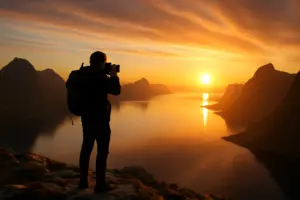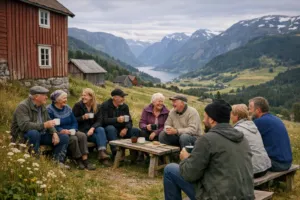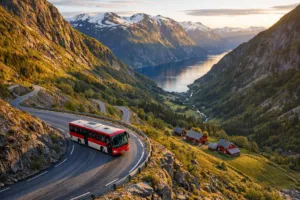
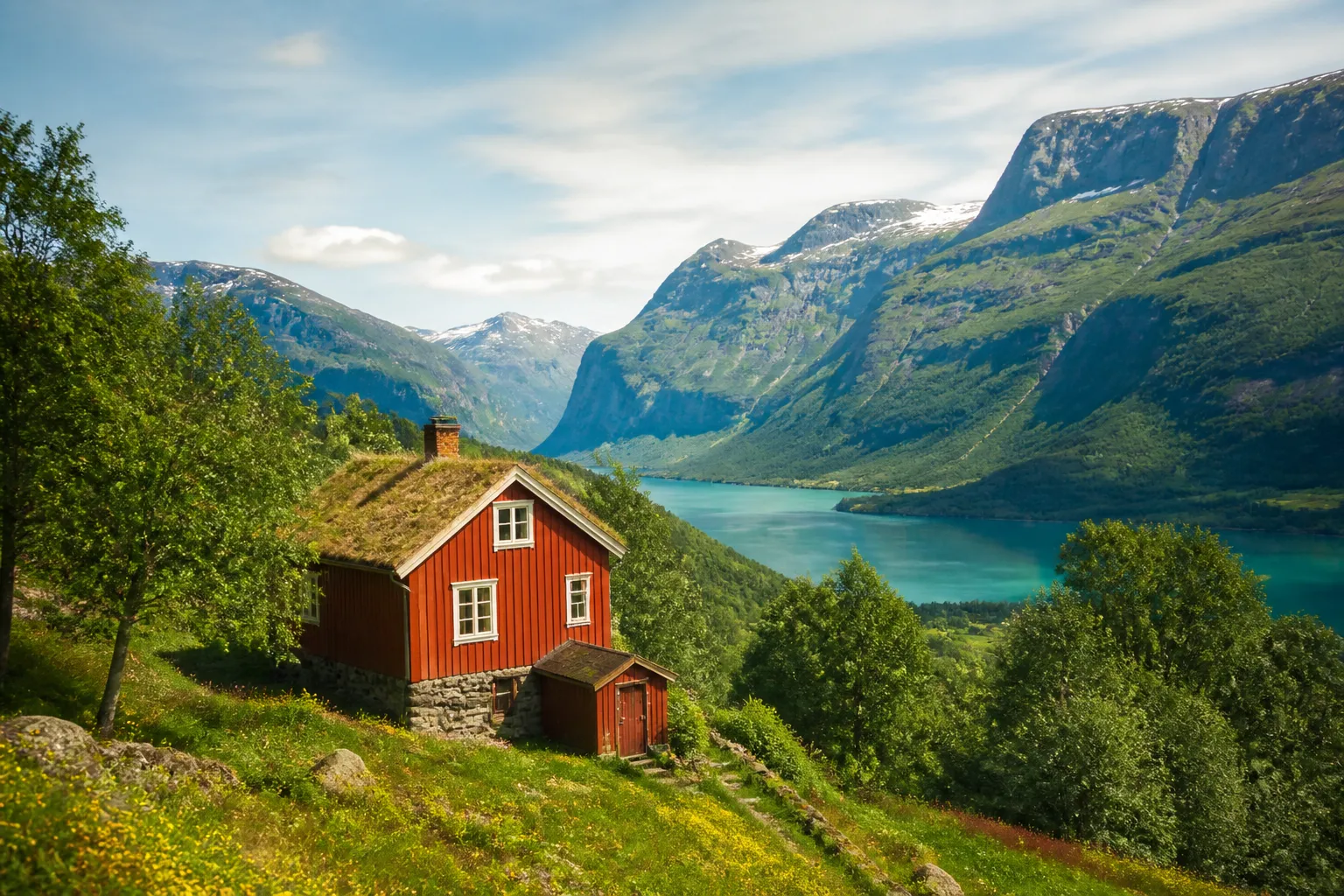
My coffee at this cramped Balestrand café costs more than a car payment back home, and three hours have passed without a single other tourist crossing my line of sight. A local farmer gives me an actual nod—real eye contact, no phone in his hand—before climbing back into his truck. This is the Norway I crossed an ocean for, and it bears zero resemblance to the Oslo hotel lobby I checked out of two weeks ago. If a Norway countryside travel guide is what brought you here, drop the assumption that this country is just another crowded Instagram checklist. The real thing happens in the quiet valleys and along the mountain roads, where 5.5 million people somehow vanish into the landscape entirely.
Population-wise, Norway sits about even with Scotland, yet all those people are scattered across territory bigger than Germany. Step outside Oslo and Bergen and you land in untouched scenery, tight-knit farming villages, and a standard of living that consistently ranks among the world’s best. What nobody mentions upfront is this: genuine rural Norway travel means adjusting to how Norwegians actually live day to day—a mental shift away from the standard tourist loop entirely.
The Allemannsretten: Norway’s Legal Invitation to Roam
Before diving into destinations, there’s a law you need in your head first, because it’s what makes the Norwegian countryside fundamentally different. Allemannsretten (the Right to Roam) is a centuries-old Norwegian principle giving anyone—visitors included—the legal freedom to hike, camp, paddle, and forage across nearly all land, private property not excluded. It’s not a courtesy. It’s written into law.
That said—and this part matters—the freedom comes with conditions. You must:
- Pitch camp no closer than 150 meters to any house or hytte (cabin)
- Cap your stay at two nights running in any single spot
- Take everything back out that you brought in, leaving zero trace
- Steer clear of private gardens and farmed plots
- Get permission first if you’ll be within 150 meters of someone’s home
This one law reshapes how you actually experience norway life in the countryside. You’re not confined to marked trails—you move through the land the way locals themselves do. I’ve set up a tent in a farmer’s field (permission granted, 200 meters clear of his house), paddled across glassy fjords, and grazed on wild blueberries halfway up a mountainside—every bit of it fully legal. Allemannsretten is essentially the key that unlocks why Norwegians hold their countryside so close.
Rural Norway Travel: The Fjord Regions Beyond the Postcard
Geirangerfjord and the Norway in a Nutshell circuit need no introduction. I’d rather point you elsewhere.
Sunnmøre: Fjords Without the Crowds
The Sunnmøre area—Ørsta and Volda especially—delivers fjord scenery every bit as stunning as the famous spots, minus the tour buses; expect essentially no other travelers around. Same steep cliffs, same mirror-still water, same dramatic weather rolling through. What’s different is you get it all to yourself. Base yourself in Volda’s compact center, grab a rental car, and spend your days tracing the narrow roads that follow the fjord edges. The Atlanterhavsveien (Atlantic Ocean Road) is a short drive away and earns its reputation—an 8.3-kilometer coastal route with lookout points that’ll fill your phone storage in no time.
Hardanger: Apple Orchards and Hidden Plateaus
Hardanger is where Norwegians escape to feel like they’ve left Norway behind. The valleys are carpeted in apple orchards—genuinely more apples per person than anywhere else in the country. A handful of cideries have popped up in the last ten years (Hardanger Sider is worth seeking out), and the Hardangervidda plateau rising above the valley has hiking that ranges from easy riverside strolls to legitimate mountain terrain. Hardanger blends norway small towns guide appeal with serious hiking credibility.
Valdres: Stave Churches and Folk Heritage
Want the actual heart of rural Norwegian culture? Valdres has it in abundance. Scattered across this farming region are stave churches—timber structures that look hand-built by folklore creatures—and the Norwegian Folk Museum in Fagernes gives a real window into centuries of countryside life. Towns stay small (Fagernes counts roughly 2,000 residents), valleys stay green, and locals still pull out traditional bunad for special days. It hasn’t become touristy because it never tried to.
Norway Villages Off the Beaten Path: Small Towns Worth Your Time
Ålesund: Art Nouveau and Seafood Excellence
Ålesund far outperforms its size. Just 7,000 people live here, yet it’s an architectural standout—rebuilt almost entirely in Art Nouveau after a devastating fire in 1904. Roam the steep streets (your legs will notice), tackle the Aksla viewpoint climb (418 steps up to one of Norway’s finest views), and eat seafood good enough to make inland travelers jealous. The fish soup has near-legendary status; the king crab arrives fresh every day. Ålesund is proof that scale has nothing to do with substance.
Balestrand: Historic and Strangely Royal
Perched on the Sognefjord (the largest fjord in Norway), Balestrand has drawn visitors from Kaiser Wilhelm II to modern Norwegian artists. The town is tiny—somewhere near 1,500 people—yet it manages to host visitors without ever feeling swamped. Kvanndalsstranda beach is gorgeous, the seafood restaurants deliver, and the architecture mixes Victorian influences with traditional Norwegian timber buildings. It’s one of the rare small towns that manages to feel authentic and welcoming at once.
Røros: A Living Museum That Doesn’t Know It’s a Museum
Røros carries UNESCO status and, by all logic, should feel like a tourist funnel. It doesn’t. The brightly painted wooden buildings trace back to the 1600s (this was once a copper mining hub), and they’re still lived in—not preserved as museum pieces but occupied by real Norwegian families. Wander the streets, stop by the old smelting works, sip coffee at a local café, and you’ll get why this place feels like a remarkably cozy trip back in time.
The Norwegian Countryside Experience: Hytte Culture and How to Live Like a Local
Something most visitors never grasp: about 25% of Norwegian households own a hytte—a cabin, typically tucked in the mountains or countryside. Norwegians don’t chase city breaks; they retreat to cabins instead. This is the core of the norwegian countryside experience. Book one through Finn.no (Norway’s go-to rental site), Airbnb, or the dedicated Norges Hytter platform. A basic cabin sleeping 4-6 runs roughly 800-1,200 NOK a night ($75-115 USD).
A hytte rental changes the entire shape of your trip. You’ll pick up groceries at Coop, cook in a no-frills kitchen, and settle into the actual rhythm of Norwegian living—early starts, coffee ahead of breakfast, long stretches outdoors in the afternoon, quiet nights with a book or a card game. Everything slows down. It costs less than hotels. And it’s simply how Norwegians live their own lives.
The Cabin Kitchen: Brunost and Mountain Coffee
Cabin cooking in Norway keeps things minimal but memorable. Brunost (brown cheese—looks like caramel, tastes like savory caramel heaven) is non-negotiable. Flatbrød topped with smoked salmon shows up at every hytte. And the Kvikk Lunsj bar—Norway’s take on the Kit Kat—earns its place because every hike here comes with a built-in chocolate stop. Grab a few at any supermarket and you’ll quickly understand the Norwegian instinct to pair chocolate with the outdoors.
Bring a thermos for coffee. Up on Norwegian mountain viewpoints, there’s no café waiting for you—just silence, a view, and locals who’ve already figured out that a thermos beats a coffee shop every time.
Walking Routes and Pilgrim Paths Through Rural Norway
The best-known long-distance trek in Norway is St Olav’s Way (Pilegrimsleden), a 643-kilometer pilgrimage stretching from Stiklestad to Nidaros Cathedral in Trondheim. Walking the entire route takes roughly a month, but here’s what few people realize: the full distance isn’t required. The southern stretches run through farmland, forest, and thoroughly rural Norwegian scenery. Tackling just 3-4 days of it—the sections near Hamar or Lillehammer, say—gives you the real feel without the month-long commitment. Expect small pilgrim hostels, plain meals, and a taste of rural norway travel at an unhurried pace.
Why I Finally Stopped Getting Soaked on Norwegian Back Roads
The Norwegian countryside has no interest in your itinerary, and the weather has even less. I found this out the hard way on a three-day hiking loop near Sognefjord, where “scattered showers” turned out to mean sideways rain for eight relentless hours.
What works
- Genuinely repels water rather than just claiming to—I’ve owned jackets that gave up within the hour, but this one kept me dry through a real downpour while I trudged a muddy trail with no shelter in sight for miles.
- Doesn’t puff up into a shapeless mess—the cut stays trim enough to sit under a backpack without turning into a wind-catching sail, which counts for a lot on exposed ridgelines where the weather flips in minutes.
- Compresses small enough to live inside your daypack rather than lashed to the outside of it—by the middle of day two I realized I could’ve brought this instead of my bulkier rain shell and freed up room for layers I actually needed.
What doesn’t
- The zippers stick a little once wet, and wrestling with waterproof gear when your fingers are already cold and clumsy is a frustration all its own.
- Noise is a real issue—not a minor one. Brush past a tree or pick up your pace and you’ll hear the jacket before you hear the fjord, which undercuts the whole point if quiet is why you came.
I nearly abandoned rain gear altogether after my third wet day in the Balestrand area, convinced it was all marketing hype and bulk. Then I grabbed this one on a whim, and it actually proved me wrong. UIQUR Men’s Rain Jacket
Frequently Asked Questions
Can I legally camp anywhere in rural Norway?
Allemannsretten (the Right to Roam) lets you camp on nearly all land, but with strict conditions: pitch no closer than 150 meters to any house or hytte, cap stays at two nights in one spot, take all trash out, avoid private gardens and farmed plots, and get permission if you’ll be within 150 meters of someone’s home.
How much does a hytte cabin rental cost per night?
A basic cabin sleeping 4-6 people runs roughly 800-1,200 NOK a night, which equals $75-115 USD. Book through Finn.no, Airbnb, or the Norges Hytter platform to find rentals across Norwegian countryside regions.
What is St Olav’s Way and how long does it take?
St Olav’s Way (Pilegrimsleden) is a 643-kilometer pilgrimage from Stiklestad to Nidaros Cathedral in Trondheim that takes roughly a month to walk fully. You don’t need to do the entire route—tackling just 3-4 days near Hamar or Lillehammer gives you the rural experience without the month-long commitment.
How many people live in Norway and where are they located?
Norway has 5.5 million people scattered across territory bigger than Germany. Most population clusters around Oslo and Bergen, but step outside those cities and you land in untouched scenery and tight-knit farming villages where people seem to vanish into the landscape.
About This Article

Written by Elena Vasquez. Elena Vasquez is a full-time traveler and the founder of Witty Passport. Over fifteen years and more than 50 countries across six continents — including a stretch spent leading groups professionally through Southeast Asia and the remote highlands of South America — she's written the kind of destination guides she always wished existed: practical, specific, and built on real experience rather than recycled itineraries. More about this site.
Scope and limits. Elena is a full-time traveler, not a licensed travel agent or immigration adviser. Entry requirements, visa rules, and advisories change without notice — always confirm against the official government source for your destination and passport before booking.
Verify this against a primary source
Specifics change, and your situation may differ from the one described here. These are the authorities worth checking directly:
- U.S. Department of State — entry requirements and travel advisories
- CDC Travelers' Health — vaccination and health notices by destination
- TSA — current carry-on and screening rules