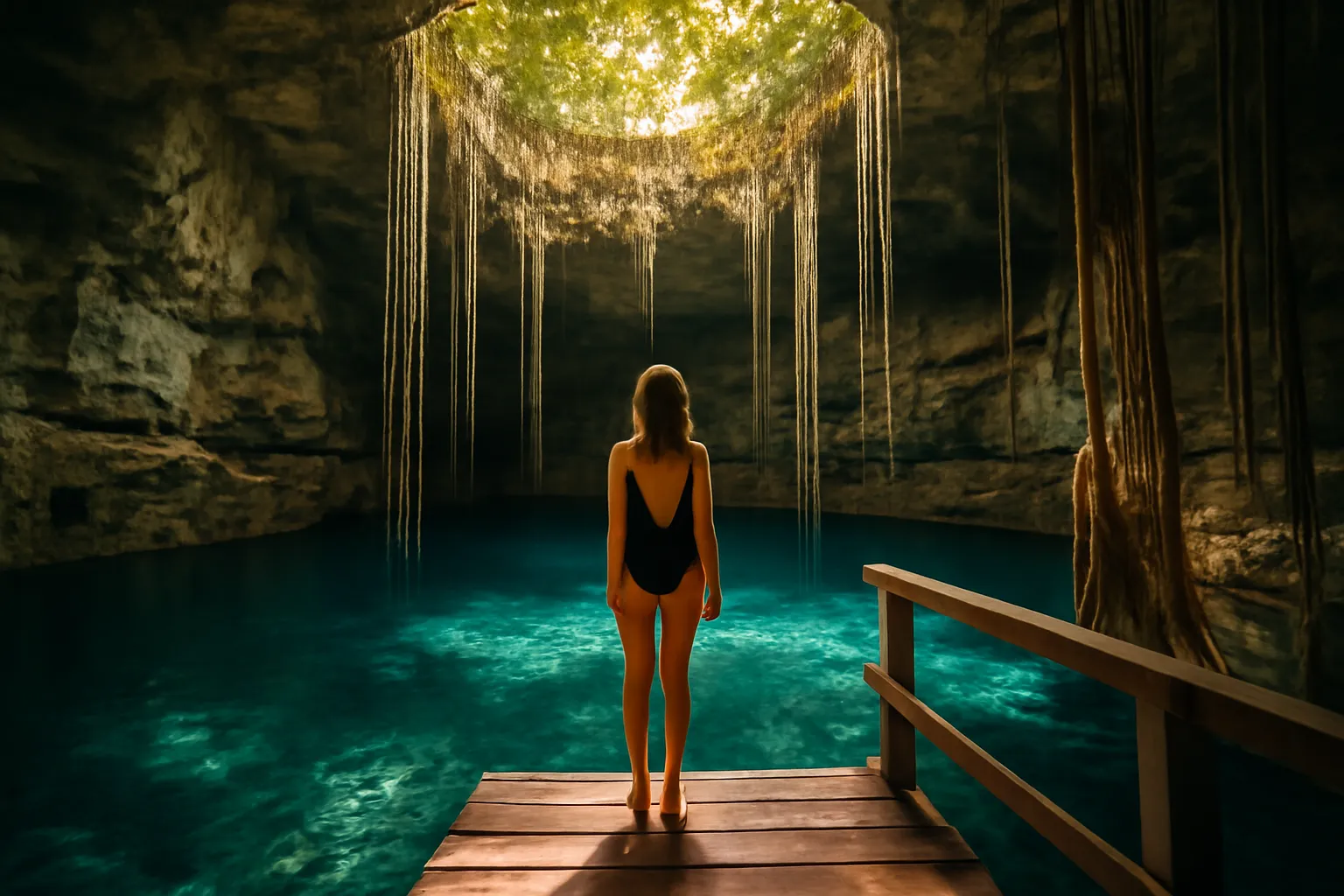
I had a group of eleven with me the day a guard in a yellow vest stopped me at the ticket window at Cenote Suytun, hand out, before I’d even paid the entrance fee. He wasn’t after money — he wanted my sunscreen. We’d rattled ninety minutes through jungle heat from Playa del Carmen, windows down, cumbia on the radio, everyone in the van buzzing about the famous shaft of light waiting for us. This guard read the ingredient list on my SPF 50 like a border agent scanning a passport, and it took him about four seconds to find his target. “Oxybenzone,” he said, handing the bottle back. “No puedes entrar.” You cannot enter. So there I was, guide credentials and all, sweating through my coverup at the gate of one of Mexico’s most photographed swimming holes, while a family behind us breezed past with their biodegradable mineral formula and a look of quiet satisfaction. This is the banned-sunscreen problem nobody mentions before a Yucatán cenote trip — and it can wreck your afternoon fast if you’ve packed the wrong bottle. My options were simple: hand over 400 pesos for the approved sunscreen sold at the counter, or rinse everything off under the outdoor shower and swim unprotected. I paid the 400 pesos. No regrets — that light beam earned every peso — but I floated through that cavern seething at every travel blog that had briefed me on what to wear and said nothing about what to put on my skin.
Why Cenote Sunscreen Rules in Yucatán Are Uniquely Non-Negotiable
What I hadn’t grasped before that day — and what trips up most visitors until they’re standing at a gate holding a confiscated bottle — is that cenotes aren’t swimming pools, and they’re not even proper lakes. The whole Yucatán Peninsula floats on top of one of the planet’s largest underground river networks, the Sistema Sac Actun, a maze of flooded caves and tunnels running for hundreds of kilometers beneath the jungle canopy. Every cenote you dip into ties directly into that system. Anything that enters the water at Cenote Ik Kil doesn’t stay put. It travels. It seeps through everything. It never really goes away.
Long before scientists caught on, the Maya already grasped this. The word cenote comes from the Yucatec Maya ts’onot, meaning sacred well, and these sites functioned as gateways to Xibalba, the underworld — places for ceremony and offering across generations. Archaeologists have pulled artifacts and human remains from some of these pools, remnants of those rituals. Float in one today and you’re literally submerged in ground an entire civilization once treated as holy. Knowing that changes how the weight of the place lands on you.
Environmental policy finally caught up to that reverence in 2019, when Yucatán’s state government made it official: chemical UV filters are banned at cenotes and other protected natural sites. The main culprits are oxybenzone, octinoxate, and octocrylene — active ingredients found in most standard sunscreens, including a lot of products marketed as “reef safe” for ocean swimming. In a closed freshwater system like a cenote, those chemicals concentrate even more heavily and do more damage than they would in the sea. They wipe out the microorganisms, algae, and cave-dwelling species responsible for keeping the water clear and the whole ecosystem running. And because cenote water doesn’t flush and refresh like ocean tides do, the contamination basically never leaves — it just recirculates through the underground network indefinitely.
How this plays out depends on which kind of cenote you’re visiting. Open cenotes — think Cenote Ik Kil, the dramatic circular sinkhole near Chichén Itzá with vines trailing down its 26-meter drop — sit completely exposed to the sky, meaning you’re swimming under full tropical sun. The Yucatán Peninsula sits between 20 and 21 degrees north latitude, and the midday UV index routinely climbs to 11 or 12 between March and October. Sun protection isn’t optional here. Semi-open cenotes such as Cenote Suytun and Gran Cenote have partial rock coverage overhead, cutting UV exposure somewhat, though the same sunscreen rules for Yucatán cenotes still apply in full. Underground cenotes like Cenote Dos Ojos, the well-known snorkeling and diving spot near Tulum, block out sunlight entirely — but you still need biodegradable formulas, since the contamination rules don’t care whether you’re catching any rays at all.
By now, most of the heavily visited cenotes — Suytun, Ik Kil, Dos Ojos, Gran Cenote — station staff at the entrance specifically to check sunscreen labels. Several keep a list of approved brands on hand. And every one of them requires a shower before you’re allowed in, to strip off bug spray, everyday lotion, or anything applied earlier that morning. This isn’t a polite ask. It’s enforced, which is exactly why the showers sit right at the entrance.
Picking a Sunscreen the Cenote Guards Will Actually Let You Bring In
These cenotes function as protected ecosystems across Mexico, and a growing number of parks now turn away anything containing oxybenzone or octinoxate — the same UV filters known for killing coral and wrecking delicate freshwater habitats. Bring the wrong bottle and your options shrink to two: buy a replacement at the gift shop counter, or swim exposed under direct equatorial sunlight.
Why This One Gets You Through
- Since it comes as a stick, there’s no bottle to wrestle with in sticky jungle air, and no greasy fingerprints left on your phone while you’re paying park fees.
- The mineral zinc oxide formula sits on top of the skin rather than absorbing into it, creating a visible barrier — which sounds odd until you realize it means nothing chemical is soaking in during a six-hour day at the cenote.
- Park staff spot it instantly — I watched three people ahead of me wave straight through the gate holding reef-safe sticks, while a couple carrying spray sunscreen got turned back toward the parking lot.
Where It Falls Short
- For roughly two minutes after you rub it in, it leaves a chalky white cast that photographs terribly — though honestly, it doubles as proof you didn’t skip a spot.
- At $18 a stick, it costs more than the drugstore bottle you’d normally toss in your bag, and because the stick format tempts you into applying thicker and more often, you’ll burn through it faster than you would a cream.
I almost skipped buying this before my trip and planned to just reapply whatever I had in my suitcase — a decision that would’ve cost me an hour of negotiation at the gate. Reef Safe Mineral Sunscreen Face Stick SPF 50 by Coral Safe turned out to be the difference between walking straight in and becoming the cautionary tale at the tour operator’s office.
Frequently Asked Questions
What sunscreen ingredients are banned at Yucatán cenotes?
Chemical UV filters oxybenzone, octinoxate, and octocrylene are banned at cenotes and other protected natural sites in Yucatán as of 2019. These ingredients concentrate heavily in closed freshwater systems and damage microorganisms and cave-dwelling species that keep the water clear and the ecosystem running.
Will cenote guards check my sunscreen at the entrance?
Yes. Most heavily visited cenotes including Suytun, Ik Kil, Dos Ojos, and Gran Cenote station staff at entrances specifically to check sunscreen labels. If your sunscreen contains banned ingredients, you must either buy a replacement at the gift shop counter or swim unprotected.
Why do cenotes have stricter sunscreen rules than ocean beaches?
Cenotes sit on top of the Sistema Sac Actun, one of the planet’s largest underground river networks running hundreds of kilometers beneath the jungle. Because cenote water doesn’t flush and refresh like ocean tides, chemical contamination recirculates through the underground network indefinitely rather than dispersing.
Do underground cenotes like Dos Ojos require special sunscreen too?
Yes. Underground cenotes block out sunlight entirely, but you still need biodegradable formulas because the contamination rules don’t vary based on UV exposure. All cenote types require biodegradable sunscreen and a shower before entry to strip off any chemicals applied earlier.
About This Article

Written by Elena Vasquez. Elena Vasquez is a full-time traveler and the founder of Witty Passport. Over fifteen years and more than 50 countries across six continents — including a stretch spent leading groups professionally through Southeast Asia and the remote highlands of South America — she's written the kind of destination guides she always wished existed: practical, specific, and built on real experience rather than recycled itineraries. More about this site.
Scope and limits. Elena is a full-time traveler, not a licensed travel agent or immigration adviser. Entry requirements, visa rules, and advisories change without notice — always confirm against the official government source for your destination and passport before booking.
Verify this against a primary source
Specifics change, and your situation may differ from the one described here. These are the authorities worth checking directly:
- U.S. Department of State — entry requirements and travel advisories
- CDC Travelers' Health — vaccination and health notices by destination
- TSA — current carry-on and screening rules