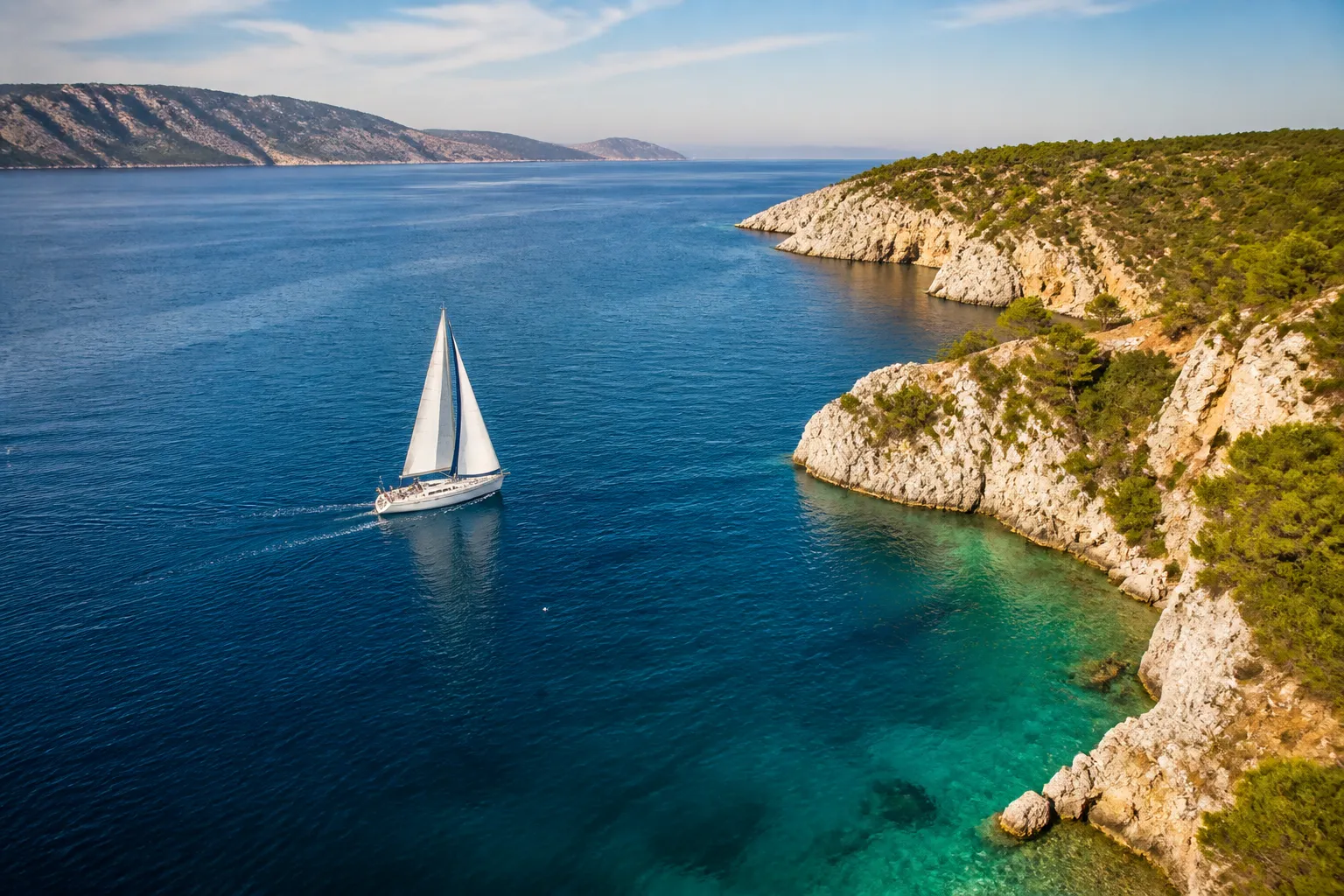
Everyone assumes Krk and Rab are basically interchangeable dots on the Kvarner map — they’re not, and after guiding groups through both often enough to lose count, I can tell you the gap between them is bigger than most guidebooks let on. Travelers land in the region, decide to bypass the Dalmatian crowds further south, and then panic because there’s only room in the itinerary for one island, not two. Fair enough — they’re the two big players of the northern Adriatic, close enough that you can spot one from the other on a clear afternoon, yet they deliver almost opposite kinds of holiday. I’ve logged real time on both, including one gloriously disorganized loop through the entire archipelago that eventually turned into my Kvarner island-hopping guide — so consider this the shortcut past all that browser-tab hoarding.
| Attribute | Krk | Rab |
|---|---|---|
| Access from mainland | Krk Bridge, no toll | Ferry required (15 min or 1 hr 40 min) |
| Airport | Rijeka Airport on island | No airport |
| Beach type | Pebbles and rocks | Sand (Lopar peninsula) |
| Main old town character | Walled quarter, cathedral, castle | Four bell towers, medieval lanes |
| Notable towns | Krk, Vrbnik, Baška, Punat | Rab town, Lopar |
| Signature wine | Žlahtina (from Vrbnik) | N/A |
| Signature food | Šurlice pasta | Rapska torta cake |
| Summer crowds | Packed in July-August | Slower tempo, quieter |
Rab vs Krk: The Short Answer
Choose Krk if simple access matters most — there’s an actual bridge to the mainland, plus the regional airport sits right on the island — along with a wider selection of towns and things to do, and a solid launchpad for exploring the rest of Kvarner. Choose Rab if you want sand under your feet (genuinely rare in Croatia), a medieval old town that stops you mid-sentence, and that unmistakable slowed-down island rhythm. Got a car and not much time to spare? Go Krk. Chasing the sandy-beach postcard? Go Rab. And if you truly can’t settle on one — relax, a direct ferry links them, so the choice doesn’t have to be final.
Reaching Each Island: Krk Isn’t Even in the Same League
Before anything scenic, let’s deal with the unglamorous but decisive factor in the Rab-versus-Krk equation: how you actually get there.
Krk is, hands down, the simplest Croatian island to reach. The Krk Bridge joins it straight to the mainland just below Rijeka — no ferry schedule to obsess over, and these days no toll either. On top of that, Rijeka Airport actually sits on Krk itself, near Omišalj at the island’s northern end. Land, grab your rental car, and you could be in the water inside the hour. For Croatia’s island logistics, that’s practically unheard of.
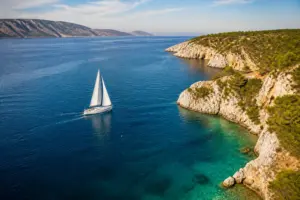
Rab, on the other hand, means a boat no matter how you approach it. The main vehicle ferry sails from Stinica on the mainland to Mišnjak at Rab’s southern tip — a brief 15-minute crossing, though getting to Stinica itself involves a fair stretch of coastal driving. There’s also a year-round daily catamaran from Rijeka straight into Rab town, roughly 1 hour 40 minutes, which suits anyone traveling car-free. And here’s the detail that takes the pressure off this whole decision: a direct car ferry connects Valbiska on Krk with Lopar on Rab, about ninety minutes each way, sailing all year with extra departures added in summer. Combining both islands into one trip is completely realistic — my Kvarner sailing routes guide maps out that exact boat-based version.
Winner: Krk, no contest. Though I’d argue that ferry ride to Rab is part of the appeal — watching an island rise up out of the water does something to your head that a bridge crossing never will.
Beaches: Sand Beats Pebbles (Point to Rab)
This is where the tables turn. Croatia, as a rule, is a pebble-and-rock coastline through and through — I’ve dedicated an entire piece to water shoes because of it — but Rab breaks the pattern up north.
The Lopar peninsula on Rab is renowned for genuine sand, with Rajska plaža — Paradise Beach — as the headline act: long, shallow, and sandy enough that you can wade out for ages while kids splash around without a single complaint about pebbles underfoot. Lopar alone has more than twenty beaches, plenty of them sandy and several still refreshingly undeveloped. Rab also claims one of Croatia’s best-known naturist beaches, Kandarola, if that’s on your list (no judgment — Croatia more or less pioneered the concept).
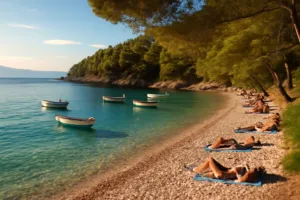
Krk plays it more traditionally Croatian: pebbles, water so clear it looks staged, and coves that reward a little extra effort to reach. Vela plaža in Baška steals the show — a sweeping crescent of fine pebbles framed by mountains, and one of the most-photographed beaches in the country. Stara Baška, tucked at the end of a nerve-testing road in the southwest, remains my personal pick for that secluded turquoise-cove feeling. For a fuller regional breakdown, I’ve sorted my favorites by type in the best beaches in the Kvarner Gulf.
Winner: Rab — if sand is non-negotiable for you, there’s really nothing to argue. Prefer pebbly coves and don’t mind sandal-shopping? Call it even.
Towns and Character: Rab Has the Beauty, Krk Has the Options
Rab town, and I say this as someone naturally skeptical of overhyped destinations, ranks among the loveliest old towns on the whole Adriatic. Perched on a slim peninsula, its silhouette of four bell towers rising over stone medieval lanes is the shot that appears on every Rab postcard for good reason. The center is compact, pedestrian-only, and best enjoyed at golden hour with an ice cream in hand and zero agenda. Late July brings the Rapska Fjera medieval festival, filling the streets with crossbows, costumes, and full pageantry.
Krk answers not with a single showstopper but with range. Krk town brings a genuinely appealing walled old quarter, a Romanesque cathedral, and the Frankopan castle on the waterfront, plus a bar-and-restaurant scene noticeably livelier than anything Rab offers. Then there’s Vrbnik, oddly perched atop a 50-meter cliff on the east coast, home to Klančić — one of the narrowest streets on earth, hold your breath — and Baška down south, buzzing with beach-town energy. Punat sits on a sheltered, lagoon-like bay with a sizable marina, and just offshore floats the tiny islet of Košljun, home to a Franciscan monastery.
Winner: genuinely too close to call. Rab town outshines any single Krk town on looks alone. But Krk gives you four or five towns with distinct personalities, which counts for a lot on a week-long stay.
What to Do: Krk Keeps You Busy
On Krk, filling a week without repeating yourself is easy: poke around Biserujka cave up north, catch the taxi boat from Punat to Košljun, drive or hike the wild route to Stara Baška, wander Vrbnik’s cliffside streets, and use the bridge for spontaneous day trips to Rijeka or Opatija. Krk also works as the natural jumping-off point for wider Kvarner exploration — ferries run from Valbiska to both Cres and Rab, which is exactly how my four-island Kvarner loop got started.
Rab is deliberately quieter, and its activity list leans gentle: cycling and walking routes through an interior that’s surprisingly green (Rab’s seaward side is noticeably lusher than Krk’s rocky terrain), boat outings around Lopar’s sandy coves, a shaded stroll through Komrčar park next to the old town, and mastering the art of doing very little. If your idea of a perfect trip is a book, a beach, and a leisurely dinner, Rab covers all the bases — it’s just stripped down to essentials.
Winner: Krk for the restless, Rab for the ones who’d rather not move much.
Food and Wine: Žlahtina Puts Krk Ahead
Both islands nail the Kvarner staples: fresh Adriatic fish, scampi (the region’s scampi carry serious local fame), lamb raised on karst pasture, and olive oil good enough to make the supermarket bottle back home taste like a joke.
Krk, though, holds a trump card: Žlahtina, a crisp white wine that grows almost nowhere else on the planet outside the fields surrounding Vrbnik. A cold glass of Vrbnička Žlahtina, sipped in a konoba above that clifftop village with the Velebit mountains stretched out across the channel, ranks among the simplest great pleasures of the northern Adriatic. Krk also turns out šurlice, a hand-rolled pasta typically paired with goulash — worth ordering at least once.
Rab counters with Rapska torta, an almond-and-maraschino cake that’s been made on the island for centuries and gives you every reason to order a second coffee. Rab town’s konoba scene is smaller than Krk’s but consistently reliable.
Winner: Krk, purely on the strength of Vrbnik’s Žlahtina. Rab loyalists, take comfort in the cake.
Crowds and Atmosphere: The Bridge Is a Double-Edged Sword
That Krk convenience isn’t free. Precisely because it’s so easy to reach, Krk fills up in July and August with weekend visitors from Zagreb, day-trippers from Rijeka, and a steady flow of caravans from central Europe. It never hits the chaos level of Hvar in peak summer, and the island’s big enough to absorb the crowds without buckling (Stara Baška stays calm even at the height of season), but the main towns and Baška’s beach do get packed.
Rab benefits from the buffer its ferry provides, and you can feel it. It’s not undiscovered — Lopar’s sandy beaches draw plenty of families — but overall the tempo is slower, evenings quieter, and shoulder season (June and September) can feel almost like you’ve got the place to yourself. If unhurried is the mood you’re chasing, Rab delivers it far more reliably.
Winner: Rab, unless a bit of buzz is actually part of the appeal for you.
Rab vs Krk: Matching the Island to the Traveler
- Flying in with a tight schedule? Krk. The airport’s on the island, so the math sorts itself.
- Bringing young kids who need sand? Rab — Paradise Beach at Lopar could’ve been built specifically for them.
- All about the wine? Krk. Vrbnik and its Žlahtina make the case on their own.
- After the most beautiful old town? Rab, four bell towers included.
- Want plenty of day-trip options? Krk — bridge access to the mainland, ferries out to Cres and Rab.
- Trying to disconnect completely? Rab.
- Torn between the two? Hop the Valbiska–Lopar ferry and do both — or go all-in on the archipelago with my Kvarner island-hopping itinerary.
Where I’d Actually Land
Handed one week and forced to pick a side in the Rab-versus-Krk argument, I’d set up on Krk for the flexibility, then ferry over and give Rab two full nights — because watching Rab town at dusk isn’t something you want to rush through as a day-tripper glancing at your watch. Krk is the sensible answer; Rab is the one you’ll end up gushing about to friends later. The real move in the Kvarner Gulf is realizing “versus” isn’t mandatory — that ferry connecting the two turns a forced choice into an easy both. For beach-specific detail across the whole region, my Kvarner beach guide has it covered, and if you’d rather arrive by water than by bridge, the sailing routes through Krk, Cres and Rab is the place to start.
Whichever island claims your week: bring water shoes for Krk, sunscreen for Rab’s shallow sandy shores, and an appetite ready for either.
Which Has Cleaner Water for Swimming: Krk or Rab?
This question comes up a lot, and the honest answer might surprise you: neither. Both Krk and Rab sit in the same stretch of the northern Adriatic, and both meet EU bathing-water standards at their monitored beaches. There is no meaningful water-quality gap between these two islands. If you’ve seen travel forum posts insisting Krk’s water is somehow “purer,” what people are actually noticing has almost nothing to do with pollution levels — it’s about what’s sitting on the seabed.
Krk’s pebble and rocky coves — particularly around Vrbnik and the Baška area — have a way of looking almost artificially clear, like someone poured bottled water into a natural bowl and called it a beach. That gin-clear quality comes from the pebble and rock seabed, which simply doesn’t stir up sediment the way sand does. Rab’s famous sandy bays, especially Rajska Plaža (Paradise Beach) down in Lopar, can look faintly hazy near the shore on a breezy day — but that’s just fine sand getting kicked up in the shallows. The water itself is just as clean.
So here’s the practical takeaway: choose your island based on the swimming experience you actually want, not water quality. If you love that jewel-bright pebble-cove feeling and don’t mind picking your way to the water’s edge in sandals, Krk delivers it in spades. If you want to walk straight out across a wide sandy beach and let the kids run wild in the shallows, Rab is your place. Both will leave you equally impressed — and equally reluctant to go home.
Frequently Asked Questions
Can you drive to Krk or do you need a ferry?
You can drive to Krk via the Krk Bridge, which connects it straight to the mainland just below Rijeka with no toll. Rab, by contrast, requires a ferry no matter how you approach it — either a 15-minute vehicle ferry from Stinica to Mišnjak, or a year-round daily catamaran from Rijeka taking roughly 1 hour 40 minutes.
Where is the airport for reaching Krk Island?
Rijeka Airport actually sits on Krk itself, near Omišalj at the island’s northern end. This makes Krk exceptionally easy to reach — you can land, grab a rental car, and be in the water inside the hour.
Does Rab have sandy beaches like Krk?
Rab has genuine sand beaches, which is rare in Croatia. The Lopar peninsula is renowned for sand, with Rajska plaža (Paradise Beach) being the standout — long, shallow, and sandy enough to wade out for ages. Lopar alone has more than twenty beaches, many sandy and several undeveloped. Krk is traditionally Croatian with pebbles and clear water instead.
What is Žlahtina wine and where do you drink it?
Žlahtina is a crisp white wine that grows almost nowhere else on the planet outside the fields surrounding Vrbnik on Krk. A cold glass of Vrbnička Žlahtina, sipped in a konoba above that clifftop village with the Velebit mountains stretched out across the channel, ranks among the simplest great pleasures of the northern Adriatic.
About This Article

Written by Elena Vasquez. Elena Vasquez is a full-time traveler and the founder of Witty Passport. Over fifteen years and more than 50 countries across six continents — including a stretch spent leading groups professionally through Southeast Asia and the remote highlands of South America — she's written the kind of destination guides she always wished existed: practical, specific, and built on real experience rather than recycled itineraries. More about this site.
Scope and limits. Elena is a full-time traveler, not a licensed travel agent or immigration adviser. Entry requirements, visa rules, and advisories change without notice — always confirm against the official government source for your destination and passport before booking.
Verify this against a primary source
Specifics change, and your situation may differ from the one described here. These are the authorities worth checking directly:
- U.S. Department of State — entry requirements and travel advisories
- CDC Travelers' Health — vaccination and health notices by destination
- TSA — current carry-on and screening rules