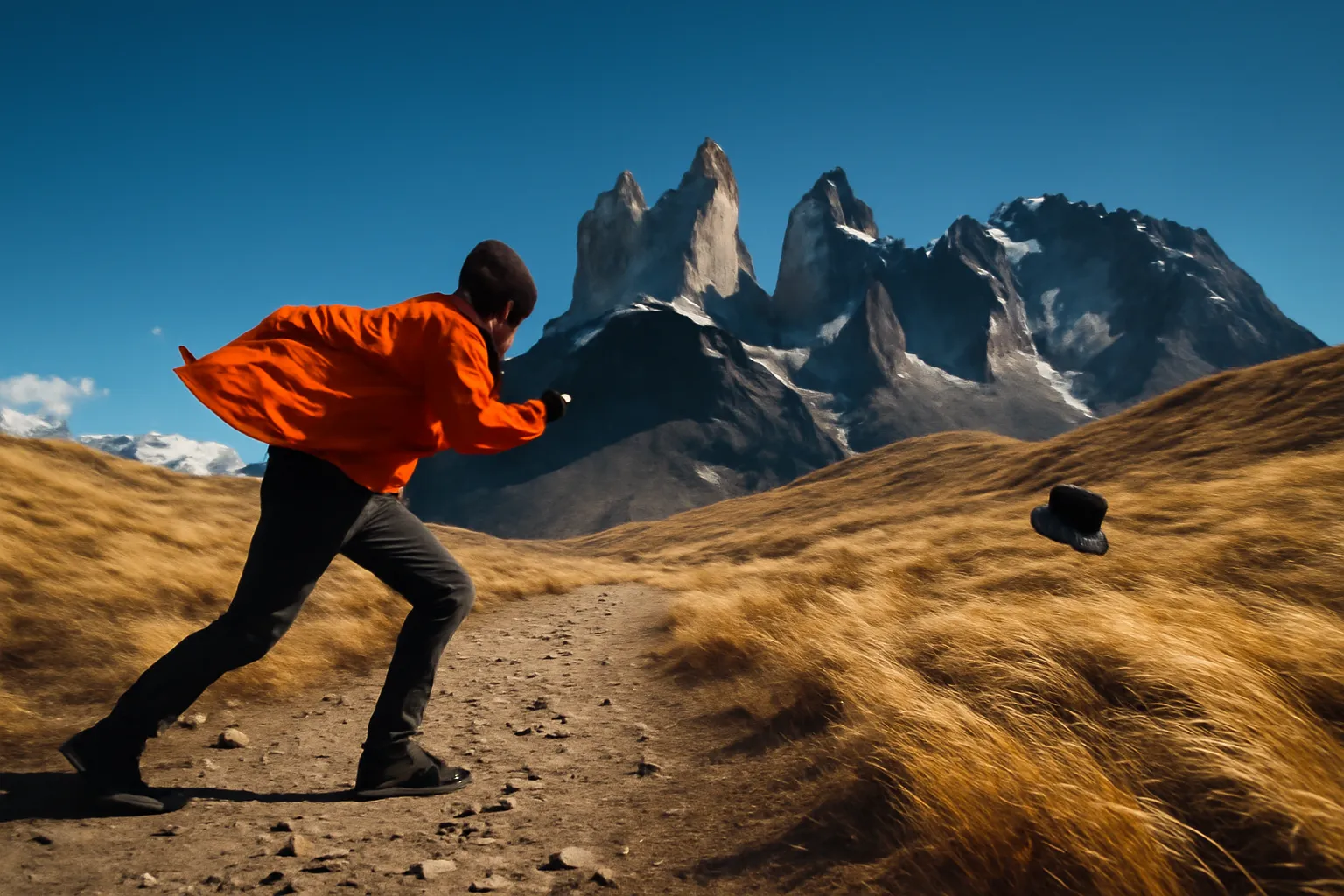
Don’t bring a hat you’re not prepared to sacrifice to Torres del Paine — the wind there doesn’t borrow things, it keeps them. Forty-five minutes into a seven-hour trek, mine was gone. Not tucked into a pack pocket and forgotten, not left behind at the refugio. Gone, as in a gust that hit like a runaway freight train reached out, made a decision, and lifted it clean off my skull. I watched it arc through the air — almost elegant, honestly — and land square in a glacial lake the color of crushed turquoise. That was it. The hat, the shade it provided, and a fair amount of my self-respect, all swallowed by the water. I’d done my homework before flying down to Patagonia. I figured I understood wind. I’d read the warnings, nodded along at the blog posts, even smirked a bit at how theatrical the language got. “Horizontal wind.” Right. “Gusts over 100 km/h.” I’m practically from Chicago — wind and I are old acquaintances, I thought. I was wrong. What I understand now, after finishing the W Trek and standing on that exposed stretch of steppe between Valle del Francés and Mirador Las Torres with my face gone lobster-red, one hand jammed against my eyes with a trekking pole for a shield, is this: picking the right hat for Patagonian wind isn’t about style. It’s a survival call. Everything below is what I wish someone had spelled out for me before I ever booked that flight into Punta Arenas.
Why Patagonian Wind Is Not Wind — It’s a Weather System With a Grudge
Something the guidebooks tend to skip: wind in Chilean Patagonia isn’t “weather” the way rain or cold counts as weather. It’s closer to a permanent feature of the atmosphere, one that’s been carving this terrain — and knocking human egos down a peg — for thousands of years. The Paine massif sits close to 51°S, and its peaks work like a funnel for the Roaring Forties and Furious Fifties, those bands of relentless westerlies that race across the Southern Ocean unimpeded. There’s no continent in the way. No friction to slow anything down. Just open water stretching from the bottom of South America to Antarctica — and when those winds finally hit the mountains, they compress and accelerate through every valley and mountain pass exactly like water forced through a narrow spout.
From November through March — peak hiking months — wind gusting between 60 and 80 km/h barely qualifies as noteworthy. On the O Circuit, the John Gardner Pass regularly clocks gusts past 120 km/h, and rangers will shut the route down entirely — not out of excessive caution, but because hikers have genuinely been blown off balance and knocked to the ground. The direction shifts with zero warning, too: one moment it’s shoving you sideways from the left, and by the time you’ve dug a snack out of your hip belt pocket, it’s slamming straight into your face.
Then there’s the sun exposure angle, which barely gets mentioned anywhere. Down at 50 to 51 degrees south, the ozone layer is measurably thinner than you’d expect, and the strength of a Southern Hemisphere summer sun at elevation makes that gap even more consequential. On a clear day in Patagonia — and clear days happen often, since the same wind stripping you of your hat also scrubs the sky clean of clouds — the UV index routinely climbs to 10 or beyond. Shade is basically nonexistent along the W Trek. The lenga beech forest sections are gorgeous, sure, but the long stretches of open steppe connecting them leave you completely unshielded. Exposed is the right word, in every sense: your skin to ultraviolet radiation, and your ego to just how small this landscape can make you feel.
Long before any hiking trail existed here, the Kawésqar people navigated Patagonia’s channels and islands for thousands of years, coating their skin in animal fat to withstand the wind and cold. When European settlers arrived to raise sheep in the late nineteenth century, they layered themselves in heavy, oiled wool from collar to boot. Both groups had figured out something it takes most modern trekkers a full miserable day to absorb: this place demands total-body preparation for its climate, and your face and scalp don’t get a pass just because you’d rather look presentable.
The Hat I Wish I’d Packed for Torres del Paine
Once my original hat became an unplanned donation to a glacial lake, the lesson sank in fast: Patagonian wind has zero interest in your sense of style. What you actually need is a hat built to stay put when the gusts arrive — not just any old hat, but something designed for the kind of weather that makes you reconsider several of your life decisions mid-trail.
What Held Up
- The chin strap isn’t decorative — it actually holds, which meant I quit death-gripping my brim every time a gust rolled through and could actually look at the view instead of bracing for impact.
- That wide brim genuinely blocks the relentless southern sun off your face and neck, and unlike a bucket hat, it doesn’t collapse inward the second you’re walking straight into the wind.
- When it inevitably gets soaked — and in Patagonia, it will — the waterproof fabric dries out quickly enough that you’re not stuck lugging around a heavy, damp hat for the rest of the day’s hike.
Where It Falls Short
- Don’t expect it to look elegant — you’ll resemble someone on a tactical expedition, which is fine right up until you notice every trip photo has you decked out in full sun-protection gear.
- The stiffness that keeps the brim in shape also means it doesn’t pack down small, so you’re basically choosing between wearing it constantly or cramming it awkwardly into a side pocket of your pack.
I’ll admit, on day three when my head was genuinely aching from sun exposure, I had a moment of doubt—wondering if any hat was worth the awkward silhouette. Then a gust hit that would have sent my bare head into a spiral, and the chin strap held firm. Wide Brim Sun Bucket Hat, Waterproof Boonie Hat for Men & Women
Frequently Asked Questions
What wind speeds should I expect hiking Torres del Paine?
From November through March, wind gusting between 60 and 80 km/h is routine. On the O Circuit, the John Gardner Pass regularly clocks gusts past 120 km/h, and rangers shut the route down entirely when conditions become dangerous.
Why is Patagonian wind so much stronger than elsewhere?
The Paine massif sits close to 51°S, where its peaks funnel the Roaring Forties and Furious Fifties—relentless westerlies racing across the Southern Ocean unimpeded. When these winds hit the mountains, they compress and accelerate through every valley exactly like water forced through a narrow spout.
What UV index should I expect on the W Trek?
On clear days in Patagonia, the UV index routinely climbs to 10 or beyond. Down at 50 to 51 degrees south, the ozone layer is measurably thinner than expected, and Southern Hemisphere summer sun at elevation makes that gap even more consequential.
What hat features actually work in Patagonian wind?
A chin strap that actually holds is essential—it lets you stop death-gripping your brim and look at views instead. A wide brim blocks relentless southern sun off your face and neck, and a stiff waterproof fabric dries quickly rather than staying heavy and damp.
About This Article

Written by Elena Vasquez. Elena Vasquez is a full-time traveler and the founder of Witty Passport. Over fifteen years and more than 50 countries across six continents — including a stretch spent leading groups professionally through Southeast Asia and the remote highlands of South America — she's written the kind of destination guides she always wished existed: practical, specific, and built on real experience rather than recycled itineraries. More about this site.
Scope and limits. Elena is a full-time traveler, not a licensed travel agent or immigration adviser. Entry requirements, visa rules, and advisories change without notice — always confirm against the official government source for your destination and passport before booking.
Verify this against a primary source
Specifics change, and your situation may differ from the one described here. These are the authorities worth checking directly:
- U.S. Department of State — entry requirements and travel advisories
- CDC Travelers' Health — vaccination and health notices by destination
- TSA — current carry-on and screening rules