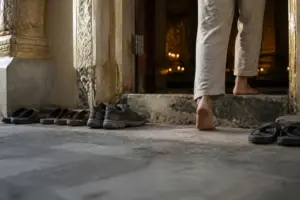
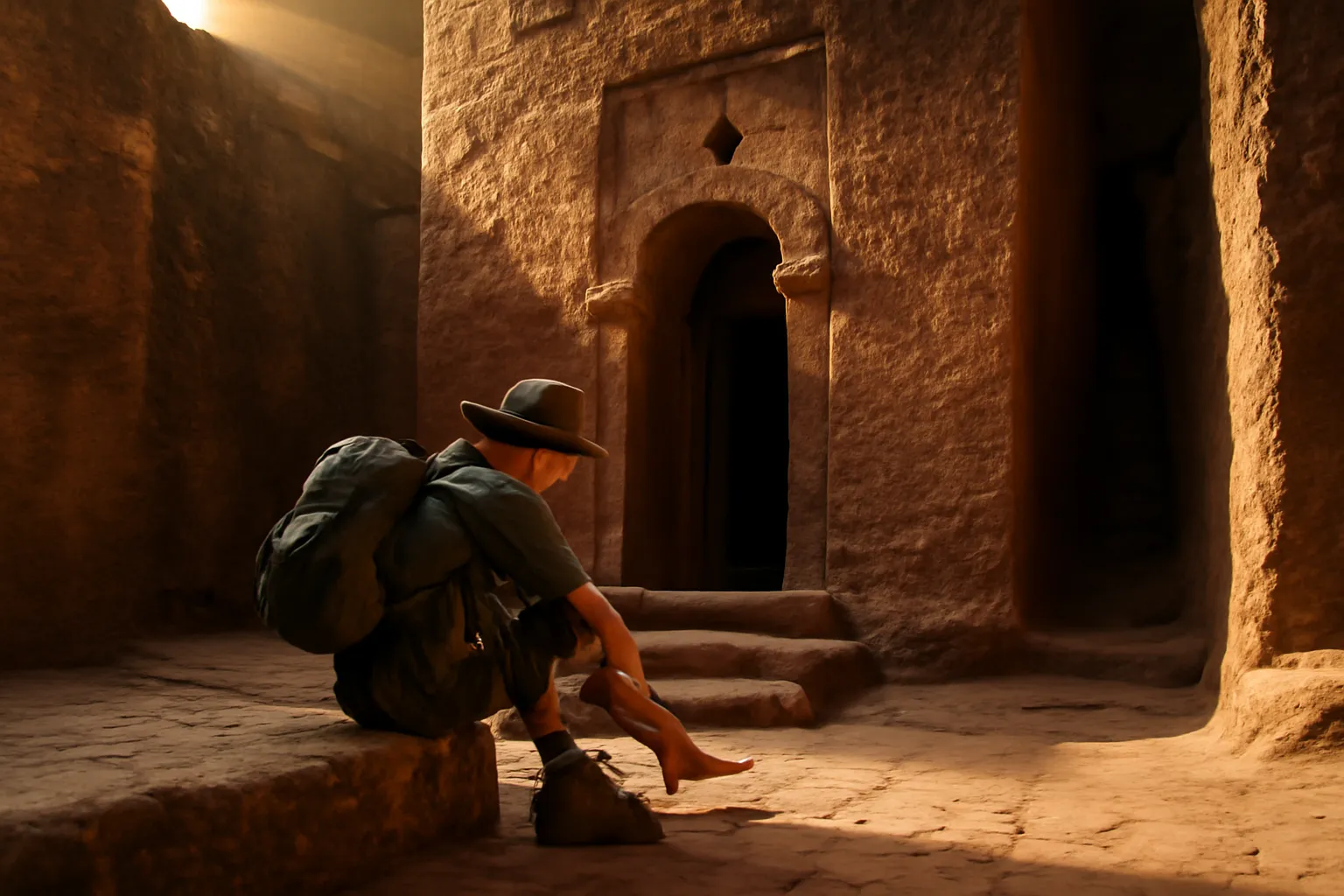
Half the packing guides for Ethiopia tell you to break in a sturdy pair of trekking boots before you fly; the other half say don’t bother, because you’ll spend most of your time barefoot anyway. The second camp is right, and it still doesn’t go far enough — nobody tells you exactly how often those boots come off, or what that actually does to your feet. The walk down into Bete Giyorgis gives you no warning at all. You reach the lip of a trench sliced straight into the Ethiopian highland rock, and then you simply drop into it — steep stone steps, walls hewn so close they brush your shoulders, incense drifting up from somewhere you can’t yet see. At the bottom I turned around and there it was: a church shaped like a perfect cross, rising out of the ground, carved whole from a single mass of volcanic stone, standing exactly where King Lalibela commanded it be cut in the 12th century. Priests in white robes waited near the doorway. A deacon’s chant rolled low and steady through the trench. Then a church attendant nodded, gently but without room for argument, toward my feet. Shoes off. I’d expected that much — visiting Lalibela’s rock churches what to wear had been one of my first searches before the trip even began. Expecting it and actually doing it, though, turn out to be two different experiences. Here’s the part the guides skip entirely: this isn’t a one-time removal. You untie your shoes at all eleven churches, every single time, across two full days of ducking through carved tunnels, hauling yourself up steep rock staircases, and walking on floors worn smooth by eight centuries of pilgrim feet — smooth, but still rough enough that you feel every grain of ancient dust straight through your socks. Somewhere around church four, my socks had given up entirely. By church seven, I was making footwear choices I’d rather not describe in detail.
Why the Shoes-Off Ritual Is Uniquely Challenging at Lalibela’s Rock-Hewn Churches
Before we get into logistics, one thing needs to be clear: Lalibela isn’t a ruin behind a velvet rope, and it isn’t climate-controlled for tourists. These eleven churches, carved into the rock between the 7th and 13th centuries and now protected as a UNESCO World Heritage Site, are still functioning centers of worship — used daily, not preserved as relics. Ethiopian Orthodox priests hold services in them every day. Deacons actually sleep in rooms cut into the surrounding rock. Come Ethiopian Christmas on January 7th, and again during Timkat, the Epiphany festival on January 19th, tens of thousands of pilgrims in white robes pour into this small highland town, packing the carved trenches and passageways with candlelight and chanting that has barely shifted since King Lalibela’s own era. Once you understand that, the whole logic behind Ethiopia church clothing rules for tourists makes sense — you’re not touring an attraction, you’re a guest inside someone else’s ongoing act of faith.
What follows from that matters a lot in practice. Lalibela sits at 2,630 meters in Ethiopia’s Amhara highlands, and the cold there is no joke first thing in the morning — January temperatures can bottom out around 5°C (41°F) before the sun climbs high enough to warm the afternoon to a far more pleasant 20°C (68°F). That swing is worth paying attention to, since your bare or sock-covered feet will be pressed against freezing stone inside the churches one minute and sun-baked rock outside the next. The site itself breaks into three clusters. The Northern Group holds Bete Medhane Alem — the largest monolithic church anywhere in the world, held up by 36 enormous pillars — along with Bete Maryam, the most ornately painted of the eleven, its ceiling colors still sharp after hundreds of years, plus a handful of smaller chapels linked by tunnels tight enough that you have to turn sideways to get through. The Southern Group centers on the fortress-like Bete Gabriel-Rufael, approached across a trench pilgrims have nicknamed the River Jordan. And roughly ten minutes’ walk away, set apart in its own carved pit, stands Bete Giyorgis — the Church of St. George — the one everyone’s seen already, since it’s on nearly every postcard Ethiopia has ever printed.
The Lalibela Ethiopia dress code shoes off rule holds at every single doorway, no exceptions. That’s eleven separate rounds of untying and retying, across ground that shifts constantly — smooth pilgrim-worn stone that turns slick when it’s damp, coarse volcanic rock, uneven dusty tunnels where an ankle roll is a real risk. Some of the connecting passages are properly dark. The stone stays cold. And because these churches are actively used, not preserved museum pieces, the floors hold onto exactly what centuries of worship leave behind — dust, hardened wax, dampness from morning dew settling on old rock. Going barefoot through all of that isn’t really practical. Which means the socks you packed are about to do a lot more work than you probably planned for.
How the Right Socks Got Me Through Eight Hours of Climbing Down Into Lalibela
Those carved trenches show no mercy toward your feet — the stone underfoot is irregular, the descents don’t let up, and you’re doing all of it while breathing thin air at 7,600 feet. I found out the hard way that ordinary hiking socks set you up for blisters that turn the climb back out into a genuinely rough experience.
Where they earned their keep
- Merino wool genuinely breathes in that dry, thin highland air — my feet stayed dry instead of turning damp and clammy the way synthetics do, which counts for a lot when you’re repeatedly climbing down into and back out of trenches.
- There’s enough cushioning to soak up the constant pounding on uneven rock, without so much bulk that your footing feels shaky on the narrower ledges, where a misstep isn’t a small thing.
- They didn’t shift or bunch inside my boots even after hours of walking — which matters, because your attention should be on the carvings in front of you, not on adjusting your socks every ten minutes.
Where they came up short
- The price tag makes you think twice about packing more than one pair, and relying on a single pair for a multi-day Lalibela visit is a genuine gamble if rain shows up unannounced.
- That soft merino feel isn’t free — it catches on rough stone easily, and by day three I’d already noticed several small snags that made me doubt these would survive a full season of this kind of wear.
I almost ditched them on day two when a blister started forming near my heel and I thought I’d just made an expensive mistake, but it turned out to be pressure from my boot fit, not the socks. DANISH ENDURANCE Merino Wool Hiking Socks are worth the investment if you’re spending serious time on Lalibela’s stone.
Frequently Asked Questions
Do I have to take my shoes off at Lalibela’s rock churches?
Yes. The shoes-off rule holds at every single doorway with no exceptions across all eleven churches. You’ll untie and retie your shoes at each one, so expect eleven separate rounds of removal across two full days of walking through carved tunnels, staircases, and worn stone floors.
What’s the temperature like inside Lalibela’s churches?
Lalibela sits at 2,630 meters in Ethiopia’s Amhara highlands where January temperatures can bottom out around 5°C (41°F) before sunrise, then warm to around 20°C (68°F) in the afternoon. Your bare feet will experience that full swing pressed against freezing stone inside the churches and sun-baked rock outside.
How are Lalibela’s eleven rock churches organized?
The site breaks into three clusters. The Northern Group holds Bete Medhane Alem, the world’s largest monolithic church with 36 pillars, plus Bete Maryam and smaller chapels linked by tight tunnels. The Southern Group centers on Bete Gabriel-Rufael across a trench called the River Jordan. Bete Giyorgis stands apart roughly ten minutes’ walk away in its own carved pit.
What happens to your feet after multiple rounds barefoot at Lalibela?
Walking barefoot or in socks across uneven stone for hours exposes your feet to ancient dust, hardened wax, and dampness from morning dew settling on old rock. The ground shifts constantly between smooth pilgrim-worn stone that turns slick when damp and coarse volcanic rock, making ankle rolls a real risk and blisters a genuine possibility.
About This Article

Written by Elena Vasquez. Elena Vasquez is a full-time traveler and the founder of Witty Passport. Over fifteen years and more than 50 countries across six continents — including a stretch spent leading groups professionally through Southeast Asia and the remote highlands of South America — she's written the kind of destination guides she always wished existed: practical, specific, and built on real experience rather than recycled itineraries. More about this site.
Scope and limits. Elena is a full-time traveler, not a licensed travel agent or immigration adviser. Entry requirements, visa rules, and advisories change without notice — always confirm against the official government source for your destination and passport before booking.
Verify this against a primary source
Specifics change, and your situation may differ from the one described here. These are the authorities worth checking directly:
- U.S. Department of State — entry requirements and travel advisories
- CDC Travelers' Health — vaccination and health notices by destination
- TSA — current carry-on and screening rules