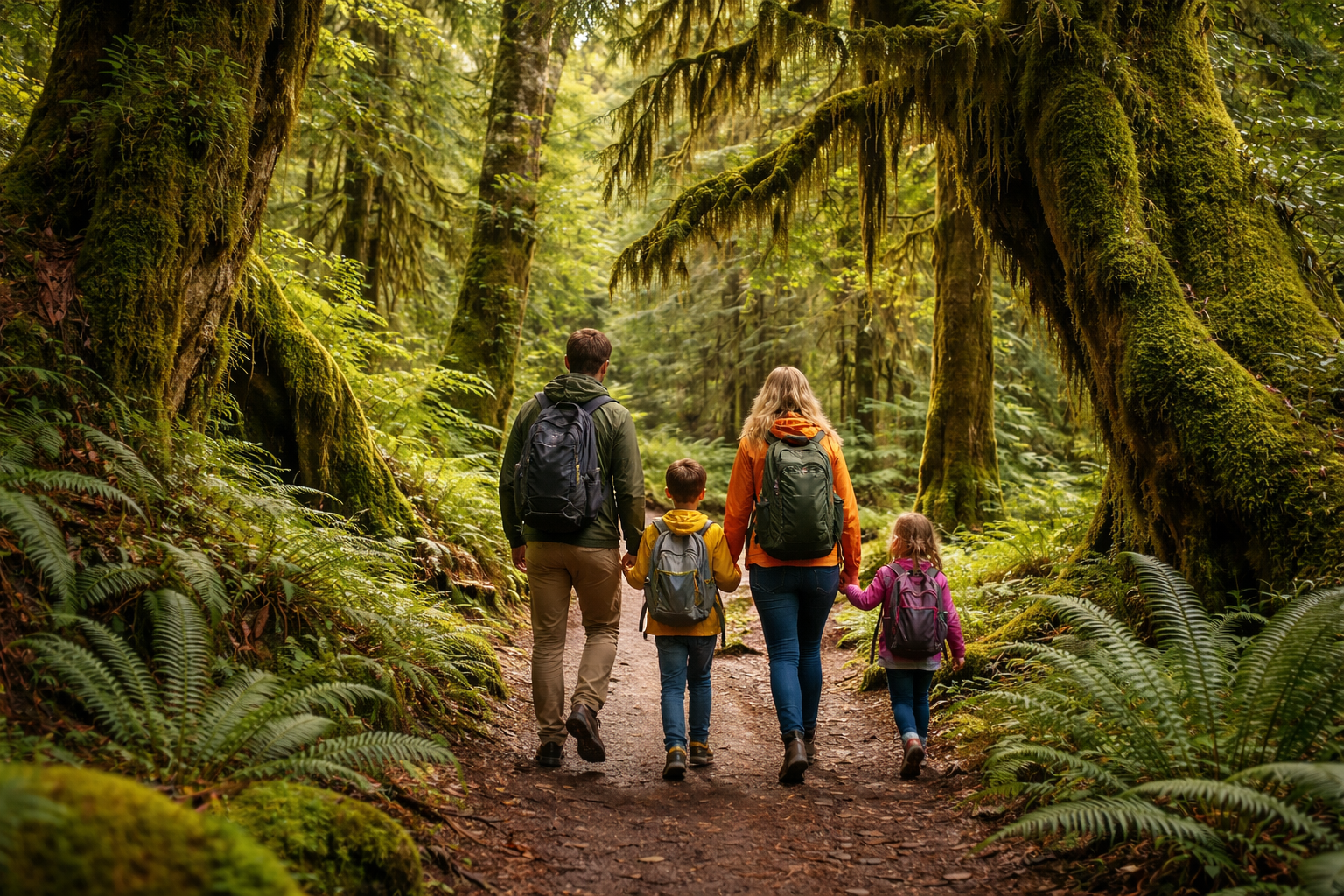
My kids have slogged through soaking jungle trails, shivered across icy alpine basins, and squinted their way through baking desert canyons with me — and none of it prepared them for Olympic National Park. It’s genuinely three parks welded into one: primeval rainforest dripping in neon moss, a jagged Pacific shoreline scattered with sea stacks and tide pools, and alpine ridgelines blanketed in wildflowers where marmots chirp at you like pint-sized trail wardens. And the real win is that every one of these ecosystems has a trail short enough and gentle enough for small legs to handle.
Olympic National Park Family Trails at a Glance
Before getting into specifics, here’s the full rundown of trails in this guide, so you can map out how to divide your days across the park’s three very different zones.
| Trail | Distance | Difficulty | Stroller-Friendly | Best Ages | Zone |
|---|---|---|---|---|---|
| Hall of Mosses | 0.8 mi loop | Easy | ✅ Yes (boardwalk) | All ages | Rainforest |
| Spruce Nature Trail | 1.2 mi loop | Easy | ✅ Yes | All ages | Rainforest |
| Marymere Falls Trail | 1.8 mi RT | Easy–Moderate | ⚠️ Partial | 3+ | Forest / Lake |
| Hurricane Ridge Meadows | 0.5–1.5 mi loops | Easy | ✅ Paved sections | All ages | Alpine |
| Rialto Beach to Hole-in-the-Wall | 3 mi RT | Moderate | ❌ No | 5+ | Coastal |
Hall of Mosses Trail — The Storybook Stroll Through Rainforest
- Distance: 0.8-mile loop
- Elevation Gain: Barely any (~30 ft)
- Surface: Compacted gravel and wooden boardwalk
- Stroller Rating: ✅ Fine for strollers on the boardwalk stretches; a jogging stroller manages the rest without much fuss
- Best Ages: Any age, infants included if they’re in a carrier
- Location: Hoh Rain Forest Visitor Center, Hoh River Valley
Out of every trail in Olympic National Park, Hall of Mosses is the one that actually stunned my kids into silence — no small feat, considering my six-year-old provides running commentary on basically everything. Step onto the loop and you’re suddenly inside a scene that looks staged by a fantasy film crew. Massive old big-leaf maples curve overhead, their branches sagging under layers of Club Moss so thick they resemble shaggy green fur coats. The light filtering down has a soft, jade tint to it. My three-year-old leaned in and asked, “Mama, are there fairies here?” I let him believe it.
The boardwalk stretches make this trail truly workable for strollers and for little ones who need level footing, and because the loop is short, even a toddler running low on steam can finish it under their own power. Elk pass through this grove often — on our visit, a small herd was grazing roughly 40 feet from the trail. Keep the volume down and give them room; Roosevelt elk are enormous, unpredictable wild animals, not petting-zoo residents.
Practical Tips: The Hoh gets around 140 inches of rain annually, so plan on drizzle no matter what the forecast says. The boardwalk turns slick when wet — keep a grip on small hands crossing the bridges. Crowds build fast by mid-morning, so show up before 9 a.m. if you want quiet trails and an easy parking spot.
Spruce Nature Trail — A River Walk with Elk Around Every Bend
- Distance: 1.2-mile loop
- Elevation Gain: Practically flat
- Surface: Compacted gravel, natural forest floor, occasional roots
- Stroller Rating: ✅ Mostly stroller-friendly; a standard stroller handles nearly all of it
- Best Ages: Every age
- Location: Hoh Rain Forest Visitor Center (shares the trailhead with Hall of Mosses)
Because Spruce Nature Trail launches from the same trailhead as Hall of Mosses, pairing them into one half-day rainforest outing is a no-brainer for families. Hall of Mosses gives you drama and atmosphere; Spruce Nature Trail gives you the river. This loop threads through ancient Sitka spruce — trunks so massive my kids couldn’t get their arms a quarter of the way around them — before following gravel bars along the Hoh River, where, on a clear day, the view opens toward the glaciers on Mount Olympus.
This is probably the single best trail in the park for watching Roosevelt elk in the wild. The Hoh Valley holds one of the largest free-roaming herds anywhere in the Pacific Northwest, and the open river corridor gives you a clear line of sight. My kids figured out on their own to freeze and go quiet when we spotted a bull along the bank — the kind of raw wildlife encounter no zoo enclosure can fake.
Practical Tips: The Hoh River moves fast and stays cold. Keep young kids well back from the water, particularly after rain when the banks get unstable. The interpretive signage scattered along the route doubles nicely as a natural history lesson for school-aged kids.
Marymere Falls Trail — Ancient Trees Leading to a Big Waterfall
- Distance: 1.8 miles round trip
- Elevation Gain: ~200 ft
- Surface: Compacted gravel giving way to a rooty forest path, with a short rocky scramble near the falls
- Stroller Rating: ⚠️ Partial — good for strollers on the first third; stash it at the trailhead or switch to a carrier for the final stretch
- Best Ages: 3+ (toddlers will need carrying on the upper portion)
- Location: Storm King Ranger Station, near Lake Crescent Lodge
Full disclosure: Marymere Falls has one catch. The trail opens flat and pleasant, weaving through towering old-growth Douglas fir and crossing Barnes Creek on a scenic footbridge my kids immediately renamed “the troll bridge.” Then the last push toward the falls turns rocky and root-tangled, with uneven steps that flat-out rule out strollers. A soft-structured carrier is the smart call for toddlers on this final section.
The reward more than justifies the extra effort. Marymere Falls tumbles 90 feet in a thin, elegant sheet down a mossy cliff face into a pool below, and the surrounding old-growth trees frame the whole scene like something out of a film set. My six-year-old just stood there, silent, for two full minutes. Coming from her, that’s the equivalent of thunderous applause.
Practical Tips: The Storm King Ranger Station trailhead sits just minutes from Lake Crescent Lodge, so a lakeside lunch pairs perfectly with this hike. The rocks near the falls get dangerously slick when wet — keep kids away from the viewing area’s edge. Parking here costs nothing beyond your standard park entrance pass.
Hurricane Ridge Meadow Trails — Wildflowers, Views, and Marmot Spotting
- Distance: 0.5 to 1.5-mile loops (several route options)
- Elevation Gain: Minimal on the paved paths; up to ~200 ft on connecting trails
- Surface: Paved on the main meadow path, compacted gravel on the connecting loops
- Stroller Rating: ✅ Great on the paved stretches; an all-terrain stroller is worth it for the gravel loops
- Best Ages: All ages; especially magical for kids 2–10
- Location: Hurricane Ridge Visitor Center, 17 miles south of Port Angeles
Hurricane Ridge sits at 5,242 feet, and the drive up feels like crossing into an entirely different climate from the rainforest valleys below. Come July and August, the subalpine meadows fill with lupine, paintbrush, and avalanche lilies in purple, red, and white, and on a clear day the panorama of the Olympic Mountains is nothing short of jaw-dropping.
For kids, though, the views take a back seat to the marmots. Olympic marmots exist nowhere else on Earth, native only to these mountains, and they show almost no fear of people. Mine spent a solid twenty minutes glued to one whistling and sunbathing on a boulder maybe six feet off the paved path. Blacktail deer graze the meadows too, and they’re just as unbothered by visitors wandering nearby.
For the littlest kids, stick to the paved 0.5-mile loop from the visitor center, then push on to the gravel Cirque Rim Trail with older kids craving more distance. The visitor center has restrooms and a small café — a genuinely welcome combo once you’re up at that altitude.
Practical Tips: The road up to Hurricane Ridge is generally open late May through October, with limited winter weekend access for snowshoers. Even in peak summer, the ridge runs 20–30°F cooler than Port Angeles, so pack layers no matter how warm it feels at sea level. Weather can flip fast up there, with afternoon thunderstorms rolling in quickly — get your hiking done in the morning.
Rialto Beach to Hole-in-the-Wall — Sea Stacks, Tide Pools, and Rugged Coast
- Distance: 3 miles round trip
- Elevation Gain: Practically none
- Surface: Cobblestone beach the entire way (no paved or packed section)
- Stroller Rating: ❌ No — cobblestones only; a carrier is strongly advised for toddlers
- Best Ages: 5+ for the complete round trip; younger kids can still enjoy a shorter stretch of beach
- Location: Rialto Beach, north of La Push
I’ll say this plainly: this is the toughest hike in the guide, and “trail” is a generous word for it — really it’s a 1.5-mile trek across a wild, boulder-strewn stretch of Pacific coastline leading to a sea arch called Hole-in-the-Wall. Adults find the cobblestone footing tiring, let alone kids. Still, I’m including it because for families with children five and up, it delivers one of the most memorable experiences anywhere in Olympic National Park. Dark sea stacks jut straight out of the surf. Driftwood logs the size of school buses litter the upper beach, and my kids threw together a solid fort in under seven minutes. Near Hole-in-the-Wall, the tide pools hold hermit crabs, purple sea urchins, sea stars, anemones, and chitons.
⚠️ Critical Safety Note: Hole-in-the-Wall is reachable only at low tide — you cannot get around the headland once the tide comes in, and sneaker waves along this stretch of coast are a real and serious risk. Check the official NOAA tide tables for La Push before you leave, and time your visit for a low tide window. Never turn your back on this ocean.
If the full round trip sounds like too much for your crew, even a 20-minute stroll along Rialto Beach near the parking lot, poking around the driftwood and rocks, is worth the drive on its own. Ruby Beach, about 30 miles south along Highway 101, offers a slightly gentler coastal alternative with equally dramatic sea stacks and giant driftwood — worth slotting into your plans.
Tide Pool Etiquette for Kids: Drill the golden rule into kids before you arrive — look all you want, but hands off. Pulling any creature out of a tide pool is both against national park rules and genuinely harmful to animals already dealing with a stressful environment. Squatting down to watch quietly is just as thrilling, and the animals actually move more when they don’t feel threatened.
Family Tips for Olympic National Park
Getting a Handle on the Park’s Layout
Olympic breaks the mold of most national parks because no road actually cuts through the middle of it. All three ecosystems — rainforest, alpine, coast — sit around the park’s outer edge, linked by Highway 101 and a handful of spur roads. Expect a fair amount of driving between zones. Port Angeles to the Hoh Rain Forest Visitor Center, for instance, runs about 90 miles, roughly a two-hour drive. Factor that driving time into your daily plans, and resist trying to squeeze all three zones into one day with young kids in tow.
What to Expect by Season
- Summer (July–August): The strongest overall window. Hurricane Ridge wildflowers hit their peak. The coast stays cool and fog-draped and gorgeous. Crowds max out here too — book lodging well ahead.
- Spring (April–June): Waterfalls run at full force. Rain is frequent, but so are smaller crowds. Trails at higher elevation may hold snow into June.
- Fall (September–October): Crowds drop off noticeably. Elk rut kicks in — thrilling to watch, but give extra space. Rainforest colors turn beautiful.
- Winter: Rainforest trails stay open all year and take on a moody, atmospheric feel. The Hurricane Ridge road shuts to regular traffic. The coast can turn dramatically stormy — gorgeous if you come prepared.
Staying Safe Around Wildlife
Roosevelt elk are the large mammal you’re most likely to run into, and they’re genuinely massive — bulls can top 1,000 pounds. Stay at least 75 feet back from any elk you see. During the fall rut, bulls turn unpredictable fast. Black bears live in the park too, so store food properly and brush up on basic bear safety before venturing into more remote areas. Mountain lions are also present, though actual sightings are rare.
Facilities and Logistics Worth Knowing
- The Hoh Rain Forest Visitor Center offers restrooms, a small bookshop, and ranger-led programs that kids genuinely enjoy
- Hurricane Ridge Visitor Center has restrooms and a seasonal café
- Cell coverage is spotty at best across most of the park — grab offline maps before you head out
- Park entry runs $35 per vehicle, good for 7 days; the America the Beautiful annual pass is a smart buy if your family is hitting multiple parks
How My Kids Got Through the Hoh Rainforest Without Melting Down Over Wet Feet
Olympic’s rainforest trails are enchanting right up until your kid’s sneakers turn into sponges and they stage a full-blown revolt two miles from the car. The moss-thick canopy keeps the rain steady but light — soaking feet rather than drenching you in a downpour — and that’s precisely the situation where real rain boots earn their keep.
Where they earn their keep
- They grip muddy, slick ground instead of sliding around like clown shoes — crucial when kids are picking their way across moss-slicked roots and creek crossings.
- On and off in seconds at the trailhead — my kids managed them solo, sparing me ten minutes hunched over in a parking lot fighting velcro and buckles.
- They squash down small enough to toss in a day pack once the skies clear, which happens constantly out here, and more often than not you’re not even wearing them by mile three.
Where they fall short
- There’s no insulation, so on truly cold mornings — early spring at higher elevations especially — kids’ feet chill faster than they would in proper hiking boots and socks.
- The tread can turn slippery on steep, wet rock — I kept a close eye on my youngest through the steeper stretches of the Sol Duc Falls trail.
I genuinely questioned whether I’d overpacked them on day two when the sun broke through and the trails dried out in hours, but then afternoon drizzle rolled in and I was grateful I hadn’t left them behind. Grab the DREAM PAIRS Kids Rain Boots before you go.
Frequently Asked Questions
What is the best Olympic National Park trail for toddlers?
Hall of Mosses is ideal for toddlers. The 0.8-mile loop features a wooden boardwalk and compacted gravel surface, making it stroller-friendly for all ages. The trail stays nearly flat with barely 30 feet of elevation gain, and you can complete it under your own power even on low energy.
Can you bring a stroller on Rialto Beach to Hole-in-the-Wall?
No, strollers won’t work on Rialto Beach to Hole-in-the-Wall. The entire 3-mile round trip crosses cobblestone beach only, with no paved or packed sections. A carrier is strongly advised for toddlers, and this trail is best suited for children five and up.
How long is the drive from Port Angeles to Hoh Rain Forest?
The drive from Port Angeles to the Hoh Rain Forest Visitor Center is about 90 miles and takes roughly two hours. Since Olympic’s three ecosystems sit around the park’s outer edge with no road cutting through the middle, factor this driving time into your daily plans.
When do Hurricane Ridge wildflowers peak at Olympic?
Wildflowers peak during July and August at Hurricane Ridge, when subalpine meadows fill with lupine, paintbrush, and avalanche lilies in purple, red, and white. This is also the strongest overall window for visiting, though crowds max out during these months.
About This Article

Written by Elena Vasquez. Elena Vasquez is a full-time traveler and the founder of Witty Passport. Over fifteen years and more than 50 countries across six continents — including a stretch spent leading groups professionally through Southeast Asia and the remote highlands of South America — she's written the kind of destination guides she always wished existed: practical, specific, and built on real experience rather than recycled itineraries. More about this site.
Scope and limits. Elena is a full-time traveler, not a licensed travel agent or immigration adviser. Entry requirements, visa rules, and advisories change without notice — always confirm against the official government source for your destination and passport before booking.
Verify this against a primary source
Specifics change, and your situation may differ from the one described here. These are the authorities worth checking directly:
- U.S. Department of State — entry requirements and travel advisories
- CDC Travelers' Health — vaccination and health notices by destination
- TSA — current carry-on and screening rules