One trip through Yosemite Valley, I watched myself become a stroller-hauling, granite-slab-scaling, fruit-snack-bribing wreck of a mother — and somewhere near a waterfall overlook, my six-year-old asked, dead serious, if we could just head back to the car. I’d do the whole ordeal again without hesitation. This park manages something rare: jaw-dropping scenery that doesn’t demand serious hiking chops to reach. The valley floor hands over Half Dome sightlines, thundering falls, and glassy lakes on trails flat and paved enough for the shortest legs in your group. Stroller, toddler carrier, or a skeptical six-year-old who insists hiking is boring — Yosemite wins them over anyway.
Kid-Friendly Hikes in Yosemite at a Glance
Not sure where to begin? Below is a fast rundown of every trail in this guide, so you can line up the right hike against your kids’ ages, stamina, and whatever gear you’re hauling before anyone puts on shoes.
| Trail | Distance | Difficulty | Stroller-Friendly | Best Ages |
|---|---|---|---|---|
| Lower Yosemite Fall Trail | 1 mi loop | Easy | ✅ Yes | All ages |
| Cook’s Meadow Loop | 1 mi loop | Easy | ✅ Yes | All ages |
| Bridalveil Fall Trail | 0.5 mi RT | Easy–Moderate | ⚠️ Challenging | All ages (3+ walking) |
| Mirror Lake/Meadow Loop | 2 mi to lake / 5 mi full loop | Easy | ✅ To the lake | All ages |
| Tuolumne Meadows – Soda Springs | 1.5 mi RT | Easy | ✅ Yes | All ages |
| Sentinel Dome | 2.2 mi RT | Moderate | ❌ No | 5 and up |
1. Lower Yosemite Fall Trail — Start Here, No Debate
- Distance: 1-mile loop
- Elevation Gain: Barely any
- Surface: Pavement and packed gravel
- Stroller Rating: Handles strollers with zero fuss
- Best Ages: Every age, carrier-bound infants included
- Best Season: May and June, when the falls run hardest
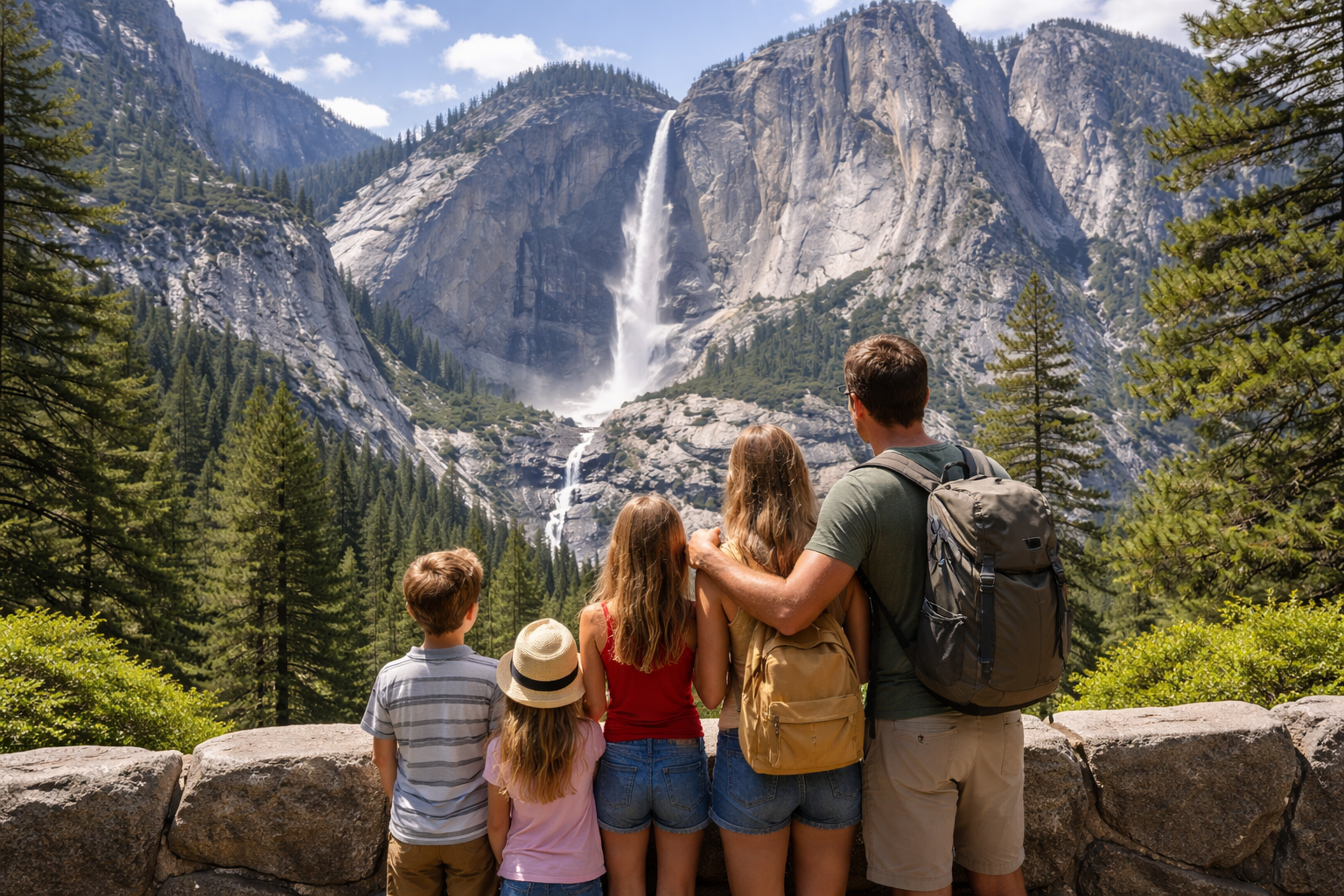
If someone forced me to pick a single family hike in the entire valley, this would be it, hands down. The Lower Yosemite Fall Trail is a paved one-mile loop that dumps you right at the foot of North America’s tallest waterfall. That’s a 2,425-foot column of water crashing down close enough to leave your kids momentarily wordless — an actual parenting miracle. The path stays wide and flat enough for a jogging stroller the entire way. Come May and June, snowmelt sends the falls into full drama mode, and the mist near the base is thick enough to soak the whole family in the most welcome way possible. My daughter dubbed it “the world’s biggest sprinkler.” Accurate.
Practical tips: You’ll find the trailhead near Yosemite Valley Lodge, reachable by the free Valley shuttle (stop 6). Because this trail draws huge crowds, get there before 9 a.m. if you’re driving, or just take the shuttle and skip the parking headache altogether. Restrooms and water fountains sit near the trailhead. The bridge at the falls’ base is prime territory for photos and mist — just keep a grip on small hands, since the rocks turn slick.
2. Cook’s Meadow Loop — Maximum Payoff for Minimal Effort
- Distance: 1-mile loop
- Elevation Gain: Essentially flat
- Surface: Paved throughout
- Stroller Rating: Ideal — you won’t find smoother ground
- Best Ages: Every age
- Best Season: Spring into fall, though winter has its own charm
Cook’s Meadow Loop is the trick I pull out on low-energy days or after mornings that started too early for anyone’s legs to cooperate. This flat, entirely paved mile through the center of Yosemite Valley serves up Half Dome, Yosemite Falls, and Sentinel Rock all at once — basically the park’s greatest hits — without a single real incline. I’ve walked this loop with a newborn strapped to my chest, with a two-year-old flatly refusing to move, and with a double stroller loaded down with snacks and complaints. Every single time, the view stopped me cold anyway.
Practical tips: This loop links up with the Lower Yosemite Fall Trail, so combining both gets you a relaxed two-mile morning without much planning. Deer show up in the meadow regularly at dawn and dusk, and kids never get tired of spotting them. Keep the noise down and stick to the trail so the meadow grass stays intact. Valley shuttle stop 5 (Yosemite Village) drops you right at the start.
3. Bridalveil Fall Trail — Brief, Theatrical, and Wonderfully Wet
- Distance: 0.5 miles round trip
- Elevation Gain: Roughly 75 feet
- Surface: Paved, with a real grade near the finish
- Stroller Rating: Tough going — the final climb near the viewpoint is steep and rocky
- Best Ages: All ages; toddlers who can walk (3+) tend to love it
- Best Season: Open year-round, strongest flow in spring
Bridalveil Fall tends to be the first waterfall families lay eyes on entering the valley from the west, and it’s obvious within seconds why everyone stops walking. The path to its base runs a mere quarter mile each way — one of the shortest hikes anywhere in the park — but don’t underestimate it. The final stretch turns steep and rocky, and the mist near the bottom soaks you quicker than expected. My kids rank getting drenched by a waterfall among life’s greatest pleasures, so this one stays permanently on our Yosemite list. If you’re pushing a stroller: the paved section gets you partway, but that last push to the viewpoint is a genuine struggle on wheels. Better to carry your child or park the stroller at the bottom.
Practical tips: A dedicated Bridalveil Fall lot sits right off Highway 41, usually less packed than the main Valley parking areas. Bring a light rain jacket, or just accept getting wet — there’s no middle ground here. The rocks near the base get very slippery, so watch little ones closely and keep them back from the stream’s edge.
4. Mirror Lake and Meadow Loop — Half Dome’s Reflection and Space to Roam
- Distance: 2 miles round trip to the lake; 5-mile full loop
- Elevation Gain: Barely any
- Surface: Paved to the lake, dirt for the rest of the loop
- Stroller Rating: Fine to Mirror Lake; the full loop works with wheels but stays unpaved
- Best Ages: Any age for the lake; 4+ for the whole loop
- Best Season: Spring gives the best reflections; by late summer the lake shrinks into a meadow
Mirror Lake justifies its name in April and May, when the still surface throws back an upside-down Half Dome so crisp it looks digitally enhanced. The two-mile round trip to the lake is flat and paved the whole way, entirely doable with a stroller or a toddler on foot, and a wide sandy stretch at the water’s edge lets kids skip rocks and splash around — basically their favorite kind of chaos. If your group has gas left in the tank, the full five-mile loop wraps through pine forest with Half Dome still in view, feeling adventurous without ever getting genuinely hard.
Practical tips: Ride the Valley shuttle to stop 17 (Mirror Lake Junction) — there’s no dedicated lot here, and driving in only adds unnecessary stress. Keep in mind that by late summer, Mirror Lake becomes Mirror Meadow as the water pulls back, which has its own beauty but loses the reflection entirely. If the photo is the point, go in spring.
5. Soda Springs Trail, Tuolumne Meadows — Nature’s Own Fizzy Water Experiment
- Distance: 1.5 miles round trip
- Elevation Gain: Almost nothing
- Surface: Dirt path, generally flat and well kept
- Stroller Rating: Works on most stretches; an all-terrain or jogging stroller helps
- Best Ages: Every age
- Best Season: Summer only — Tioga Road (Highway 120) usually opens late May or June and shuts by early November
Tuolumne Meadows sits at 8,600 feet along Tioga Road, an entirely different landscape from the valley floor — open subalpine grassland, granite domes, and air that feels almost too clean to be real. Soda Springs makes the perfect entry point for families exploring this stretch. The main attraction is a naturally carbonated spring bubbling up through a rust-colored iron pool, and watching my kids try to wrap their heads around sparkling water coming straight out of the ground ranks among my favorite parenting moments ever. They were mesmerized. My six-year-old still brings it up.
Practical tips: The trailhead begins at the Tuolumne Meadows Visitor Center parking area. At 8,600 feet, altitude can hit both kids and adults harder than expected — slow the pace, drink more water than usual, and watch toddlers for fatigue signs especially. This meadow is a protected ecosystem, so keep everyone on the trail. It’s also solid wildlife territory: marmots, pikas, and occasionally a black bear turn up during summer.
6. Sentinel Dome — The Bigger-Kid Hike With the Park’s Best Payoff View
- Distance: 2.2 miles round trip
- Elevation Gain: Around 400 feet
- Surface: Dirt trail with an exposed granite scramble at the top
- Stroller Rating: Not an option
- Best Ages: 5 and up, and only confident walkers
- Best Season: Late spring through fall; Glacier Point Road generally opens late May
Once kids are ready to conquer an actual summit, Sentinel Dome is what I point them toward. The round trip runs 2.2 miles with a manageable 400 feet of climbing — enough of a challenge that kids feel like they earned it, without wearing anyone out to the point of being carried. The last section involves a short scramble over exposed granite, which most kids five and up find thrilling (parental nerves about heights, on the other hand, vary widely). At the top, you get a full 360-degree sweep from Half Dome to El Capitan out to the High Sierra backcountry. My six-year-old threw her fist in the air at the summit like she’d won a trophy. In a way, she had.
Practical tips: Find the trailhead off Glacier Point Road, near the Taft Point lot. There’s zero shade on the dome, so start early, load up on sunscreen, and carry more water than seems necessary. The granite gets slick when wet, so skip this hike on rainy days. Very young toddlers aren’t a fit here — the drop-offs near the summit demand close supervision of any kid prone to wandering.
A note on Mist Trail to Vernal Fall: This trail comes up constantly in family trip planning, and for good reason — it’s one of Yosemite’s most popular hikes. Here’s my honest take: Mist Trail is steep, wet, slippery granite with real drop-offs, and the spray off Vernal Fall makes those steps genuinely dangerous. I’d save this one for confident hikers seven and up. It’s a gorgeous hike, but it’s nowhere near the easy waterfall stroll some other posts make it sound like. Wait until your kids have logged a few solid trails first.
Family Logistics Worth Knowing Before You Go
Entry Reservations
During peak season (roughly late May through early September), Yosemite requires a timed-entry reservation for day visitors arriving between 5 a.m. and 4 p.m. These vanish fast, often within minutes of being released. Check nps.gov/yose for the current reservation window and grab your slot the moment it opens. Anyone staying overnight, whether in park lodging or a campground, is typically exempt — one more reason basing yourself inside the park simplifies family logistics enormously.
Parking Strategy
Valley parking is famously tight and fills by mid-morning on any busy day. Your best bets: arrive before 9 a.m. to claim a spot, or show up after 4 p.m. once day visitors start clearing out. For the hours in between, lean on the free Valley shuttle, which runs often and hits nearly every major trailhead and landmark. I actually prefer it to driving — it removes all the parking anxiety, and my kids treat the ride itself like part of the adventure.
Bears and Food Storage
Yosemite’s black bear population is active, and proper food storage isn’t a suggestion — it’s the law. Bear boxes sit at every major trailhead and picnic spot. Never leave food, scented products, or even empty wrappers inside your car. This doubles as a solid teaching moment: explain to kids why the storage rules matter, and suddenly bear boxes go from annoying to exciting. My daughter has appointed herself official bear box supervisor.
Junior Ranger Program
Grab a free Junior Ranger activity booklet from any Yosemite Visitor Center. Kids work through age-appropriate tasks during their visit and earn an official badge from a ranger once finished. It’s one of the strongest trail-motivation tools I’ve come across — my six-year-old hiked an extra mile solely to track down a bird she needed for her booklet.
Planning Around the Seasons
- Spring (April–June): Waterfalls run at full strength; certain roads may still be closed; wildflower meadows put on a real show.
- Summer (July–August): Crowded, but Tioga Road stands open, unlocking Tuolumne Meadows; reserve everything far ahead.
- Fall (September–October): Crowds thin out, the weather turns lovely, waterfalls quiet down, but the light is golden and stunning.
- Winter (November–March): Chains may be required on valley roads and several facilities shut down, but a snow-dusted Yosemite Valley remains one of the most magical scenes I’ve shared with my kids.
The Backpack That Stops Kids From Going Limp by Mile Three
A kid-sized pack isn’t about picking a cute color — it’s about handing your child real ownership of their own gear, so they quit begging you to carry everything halfway up the trail. On Yosemite’s steeper stretches, like the climb to Vernal Fall, even a featherweight pack is the difference between a cooperative hiker and a full negotiation over whether a boulder counts as a chair.
What works
- The hip belt shifts weight onto their hips instead of letting it all hang off the shoulders, so they can go longer before complaining their back aches.
- Cut to actual kid proportions, so it doesn’t slide down or bounce around the way an adult pack scaled-down would — especially valuable on rocky, uneven ground.
- Loud enough in color that you can spot it instantly the second your kid wanders off-trail chasing a squirrel, which happens more often than anyone plans for.
What doesn’t
- Capacity tops out around 10-12L, so don’t count on your kid hauling more than their own water and snacks — you’re still stuck with the rain jacket and first aid kit.
- The zippers run stiff right out of the box, which trips up smaller hands, especially when they’re tired and just want their snack immediately.
I had my doubts about whether my six-year-old would actually keep it on instead of abandoning it after ten minutes, but she wore it the entire Mist Trail without complaint. IVYGREEN Little Kids Hiking Backpack (Purple)
Frequently Asked Questions
What is the easiest kid-friendly hike in Yosemite Valley?
The Lower Yosemite Fall Trail is a one-mile paved loop that reaches North America’s tallest waterfall at 2,425 feet. It has barely any elevation gain, stays wide and flat enough for a jogging stroller, and works for every age, including carrier-bound infants. Come May and June when snowmelt peaks, the mist soaks the whole family.
Can I push a stroller on Bridalveil Fall Trail?
The paved section gets you partway, but the final stretch to the viewpoint is steep and rocky. The park recommends carrying your child or parking the stroller at the bottom. If you do push wheels all the way, that last push is a genuine struggle. The rocks near the base are very slippery.
When is the best time to see Mirror Lake’s Half Dome reflection?
April and May offer the best reflections, when still water throws back an upside-down Half Dome so crisp it looks digitally enhanced. By late summer, Mirror Lake becomes Mirror Meadow as the water pulls back, which loses the reflection entirely but has its own beauty.
What age should kids be for Sentinel Dome hike?
Sentinel Dome works for kids five and up who are confident walkers. The 2.2-mile round trip with about 400 feet of elevation gain includes a short granite scramble at the top with exposed drops, so very young toddlers prone to wandering aren’t a fit here.
About This Article

Written by Elena Vasquez. Elena Vasquez is a full-time traveler and the founder of Witty Passport. Over fifteen years and more than 50 countries across six continents — including a stretch spent leading groups professionally through Southeast Asia and the remote highlands of South America — she's written the kind of destination guides she always wished existed: practical, specific, and built on real experience rather than recycled itineraries. More about this site.
Scope and limits. Elena is a full-time traveler, not a licensed travel agent or immigration adviser. Entry requirements, visa rules, and advisories change without notice — always confirm against the official government source for your destination and passport before booking.
Verify this against a primary source
Specifics change, and your situation may differ from the one described here. These are the authorities worth checking directly:
- U.S. Department of State — entry requirements and travel advisories
- CDC Travelers' Health — vaccination and health notices by destination
- TSA — current carry-on and screening rules