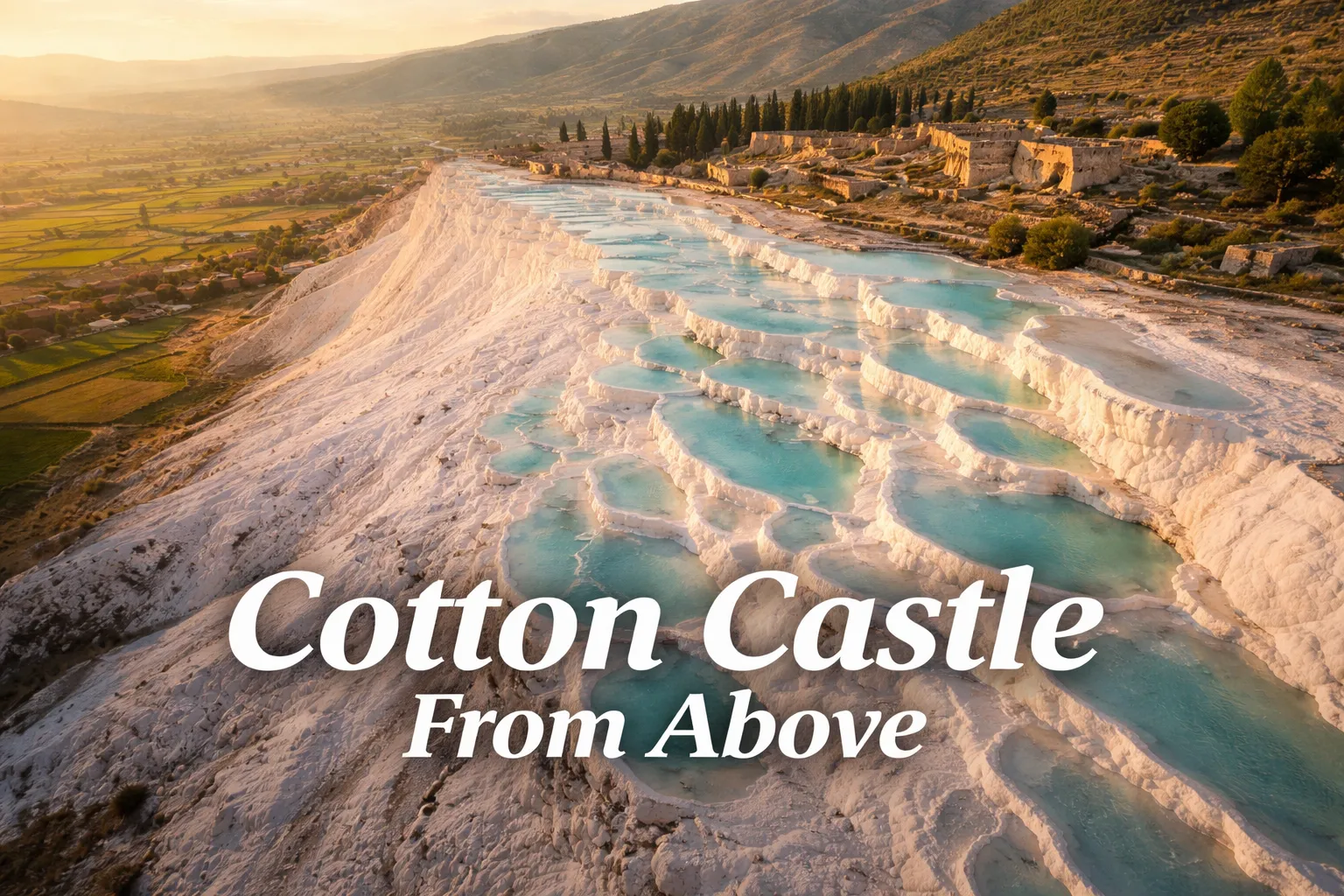
There’s a particular smell that hits you before anything else at Pamukkale — sulfur and hot mineral water, mixed with sunscreen and the dust kicked up by hundreds of bare feet on white calcium. The queue to walk the terraces builds fast once the tour buses roll in from Denizli, and by mid-morning the paths are shoulder to shoulder. None of that crowd exists once you send a drone up. I tilted the camera down over the terraces on my first flight here and just stopped talking mid-sentence. What reads as an odd white hill from the parking lot becomes, from height, something almost architectural — a stepped cascade of calcium basins dropping down a 200-meter cliff, each pool holding water anywhere from milky turquoise to a deep mineral navy, all of it set against the dark green of the Çürüksu Valley below. Shooting Pamukkale’s thermal pools from above isn’t like any other aerial subject I’ve worked with in fifteen years of doing this. The color shifts, the texture of the travertine, the ancient city perched right above the pools — none of it fully clicks until you’re staring straight down from 150 meters. Everything below is what I wish someone had handed me before I ever touched down in Denizli.
Drone Flight Brief: Pamukkale Aerial Photography Quick-Reference
Before anything else, here’s the reference data every aerial shooter should have locked in before flying Pamukkale. Read through the regulations portion in full before deciding anything — this is a protected site, and the rules aren’t vague.
| GPS Coordinates (Main Terrace) | 37.9207° N, 29.1189° E |
| Recommended Altitude Range | 80–250 meters AGL for wide compositions; 40–80m for detail pool shots |
| Best Time of Day to Fly | Sunrise (6:00–7:30 AM local time) — low raking light, minimal crowds, pink-toned travertine |
| Best Season | April–May and September–October (mild temps, lower visitor numbers, ideal light quality) |
| Turkish SHGM Drone Regulations | Registration required via SHGM (Turkey’s civil aviation authority). Pamukkale falls within a UNESCO-protected zone with flight restrictions; commercial and recreational flights require prior authorization. Peak-hour flight bans apply. Full detail in the regulations section below. |
| Skill Level Required | Intermediate — thermal updrafts off warm water surface, variable wind off ridge, restricted airspace management |
| Nearest Airport (Controlled Airspace Ref) | Çardak Airport (DNZ), approximately 65 km from site |
What Pamukkale’s Travertine Shows You Once You’re Airborne
Standing on-site, visitors experience the terraces one pool at a time — bare feet on the white paths, glancing down into a single glowing basin before shuffling to the next. The full system never really comes together at ground level. From the air, it snaps into place immediately. The travertine reads as a frozen waterfall from above — a tightly organized cascade of concentric calcium basins, each one a step lower than the previous, all fed by the same underground thermal source pushing up water at a steady 35–36°C (95–97°F).
What actually caught me off guard mid-flight, though, wasn’t the terraces themselves — it was spotting the ancient Roman city of Hierapolis sitting right on the plateau above them. From up high you can trace the entire street grid: the colonnaded main avenue known as the Plateia, a sprawling necropolis stretching north, a theatre cut into the hillside, and bath complexes deliberately positioned over the thermal springs. Hierapolis and Pamukkale share UNESCO dual heritage status, both natural and cultural, and at 200 meters you finally understand why that designation exists. The white calcium cliffs and the reddish Roman stonework sit on the same ridge, just a few hundred meters apart, and there’s no ground-level photo that captures both at true scale in one frame.
The aerial vantage also reveals something most visitors never realize: large stretches of the terrace system aren’t fully active. Turkish tourism officials periodically shift the water flow so certain sections can re-mineralize, which means the brilliant, pool-filled white zones you see in photos only account for part of the hillside. From up high, you can see the gradient clearly — vivid blue, fully active terraces with white carbonate rims; damp, poolless, cream-toned semi-active sections; and dry, grey-brown dormant zones — a pattern that’s completely invisible from the walking paths below. Knowing this before you arrive changes how you plan your shots considerably.
The Pamukkale Aerial Shots Worth Setting Up For
After flying this site repeatedly, I’ve narrowed it down to five compositions that reliably deliver. The trick with Pamukkale from the air is that you’re balancing natural geometry against natural color — and the two don’t necessarily peak at the same altitude or angle.
Straight-Down Pool Geometry (80–120 Meters)
Bring the drone down to 80–120 meters directly over the most active terrace stretch and lock the gimbal at a full 90-degree downward angle. At this height, individual pools become abstract shapes filling the entire frame — uneven white-edged circles and crescents holding three or four distinct blue tones at once. That color variation comes down to differences in mineral density, water depth, and suspended sediment, and it’s only detectable from directly overhead. This is consistently the shot that performs on social media and in print — it looks almost fake, like peering down through a stained-glass panel.
Sunrise Cascade Angle (150–200 Meters, 45 Degrees)
Set up east of the terraces at 150–200 meters, tilted around 45 degrees back toward the cliff, within the first half hour after sunrise. That low morning light travels across the travertine horizontally, carving out every calcium ridge and turning the white carbonate a pink-gold color that midday sun simply can’t produce. Against that warm white, the pale blue pools practically glow. Keep the valley visible in the lower third of the frame — the dark farmland against the white cliff face gives the shot its sense of scale.
Hierapolis and the Terraces Together (220–250 Meters)
This one’s harder to pull off but carries the most weight historically. From 220–250 meters, positioned southwest, you can fit the entire terrace cascade and the visible street grid of Hierapolis into a single wide frame. The red stone of the ruins above and the bright white-blue terraces below create a contrast that tells the whole UNESCO story in one shot. Get here before 8 AM — the theatre still holds strong morning shadow, which adds depth to the ruins, and the terrace pools are at their clearest before foot traffic stirs up the sediment.
The Wide Shot of the Thermal Source (150 Meters, Facing North)
Set up north of the plateau, angled south, to catch the thermal river channel feeding the whole terrace system. It reveals something most people walking the terraces never register — a continuous stream of warm water crossing the plateau surface before it drops down the cliff. During certain months, you can catch steam lifting off that channel, visible even in still frames as a faint haze. This composition works best October through March, when the gap between the 35°C water and the cooler air produces the most visible mist.
Is Flying a Drone at Pamukkale Legal? Breaking Down Turkey’s SHGM Rules
Read this part slowly. Pamukkale drone flights sit under several stacked layers of regulation, and the honest answer to “can I fly here?” is it depends entirely on how you go about it — and cutting corners at a UNESCO site with active heritage enforcement is a genuinely bad move.
The SHGM (Sivil Havacılık Genel Müdürlüğü), Turkey’s civil aviation authority, requires every drone — commercial or recreational — to be logged in the national registration system before it ever takes off. Visiting with a drone registered in your home country doesn’t exempt you from Turkish airspace rules under SHGM, and Pamukkale sits inside a zone requiring dedicated authorization because of its dual UNESCO status and its closeness to the protected Hierapolis archaeological grounds.
In practical terms, a few things follow from that. Peak operating hours carry flight restrictions — flying over the walking terraces during park hours (roughly 8 AM to 7 PM in summer) is limited to keep visitors safe and to protect the terrace surface itself, which really is fragile calcium carbonate. The Ministry of Culture and Tourism also controls the Hierapolis zone, so flying over the ruins requires its own separate permit beyond SHGM registration. And enforcement on the ground varies, but rangers and UNESCO monitoring are present, and travelers caught flying without clearance risk having equipment seized along with fines.
If you’re serious about shooting this legally, contact the Pamukkale National Park administration and the SHGM 4–6 weeks ahead of your visit to request flight authorization. Plenty of working photographers go through a Turkish fixer or local production company that already has ministry contacts. Sunrise flights, before the park opens to foot traffic, are what most authorized shooters rely on — the light’s at its best, the terraces are empty, and clearance for pre-opening hours tends to move faster. Don’t attempt this without authorization. Turkey’s cultural heritage protections carry real consequences, and this site doesn’t need unauthorized overflights.
The Cotton Castle’s Color Science, Explained
One of the more technical parts of shooting Pamukkale from above is understanding why the water shifts color across the terrace system — and then using that on purpose when choosing your shots. The nickname “cotton castle” comes from the white travertine itself, but the real visual payoff from the air is in how the blue in the water keeps changing.
Three things drive that color shift. Depth is the first: shallow pools under 30 cm come across as a pale, milky turquoise because suspended calcium particles scatter light back up before it can travel deeper. Pools 60 cm and beyond absorb more of the red spectrum and reflect blue, reading as a clean, deeper cyan. Mineral concentration is second: pools within the active zone carrying higher dissolved mineral content take on a milky, almost opaque look — closer to liquid chalk than water. Near the edges of that active zone, where the water runs slightly cooler and less saturated, the color turns clearer and bluer. Light angle relative to your camera is the third factor: in the hour after sunrise, that raking low light hitting rippled water throws strong specular highlights across the surface. By mid-morning, with the sun overhead, the pools flatten out into a more uniform blue. This is exactly why ND filters aren’t optional here — you need shutter speed control to manage the glare off white travertine and the color depth in the water at the same time.
Dealing With Pamukkale’s Midday Glare: Why ND Filters Matter
Pamukkale’s white terraces work like a giant reflective surface once the sun’s fully up, and flying without neutral density filters at midday gets you blown-out, washed-looking footage that flattens those saturated blue pools into something closer to a faded print. I found this out the hard way on my very first flight there.
What actually works
- ND64 and ND128 filters restore the saturation and depth in the mineral pools — the turquoise and deep blue that made you want to shoot Pamukkale in the first place actually show up instead of blowing out to white.
- A CPL filter cuts through the haze sitting over the valley, which matters a lot when you’re framing a wide landscape shot where heat and moisture create a constant shimmer.
- Snap-on filters let you switch mid-flight without landing the drone — which matters when your window of good light is maybe 20 minutes and there’s no time to pack up and start over.
What doesn’t work
- At altitude, even a tiny smudge on your ND filter shows up in the footage — you end up wiping these down constantly, since dust around the thermal pools settles on glass fast.
- Heavier ND filters (64/128) force slower shutter speeds, which means you need genuinely calm wind to keep the footage steady — fly on a gusty day and the results come out jittery no matter how good your glass is.
I almost turned around on my second flight when I thought I’d forgotten the ND32 in my hotel room, convinced my footage would be ruined—but the full set meant I had backup options. Get the NEEWER ND Filter Set for DJI Mini 3 / Mini 3 Pro (6 Pack — CPL, ND8, ND16, ND32, ND64, ND128) before you go.
Frequently Asked Questions
What altitude should I fly my drone at Pamukkale?
The recommended altitude range is 80–250 meters AGL for wide compositions and 40–80 meters for detail pool shots. The specific altitude depends on your composition: 80–120 meters for straight-down pool geometry, 150–200 meters for sunrise cascade angles, and 220–250 meters to capture both Hierapolis and the terraces together in a single frame.
Do I need a permit to fly a drone at Pamukkale Turkey?
Yes. Registration with the SHGM (Turkey’s civil aviation authority) is required for every drone, and Pamukkale requires dedicated authorization because of its dual UNESCO status and closeness to Hierapolis archaeological grounds. You also need a separate permit from the Ministry of Culture and Tourism to fly over the ruins. Contact the Pamukkale National Park administration and SHGM 4–6 weeks ahead of your visit.
When is the best time to fly a drone at Pamukkale?
The best time of day is sunrise between 6:00–7:30 AM local time, which offers low raking light, minimal crowds, and pink-toned travertine. The best seasons are April–May and September–October for mild temperatures, lower visitor numbers, and ideal light quality. For capturing thermal mist, fly October through March when the 35°C water creates visible steam against cooler air.
What ND filters do I need for Pamukkale drone photography?
Get the NEEWER ND Filter Set for DJI Mini 3 / Mini 3 Pro (6 Pack), which includes CPL, ND8, ND16, ND32, ND64, and ND128 filters. ND64 and ND128 filters restore saturation and depth in the mineral pools, while a CPL filter cuts through haze over the valley. Snap-on filters let you switch mid-flight without landing.
About This Article

Written by Elena Vasquez. Elena Vasquez is a full-time traveler and the founder of Witty Passport. Over fifteen years and more than 50 countries across six continents — including a stretch spent leading groups professionally through Southeast Asia and the remote highlands of South America — she's written the kind of destination guides she always wished existed: practical, specific, and built on real experience rather than recycled itineraries. More about this site.
Scope and limits. Elena is a full-time traveler, not a licensed travel agent or immigration adviser. Entry requirements, visa rules, and advisories change without notice — always confirm against the official government source for your destination and passport before booking.
Verify this against a primary source
Specifics change, and your situation may differ from the one described here. These are the authorities worth checking directly:
- U.S. Department of State — entry requirements and travel advisories
- CDC Travelers' Health — vaccination and health notices by destination
- TSA — current carry-on and screening rules