Giants Causeway Drone Photography Northern Ireland: What You See at Altitude Changes Everything
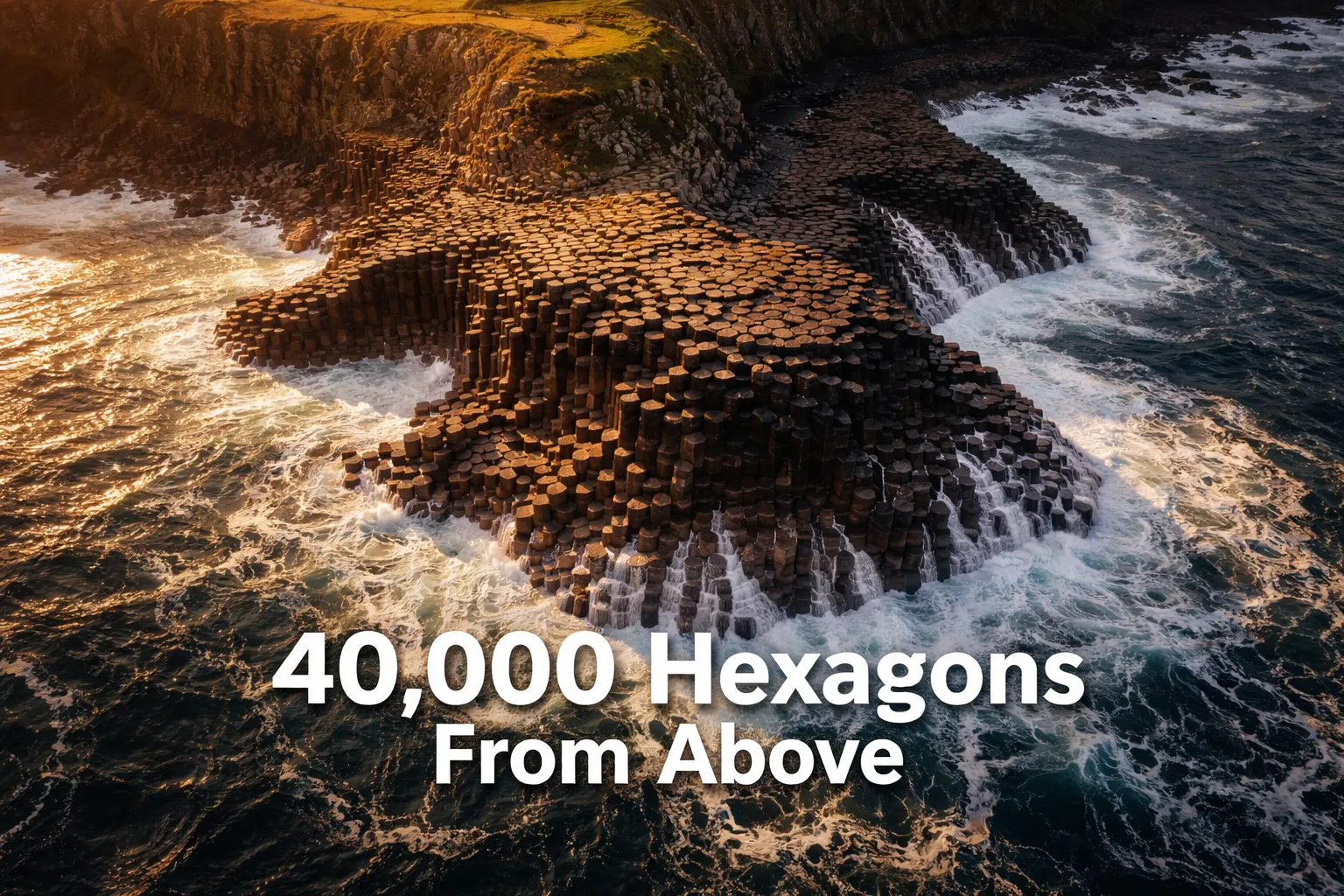
Walk the Giant’s Causeway at ground level and you get texture — cool basalt under your palm, hexagonal edges you can trace with a fingertip, a vague sense that something ancient happened here. Send a drone up to 80 metres instead, and you get comprehension. The ground-level version loses, flatly, and I say that as someone who spent a full afternoon down among those columns before I ever launched. Giants causeway drone photography northern ireland belongs to a small category of aerial subjects that simply refuse to make sense until you’re airborne — the hexagonal tessellation runs from the cliff base out into the grey-green North Atlantic like a colossal tiled floor laid by some geometry-obsessed mason, and only from up there do you understand why old Irish stories insisted a giant had to have built it. Sixty million years of volcanic activity produced this, and your brain will keep arguing that nothing natural is that regular. It is.
Quick-Reference Flight Brief: Giant’s Causeway From the Air
| GPS Coordinates | 55.2408° N, 6.5116° W (main causeway platform) |
| Recommended Altitude Range | 60–120m for pattern detail; 150–200m for full coastal context |
| Best Time of Day | Sunrise (approx. 05:00–07:00 BST in summer) for low-angle shadow detail in the hexagonal gaps |
| Best Season | November–February for low winter sun, dramatic Atlantic swell, and thinner crowds |
| Drone Regulations Summary | CAA UK rules apply (Drone and Model Aircraft Code). The Giant’s Causeway is a National Trust managed UNESCO World Heritage Site — commercial and recreational drone flight requires advance written permission from National Trust Northern Ireland. Flying without permission is a violation of both site rules and potentially CAA Operational Authorisation requirements. Do not assume open-access flying is permitted. |
| Airspace Classification | Uncontrolled airspace (Class G) — no NATS restriction at the causeway itself, but always verify via NATS drone assist or the UK CAA Drone Safe app before flying |
| Skill Level Required | Advanced — coastal winds, salt spray, unpredictable Atlantic gusts, and restricted fly zones demand confident, experienced drone handling |
| Nearest Town | Bushmills, Co. Antrim (3km) |
What the Hexagonal Columns Actually Show You Once You’re Airborne
Standing on the causeway hands you an intimate, close-quarters version of the basalt columns while quietly concealing the one thing that makes them remarkable. From the path, your eye takes in maybe 20 or 30 columns before it gives up. Climb a drone to 80 metres, though, and the entire platform opens up — something like 40,000 columns locked into one continuous tessellation, spreading roughly 150 metres from the cliff base out into the Atlantic. Viewed this way, what geologists label “columnar jointing” becomes visible at a scale you could never register on foot: identical fractures radiating with near-uniform width across the whole platform, a fingerprint left by molten basalt cooling and contracting at an unusually consistent rate somewhere between 50 and 60 million years ago.
The thing that caught me off guard on that first flight was the colour shift across the platform. The central columns, permanently in the tide’s path, sit dark charcoal, almost black once wet. Higher columns nearer the cliffs dry out between tides and lean toward deep grey-brown instead. From 100 metres up as the tide comes in, you can watch thin sheets of white foam slide across the hexagons, filling each gap in sequence until the whole geological pattern briefly resembles a living circuit board. This effect peaks in a fairly narrow window — roughly 90 minutes before high tide — when moving water traces out every crack and joint on the platform.
The cliffs behind the platform tell their own story from up there. Walk the path and the cliff face reads as a rough basalt wall, nothing more. Send the drone out over the water to 60–80 metres and look back at the coast, though, and those same cliffs resolve into perfectly vertical organ-pipe columns — identical hexagonal structures, this time oriented sideways, stacked 12 metres high. Locals call this formation “The Organ,” and shot in profile from roughly cliff-top height, it genuinely looks built rather than grown — a pipe organ carved straight out of living rock.
Framing It Right: Shot Ideas for Aerial Photography at the Causeway
Straight Down Over the Tessellation
This is the signature frame of giants causeway drone photography northern ireland — nadir position, dead straight down, at 60–90 metres, centred over the widest stretch of the causeway platform. Low winter light throws individual shadows into the hexagonal gaps, turning the surface into a textured relief map. Shoot RAW, bracket your exposures, and hold off for a wave to slide partway across the platform to get that circuit-board effect. Put one or two people on the causeway within frame for scale — the columns run about 15–50cm across, and without something human-sized in the shot, the nadir image loses the sense of scale that makes it work.
The Wide Shot Where Causeway Meets Ocean
Park the drone at 120–150 metres, tilt around 45 degrees, and look northeast up the coastline with the causeway sitting in the foreground and the Antrim plateau cliffs running off to the right. This is the frame that sells drone photography northern ireland coast at its most convincing — the causeway’s rigid geometry set against the breaking Atlantic’s chaos, dark volcanic cliffs rising behind both. On days when a southwest wind is pushing a heavy swell, spray off the outer columns forms a natural mist that softens the background nicely.
A Profile Shot of the Organ Pipes
Push the drone out over the water roughly 200 metres from the cliff face, holding at cliff-top height — around 100–110 metres above sea level here. The Organ — a fan of vertical basalt columns reaching up to 12 metres — reads dramatically in profile. Fly it in the last hour before sunset, when low western light rakes across the column faces and throws every vertical joint into sharp contrast. It’s one of the more striking basalt-columns-from-above compositions precisely because you’re not above them at all — you’re level with the clifftop, taking in the full height of the columns from the side.
Close-Up Detail on the Giant’s Boot and Wishing Chair
The formations that rarely get photographed — the Giant’s Boot (a naturally shaped basalt form near the main platform), the Wishing Chair (a throne-like cluster of columns), and the Giant’s Gate — barely register from the walking path but come through clearly from 40–50 metres up. These low-altitude shots demand the most careful handling given how close you’ll be to rock and sea spray, but the payoff is a set of images most causeway photography completely misses.
Is Flying a Drone at the Giant’s Causeway Legal? The Straight Answer
I need to be blunt here, because the internet is stuffed with gorgeous Giant’s Causeway drone clips and near-total silence on how any of it was legally filmed. The Giant’s Causeway is a UNESCO World Heritage Site under National Trust management for Northern Ireland, and the Trust enforces a blanket rule: any drone flight over its land, recreational or commercial, needs advance written permission. That requirement sits on top of — not instead of — the UK Civil Aviation Authority’s Drone and Model Aircraft Code (2020), which governs every drone operator in the UK regardless of where they’re flying.
Flying above board means doing three things: first, hold a valid UK CAA Flyer ID and Operator ID, both free and issued at register-drones.caa.co.uk; second, write to National Trust Northern Ireland directly and request a specific filming permit well ahead of your trip — the Giant’s Causeway visitor centre or the National Trust NI regional office are the right contacts; third, keep written proof of that permission on you while you fly. The airspace itself is uncontrolled Class G, with no NATS restriction zone sitting over the causeway — but that’s an airspace fact, not a land-access one, and it doesn’t substitute for National Trust permission. Treat the two as completely separate hurdles.
Here’s what actually happens on site: turn up without a permit and National Trust rangers or visitor centre staff will tell you to put the drone away. I’ve watched it play out. Over a million visitors pass through the site each year, and staff are used to spotting drones. Commercial operators should build in several weeks for the permit process; recreational flyers face a looser but still mandatory version of the same request. If permission doesn’t come through in time, the honest move is to enjoy the causeway on foot and buy licensed aerial footage from a National Trust-approved operator instead — a handful of Northern Irish drone companies hold standing permission for the site already.
Beyond the Causeway: More Drone Spots Along the Coastal Route
The Giant’s Causeway sits roughly halfway along the Causeway Coastal Route, one of Europe’s more dramatic coastal drives, and for drone photography northern ireland coast, the ground nearby is every bit as rewarding — sometimes more so, legally speaking. Carrick-a-Rede rope bridge, about 8km west of the causeway, crosses a 30-metre chasm between the mainland cliff and Carrick-a-Rede island. From 80 metres up, the bridge shrinks to a thin thread strung between two cliff edges over turquoise-green water — one of the most vertigo-triggering aerial compositions you’ll find in the UK. It’s also National Trust land, so the same permission process applies here too.
Dunluce Castle’s ruins, sitting on a sea stack about 5km east of the causeway, fall under a different landholding, so access rules may differ — check directly with the Historic Environment Division (HED) Northern Ireland. From altitude, the castle’s roofless medieval walls on their isolated basalt stack, ringed by crashing Atlantic swell, make for pure visual drama. Between Ballycastle and Portrush, the causeway coastal route offers roughly 40km of aerial opportunity for anyone willing to sort out the permissions properly first.
Propellers That Held Up Against the Causeway’s Coastal Wind
The Northern Irish coastline treats wind as a personal challenge, and propellers are usually the first thing to give. I found this out the hard way when a gust nearly put my drone into the Atlantic, and it became obvious that my stock props simply weren’t built for this kind of relentless, erratic coastal air.
What worked
- A clear improvement in crosswind stability — I held a steady frame on those hexagonal columns even as gusts picked up, rather than wrestling to keep the drone level.
- They hold up better against snapping or splintering than the stock blades; there’s real heft to the material, which counts for something when you’re flying over rock and open ocean.
- The dark grey and orange colouring makes them much easier to spot on the ground after a rough landing — something I’ve had to do more than once.
What didn’t
- The added weight over stock props costs you a bit of flight time — I saw roughly 2–3 minutes shaved off per battery, which matters when you’re racing the light on a coastal shoot.
- Fitting them is fussier than expected; the quick-release is noticeably tighter than the factory version, and I botched my first swap standing on a windy cliff edge.
I nearly aborted my entire Giant’s Causeway shoot because I wasn’t confident the drone would stay airborne during one particularly aggressive wind gust, but switching to these props turned a nerve-wracking afternoon into something I could actually enjoy. If you’re flying coastal terrain, grab the Bwine Drone Original Propellers for F7GIM (4-pack, Dark Grey & Orange).
Frequently Asked Questions
Do I need permission to fly a drone at Giant’s Causeway?
Yes. Giant’s Causeway is a UNESCO World Heritage Site under National Trust management, and any drone flight—recreational or commercial—requires advance written permission from National Trust Northern Ireland. You must also hold a valid UK CAA Flyer ID and Operator ID before flying.
What’s the best time of year to photograph Giant’s Causeway by drone?
November–February offers the best conditions: low winter sun creates dramatic shadow detail in the hexagonal gaps, the Atlantic swell is more pronounced, and crowds are thinner. Sunrise between approximately 05:00–07:00 BST in summer provides ideal low-angle lighting.
How high should I fly a drone at Giant’s Causeway?
For hexagonal pattern detail, fly at 60–120 meters. For full coastal context showing the causeway and surrounding cliffs, fly at 150–200 meters. Profile shots of the Organ pipes work best at 100–110 meters above sea level.
What drone experience do I need for Giant’s Causeway aerial photography?
Advanced skill is required. Coastal winds, salt spray, unpredictable Atlantic gusts, and restricted fly zones demand confident, experienced drone handling. The site sits in uncontrolled Class G airspace, but that does not reduce the operational difficulty.
About This Article

Written by Elena Vasquez. Elena Vasquez is a full-time traveler and the founder of Witty Passport. Over fifteen years and more than 50 countries across six continents — including a stretch spent leading groups professionally through Southeast Asia and the remote highlands of South America — she's written the kind of destination guides she always wished existed: practical, specific, and built on real experience rather than recycled itineraries. More about this site.
Scope and limits. Elena is a full-time traveler, not a licensed travel agent or immigration adviser. Entry requirements, visa rules, and advisories change without notice — always confirm against the official government source for your destination and passport before booking.
Verify this against a primary source
Specifics change, and your situation may differ from the one described here. These are the authorities worth checking directly:
- U.S. Department of State — entry requirements and travel advisories
- CDC Travelers' Health — vaccination and health notices by destination
- TSA — current carry-on and screening rules